
Welcome to the first post of the year. Let’s talk about Angeline Era.
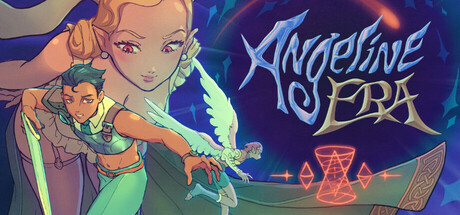
I was going to say that Angeline Era describes itself as a 3D action platformer, but technically it doesn’t do that. In this thread here, the developers describe it as a “Light-Story Action-Adventure VLASRPGEG.” They also note that it has bumpslash combat, which should not be confused with a bump-combat game.
Yes, that is a lot of text. No, I don’t quite understand it either. In fact, there’s a lot of things I don’t understand about Angeline Era, so it’s probably best to do some groundwork. Let’s lay out the things I do understand, the things I don’t understand, and a mistake I made very early on while playing.
First of all: the mistake.
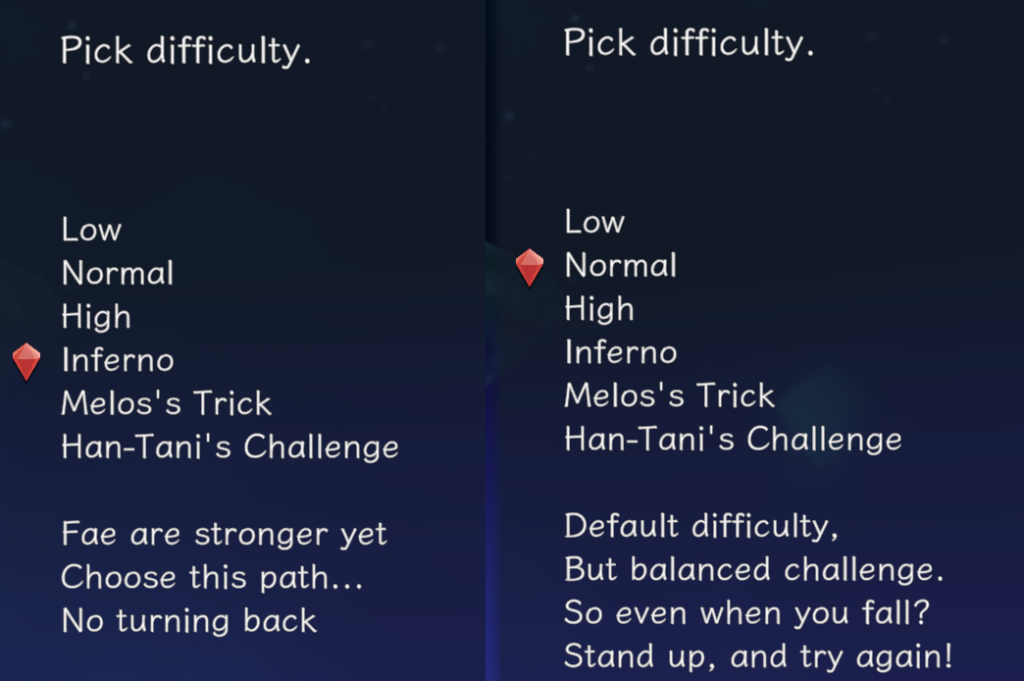
I chose to play Angeline Era on Inferno difficultly. I did this for a few reasons. When I play a game, I want to have the “intended” experience—as close as possible to what the designer wants me to experience. I usually assume the harder difficulty is, the more the game will force me to truly engage with systems, choices, and designs. My second reason is that I’m used to weird indie games being too easy, and too short, so I figured clicking up the difficulty a bit (while still being below the highest) would be fine.
And on this second reason, I was wrong. I was incredibly wrong. Greek hero levels of hubris here.
I think comparisons to From Software games are overblown when discussing or writing about games, but I cannot think of another game that has gives me the same sort of emotional response that I had to many sections of Angeline Era as Bloodborne. When I describe sections of Angeline Era as exhausting or draining, it’s probably because of my choice to play on Inferno.
Enough caveats, let’s talk about the game for a bit.
Gameplay and Narrative
Angeline Era starts out fairly simple. It stays that way for about 30 seconds.
It’s 1950-something, you play as Tets Kinoshta, and you’ve been called by angels to come to the country of Era for… some reason. On the way there, your ship is attacked by the fae, and about 30 seconds into the game, it’s time for the first boss: a set of laser-shooting fish. You defeat them, a few things happen, and a little while later you’re introduced to the angel Arkas, who tells you that they were the one who called you to Era.
The reason?
So you can collect the Bicornes: the only way to get into the damaged angel spaceship, repair it, and allow the angels to return to their true form as beings that can shimmer throughout the universe.
If you find yourself overwhelmed at this point: don’t worry. I felt the same way, and after 20 more hours of gameplay, I can confidently say that I am still confused. More on that later.
Regardless, it’s shortly after this that the game opens up for what will be the majority of the experience. The loop goes something like this:
1. Explore the overworld, looking for weird or unusual spots.
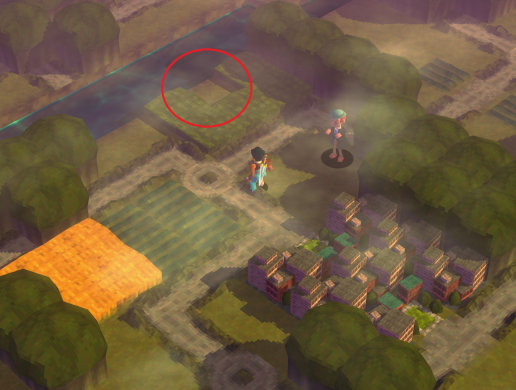
2. When you find one, go over and search it.
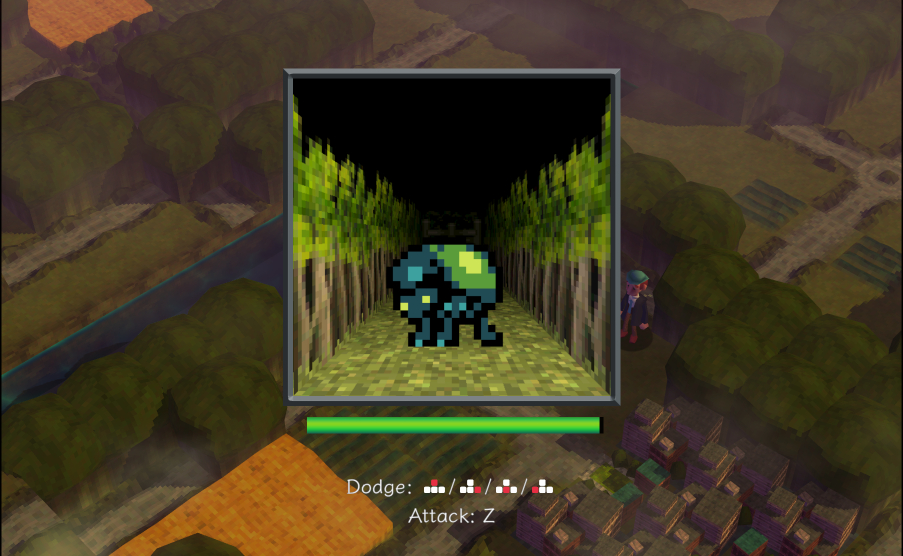
3. If it is a secret, play a little dungeon crawl minigame sort of thing. Beat that to unlock a level.
4. Depending on the type of level, play through it and collect a Scale at the end.
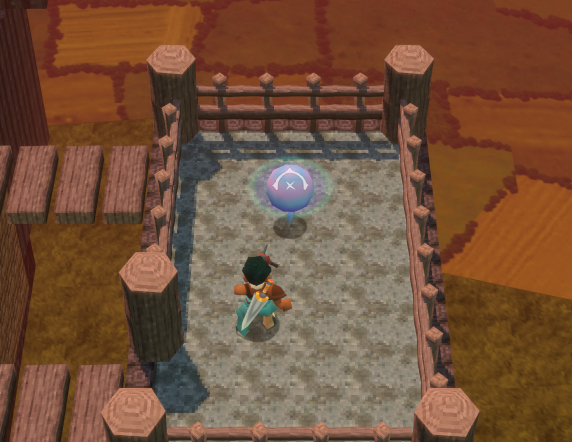
5. Finally, beating levels unlocks and adds path to the overworld. (Note the bridge and gap in the trees!)
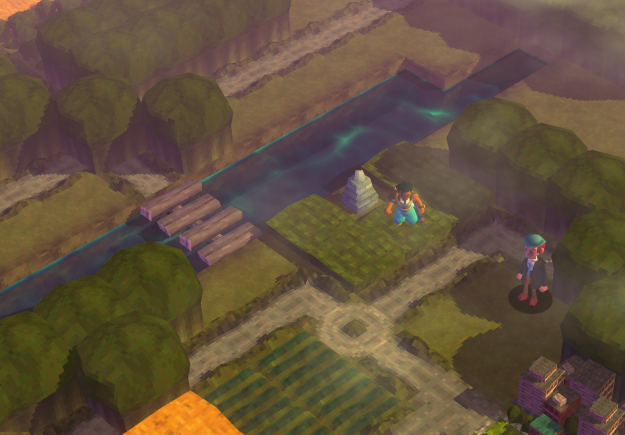
Rinse and repeat!
Or, if you’re me, do the following. (Click to expand)
Find the level. Try. Fail. Try again. Fail again. Try a third game. Get a bit farther, and get killed by something that seems impossible to beat. Quit the level, and look for other levels. Find one. Discover it’s somehow worse. Jump back to the first level. Lose until the moment something finally clicks. Get further than you have before. Die to an enemy doing something you weren’t paying attention to. Rage quit for the day. Come back the next day and beat it in 20 minutes.
The majority of my time in Era, though, was spent on combat. So let’s talk about the combat system.
Many of Angeline Era’s mechanics work pretty similar to other games with top-down 3d combat. Tets can be moved around with a control stick and perform a double jump to get over enemies or cross gaps. What makes Angeline Era different is how it handles attacks, because there is no attack button. Instead, whenever Tets bumps into an enemy with his sword, he’ll automatically slash at them.
This is the core of Angeline Era’s combat, the bumpslash if you will. It does a few very important things, but the first one is that as the player, you cannot actually control when Tets attacks. If you get pushed into a corner by enemies, you’ll lash out whether you want to or not. And you might not want to, because each time Tets makes an attack, there’s a decent amount of knockback in the other direction. Knockback that might send you into a pit, spikes, or get you stuck in a corner.
The other big part of combat is your gun. Due to the low poly nature of the game, I can’t quite tell what type of gun it is. Maybe it’s a magic gun! It does refill its bullets each time you hit something. Maybe it’s a cursed gun. It can only ever shoot towards the top of the screen. This is actually less annoying than you might think.
I did find in my play-through that I didn’t use the gun much until I got an upgrade that let me use it as a short range shotgun, allowing the next connected round every five seconds or so to be used as an AOE blast.
Of course, combat only matters in combination with enemies. And while Angeline Era has what feels like a low number of enemy models, it doesn’t have a particularly low number of enemy types. Multiple enemies in the game share the same character model, but behave differently. Here’s two examples.
The black fae beatledog is one of the game’s most basic enemies. When you kill it, it explodes damaging you and other enemies nearby. However, its actual behavior is pretty variable. Off the top of my head, I think I’ve seen it used as a patrolling enemy, an enemy that rushes at the player, and an enemy that actively tries to run away from the player.
A better example might be the weird purple cat mosquito fae. Sometimes they’re turrets, sitting in one location, spinning in a circle and shooting at you whenever you cross their line of vision. Other times they actively move around, avoiding the player while firing.
Most enemies are like this, with a set of different behaviors that add more variety then you might expect.
Many of the levels in Angeline Era are combat levels, consisting of a set of rooms populated with enemies, and you need to defeat a certain number of them or a certain group of them to advance to the next room.
In harder levels, I found myself trying to solve the levels like a puzzle more than fight through them.
Is there a grace period where enemies aren’t moving as I enter? Try to find one enemy to a clip of ammo into and quickly kill.
Are there spikes, and a slightly elevated location? Rush over, jump up high, and let the randomly rolling enemies kill themselves on the hazards.
Is there cheese? Is there a trick? What’s the minimum number of enemies I actually need to beat to progress?
As I got further and further, I found myself increasingly exhausted by the process of exploring the island of Era.
Intermission – Art and Cultural Context
I’m of the opinion that for me to understand art, I need to exist at least in part in the culture that created it. Let me give a few examples of situations where that hasn’t been the case for me:
Let’s start with Amazing Cultivation Simulator. This game expects you to have a strong understanding of the tropes and nature of a Wuxia-based setting in order to parse it whatsoever. As it turned out, there were a fair number of folks I knew who actually were familiar with this stuff, either because they came from a cultural background with these stories, or just really liked 10,000 chapter web novels. As I wasn’t, I had to consult with these people to understand why I kept getting my guys killed with bad Feng Shui.
Another, slightly more abstract example can be found in Sanda, a manga series by Beastars author Paru Itagaki. On its face, this is a series about a kid who can turn into a super buff version of Santa Claus. Under that, though, I think it might actually be a series about queer awakenings, the way that youth is overvalued by adults, the population crisis in Japan, and trying to hold on to past days. Do I understand any of those messages? Absolutely not, because I don’t have an ounce of the context really needed to parse them on any meaningful level. I’m aware that Japan has a rapidly declining population, but trying to comment on it as someone who has no real understanding of the culture would be an act of grand hubris.
Finally, there was Land of the Lustrous. Even if I told you the premise, it wouldn’t be useful because the actual themes and mechanics of the series instead seem to be playing around with the nature of various Buddhist beliefs. At least I think so! Again, I don’t entirely know what I’m looking at.
Now, you might have noticed that in all of this I’ve been careful to avoid the words “weird” or “alien” as descriptors of these works. And that’s because I’m not convinced that they are. Even if they are weird, I don’t think I’m positioned to apply the label. Looking in at another culture, at its traditions and at its stories, we—the outsiders—are the aliens. Just because something doesn’t connect with us doesn’t make it inhumanly alien; just a part of humanity we haven’t experienced, and something that might be a casual part of everyday life for someone. They’re bad labels. I’m happy to call something like Homestuck, or Undertale, or Athenian Rhapsody weird because I know where they’re coming from, and from that place they are unusual!
Okay, so what does any of this have to do with Angeline Era?
Well, I might be an idiot.
I have spent an large amount of my playtime through Angeline Era wondering if I’m just an idiot, for a variety of reasons. Some are gameplay-related. There were at least two bosses I just completely failed to understand how to fight.
In one case, I was stuck flailing until a friend made an observation that let me beat it. In another, I spent at least two hours failing miserably until I finally pieced together how I was actually supposed to defeat it.
There are also the levels that just felt far too long to beat.
Most of all though, there’s been the narrative.
Angeline Era’s narrative feels like it’s managed through a series of “short story” style experiences. You, as Tets, are not the primary mover and shaker in these experiences. Instead, you arrive late in the story, after things have drawn towards a conclusion. The process of obtaining each Bicorne is the process of stepping through one of these short stories; a narrative about characters who are not you, and often not even hugely interested in you.
These stories on the whole are pretty grim. I’ve included a brief smattering below, but please be aware these are spoilers.
Click here for story arc spoilers
-A girl kidnapped by the fae at birth and swapped with a changeling returns to her human mother, but grows jealous of her changeling sister and begins robbing people. The townsfolk blame her changeling sister who is run out of town, while you proceed to fight and kill her, followed by murdering the fae family who had raised her as a sort of weird pet, and that she had locked in the basement.
-A “not-quite-dream” sequence involving what might just be a plan to control the entire human race via mind control juice! Or maybe it’s a hallucinogenic vision.
-A woman marries an angel who got involved with her only for her property. The angel digs too greedily and too deep, finds some sort of ancient being, is sacrificed to it by his wife, who then continues to feed other people into its maw.
-An angel scientist, upset by the fact that angels can’t reproduce, creates an unholy abomination clone of an angel that stands two stories tall in a mockery of the concept of life.
Oh, and while we’re at it, lets get the big one out of the way.
MAJOR STORY SPOILERS
Angels aren’t angels! They’re a sort of semi-parasitic alien, one possibly controlled by their crashed space-ship in a sort of hive mind that parasitized Tets, and seems to have been at the start of trying to take over the world when their ship got blasted into oblivion. It didn’t crash, it was blown up by someone they were trying to mind control!
Now, what I’ll say about all of these things is that they don’t quite feel connected. Everything I’ve put in the text boxes above took me 24-ish hours of playtime to get through. They’re like a set of vignettes, each discomforting in its own right, but none of them felt like they were contributing to a greater narrative more than they were contributing to a tone. The same is true of all the characters, NPCs, and other interactions.
Angeline Era has made me feel deeply out of place both with its gameplay and narrative, and sometimes, in the ways they overlap. Mechanically, the game’s bosses kicked my ass so badly and so many times in a row, in a way that I haven’t been on the receiving end of except for games like Silksong.

See this red gauge under the health bar? It fills up as you attack enemies. I’ve played 26 hours of this game, and I have no idea what it does or means. I’ve even made new save files and replayed through the game’s opening section to see if I missed a tutorial, or a section where it is introduced, but if I did, I still haven’t found it.
There are parts of Angeline Era that are fantastic. Certain sections of the game are incredibly fun. At one point the game turns into a sort of mining/exploration mini-game. There’s one song I’ve played on repeat while writing this.
But there’s also a sense of extreme exhaustion. Of bosses that feel borderline unfair, and in one case, slightly bugged. Of exploration that’s draining instead of exciting.
Most games feel like escape rooms. Angeline Era feels like hiking up a mountain to a run-down car park, or a closed ski resort during the summer. The gaming trope of every investigation you do being rewarded with a treasure, or secrets, or lore simply isn’t there. Sometimes a coke can in a parking lot doesn’t tell of a mystery of the universe, it just tells of someone who doesn’t throw out their trash.
But fundamentally, I can’t tell if this is the experience I’m supposed to be having, or if I took that coke can, spun it around three times, and tossed it into a river, a mystical genie would come out.
I can’t tell if Angeline Era is at times intentionally abrasive, strange and unusual, or if I’m just fucking idiot who can’t observe or uncover its secrets, or understand its mechanics.
And this brings me to my big confession.
The Big Reveal
When I wrote most of this, I had not beaten the game. I thought I was about to! I had collected all the Bicornes. There was a big boss fight.
Then! A grand twist! A big reveal! A second boss fight, in a way that felt like it was the final moment of the game, like it would all end here. This one was a bit more exhausting but I beat it.
And then the game just sort of kept going. A third boss fight, one that didn’t quite make sense to me in context, and still doesn’t make sense to me now. Also, it took longer than the first two.
Some even more confusing plot developments.
Then there was a weird and incredibly unfun minigame.
Then another unfun mini-game.
Then a third awful mini-game. It legitimately might be intentional that this part sucks so much. It would be a really clever bit of telling a story through mechanics. Still, it sucks.
Anyway, after finally working up the energy to play through it, I did beat the rest of the game. And I’m now ready to give some final thoughts.
Final thoughts
From a gameplay standpoint, I mostly like Angeline Era. There are quite a few things I’m sure I missed in my play-through, but the bumpslash combat feels good, and the individual levels work well. I can’t say the same for all of the exploration. There are plenty of points I found it purely frustrating, and there are some sections in the end game where it really feels like the game just stopped thinking about the experience it was providing.
From a story standpoint though. From a story standpoint, by the end of everything, the game feels like a fever dream.
FINAL STORY SPOILERS AND THOUGHTS
I don’t get the story. I don’t think I like the story. In fact, I might straight up loathe it.
I use the phrase fever dream because it feels like a selection of set pieces that are completely unconnected from each other, especially in the finale.
Everything feels uncomfortably rushed. Characters are examined and developed far more in the last 3 hours than the first 25, and their characterization just feels off. While I was exploring Era, I didn’t get a great sense of who Tets was a character, but in the finale sections of the game, we get TOLD that he’s a recovering veteran of World War 2 who might have become an alcoholic, ignored his father, and chased after his own beliefs. This is followed by him being in an abusive relationship (as the victim) with a magical Fae, followed by one of his Fae children being killed as his abusive wife is kidnapped by her brother for… reasons. Maybe they were explained and I didn’t understand them?
Again. Fever dream.
The nature of video games and stories is that you have a lot more time and different tools to tell stories with, and I feel like the plot beats that Angeline Era is trying deliver on could have worked for me. Tets doesn’t control or act like a deadbeat son with PTSD using religion as a shield to avoid addressing his trauma throughout the game, so finding out that’s what he’s supposed to be is a bit of a moment of whiplash.
And I don’t think you can ignore any of that! Angeline Era kept me involved because of its narrative, and seeing how it concluded… I feel bummed. I want to like this game more than I do. I want to recommend it to other people.
Angeline Era is an unusual game unlike many other things I’ve played. If you like hard games, and are good at them, maybe give it a shot. If you want to understand a world I couldn’t, find secrets I didn’t, and experience something deeply different from a lot of other video games, it might be for you.
But I don’t think it was for me.
