Green Mountain Gamers – Winter Weirdness 2026

I got back late last night from another Winter Weirdness, one of the events hosted by Green Mountain Gamers, a group that organizes game days in the Vermont/New Hampshire area. I quite like these events.

It’s a very lightly structured event. Folks bring their personal games to the event to lend to other people for the event, and then just spread out to play games.

As always, I’ll be talking about what I played, what I liked, and anything else about the event that strikes my fancy.

The games I brought

I brought a smattering of stuff, including Mottainai, Combo, Trio, Pride of Ninja, Brightcast, Blaseball Wild Cards, and the first LoTR trick taking game. These were all small, and I was able to to stuff them into a bag. I’ve linked the ones I’ve done reviews for up the blog, but I enjoy all of these, and someday I really need to give Trio it’s own write-up.

Image of 7 board games, LoTR trick taker, Combo, Trio, Brightcast, Mottanai, Pride of Ninja, and Blazball
Image of the 7 games I brought
Game time

First thing I did once I got there was crack open my copy of Pride of Ninja, and recruit a few people to play with me. I’ve been interested in Pride of Ninja ever since I first saw it two years ago at PAX Unplugged, and having actually managed to buy a copy this year, I finally got a chance to sit down and try a full game.

I really like it! It’s a pick and pass drafting game with what I’d consider to be two small twists: First, after everyone takes a card, players either reveal that card, and place it in a front row slot, or keep it hidden and place it into a backrow slot. This means that as the draft goes on, you get some information about what your opponents are doing, but it’s still possible to hide key pieces.

Secondly, many of the cards work in such a way that you need to care more about what your opponents are doing, and a few can be effective tools for either punishing them, or drafting off their success. What I really liked about these cards though is that it never really felt particularly painful to be on the receiving end of these plays.

Pride of Ninja is great.

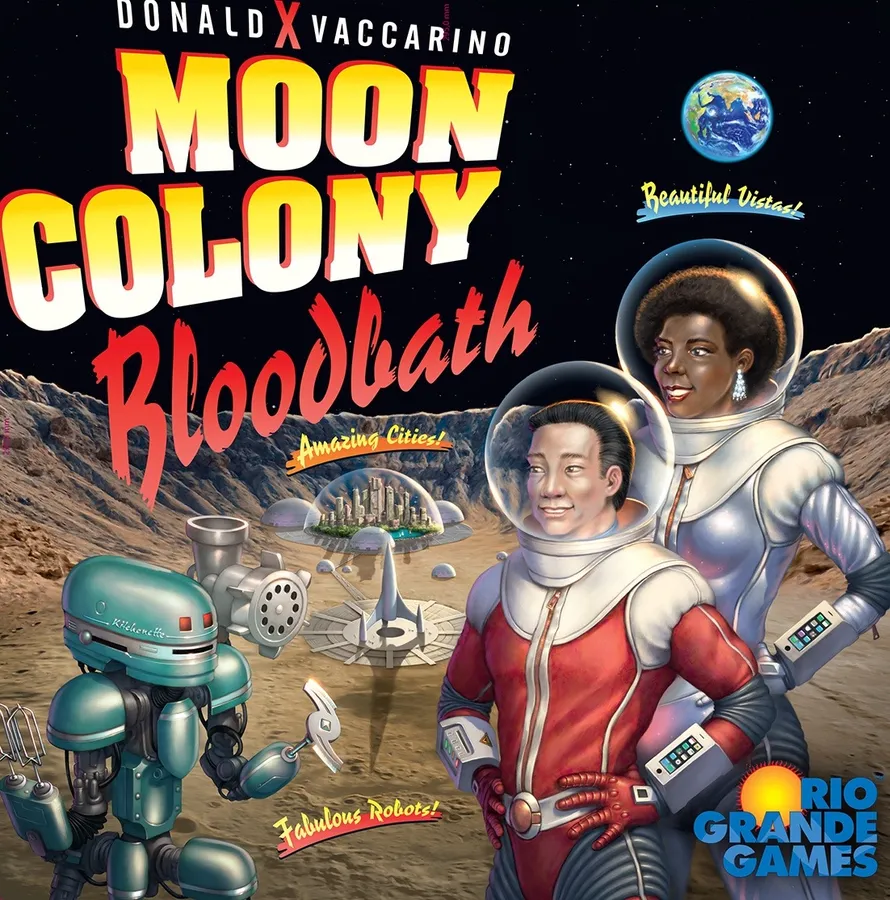
Next up was Moon Colony Bloodbath. This was a weird one.

Moon Colony Bloodbath is a tableau builder where you build up, and then lose your tableau. Well, you do if you’re me. If you’re winning, less of said tableau ends up blown away by accidents, infighting, and malfunctioning robots. The player power graph goes up, and then it goes way, way down.

My feelings on Moon Colony Bloodbath is a decided sense of “Hmm”. I don’t know if I disliked playing it because it’s a bit undercooked, or because I just lost every game horribly. During the back half of the game, once my starting supply of colonists had been whittled to nothing, and I was forced to liquidate buildings, there was a sort of dull sense of a boredom instead of a comedy of overconfident self-destruction.

Image taken moments before everything is liquidated and destroyed.

It felt like the final turns of a game of Terraforming Mars, where instead of doing anything interesting, you just min-max for victory points, as there isn’t enough time for any grand scheme to actually come to completion.

I also have a really weird complaint about the games art and theming. The game feels like it wants to be doing a sort of 1950’s-60’s pop-sci/science fiction cover thing. I think this is a really good theme, and standing alone the art is fine if not great, but in conjunction with the rest of the games mechanics, it feels like the artist was never in on the joke. Every location is played fairly straight, every robot just looks like a generic robot. It feels like no one told Franz Vohwinkel that each of these colonists was going to meet a horribly grisly death.

Anyway, with those two finished, I switched over to a few quicker games. This included a few rounds of Tiger and Dragon, a quick playthrough of the first level of the Lord of the Rings Trick Taking Game, and a short game of Combo. No notes here except maybe a reminder to myself that I should actually do a writeup on Combo one of these days.

After all of that, I played Panda Royale. I don’t like Panda Royale. This might be a bad game between the fairly aggravating draft order system, the dull dice types, the pointless and tedious arithmetic, and also the fact that the theme has absolutely zero connection to the mechanics of this sloggy roll and write.

This was followed up by doing a 4 person draft of Edge of Eternities to round out the day. Unlike the other several times I’ve drafted this set, I actually did quite well this time, and manged to win almost all of the games I played.

And then it was time to leave.

Oh…

The Barre Social Club

This event was held in Barre Social Club, and I just want to note that it might be the single most beautiful space I’ve ever been in.

There’s all this great old furniture, and the walls are covered in old maps, magazines, playbills, and other fun bits of old paperwork.

Like, just look at it.

Oh, and this bookcase?

It’s a secret door!

Okay, not that secret, it leads to a kitchen space, but like… still! Isn’t that cool?

It’s a coworking space, so if you’re in Barre, might be worth checking out. Anyway, that’s all for me right now, I’m gonna see if I can write something to put up for today about a specific game. Talk more later.

Holo Vs Robo – a Plants Vs Zombies inspired Hololive Fan Game

I tried to cook bacon this morning after removing 2-3 feet of snow from around my car. As a result, I type this in an apartment filled with an incredible sort of grey haze, like a small cloud of carcinogenic fog has decided to take a nap, sprawling from the kitchen toward the general living room space.

None of this has anything to do with Holo Vs Robo, but if at any point my thoughts wander a little too far, it’s probably from the smoke inhalation.

Anyway. Holo Vs Robo. It’s a Hololive themed Plants Vs Zombies clone. It’s a perfectly okay game, if a bit underwhelming currently in some areas. If you like Hololive, and never played Plants Vs Zombies, you’ll probably like this. If you don’t know what Hololive is, it’s a Japanese VTuber company, and if you don’t what VTubers are, you can either watch this video, or live in blissful ignorance.

On the other hand, apparently Plants Vs Zombies came out 16 years ago, back when I still had hope for the future, and joy in my heart, and given that it’s been turned from a lovely polished single game, to a franchise that included a class-based shooter (that I actually really liked) and a billion terrible mobile games, I figure it’s probably worth discussing the mechanics at least a little bit.

Gameplay

Overall, this is a Tower Defense game. If you’re not familar with the genre, it goes something like this: Waves of enemies spawn in, and you the player need to build structures to attack and stop them from reaching your base. When I call Holo Vs Robo a Plants Vs Zombies clone, it’s not because the two are both tower defense games, it’s because HvR pretty much lifts all of it’s mechanics wholesale from PvZ.

This includes things like the pre-battle screen. Here, you’ll select the up to 8 units you’ll be able to use in any given battle that you want to bring in, while on the right side of the screen being given a preview of the enemy types you’re going to face. Enemies start out as fairly simple robots, and evolve into fancier versions as the game goes on, most of which are some sort of Hololive callback or in-joke.

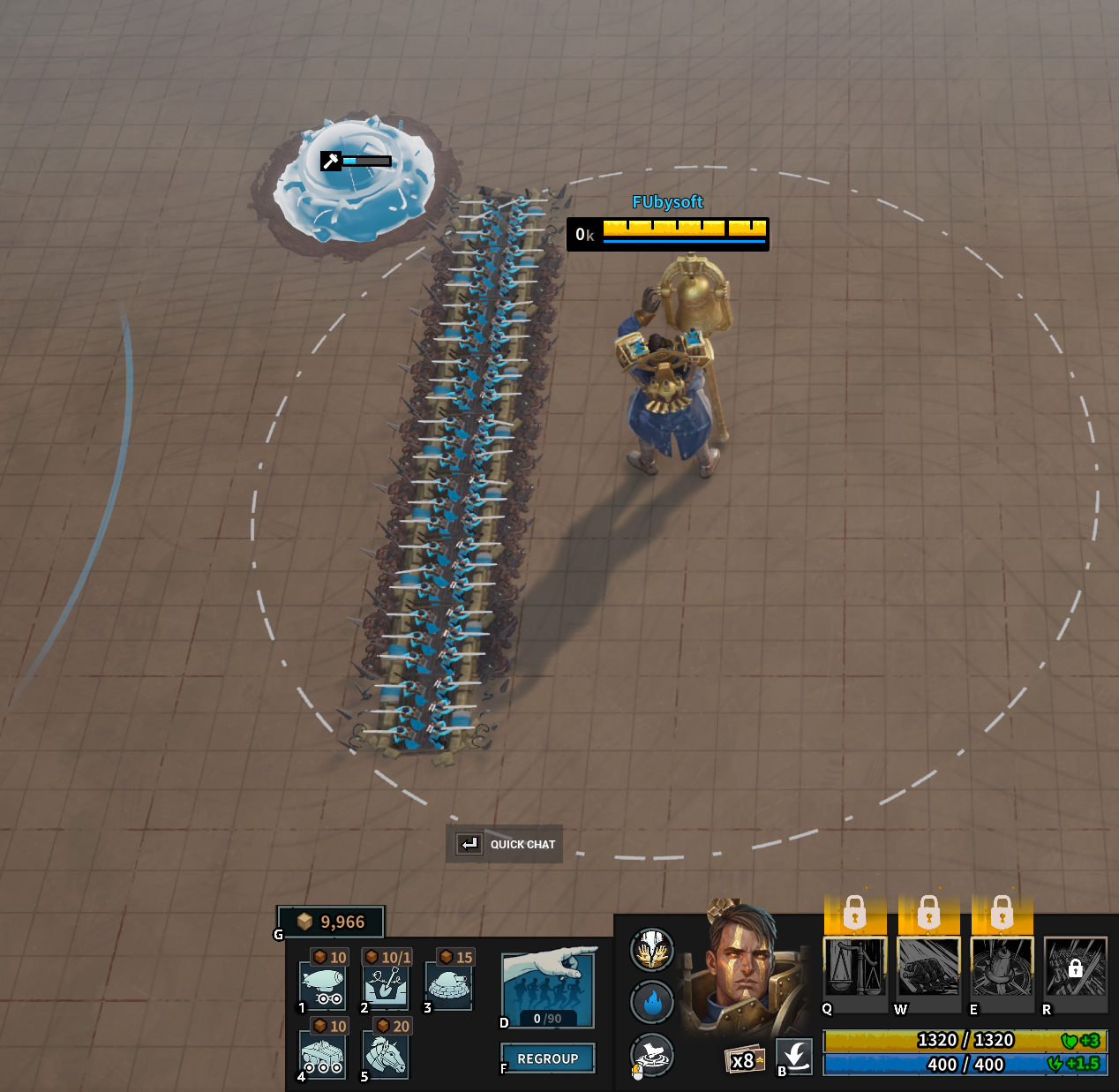
Once you’re in a level, you’ll spend Cheer (sun/money) to place down towers. Towers have a variety of properties, best demonstrated by going over the ones I have in the above image.

Furthest on the Left, we have Ollie, the red-haired one. Ollie doesn’t attack, but does generate additional Cheer to buy more towers. In the second lane from the left, we have Gura (White Hair/Blue Shirt) and Aqua (Pink Hair). Gura shoots bullets that travel down her lane, and the lane above and below her, while Aqua shoots fast weak attacks down the lane she’s placed in. The green one is Fauna, who heals towers in front of her, and the brown haired one is Nodoka, who acts as a wall.

So there’s your general list of tower behaviors: Generate resources, attack, heal, or generally serve as a wall.

You might notice that there’s no enemies actually visable on the screen, because they’re getting pretty much as fast as they spawn in, at least in this specific case.

There are some special robots, and a few levels that are a fair amount more challenging, but overall, this is not a very hard game. In my case, I found everything but the bonus content and sliding pannel levels to be pretty easy, taking about 11 hours total to do 90% of the games content.

Complaints and Praise

I don’t think Holo Vs Robo is a bad game, but that’s mostly because Plants Vs Zombies wasn’t a bad game. There are some things I am more tolerable of, and some which I am less tolerable of. There’s also a few things I quite like.

As a small thing, the menu options is a bit shit, and following a grand tradition of a certain types of games, I had to launch the game with custom unity flags to make it run on my ultrawide, something I’ve found myself doing a lot more then I’d like to as of late.

As a larger thing, the game doesn’t really do as much to solve the fundamental problem of tower defense games: Once you find a setup that works, you tend to just run that setup until it stops working. This was also a problem that Plants Vs Zombies had, but again: That game came out 16 years ago. While a few levels spice things up, there are still really limited options for Cheer generation, and many of the “good” units… just stay good throughout the entire game. As a result, I don’t really remember what I did during the last 10 levels prior to the finale.

I did really enjoy a lot of the bonus content. There’s some fun goofy little mini-games in addition to the story mode. The art for the little chibi Hololive members is pretty great.

Overall, I don’t really recomend Holo Vs Robo to non-Hololive fans at the moment. It’s a perfectly fine game, but so much of the humor and enjoyment here is based on knowing Hololive in-jokes, that I have to imagine it’ll feel a bit non-sequiter for anyone else.

For Hololive fans, if you’ve never played the original Plants Vs Zombies, this might not be a bad place to try it out. It’s $7.00 on Steam.

Side Note: As a Hololive fan, I was a bit bummed to discover that the Hololive member I follow (and whose on my computer case), Mori Calliope wasn’t available as a tower, but as one of the single use powerups, and IMO, the worst one in the game. It’s a not tragedy or anything, but I can imagine folks who discover their favorite member either isn’t available, or just kinda sucks being a little disappointed like I was. I wish the game did offer more ways to use each tower type. It’s a small thing, but something I did find myself thinking about.

Magic Player shows up and wins One Piece TCG pre-release with no preparation.

The last time I wrote about showing up to a pre-release for a game I’d barely played with no clear strategy in mind, it was for Lorcana’s Azurite Sea. Last week, I decided to do it again, except this time for One Piece’s newest set: The Azure Sea’s Seven. I just want to note that it’s wild how close the the names of those two sets from entirely different cards games are.

We’re not here to talk about set names though. We’re here to talk about my “incredible” victory. Spoiler: almost no one else showed up. I played one game, and the fact that I won that one game made me the champion.

Not exactly my most impressive accomplishment. And while I’d have liked to play more, I’m also happy to just take the prizes and call it a day.

Still, this was my first time playing One Piece in a limited format, so let’s talk about how that went.

Deckbuilding

Normal One Piece deck construction requires that all of your cards match the color of your Leader card—a special card that starts in play. For Magic players, this is pretty similar to the rules for making Commander decks.

For limited One Piece, I was told that I could use any leader I had, and that I didn’t need to follow color rules. We were also all given a special Luffy that counted as all leaders and all colors. This led to my first big decision, because while I hadn’t brought any leaders with me, I had opened a Dracule Mihawk.

Because Luffy counted as all attributes, and my opponents were pretty much guaranteed to be playing Luffy, (none of us had done a One Piece pre-release before), Mihawk would be a base 6000 power to their 5000, making it a fair bit harder for them to attack into me, and much easier for me to attack into them.

On the other hand, running the all colors/types/names-Luffy meant that every single ability that cared about the Leader card would trigger, and that I could use any types. At the time, I thought the utility from running Luffy was the better choice, but looking back at it now, it might have been better to just run Mihawk.

Still, it seemed more fun to use Luffy, so that’s what I went with.

As for deckbuilding, this is normally where I would just include a list of the cards I picked out. Unfortunately, I didn’t have the presence of mind to take a photo of decklist, and instead just sorted things out when I got home. Still, I can at least talk about the deckbuilding.

I went fairly top-heavy with my deckbuilding, aiming to mostly include my higher cost cards. I figured that anything over 8000-9000 power would be pretty capable of just pushing through. I also tried to make sure I had a decent smattering of cards that drew me more cards.

Again, since I’m mostly a Magic player, I was going off of my experience with limited Magic more than anything else, and valuing bodies, and card redraw. If I’d picked up any removal, I would have taken it, but I didn’t see any cards like that in my opened packs.

The end result was a fairly top heavy deck with some lower cost cards to refill my hand and give me bodies early on in the game.

The Game

Since it was best of 1, and I lost rock-paper-scissors, my opponent opted to go first. Something that became very clear after just a few turns was that I had not remotely considered how valuable cheap blockers could be in the early game, trading a single card to block a hit to life points. Despite this, I did manage to take an early lead, trading aggressively and getting two or three hits into life points.

It was around this point that tempo started to switch, and I found myself on the back foot. My opponent had continued to play out blockers, and I found myself unable to push through. My opponent had accumulated a fairly decent amount of card advantage, something like 6 cards in hand to my 4.

(Side note: For folks who might not know why this is important in One Piece, many cards have a sort of bonus ability that lets you toss the card from your hand for a temporary defensive buff. It’s a very cool mechanic, but it also means that card advantage can give you more space to play with.)

I tossed down a Issho in an attempt to even up the card balance a little bit, bringing myself down to 2 to their 4, hoping that I would be able to end the game before I just got outpaced. It did not work as well as I had hoped, but it did force them to toss a few more cards to keep from taking more hits.

And this was where I found myself around turn 4-5. I was starting to lose control of the board state, I was behind on cards in hand, and my opponent had finally built up a board state that was both threatening lethal, and that I was unlikely to be able to respond to.

One of my last cards in hand was Whitebeard, and I had a choice. I could push my luck this turn, and try to go for lethal. It was possible that my opponent would be able to toss their hand, while trying to do the mental math, I thought it was pretty likely that I would be able to end the game that turn if they didn’t have two +2000 counters in hand.

On the other hand, if I committed to that path, I was guaranteed to lose the next turn if all of my attacks didn’t go through.

The flip side was that even if I did play Whitebeard, there was no guarantee I’d survive, and even if I did, I would still be on the clock with no real outs that I was aware of in my deck. As impressive as Whitebeard’s 8000 power was, since we were on turn 5, it would only take my opponent spending half or less of their don to pump someone to kill him after I used him to block.

All things considered, I ended up going with the riskier play, and it worked out! I managed to take the game.

Overall Thoughts

I really like limited formats for card games, but One Piece felt especially fun. I think way that Don works as a resource system combined with the All Colors Luffy made it a very interesting format. Notably, it’s also probably the only time I’ve seen limited-only cards really elevate a card game’s experience.

I’ll probably do another pre-release if I get the chance. I think I have a lot to learn about how to play One Piece. Limited always feels like a much better learning environment for me, because when I lose it’s due to skill instead of someone having netdecked better (and also is more skilled).

Oh, and since it’s fun, here’s a photo of the pile of prizes.

Horses

Ed Note: I generally consider Gametrodon to be fairly low-key, easy reading. Because of the content of the game in this review, that is not the case this week. Horses contains content many people will likely find offensive, shocking, and that some people may find triggering. I suggest reading the quoted content warning below before reading the rest of this review.

I’m going to save us some time here. Horses is a somewhat graphic and discomforting experience, but to me felt devoid of any real greater purpose or meaning. I don’t recommend it, even from a “experience uncomfortable art” perspective, as it’s not novel enough to deserve that.

Sometimes games are hard to write about because it’s difficult to find a good place to start. Horses on the other hand, sits on the other side of this. There are too many good places to start.

That said, after a little bit of thought, I think the only good place for me to start is the relevant part of the game’s content warning.

This game contains scenes of physical violence, psychological abuse, gory imagery (mutilation, blood), depictions of slavery, physical and psychological torture, domestic abuse, sexual assault, suicide, and misogyny. The inclusion of these elements is intended to depict and characterize a fictional world and its fictional inhabitants. The presence of these elements is not an endorsement of them, nor do they reflect the beliefs or values of the creators. … Character dialogue also includes references to psychological trauma that may be upsetting, especially for those who may have had similar experiences in their pasts. Player discretion is advised. If you feel uncomfortable or upset while playing, please consider stepping away and reaching out to someone you trust.

Ed Note: I have omitted a small part of the content warning that is not relevant to this review.

If you are uncomfortable with these topics in the content of an interactive media experience, this may not be the review for you. I don’t intend to discuss every aspect of the aforementioned content in this review, but some of it will be discussed.

Cool. Elephant number one dealt with. Now let’s talk briefly about elephant number two.

Steam and Epic Store Bans

The reason I even heard of Horses at all—and the reason I decided to play it— was because the game has been banned off Steam and the Epic Store.

After playing the game, my verdict is probably something like this: the game is disturbing and contains material that is only appropriate for adults.

It is also less sexually explicit in many ways than other games I’ve played on Steam. Where it is explicit, it’s hard to imagine it being for the purpose of sexual gratification.

The game isn’t pornography.

Second elephant addressed. Let’s talk about the actual game.

Horses

The first thing that happened in Horses, after accepting a very lengthy trigger warning screen, was that I couldn’t move forward, used a rock to jump past
an invisible wall, and immediately clipped out of bounds.

There’s no jump key, so my odds of getting back in bounds seemed slim.

After a bit, however, I manage to get back onto a track, and find myself face to face with the “horses” for the first time, chained together, and clipping through a fence.

This black and white film grain is present for the entire game. I didn’t find it interesting on any level.

I have to imagine this is not the intended experience.

It is still deeply uncomfortable.

After a few more minutes of failing to get back to the happy path, I started a new game.

Intermission 1

One of my favorite manga series of all time is Beastars. It has a horribly written ending, but 80% of the series or so is incredibly good. At least to me, it spoke accurately to some conflicted internal feelings I was having at the time.

These feelings were mostly around kink and sex. The version of sex education I got growing up was decent, but perhaps not all encompassing on some topics. I got what I’ll term as mechanically accurate information: “Use a condom. Vaginal sex gets you pregnant. Sex can feel really good. Get tested for STI’s. Make sure there’s consent.” It’s all well and good, but what it doesn’t do is give you any context for anything else.

For example, what if you enjoy inflicting pain? What if hurting people, something you’ve been told is wrong your entire life, sexually excites you?

In that case, what you need is someone to sit down and walk you through the general concepts of paraphilias, the nature of sexual development, the complexity of sexuality, and perhaps an overview of things like safe-words, the idea of “Safe, Sane, Consensual,” and other kink basics.

If you don’t get that, then you can very, very quickly end up hating yourself and seeing yourself as a future sexual predator who deserves to die. It is not a good place to be.

Beastars is the only piece of media that I’ve ever read that really felt like it captured that confused desire of wanting something that you hate yourself for wanting.

Of course, when I show the series to other people, they tend to bounce off it. That weird sense of relief—knowing that someone else has also felt this set of specific uncomfortable emotions—doesn’t exist for them.

Their life has had a set of difficult and complex challenges, but they didn’t have this one.

So Beastars doesn’t resonate.

Life Around The Farm

Horses is a fairly short game. It isn’t the most interactive game either. A large portion of the game is closest to a walking simulator. There are a few chores, but they’re incredibly simple, and consist of clicking the thing, clicking the other thing, and then clicking to put the first thing back. There’s also a single puzzle which I felt was quite poorly designed.

Instead, the game mostly consists of set pieces. Specifically, set pieces about being a farm hand on a farm with slaves.

Except… not quite.

The primary problem I have with Horses is the problem my friends had with Beastars: I don’t know what this game is trying to say.

Is it a statement about the treatment of farm animals? I don’t think so. We’re told explicitly by one NPC that everyone knows that the slaves in horse masks aren’t really horses. It’s never explained exactly what they are, but it’s implied that they’re social undesirables. In one case, we learn that a couple was caught having sex in the woods, and then turned into “horses.” They are absolutely human beings.

Well, maybe it’s a statement about slavery; about human chattel? I don’t think it’s that either. The horses in the story are only used for manual labor briefly, and only in a few instances. They seem to be mostly kept around simply as a way to deal with undesirables.

Additionally, its made very clear that the process of turning someone into a “horse” is at least a bit supernatural, which for me takes away from what should be the mundane horror of slavery. You don’t need science or magic to strip someone’s humanity.

There are also several elements of the presentation that are a bit too dreamlike for me believe this is the case.

Maybe it’s a game about the dangers of complicity to inhumanity? Except… it doesn’t feel like that either! I played through as a good little bootlicker, smiling enthusiastically at each assault and violation of human dignity I was present for, and I still got what felt like a “good ending” instead of perhaps, the bullet I my actions would have deserved.

On the other hand, it often felt like I was forced into the role of a bystander. There was no chance offered to degrade or uplift. No choice to become an enthusiastic participant in dehumanization, or to pick up the axe out back, and solve the problem I was confronted with quickly and efficiently.

In real life when I fail— when I don’t contribute to the solution of problems I claim to abhor—I’m at least left with a sense of quiet shame. I could donate the contents of my bank account to ACLU. I could spend more, and buy clothes that aren’t practically made by slaves. I could speak louder for the causes I say I care about. None of those would change the world, but at least I could try.

In Horses, that choice is made for me. There’s no ability turn the brand on the brander. Instead, I’m just a passenger as I sear flesh with initials. I’m a bystander for rape, castration and assault.

Intermission 2

I’m not really a horror person, be that games, movies, etc. I just don’t get it. I’ve had people explain to me that often in horror, the “monster” is just an already present danger made manifest, given fangs, a knife, or whatever else it needs to do its job.

I know I’m not a horror person, because I’m struggling to even think of an example to give. The only thing that comes to mind is the [REDACTED] in Jordan Peele’s movie “Nope” as a stand-in for the dangers of chasing wealth and fame at any cost.

Perhaps that all makes me very badly equipped to look at a piece of work like this.

One theme in Horses that I haven’t touched on at all is religion. I don’t quite know what to make of it.

It’s possible that this is what Horses is actually about, or at least intended to be about. Something about religious guilt; feeling forced to obey a specific upbringing or the nature of relationships. There’s a lot of what I would consider Christian symbology including something that feels like a crucifixion.

If Horses is about religion, it didn’t click or land for me.

Overall Thoughts

I don’t have particularly strong feelings about Horses. I don’t think it’s very good, or very bad. Just deeply disturbing, and a bit buggy.

I don’t recommend it.

“But!” I hear you saying. “You just wrote an incredibly long review of the game! Surely that means it had some impact on you, and that’s indicative of its success as a piece of interactive fiction!”

To which I respond: “Not really.” Horses is using a set of absolutely brutal themes and elements. F0rcing the player to witness sexual assault, human branding, slavery and suicide is going to provoke a reaction. A bad chef that tosses 50 pounds of jalapeno peppers into a dish is going to make something spicy, regardless of the quality of that final product.

If this game hadn’t been banned, I wouldn’t have bought it. At best, it’s a disturbing piece of media that plays out like a dreamy fugue state. At worst, it’s an agency-free walking simulator with no real statement.

It’s $5 on GoG.

Post-Script: I wrote this review last year, the day Horses came out, and at the time, decided against putting it up on the site. I was in the middle of promoting Card City Critters, and quite bluntly, Horses didn’t match the tone I wanted to have on the blog at the time.

I don’t think Horses is a very good game. It has minimal gameplay, I found the story to generally be dull, and in the weeks since I played it, I haven’t really thought about it at all. For a game built around shocking the player, it had very little impact on me personally. There are campfire stories that have greater staying power with me than Horses and its parade of human violation.

There are movies that show worse. There are books that show worse. Hell, there are plenty of games that show FAR worse. Horses is perhaps only novel in that it isn’t explicit pornography, and is coated in a black and white film grain. All games are art, but Horses isn’t a piece of art that’s worth your time.

Lorwyn Eclipsed – Pre-Release and Thoughts

I went to a Lorwyn Pre-Release on Friday. It went well. I went 3-0 in my pod and got 2nd place overall after a cut to top 4. That said, I also think I got quite lucky.

If you just want to read and see the deck+pool, click here. Otherwise, I’ll be talking about the whole experience.

Pre-Event Prep

I did a little more prep than I usually do for events, but still not a huge amount. First, I did what I consider the bare minimum: reading through every card in the set on Scryfall. However, unlike some sets, I did this with a friend. I’ve always found having a second pair of eyes, and a chance to discuss things helps spot interactions or mechanics I might otherwise miss.

One thing this early review did was to make us think about Curious Colossus, and check how exactly its effect works. And while this was completely irrelevant to me, my buddy ended up opening TWO copies of it, and making it a build-around in his pool—something that might not have happened if we hadn’t known it was a permanent effect.

Next up, we did some test pools on Draft Sim. This is not usually something we do, but we had some time, so we loaded up some sealed pools for Lorwyn Eclipsed, built some decks, and put in the time to play two to three games with each. I’m always a bit leery of trying to take too many lessons from a single pool sim, but I think playing a few gave me a much better sense of the format, and the cards in it.

Here were my key takeaways:

  1. The lack of any two-color lands felt quite weird after Avatar and Final Fantasy, though to be fair, Edge also only had one fixer below rare (Command Bridge). In any case, running 3 colors “felt” more risky to me.
  2. Removal felt much lighter than many other sets in the past. (Below the rare slot at least!) It was hard to tell if this was just our test pools, or removal was just generally at more of premium.
  3. The lack of removal meant that bombs tended to stick around MUCH longer than they might otherwise, making them all the more valuable. Same thing for fliers.
  4. Red/Blue seemed like a weak pool to build in sealed. (Side note: Having played tonight, I’ve actually revised my opinion on this, mostly because of Tanufel Rimespeaker.)

So, my assumption going into the night was that it would be a bit of a sloggy format populated with some very scary bombs, and less removal than usual.

Deckbuilding and Pool

(To see the full pool, click this link)

After opening my packs, my assumption about removal felt fairly accurate. My kit promo was a Blood Crypt, and normally I’d be be excited about a foil shockland, but not when it’s only worth $10 instead of being an extra playable bomb. I had a single boardwipe in white, 2 red bolts, zero blue counterspells and a single bounce, two flier killers in green, and 4-ish pieces of removal in black.

My rares also failed to inspire confidence. I opened zero mythics, and another shockland, meaning two of my rare slots were somewhat dead. Between High Perfect Morcant, Maralen, Fae Ascendant, and Selfless Safewright, I decided to go into black green, splashing blue just to be able to drop Maralen.

Here’s what I ended up making.

Looking back at this, I do find myself questioning my choices, but not a huge amount. My game plan was simple: stall out the game long enough to get either Morcant or Maralen, and use their triggered abilities to take over the game. While it was possibly a good idea to run red instead of one of those two primary colors, I was worried I wouldn’t have the curve to support an effective red/black deck, or enough siege breakers to support red/green. And at the same time, my bombs were all multicolor.

It’s quite possible there is a better deck in this pool, or a few more blue cards I could have tossed in to improve this list. But at the time I felt fairly choked off by already having no fight spells, and figured I’d take my chances. I also thought if I got smoked round 1, and I’d swap in red as a primary color.

As a side note: for my first two games, I had a second Unforgiving Aim, instead of Requiting Hex.

Match Performance

Match 1 was a set of games into someone playing red/black goblin aggro. Game 1 was won by a somewhat unlike hero: my single copy of Rooftop Percher. 5 mana for a 3/3 flier isn’t fantastic, but I was valuing fliers highly, and figured the rider abilities couldn’t hurt. As it turned out, we both ended up filling our boards, and I was the only person with evasion.

My opponent also missed several opportunities to dig for an answer to the Percher with Gristle Glutton, and I suspect if they’d played a bit more aggressively, they would have likely beaten me. As it was, I got lucky.

In fact, that luck continued with game 2! My opponent flooded out, and I just beat them down before they could play anything to stop me. Again. Luck.

Match 2 was the game that made me reconsider my opinions about the elemental archetype. My opponent was running green/blue/red with an elemental focus. I don’t have any particular memories of game 1 outside of having to spend Bogslither’s Embrace on a Tanufel Rimespeaker to stop them from getting massive card advantage, but it was a close run thing.

Game 2 turned when I managed to drop Maralen, and pull enough cards with her from their deck to get commanding board position, and force my way through, mostly off of an Unexpected Assistance.

This brought up match 3. My opponent was a friend of mine who’d also gone 2-0 convincingly, and while I manged to win game 1, I lost game 2. Going into game three, things seemed to be going against me as my buddy managed to put out a massive swarm of smaller bodies and Kithkin tokens, with a Timid Shieldbearer backing them up.

Unfortunately for him, Magic the Gathering is a game where luck can just absolutely screw you. I managed to get out Maralen once again, and Maralen immediately pulled Adept Watershaper off the top of his deck. With that out, I was able to continually push into his board, and eventually force lethal in an all out push by Blight Rotting his pumped Reaping Willow.

With my 3-0 record, I made it to top cut. I won’t go into the details here, but at the store I play at, just playing more matches gives better prizing, so I was cheerful about getting to play at least one more match before getting defeated.

In what was becoming a regular theme of the night, match 4 (a best of 1) ended fairly quickly after my opponent flooded out, and I dropped a series of 2 and 3 drops into a fairly early Selfless Safewright and ended the game before too much happened.

At this point, though, my luck finally ran out. In the best of 1 finals match, I milled Maralen with my own Scarblade Scout, and then got solidly chipped down and out by Rooftop Percher, and Shore Lurker. Honestly, I wasn’t that surprised, as my opponent had built a deck that didn’t rely on its bombs as much as mine did. Looking back at my games, at least 2 or 3 of them turned on critical top decks, and my opponents not drawing into removal.

Still, 2nd place isn’t too bad.

Overall

Lorwyn is an interesting set. I think at least a few of my opponents deserved to take games off me that they didn’t manage to, but hey, that’s the nature of luck.

Personally, I’m a little underwhelmed by Lorwyn. Games felt very tense, but never felt very exciting, if that makes sense. I don’t have a strong feeling yet about if the set is a “bad” limited set. I suspect it’ll be a much better experience in draft than sealed, where typal can really shine, and removal will be easier to grab.

It was a bit of a bummer to see that all the shock lands I opened weren’t worth very much, and the the lack of foil stamped cards also was a bummer. I don’t know that I’d do more 6-pack sealed of Lorwyn, but I do want to try to draft it at least.

Anyway, that’s all for today. I’ve been going full tilt all weekend since Friday. It is 1:00 AM Sunday. I am going to sleep.

Then I will write about my One Piece pre-release, and Donkey Kong Bananza, and this F1 arcade went to, and Horses.

But for now, sleep.