
I am not good at portioning things. I read books in a single sitting, sometimes two if they are especially long. I’ve eaten an entire box of Oreos over a single day, and back when I had peanut butter in the house, eating the whole thing with a spoon was not an uncommon occurrence. The same is generally true of games. When I pick up a new game, especially a roguelike, I find myself playing for hours at a time.
I’ve had Titanium Court for just under 2 weeks, and in that time I’ve played 10 hours of it. This is a shockingly short amount of playtime for something I like this much.
Listing the labels that apply to this game is an exercise in pointlessness. They’re all there. It’s easy enough to put them out. But it’d be like listing the ingredients for a cake without the instructions. It’s mostly pointless.
I could tell you it’s a roguelike match-3 puzzle strategic tactics game, but I might as well tell you lemon, egg, butter, flour, sugar. Giving these descriptors might tell you why you wouldn’t like it(for example, if you really hate roguelikes or match 3 games, or are allergic to lemons), but it won’t tell you anything else about the experience.
Anyway, welcome to Titanium Court.
Gameplay
It’s a little tricky to know where exactly to start with Titanium Court, but war is probably as good a place as any. Every day, the court will go to war, and you must lead it. War consists of multiple encounters, and each encounter has two phases, high tide and low tide.

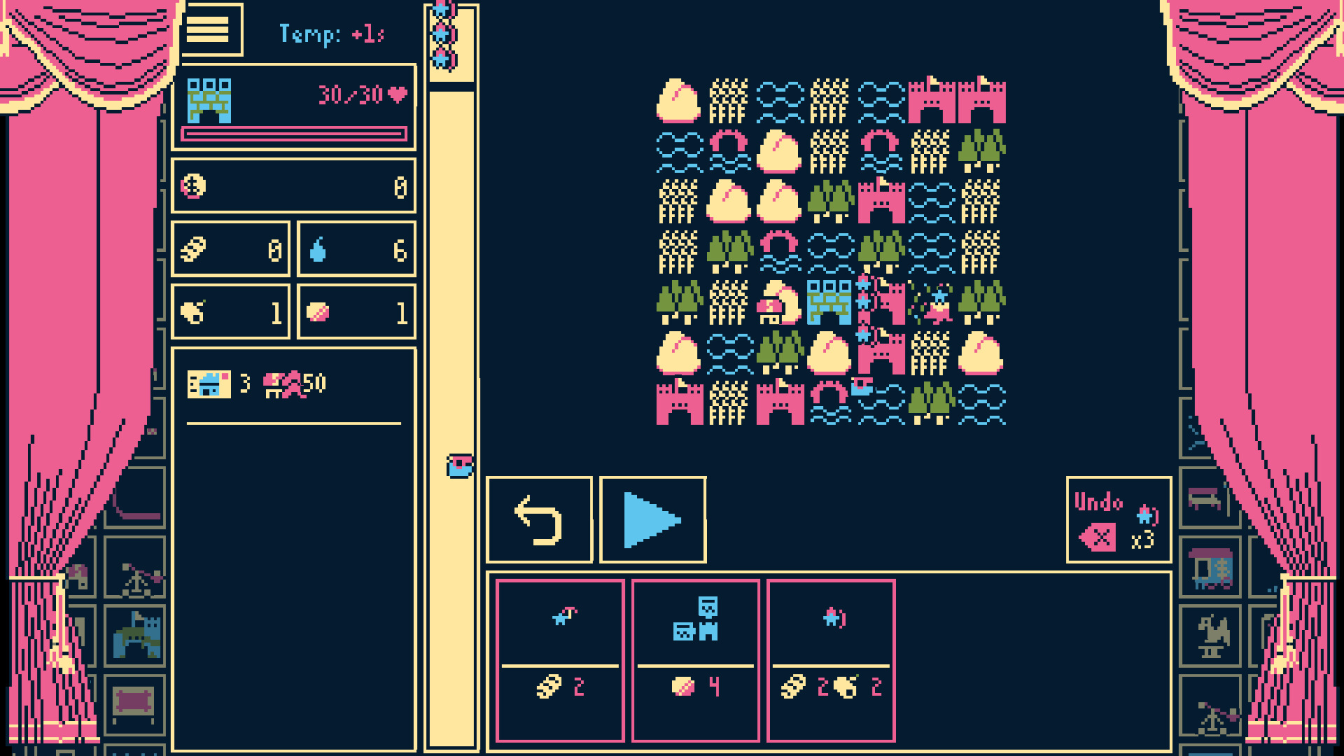
High tide is the match 3 phase. In this phase, you manipulate the battlefield by swapping around tiles. Matching tiles removes them from the battlefield and grants the appropriate resource. Match water for water, match wheat for food, match hills for rocks, and forests for wood.
Each move removes a small amount of your bar, with multi-matches refilling it. When the bar empties, it’s time for low tide.

Low tide is the prep phase for the tactical strategy portion. In this phase, you can produce units and cast spells from the unit cards in your slots. You have five slots for units and spells, and they can be cast as many times as you have resources. Most spells are instantaneous, but producing units takes time. Units go down the time tracker on the left.
Of course, it wouldn’t be a strategy game if it was just your units showing up. Enemy castles that are left on the board in Low Tide will produce units. Some attack your castle, some just sit around, and some don’t do much of anything.
Oh. Hmm. The word Enemy is in pink text over there. How very odd. Probably nothing to worry about.
Narrative
I find it tricky to talk about the narrative of Titanium Court for two reasons. First, I haven’t finished the game, and even if I did finish the game, I suspect that I don’t really understand what is going on with Magic, and the Enemy, and everything else. Second, I think it’s a big spoiler to reveal what I do think I know, but maybe I’m wrong. Third, the game’s tone is something I think is best experienced rather than revealed.
That said, I can offer a sort of litmus test; a bit of a sampler, if you will, of whether or not you will enjoy the writing in the game. At one point, I was offered the option to skip a boss fight in exchange for watching a three minute musical number about Atlantic Salmon. During another, a funeral procession was held for a football that I routinely failed to protect.
The game also has a few moments I’ve found surprisingly unsettling, and an antagonist I’ve grown to genuinely dislike, despite the the high amount of space between the player character and myself.
Overall
I quite like Titanium Court. I think it’s going to be one of those sleeper hits that doesn’t get quite enough attention until someone bigger than me picks it up, and it turns into a cult classic. It’s clever, well written, and manages to be genuinely unnerving at times despite its apparent simplicity.
That said, I’ve also found it weirdly draining, and that it requires my full focus. It’s not particularly snacky, or bite sized, or other nice words we use to compare things to food that is easily consumed. It’s more like ice cream. Try to consume it too fast—stuff too much of it into your mouth—and you’ll get a headache.
Still, I recommend it.
If you’re still on the fence, may I suggest watching the trailer here?
It also has a demo on Steam you can give a try.