
I’m just kinda sitting here, staring at my screen and trying to figure out how to introduce Chico’s Rebound. You can probably tell that it’s not going great, and that I’ve been forced into meta-narration. Because otherwise I am going to sit here until the flesh rots off my bones and the sun burns out.
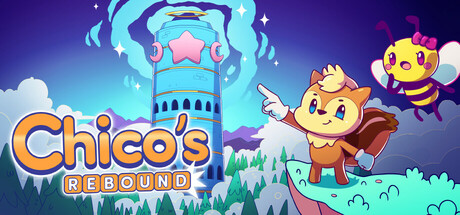
Chico’s Rebound is a sort of follow up to Chico and the Magic Orchards, a game I wrote about a few years ago. It’s also not really a follow up, because while the characters are the same, the core gameplay isn’t at all. Magic Orchards was a light puzzle game with some exploration elements.
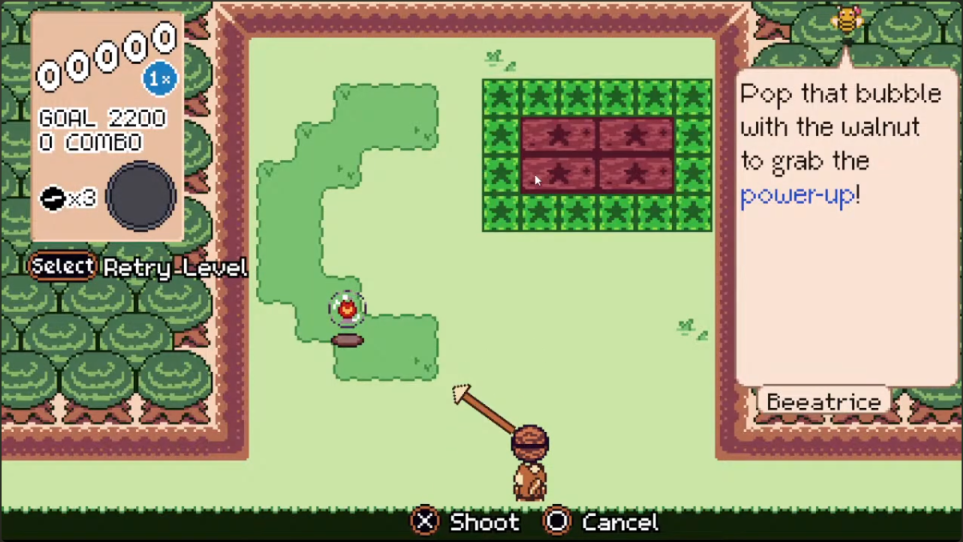
Rebound instead takes its inspiration from that classic iPod1 game breakout. If you’ve played Breakout, you know the basic deal. If you haven’t… well. It’s pretty simple. You have a ball, and at the bottom of the screen you have a paddle of some sort. You bounce the ball off the paddle, and when it hits bricks, they disappear. Get rid of all the bricks to clear the level. Pretty much just PvE pong.
I really hope we all know what Pong is?
Anyway, that’s what Chico is cribbing off of: a souped up version of Breakout with more mechanics. It also has some other mechanics, including overworld exploration and some puzzles, but the less said about these, the better. They’re not particularly fun, and I found myself struggling a fair bit with them when it felt like I shouldn’t be2.
Instead, the main gameplay is the variants of Pong. There are a lot of fun ideas here. One world has fire and water powerups that interact with growing and burning down plants. Another ghost themed level lets the ball swap between corporeal and phantom states, ignoring platforms in the other modes. Another world has a set of mushrooms that swap colors when hit, and can only be destroyed by hitting a matching colored switch.
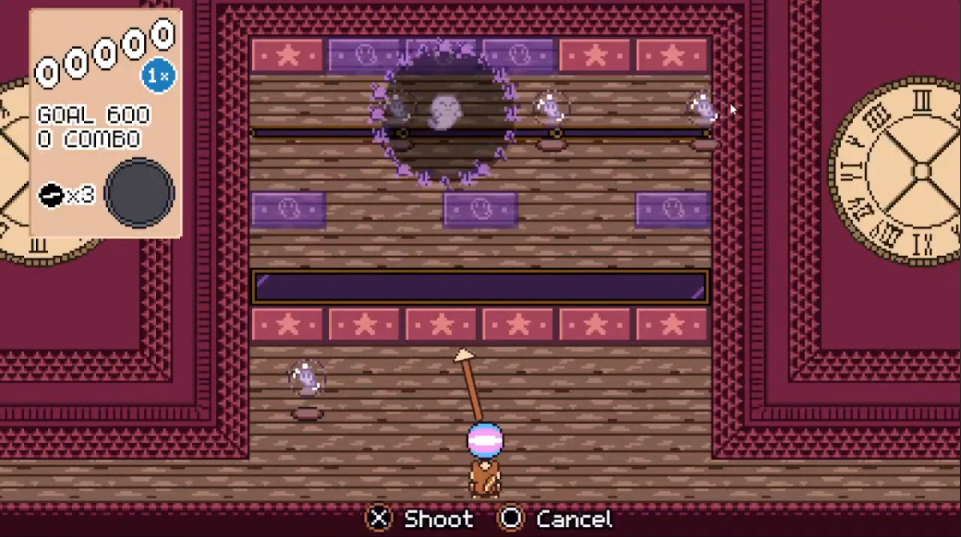
These are good, and pretty fun. Unfortunately, this is where most of my praise ends, because Chico’s Rebound is doing some really weird stuff with its controls. To explain why, we need to talk a bit more about Breakout and how progression in Chico’s Rebound works.
Most of the time in Breakout, any connection of the paddle to the ball launches the ball back up. The ball only resets if you drop it and it goes off the screen. In Chico’s Rebound, however, you can regrab the ball by just touching it. If you want to keep the ball bouncing, you have to do an input to do a tailspin. If you fail to do that input, Chico just grabs the ball, and then you can relaunch it.
This would make the game trivial; you could just clear all the blocks with no risk. Except Chico’s Rebound has a scoring system, and to cut to the chase: unlocking more levels ultimately requires beating previous levels at certain score thresholds. Getting higher scores requires high combos, and losing the ball offscreen or catching the ball both drop the combo.
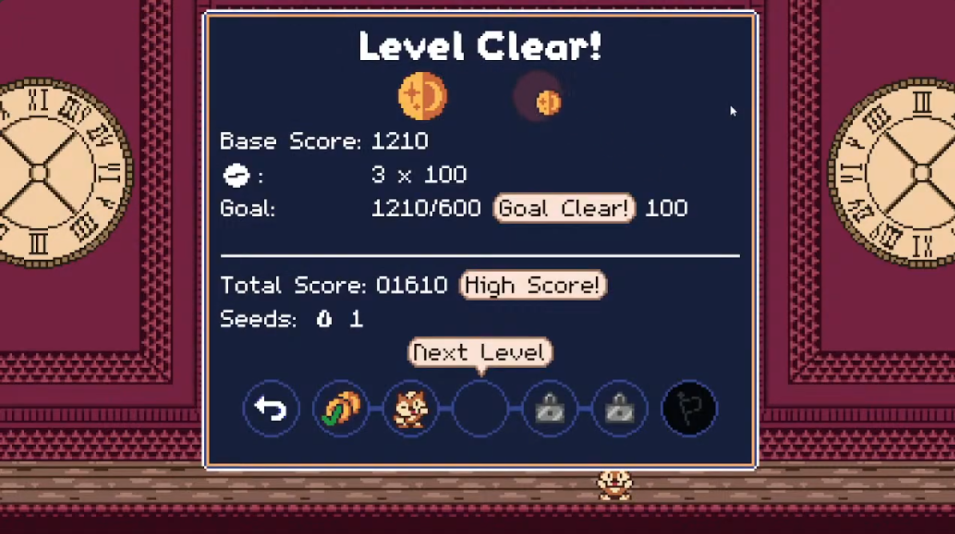
The end result is that you need to do the tailspin input constantly, and if you mess up at all, even if you were in the right part of the screen…. you probably have to restart the level.
It doesn’t help that the controls feel inconsistent at times, and I found myself dropping hits I’d thought I’d done an input for. I found that the frustrating controls overwhelmed most of the enjoyment I got out of the game’s unique level mechanics.
The game also has bosses. I generally liked them, but some require you to patiently regrab the ball and wait. Those are a bit less enjoyable.
Chico’s Rebound was $8 and 4 hours long. I don’t really regret it, but I wish I could recommend it more strongly.
- Apparently iPods are retro now. If this makes you feel old, you are welcome to join me in this shallow grave I will be digging for myself shortly. ↩︎
- There’s nothing intrinsically wrong with Chico’s Rebound’s overworld, but it’s so disconnected from the game’s main mechanics. Imagine each time you wanted to play a level of Mario, you had to solve a crossword first. That’s the energy here. ↩︎