
I guess I’m doing book reviews for a bit. Look, at least some of these books will be about games, so at least that helps. Not this one though!
This Way Up: When Maps Go Wrong is a (generally) non-fiction book by Jay Foreman and Mark Cooper-Jones, who are better known for their Map Men series on YouTube. I quite enjoy their videos, so when a friend got their book, I decided to take the opportunity to borrow it, and give it a read.
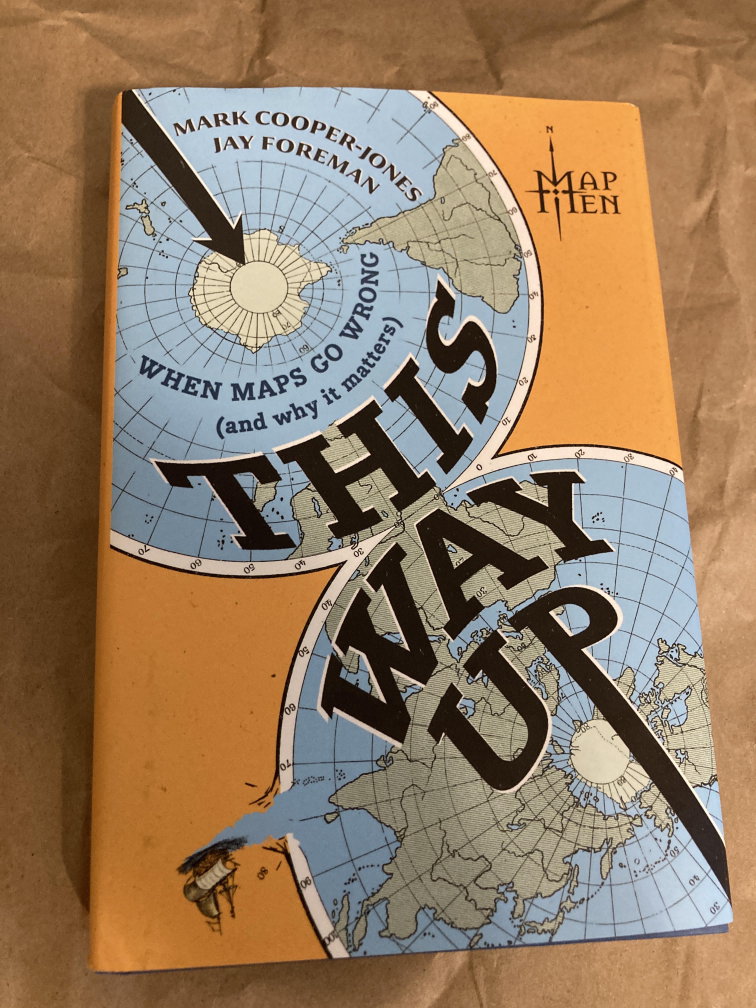
It’s roughly 15 chapters, each of which are standalone stories, all of which are about maps, or mapping, or the role maps have played in various things. If you’re a fan, consider it to be effectively 15 episodes of Map Men in book form.
As a fan, I have mixed feelings on it.
One problem is that some of the chapters are effectively remixes of some of their existing videos. These chapters mostly retell stories that they’ve covered before, such as their chapter on the history of Russian maps in the cold war, or the one about trap streets. To be fair, they often expand the on the base, but the general “oh neat” moment is one long time viewers will have seen before.
If this was the only problem, I think I’d be mostly satisfied with the book. Unfortunately, the larger problem I have is with the writing style.
Problem: Books are not videos
Based on the credits in their videos, I would consider Mark and Jay to be very solid writers and presenters, and good at delivering on a specific and possibly very British tone. This tone works very well in video content. I think it works very poorly in books. And unfortunately, the pair have not adjusted their style for this book.
Here’s an example: One semi-consistent bit the duo will do is to give a straight-faced accounting of a set of true facts, coupled with either an additional ridiculous fact, or a ridiculous explanation of the true fact. In their video on the North/South divide in England, at 47 seconds in, they note that “Which side you’re on can affect your house price, education, or your life expectancy!” followed by the presenter cheering for the wrong football team, while surrounded by a group of supporters for another team.
This works well in video, where we as the audience can understand that the stated “Fact” is likely true, but not for the reason it’s being presented, IE, the shorter life expectancy is not because you’re going to get the shit beaten out of you. Video has a lot more signals to work with then text.
The problem is, when you convert this style to a non-fiction book, you end up with little mental traps where it’s necessary at all times to ask yourself if what you’ve just read is true, or if they’re taking the piss.
This continues with other jokes as well. The aforementioned chapter on Russian maps is written as to imply that Russian hackers have broken into the publishers database, and censored the book themselves. This is mildly amusing when it’s used on a word that is easy to suss out, or pokes fun at Russia, but it shifts to being purely annoying when there are multiple pages of entirely censored text that have to be skipped.
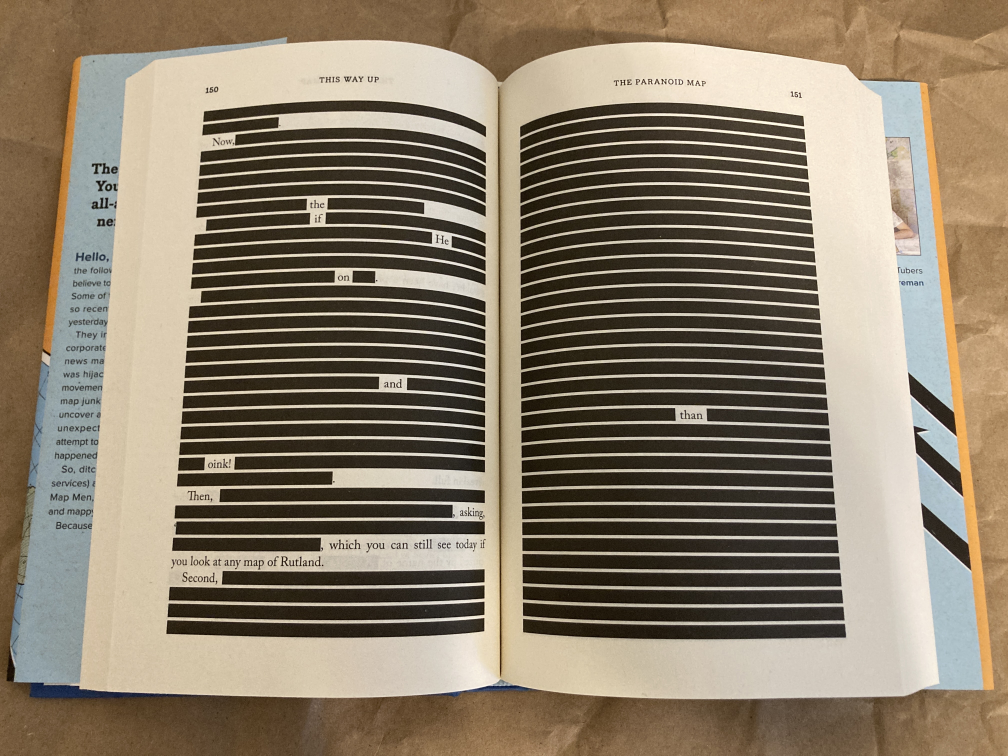
Again, this is the sort of joke that might work well in a video, where having Jay and Mark say something that is clearly edited to give a favorable impression of Russia, but is just annoying in a book.
Speaking on annoying, lets talk briefly about the two chapters I skipped. One is written as a series of letters from various countries and individuals, and I found incredibly frustrating to follow as it used a lot of different fonts/tones for no real reason other then commitment to the bit. The second is a script for a true-crime podcast on the Donner party.
Another one is a song/poem, which I did read, and Jay is a very good comic songwriter, but I don’t want to read comic songs.
Jay, Mark, on the off chance you read this, I would like to offer a single piece of feedback.
When I read a book, I want to read a book. I do not want to read a podcast. I do not want to read a series of fake letters.
I want to read a book.
These could have been the most interesting stories in the book, and I wouldn’t know, because the format in which they were presented was obstructive to actually reading them.
The Twist
The thing is, I think the pair can tell effective stories in books, as best evidenced by chapter 14. Chapter 14 is about the Marshal Islands, Operations Crossroads, and Bikini Atoll. It’s a fascinating story, and my only critique is that I wish they had spent slightly more time on the whole thing.
I think that because of the nature of the chapter, a lot of the comic material is front-loaded, with the later half taking a much more serious tone. And frankly, I prefer that.
I won’t spoil it because 1. At least two of the people who will read this review want to read this book, and 2. I do want the book to be successful, if less for the quality of the book then so that Jay and Mark can keep making cool stuff. But it’s a better example of what I’d hoped for from the entire book, instead of portions of it.
Overall
I can only really recommend This Way Up: When Maps Go Wrong to folks who are already fans of Map Men. I felt when I was reading it that there were multiple points where I would have misinterpreted the book if I wasn’t already familiar with the duos specific tone.
The good news is they’re at least somewhat easy to be fans of, and I’d suggest checking out this video they made about map projections to see if you enjoy their style.
When Maps Go Wrong is $30, unless you borrow a friends copy, in which case it is free!