Death’s Door

Death’s Door is has some great moments, and a lot more monotonous ones.

Death’s Door is a Zeldalike. I had that word in brackets, intending to replace it with something else, but I couldn’t find an appropriate replacement, so it stays. You play a small crow working for the Souls Commission. Things happen, and now you have to go places and kill the monsters who live there.

Death’s Door is fine, but it’s not good enough for me to really want to recommend it. It doesn’t do any single thing wrong, but it also never really felt like it did anything super special or unique. It has good moments, but after playing for 10 hours, my primary memory is one of frustration with the controls, and a few cool boss fights.
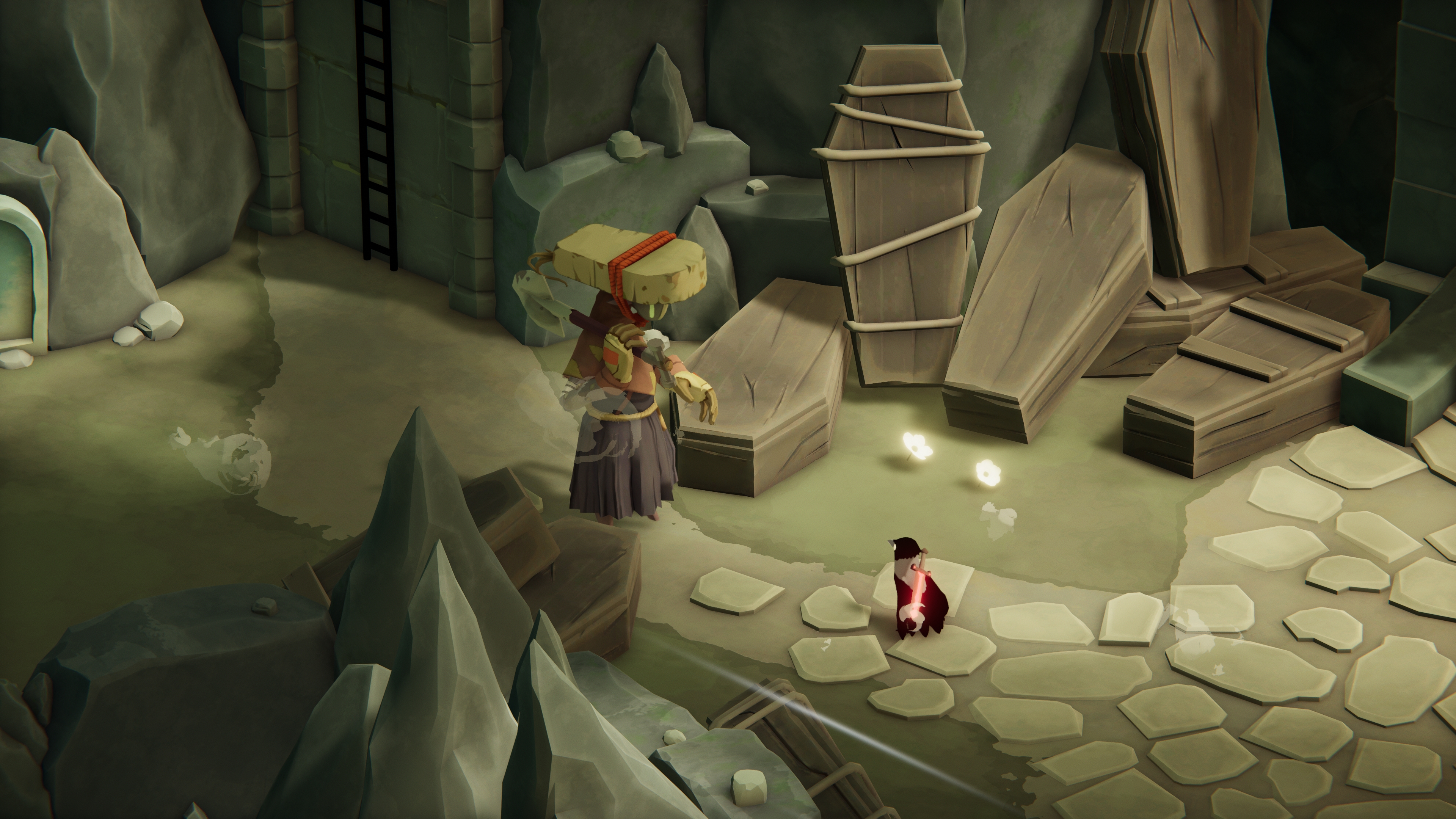
You’ll go from area to area, solving puzzles, and combat gauntlets, and finally getting to a boss who has to be defeated. These areas are fairly linear with a bit of back tracking. As far as I could tell, there were no real branching pathways, but there were a fair number of hidden areas.

The game just never felt that special though. There are a bunch of weapons, but only one really feels like it changes up how attacks work. Of the four spells you get, three felt just like the same projectile with different charge time. The puzzles were never quite challenging. The combat gauntlets were fine, but the longer non-gauntlet sections often ended up feeling tedious. The upgrades that you can buy are purely numerical, and never felt all that special or meaningful.

Howeverrrrrr…..
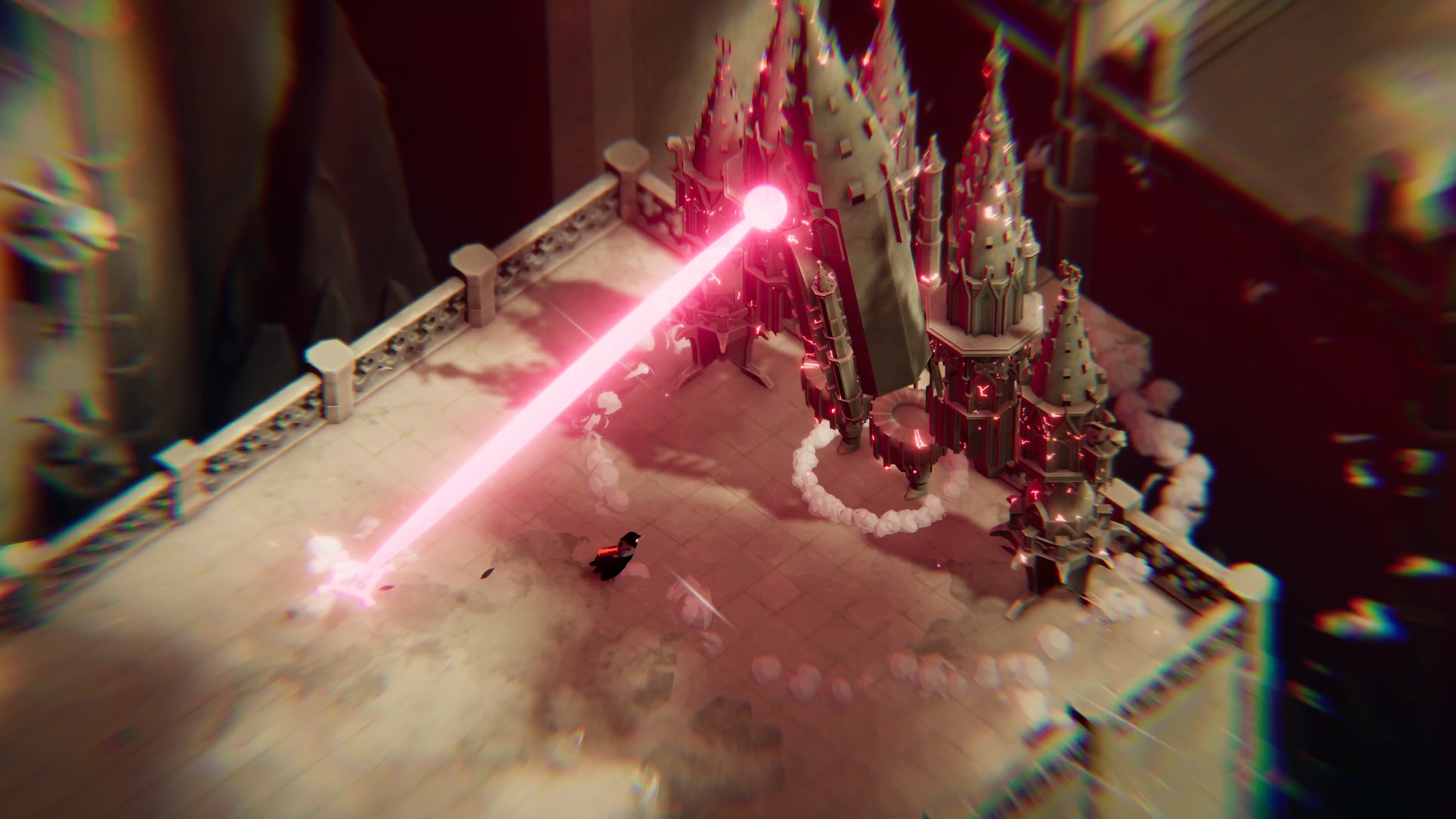
To be clear, this is effectively a mini-boss.

The full boss fights are, with a single exception, my favorite part of the game. They’re fast paced, bombastic with incredible art, and don’t overstay their welcome. Or at least most of them are. There was a single fight that drove me absolutely insane, and did a great job of illustrating my biggest problem with the game: the controls.

Death’s Door does not feel like it was meant to be played with a mouse and keyboard. I’m not sure how to illustrate this outside of giving an overly long explanation, so here goes:

Your movement is controlled with WASD. You can also swing your weapon with left click, use a spell with right click, and charge a heavy attack with middle mouse. (I never incorporated the heavy attack into my patterns, it was just too inconvenient.) You dodge with spacebar.

The problem is with how directionality works. Since you move with WASD, you can only move in 8 directions, and moving anything that isn’t up/down/left/right requires you to hold down two keys at once. Attacking, however, uses targeting from your mouse, and specifically where your mouse is relative to your little crow. Dodging, however, uses the direction that you’re facing at any given point in time. In addition, the camera isn’t permanently centered, which means that if it moves to keep a boss in frame, you can find yourself swinging in the wrong direction because the camera moved, and moved your mouse relative to your player. I often found myself dodging into an attack I was trying to avoid, or missing attacks because I lost track of where my mouse was relative to my crow.

This is my biggest actual problem with the game. While there were some minor technical issues with text boxes and pop-ins on various objects, I suspect these were caused by the fact that I was playing on an ultrawide monitor more than any actual technical failing.

The one thing I really do want to praise about the game is the art. There are some incredibly beautiful moments, mostly with the boss enemy design. The world itself is striking, even if it’s not always obviously impressive.
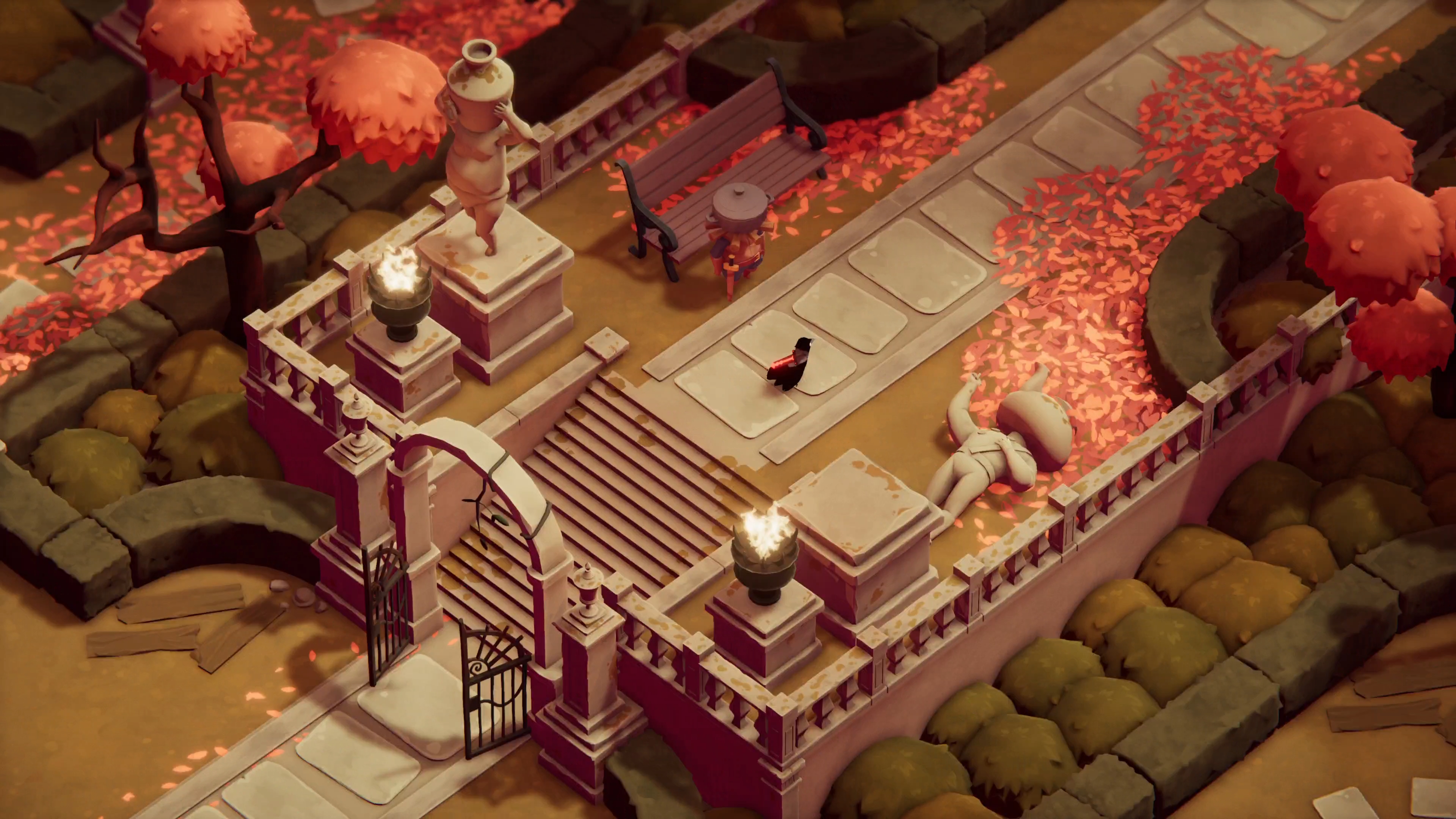
So that’s Death’s Door. A solid Zeldalike with incredible art, a few clever moments of world building, great boss fights, but also with janky controls, and a generally sort of humdrum feel for the other parts.

If you’re absolutely craving a game with simple Zelda-esque gameplay though, you could probably do worse. It’s available on pretty much every standard console, and for PC on Good Old Games, Steam, and the Epic Games store.
Inscryption

An incredibly interesting deckbuilder that takes the 4th wall and uses it as cardstock.

Let me save you a lot of time. Go play Inscryption. Here’s the game’s homepage. It is very good. That’s not to say I don’t have problems with it. I actually have one very large problem, but I’ll get to that later. Once you’ve played the game, obviously.

It’s okay, I’ll wait.

……………..

You finish it yet?

>NO, I haven’t bought it or started it.

>NO, but I started Inscryption .

>YES, I finished Inscryption

Your move.

Orna

Orna is an interesting augmented reality game, with an focus on the “Game” bit.

Orna is an augmented reality game in the general vein of Pokemon Go. Where Pokemon Go is heavy on the augmented reality and sometimes forgets to be a game, Orna remembers that AR games are supposed to actually be… well, games. In general, it functions as a semi-procedural RPG. There are monsters to fight, dungeons to explore, quest givers, inns, and shops.

You can filter what shows up on your map by what you’re looking for, including only showing enemies, or only showing larger bosses.

Like Pokemon Go, you have a sphere around you that dictates what you can interact with, and if you want your character to move, you need to move around in real life. The game world is overlaid on top of a world map, and you tap nearby things to interact with them.

Perhaps the biggest difference between Orna and most other augmented reality games I’ve seen is that Orna is focused on being a game. While combat starts out as a fairly simple affair, leveling up gives you the ability to unlock and switch between additional classes. The higher tier classes give access to additional skills, abilities, and skill slots, letting you bring more moves into battle.

For example, earlier in the game I had a thief who turned into a magic wielding wizard. I would buff myself up to be able to dodge attacks, then just stab people a bunch. After a while, I found that not having access to elemental abilities was making it harder to defeat certain enemies. So I switched over being more of caster.

Before I stopped playing, I’d rebuilt again into using physical damage, but casting low-mana cost spells to apply elemental damage of various types to my attacks, while trying to lock the enemy down with sleep and other status effects. This only worked because I’d unlocked a high enough tier class to bring in about 8 spells to battle, and ran a pet that had a chance to heal me each round, so I could just focus on damage and status effects. So there was quite a lot of build variety available to me.

You start out with just two skill slots, but you get more as you unlock higher tier classes.

The end result of all of this is a reasonably in depth system that, oddly enough, illustrates something to me that I hadn’t thought about too much before. Why do so many Augmented Reality games lack in-depth mechanics? The answer, I realized, is because outside of all this combat, you are at least in theory supposed to be playing this game while wandering around outside. In games with in-depth combat mechanics, combat actually requires attention and planning. Trying to play Orna and not walk into people/traffic/road signs is actually pretty tricky.

Instead, I often found myself pausing my walk in order to finish combat encounters or larger boss fights. Orna includes an auto-attack system to get through fights while not paying attention, but using it tended to result in me getting my ass handed to me. A level of attention and focus was necessary to actually win.

Most of the game’s secondary systems also run into a similar problem. There are dungeons, which are a longer gauntlet of battles, and you can’t pause or anything between. There’s the arena, where you face off against other players’ builds controlled by the AI. Both of these can be a bit tricky, and require you to actually be careful with your moves.

On the flip side, there are some systems that encourage moving around, at least a little bit. You get quests through daily random quests, from quest givers, or from other sources. Some quests just ask you to “explore” and walk a certain distance. In addition, there’s a territory capturing system that gives you bonuses for a time period for beating the mini-boss controlling an area.

No, the blue currency isn’t premium, it’s Orns, used to create various buildings and unlock new classes. But you can’t buy it with real money.

You can also construct various different types of shops and buildings to provide additional passive income, and other boosts and benefits. Some of these buildings can be seen and used by other players, while some can’t. But if you want you can choose to make the public ones private. In theory, this would let you wander around and discover other players’ structures, but in practice, I mostly just built everything in one place, and never left that area.

There are a bunch of other systems, including upgrading items, socketing gems into items, fishing, and various multiplayer raids, but I haven’t played around with them enough to really know what to say.

Look, this photo of my gear is just here to pad out the article.

And that’s a general overview of Orna. An interesting augmented reality game without excessive microtransaction bullshit, but which is sometimes a bit hard to play because of how many mechanics and systems work. Or at least, difficult to play while not getting hit by a truck.

If Orna sounds cool, or you want to play something that requires you to walk around a bit and isn’t Pokémon Go, you can find Orna on the Apple App Store and Google Play store if you just search the name. If you’re not sure, there’s more info on the game’s webpage here.

Deltarune – Chapter 1 & 2

So, Deltarune. I think it’s very good.

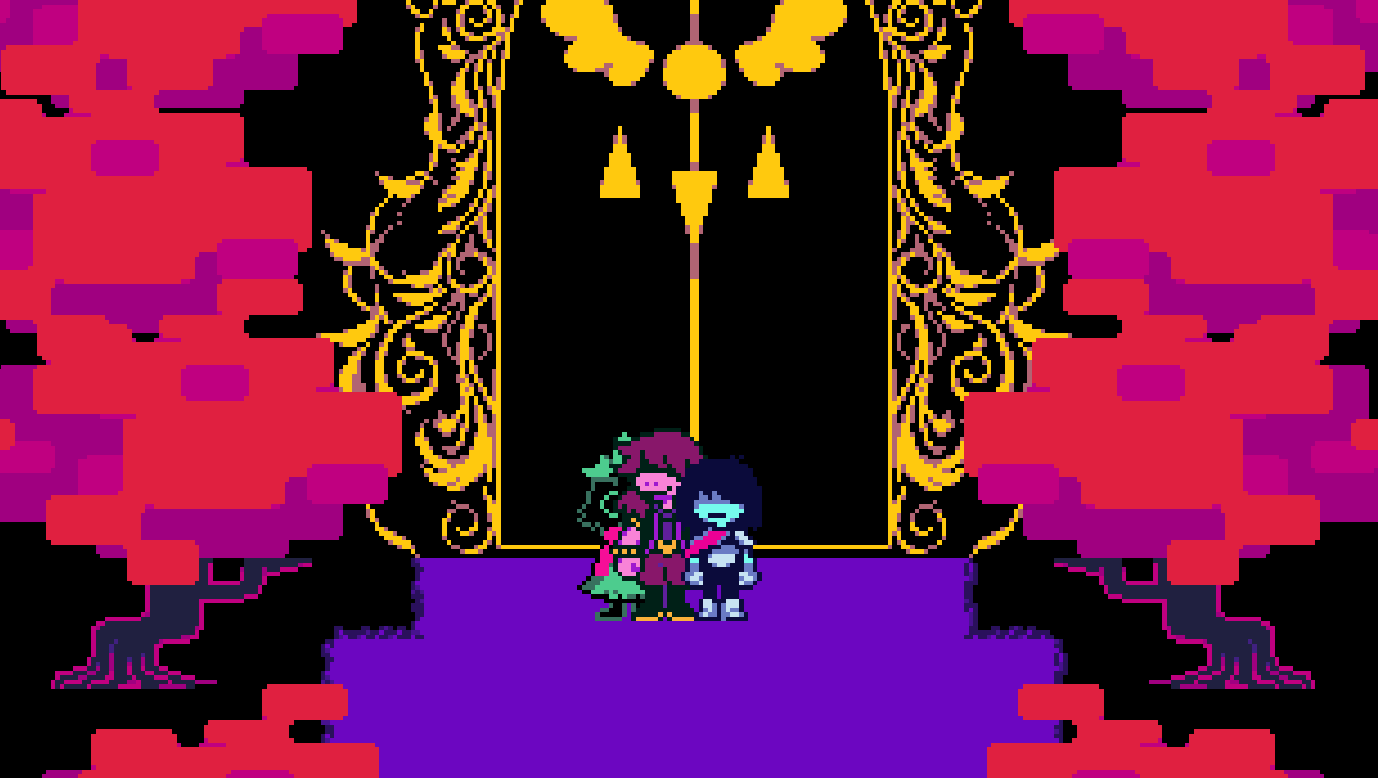
Deltarune is a turn-based RPG. It’s made by Toby Fox, the creator of the darlingest of indie darlings, Undertale. There are a large number of similarities between the two games, including rad as hell music, incredibly weird yet cohesive stories, and bullet hell gameplay mechanics for dodging enemy attacks.

They’re also both games that at least to my mind are much richer if you go into them with no spoilers. As such, if you enjoyed Undertale or games like Earthbound, I would encourage you to grab your gaming machine of choice, and download Chapter 1 & 2 right now. They’re free, and they’re available for PC, Switch, and PS4.

Now, it’s possible that this isn’t enough information for you. You want to know more about what you’re actually getting into. So this next section of the article is for those of you who are either on the fence, or not as interested. Perhaps you played Undertale and it never grabbed you. Perhaps you’ve had your fill of weird internet humor. Perhaps you’re tired of listening to Megalovania. Whatever the reason, I’d still suggest you check out Deltarune.

Deltarune is still just as weird as its famed predecessor, and the music is in my opinion just as good. However, Deltarune’s combat and ACTION system are vastly improved over those of Undertale.

One of Undertale’s primary selling points was that you didn’t have to kill anyone. You could play the game as traditional turn-based RPG with grinding, attacks, and murder. But you could also play through the game by choosing to talk and interact with enemies, and then SPARING them, ending combat without defeating them.

How the story unfolds if you choose to spare enemies is one of the most unique parts of the game. Unfortunately, choosing to spare “trash mobs” quickly becomes tedious after the first time you fight that type of enemy. Combat encounters in Undertale are fairly simple. Combat starts, and on your turn as a pacifist, you select various options in the interaction bar to try to butter up or calm down your opponent. Whenever they attack you, you play a bullet hell dodging mini-game to avoid being hit. While this is fine for bosses, it quickly becomes a boring for the other fights. Every type of normal enemy has the same sequence each time to “beat” the encounter.

But this writeup is about Deltarune, not Undertale. Deltarune still allows you to be a pacifist, but without making the encounters boring. There are a few new mechanics that solve this problem, as well as some general ways that combat encounters have been made more meaningful than they were in Undertale.

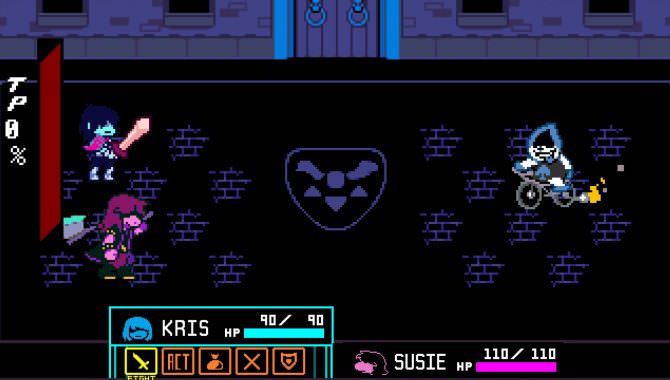
The first new mechanic is a system called TP. When enemies attack you in both Undertale and Deltarune, you play a short bullet hell sequence. This sequence varies wildly based on the enemy, but the general rule is: don’t get hit. Deltarune adds the TP gauge to these sequences. It’s used for various special actions and magic attacks including healing, and it fills by being just barely close enough to not take damage from attacks.

The second new mechanic is that pacifist actions also occasionally have their own mini-games associated with them. They’re nowhere near as elaborate as the bullet hell sequences mentioned above, but they’re more fun than simply choosing options on a menu like in Undertale.

And finally, you now have multiple party members to use. Some of the more interesting encounters in the game play with how pacifist options work differently for each party member. And this makes sense because some of your party members are… shall we say… “Less Inclined to Non-Violence” than others.

(Looking at you Susie.)

Deltarune keeps the parts of Undertale that were already loved by pretty much everyone (including the strange story, bizarre art and animation, and music that goes so much harder than it needs to), but just makes them more fun to experience.

I highly recommend you play Deltarune, or at least what’s out so far. I don’t think you’ll be disappointed.

Author Note: Images are from the IGDB because I was too lazy to take screenshots while I was playing.

Square Enix’s Letter From The Chairman – A Spicy Hot Take

Stop being concerned about the Square Enix letter, please.

I’m not sure how to start this brief writeup, but that’s okay. Anyway, now that we have a starting sentence, have you read the investor letter from Square Enix’s president? Here’s a link to the actual letter.

This letter has a lot of people hot and bothered, because it has terms in it like “NFT” and “Blockchain.” A large number of people are acting like he announced that the Square Enix servers will be powered by harvesting life energy from the Earth and that he’s renaming the company Shinra.

This interpretation is incredibly stupid for a variety of reasons, but it makes me think that people, perhaps understandably, don’t quite know how to read this sort of letter.

Brief diatribe. I think NFTs in their current implementation are fairly stupid. The idea of exchangeable digital property? Kind of neat. Everything about how they currently work, including the lack of oversight/controls, massive wastes of power, use for money laundering, and general pointlessness? Miserable, awful, needs to die in a fire.

Anyway, we’re talking about this specific type of letter. See, the purpose of a letter to investors is more or less to just buoy investor confidence. It’s not directed at consumers. If you do not care about SQENIX’s stock price, there is no reason to care about the content of this letter. Buy their games, products, and services based on what they actually release, at release. As a result, these letters tend to be filled with the appropriate buzzwords and terminology to signal to investors that the company leadership has their finger on the pulse of the industry.

As an example of this, I want to bring up the 2017 letter from the Chairman. In this letter, you’ll see extensive reference to virtual reality, augmented/alternate reality, and the key importance of smartphones. Why are they talking about Augmented Reality even though they haven’t ever made a augmented reality game? Simple. Because Pokémon Go came out in 2016 and made a godscrillion dollars while being a worldwide fucking phenomenon for several months.

So, with that as the context, let’s go back and dissect the actual letter with the framing, and the offending paragraphs that have people so annoyed.

Paragraphs 1 & 2 are primarily fluff about the concept of the “Metaverse.” They end with the following line.

As this abstract concept begins to take concrete shape in the form of product and service offerings, I am hoping that it will bring about changes that have a more substantial impact on our business as well.

Yosuke Matsuda, 2022 Letter from the Chairman

No promises. No commitment or statement of investment. Just 2 paragraphs of fluff that if these concepts transition into actual products and services instead of a pipe dream, they may impact the gaming and entertainment industry.

Paragraph 3 is the spicy one that actually talks about NFT’s.

 However, we do observe examples here and there of overheated trading in NFT-based digital goods with somewhat speculative overtones, regardless of the observed value of the content provided

Yosuke Matsuda, 2022 Letter from the Chairman

In case anyone is wondering how you say “Right now the value of any of this is massively fucking inflated, and the things being sold are pretty much worthless” in this sort of letter, here you go.

Paragraphs 4 & 5 touch on AI technology and cloud services. Of these, only paragraph 4 includes any actual statement of action, noting that the company has established SQUARE ENIX AI & ARTS Alchemy Co., Ltd. with a stated goal of R&D on AI.

5, 6 & 7 are all about token economies/crypto. They’re the second set of paragraphs that have people annoyed, and so I’m going to break them down a little bit here. I don’t actually agree with some of the concepts espoused here, but I’m gonna put my thoughts at the end.

Paragraph 5 is mostly a definition of the concept of “Play to Earn”, Blockchain-based games, and their theoretical differences from standard game development.

Paragraph 6 is, interestingly enough, the most consumer focused paragraph of the whole thing. I think this paragraph is attempting to make the case that there is value in the technical space that has been opened by Crypto. I think this paragraph is trying to win over people like myself who don’t like Crypto.

Paragraph 7 is the densest section of the letter, and has multiple concepts. Again, I encourage you to read the letter yourself, first from your own perspective, and then from the perspective of someone who is financially invested in Square Enix. I will likely not cover all aspects of it.

Loosely, I would summarize it as follows:

  1. People play games for multiple reasons, which in some cases include modding, creative expression, and gold farming. Traditionally, gaming structures do not have built-in methods for rewarding those types of players.
  2. The technology around Blockchain-based design, and social acceptance is currently mature enough to support creating games that do reward those types of players.
  3. Square Enix will continue to observe these changes, and will move to expand their portfolio of entertainment products to include what they define here as “Decentralized Games” if they think they can make money off it, which could include systems that financially reward those types of players.

8 is a generic wrap-up, and acknowledges the worldwide pandemic. Nothing too special here.

So, that’s the letter. It contains some overviews and definitions of some trendy topics in the video game sphere of business. It has a single concrete statement of action about AI for something they already did in march of 2020.

PS: I really do not agree with the definition of Decentralized Gaming presented in this letter. If the fundamental technology stack that is needed to actually run and play a video game from a technical standpoint is not actually freely available and modifiable, you have not created a decentralized game. You have simply created a game that uses Blockchain/a decentralized database as a repository for user game objects. But hey, that’s just my opinion. It remains to be seen if it ages like wine, or like my high school quote about how “The iPad will be a failure because it doesn’t support Flash”.

That’s a real thing I said.