Category: Board Games

  • Board Game Geek refuses to run ad campaign due to personal experience with “demonic possession”

    Board Game Geek refuses to run ad campaign due to personal experience with “demonic possession”

    This is a developing story.

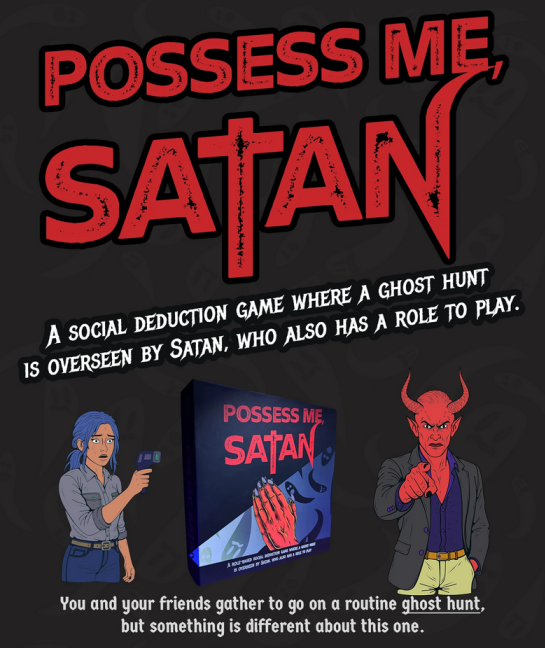
    Publisher Falling Whale Games has claimed that popular board gaming website Board Game Geek refused to run an advertising campaign for their game “Possess Me, Satan.” They say that their campaign was rejected due to its theme, with the unnamed employee rejecting the campaign stating that their personal experience with demonic possession and oppression.

    The game in question bills itself as a social deduction game in the vein of Mafia or Werewolf.

    Splash promotional image for the game Possess Me Satan

    This first surfaced on this reddit post. I reached out to Falling Whale Games, who confirmed that one of their team members had been the one to post the emails, and provided the full email text, which can be viewed at the bottom of this post.

    Notable quotes include:

    As a follower of Jesus, I routinely help people suffering from demonic oppression, and more occasionally, possession, and it’s absolutely devastating the damage he does to peoples’ lives.

    and also

    we’ve walked with one lady who was diagnosed with 32 distinct personalities as a result of horrific occultic abuse, and she eventually was one whole, complete individual, healed by Jesus, with no fragments or need of all her psychological meds

    The employee also suggests that Falling Whale Games pull the entire project.

    IMO, the responsible thing to do would be to pull the entire project, as there are *way* more people that suffer this than you could possibly imagine, putting on a good face (usually enabled by dissociation), but suffering terribly behind the scenes.

    When Falling Whale Games requested clarification, they were rebuffed, and the employee also stated that if it were up to them, they would not be running ads for Pillbox Games’ “All True Believers” either, and that it’s “it’s not over religion, but reality.”

    Update – 11:39 PM

    Board Game Geek has confirmed the messages were genuine, and that BGG’s Advertising Manager has been let go. Scott Alden made the following statement.

    “Due to a situation in which BGG’s Advertising Manager responded inappropriately in a business email to a designer, I have decided to let him go. His response does not reflect or represent our company or the way we conduct business.”

    Reaction

    Community reaction has been mixed, but often critical. Responses on reddit range from demanding an explanation from BGG, to stating that they will be ending their support for BGG. The community seems to have found consensus that this is an unusual and disappointing reason to reject an ad campaign.

    Full Email Text

    Unnamed Board Game Geek Employee
    “Thanks for submitting your ad campaign. We’ll review it and contact you if we have any scheduling conflicts or errors.

    Once your ad campaign is approved, you’ll receive a confirmation email.

    Contact me if you have any questions.

    Best regards
    [Name Removed by Falling Whale Games]”


    Falling Whale Games Team Member
    “I just wanted to follow up to see if this ad campaign was approved for not? Last time we did ads with Board Game Geek we got a confirmation email the very next day.

    I just need to make sure the ads are actually going to run on time since our crowdfunding starts on May 19th.”


    Unnamed Board Game Geek Employee
    “Thanks for the follow-up!

    To be completely transparent, I’ve been sitting on this one and praying about what to do in this instance. As a follower of Jesus, I routinely help people suffering from demonic oppression, and more occasionally, possession, and it’s absolutely devastating the damage he does to peoples’ lives. It’s sometimes beyond what would even dare be depicted in a horror film. The amazing thing is that I get to see Jesus completely heal folks of even the most severe effects (we’ve walked with one lady who was diagnosed with 32 distinct personalities as a result of horrific occultic abuse, and she eventually was one whole, complete individual, healed by Jesus, with no fragments or need of all her psychological meds), but it doesn’t change the terrible reality behind the theme that this game is depicting.

    So, I just can’t in good conscience approve this one; given what I’ve seen firsthand, the thought of displaying this subject matter makes me sick to my stomach. I don’t begrudge you personally, as many people just plain don’t understand the reality of it, but I’d strongly urge you to consider these things. IMO, the responsible thing to do would be to pull the entire project, as there are *way* more people that suffer this than you could possibly imagine, putting on a good face (usually enabled by dissociation), but suffering terribly behind the scenes.

    I know this response was more than you bargained for, but I wanted to be 100% honest about where I’m coming from, rather than just ignoring the request. Even though you may not be on the same page, I appreciate your understanding.”


    Falling Whale Games Team Member

    “Thank you for getting back to us.

    It’s very disappointing to hear you are denying us service based on religion. Is this the decision of Board Game Geek as a company or of just you personally?

    Is there an advertising policy rule we are breaking?

    There is currently ads on Board Game Geek for a game called “All True Believers” which is themed to the occult so it seems strange that our game is being singled out. 

    We are definitely not going to pull the project due to individual people not liking the theme. It is simply not for those people.”


    Unnamed Board Game Geek Employee

    “Keep in mind it’s not over religion, but reality. It’s the same reason I would say a game would be in very poor taste if it featured being a sexual predator, or something that would directly trigger someone that’s been harmed by the subject matter. It’s about keeping BGG welcoming to everyone, and since I’m privy to this subject matter, I know firsthand that this is not friendly content, and incredibly triggering, put in front of some of the population that visits BGG.

    Similar to site moderation, there are of course judgement calls to be made when it comes to displaying ads on the site. If it were just my personal preference, “All True Believers” wouldn’t be approved either, but I have to factor in if something being displayed is going to be overtly triggering. In that game, it’s a bit less obvious from the title, whereas you went for the shock value. Of course, that’s a business decision on your part, but it also means it’s not responsible of me to put it in front of a diverse community of gamers.”

    Sources and Confirmations

    After reviewing the initial reddit post, Gametrodon reached out directly to Board Game Geek and Falling Whale Games.

    Falling Whale Games stated to Gametrodon that they had indeed posted the messages on reddit. Board Game Geek has yet to respond.

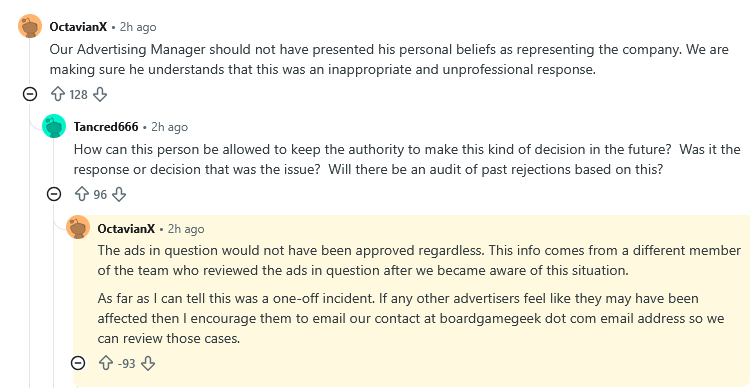
    Further down in the reddit thread, the user u/OctavianX, who we believe to be the community manager for Board Game Geek, stated that “Our advertising manager should not have presented his personal beliefs as representing the company. We are making sure he understands this was an inappropriate and unprofessional response”.

    Falling Whale Games has provided us with the banner ads that they would have run during the campaign. It’s not clear to us why these or their other content would not have been approved.

    Initial community reaction was skeptical: why would Board Game Geek make this decision? Was this a publicity stunt on the part of Falling Whale? But our investigation suggests that the email thread that Falling Whale posted is accurate and genuine.

    Some Quick Final Thoughts

    Everyone is entitled to their beliefs. Also, if your beliefs include the idea that someone can be healed by religion so that they no longer require anti-psychotics, I will fight you in a Denny’s parking lot.

    I’ve tried to keep a neutral tone as I’ve reported on this situation, but I can’t remain neutral about these extremely harmful attitudes towards peoples’ health.

    I believe that it’s the responsibility of Board Game Geek to address this appropriately, starting with an apology to Falling Whale Games for having someone on their advertising team tell them to cancel their game. If they don’t, I’m going to avoid using the site in the future. I encourage users who feel equally frustrated by this decision to do the same.

    What the community should NOT do is actively harass or dox the person who made this decision at BGG. It’s not an appropriate or acceptable response, and frankly is likely to just make that person feel like a martyr than actually having them confront their fairly rude and spiteful decision.

  • Spring Cleaning Write-up

    Spring Cleaning Write-up

    It’s been a little bit hasn’t it? In the interest of cleaning out my backlog of unfinished work and making it so that I don’t have to look at 18 drafts every time I log into this website, here’s a bunch of stuff I played enough to have opinions on, start write-ups, and then just never finish them.

    Order is going to be how good the games are, because one of is these is simply one of the greatest games I’ve ever played, some are the greatest games I played last year, and some were only marginally better than taking the money I spent on them and setting it on fire.

    Without any adieu or whatever, let’s begin.

    Blue Prince – The greatest puzzle game of the last 10 years.

    I started a Blue Prince write-up after “beating” the game, then went back and played another 50 hours, and I have still not beaten the game.

    Blue Prince is one of the greatest games in the last 10 years. It is easily the greatest puzzle game I have ever played. If you have not played it, and you like puzzle games at all, go play this. I took notes playing this game, and even with the screenshots, my Blue Prince google doc is 170 pages long. And yet the game never felt overwhelming, or extensively frustrating1.

    Blue Prince is a masterpiece. It is brilliant, and you should play it. The rabbit hole goes as deep as you want it to.

    UFO 50 – 50 incredible games from Derek Yu and other collaborators for a video game console that never existed.

    You know what was great last year? UFO 50. I played a bunch of UFO 50, I was going to try to review it, then it turned out that was going to be too hard, so I was going to review a single game from UFO 50. That was Avianos, a dinosaur themed 4x game with action selection mechanics, and I couldn’t even get that done. So yeah. UFO 50. It’s incredible. You will find something you love in it, and that’s ignoring all the other secrets and collectibles, and a billion other things I never even touched.

    High Tide – Abstract tile movement game by Marceline Leiman

    I don’t know how to write a good review of an abstract ocean themed game about hexagon movement, but I’m not a full time game reviewer. Dan Thurot is, so I’m just going to link to his review, and hopefully that makes up for stealing the images from it.

    One thing I do want to quickly note is that it now has a commercial release, instead of having to make some sort of eldritch deal to get one of the very limited night market copies!

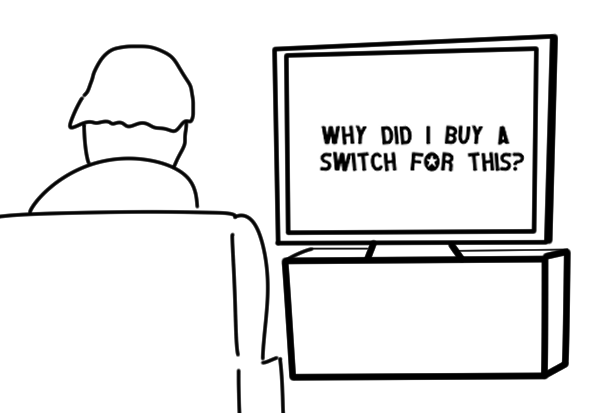
    Hytale – Minecraft, but not finished, but also designed by people to whom “quality of life” is not just 13 random letters in a row.

    What if Minecraft was designed by someone who cared about player experience on all levels of the game, instead of keep in a perpetual state of stasis by suits at Microsoft who are so scared of ever making any adjustments to their 2 billion purchase that Roblox already ate their lunch? You’d probably get Hytale, and if the game goes and manages to actually ship all of its content instead going back to development hell, it is going to be the best one of these crafting games.

    It’s a big IF though. Like a HUGE fuckin’ if.

    Gundam Card Game – I keep thinking it’s spelled Gundum, but I guess that’s wrong?

    It’s fine. Resource structure similar to One Piece, mostly entertaining to play, and nobody’s scalping it quite as hard as some of these other games, so that’s cool.

    Donkey Kong Bananza – I keep spelling “Bonanza” correctly, which is wrong.

    I was going to put Donkey Kong Bananza here, but then I realized I’d mostly already finished this writeup? And never posted it? I think because I got laid off almost immediately after getting it to 80% complete. Anyway, you can read that write up here.

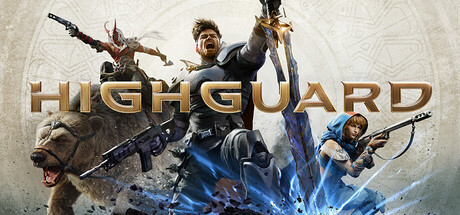
    Highguard – Lessons should be learned here, but they won’t be.

    It lived, it died, we hardly cried. The most notable thing about Highguard to me is that it’s not the very bottom of this list, but you can’t even play it if you want to, so who cares?

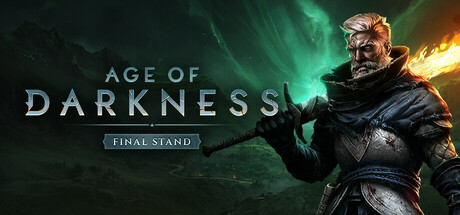
    Age of Darkness: Final Stand – The worst RTS I have ever played.

    It is rare that I play a game that fails on every conceivable level, while still somehow making it to release. Age of Darkness is that game. It is so shockingly bad that even just thinking about it again, more then a YEAR after I last played it brings to mind a list of problems burned into my brain. Here it is!

    The game’s networking is awful and it disconnects in multiplayer constantly. The game is micro intensive while requiring equally expansive macro. The units are both hard to control and incredibly dull, with no single character matching the personality of zergling, space marine, or zealot. There are no alternate build paths, the campaign difficulty is a brick wall, the game just looks bad, and as a result of all of these it just isn’t fun to play.

    There is nothing redeeming, and nothing it does better than its ancestors or contemporaries. It’s not even bad in an interesting way, it’s just awful and I want my $28 back.

    I’m not even going to link to it. They don’t deserve it.

  • Green Mountain Gamers – Winter Weirdness 2026

    I got back late last night from another Winter Weirdness, one of the events hosted by Green Mountain Gamers, which organizes tabletop game days in the Vermont/New Hampshire area. I quite like these events.

    They’re very lightly structured events. Folks bring their personal games to the event to lend to other people for the event, and then just spread out to play.

    As always, I’ll be talking about what I played, what I liked, and anything else about the event that strikes my fancy.

    The games I brought

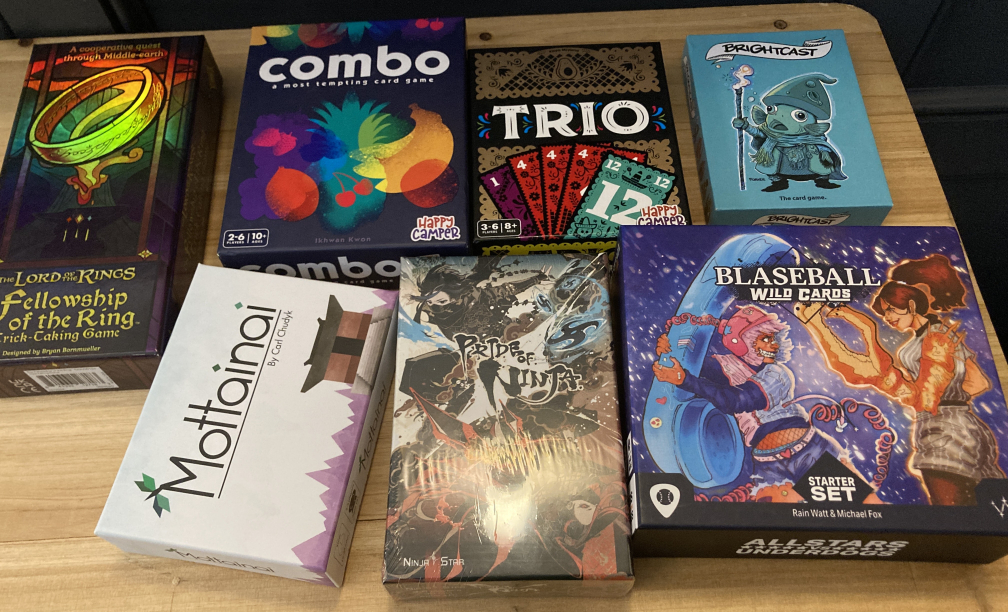
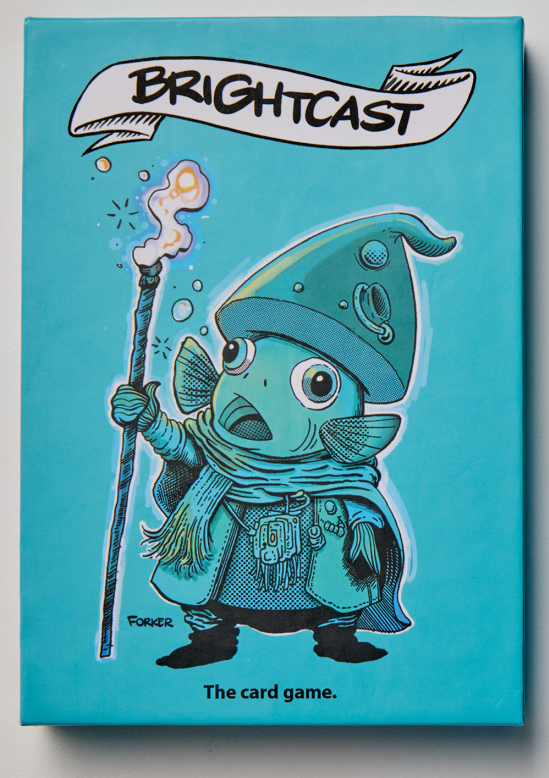
    I brought a smattering of stuff, including Mottainai, Combo, Trio, Pride of Ninja, Brightcast, Blaseball Wild Cards, and the first LoTR trick taking game. These were all small, and I was able to to stuff them into a bag. I’ve linked the ones I’ve done reviews for, but I enjoy all of these, and someday I really need to give Trio its own write-up.

    Image of 7 board games, LoTR trick taker, Combo, Trio, Brightcast, Mottanai, Pride of Ninja, and Blazball
    The 7 games I brought
    Game time

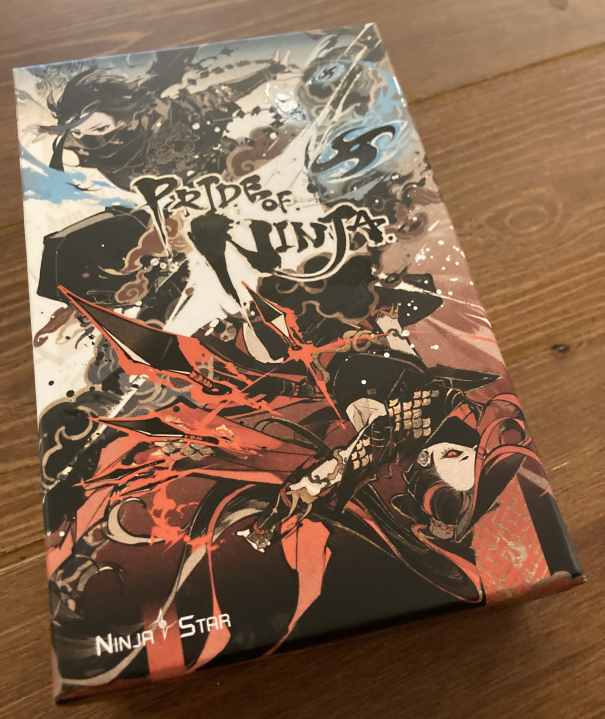
    First thing I did once I got there was crack open my copy of Pride of Ninja, and recruit a few people to play with me. I’ve been interested in Pride of Ninja ever since I first saw it two years ago at PAX Unplugged, and having actually managed to buy a copy this year, I finally got a chance to sit down and try a full game.

    I really like it! It’s a pick and pass drafting game with two small twists: first, after everyone takes a card, players either reveal that card, and place it in a front row slot, or keep it hidden and place it into a backrow slot. This means that as the draft goes on, you get some information about what your opponents are doing, but it’s still possible to hide key pieces.

    Second, many of the cards work in such a way that you actually need to care about what your opponents are doing, and a few cards can be effective tools for either punishing your opponents, or drafting off their success. What I really liked about these cards, though, was that it never really felt particularly painful to be on the receiving end of these plays.

    Pride of Ninja is great.

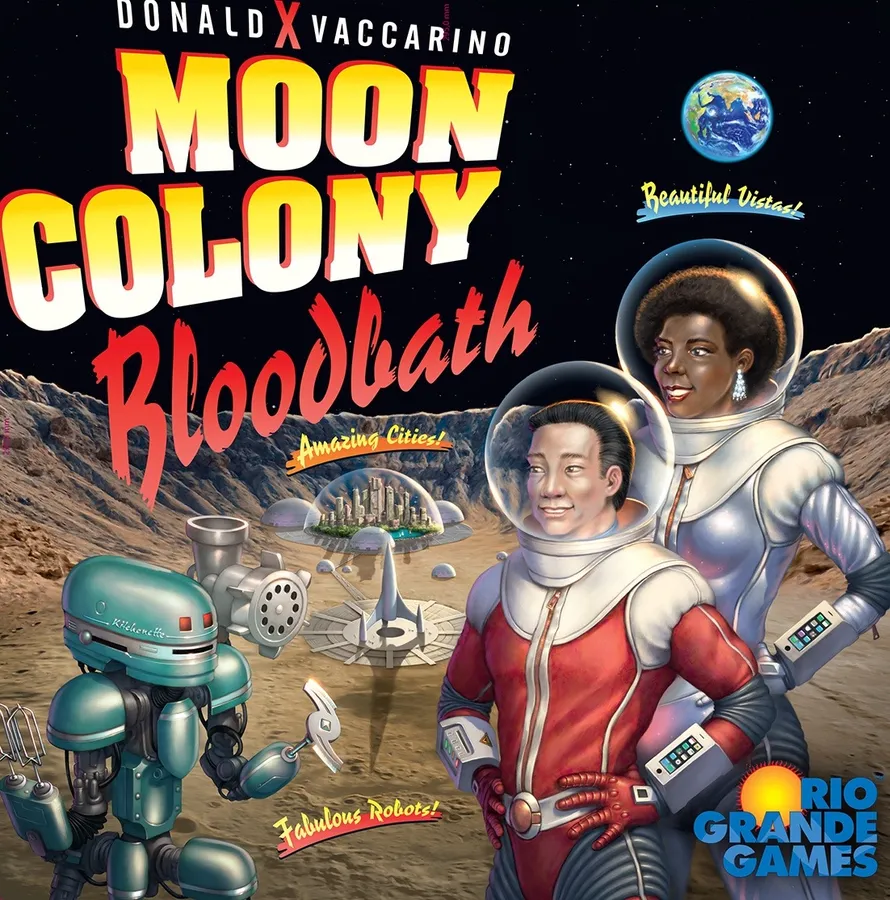
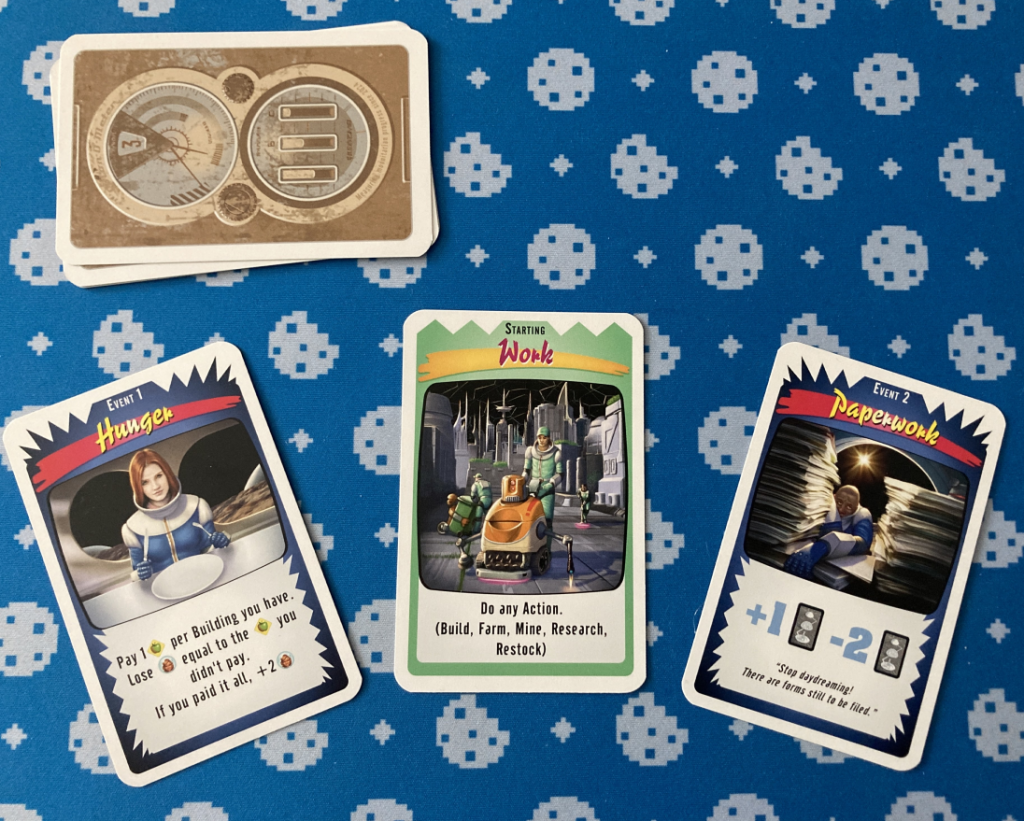
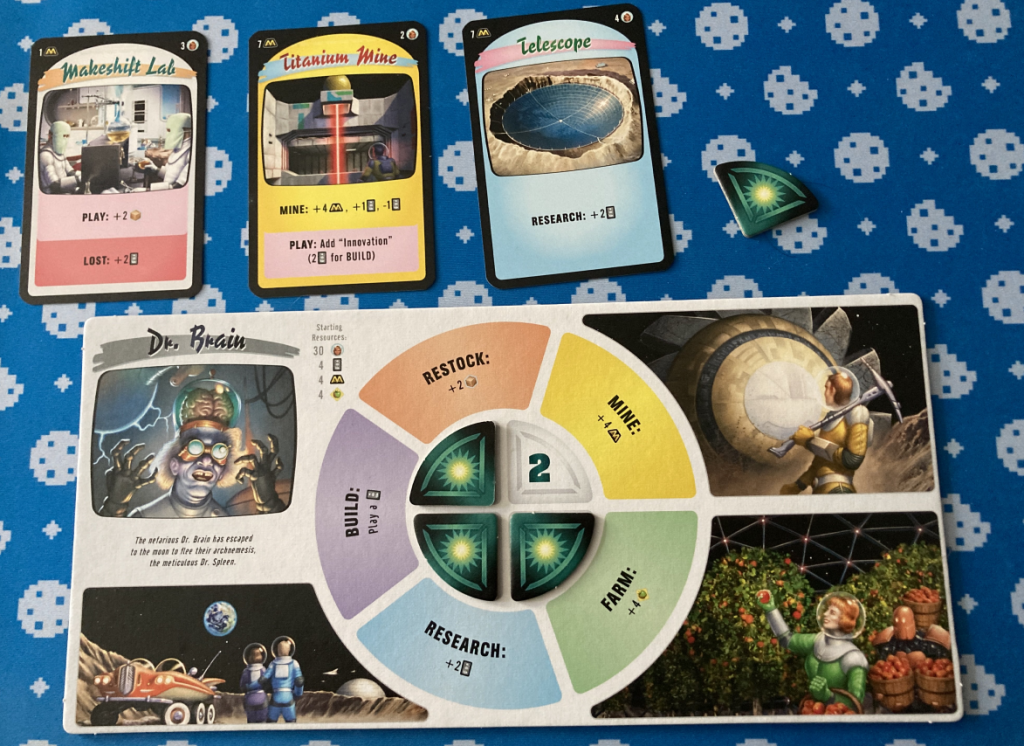
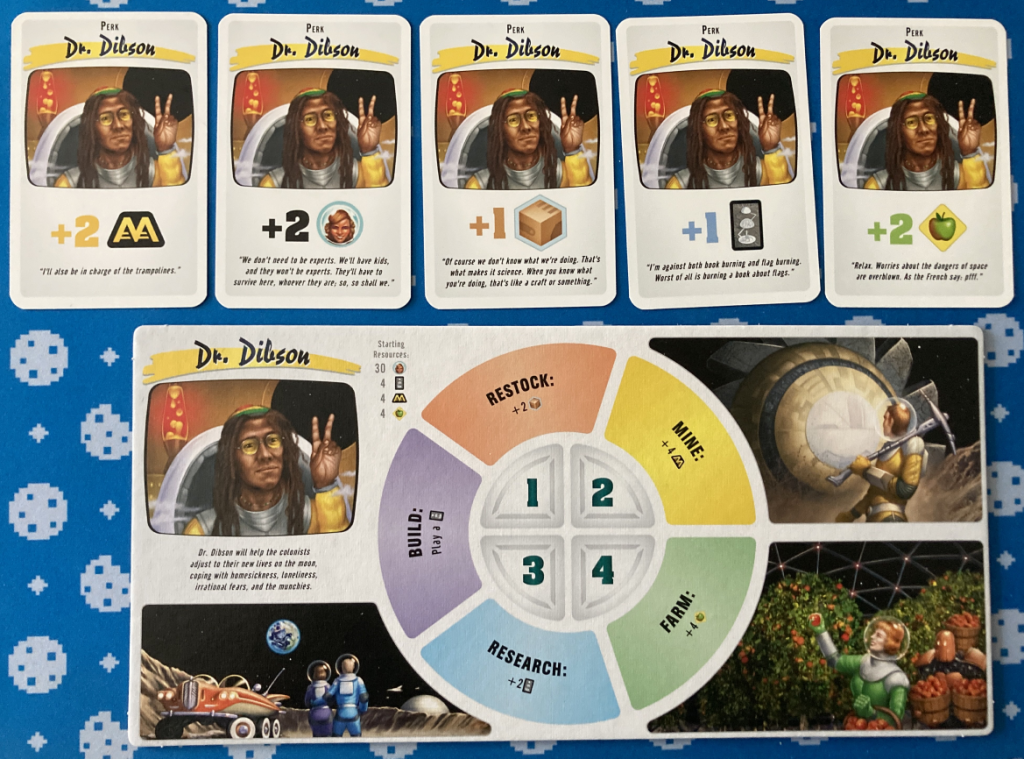
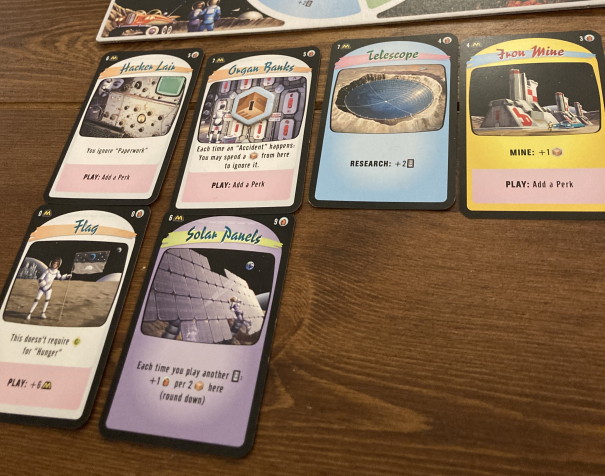
    Next up was Moon Colony Bloodbath. This was a weird one.

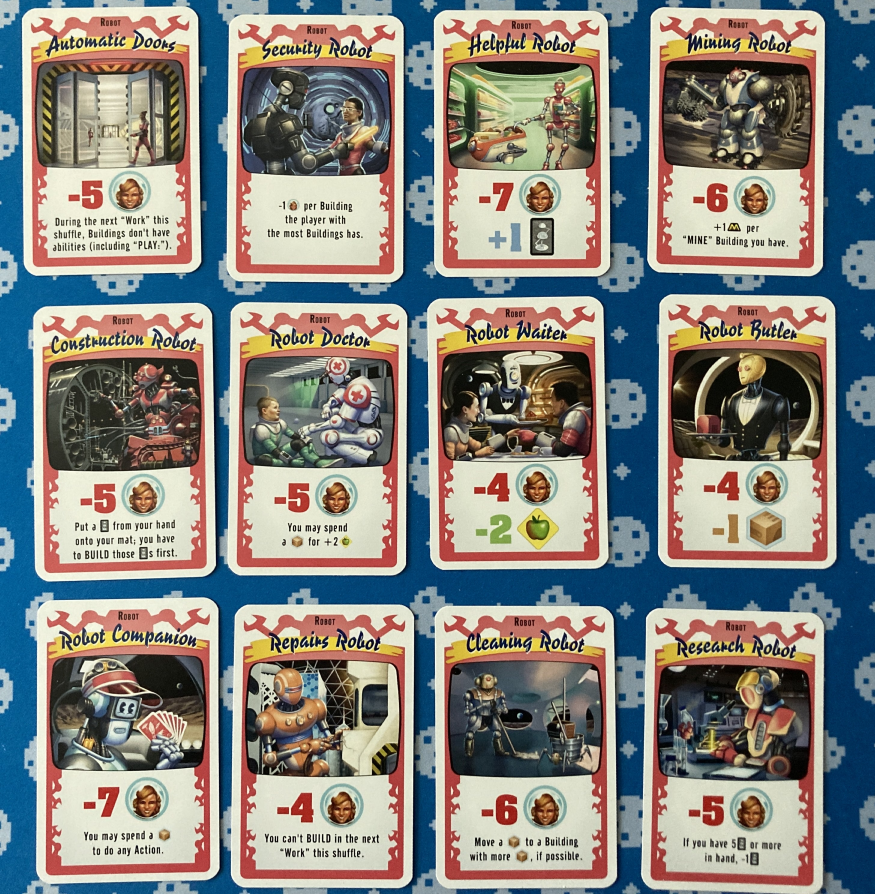
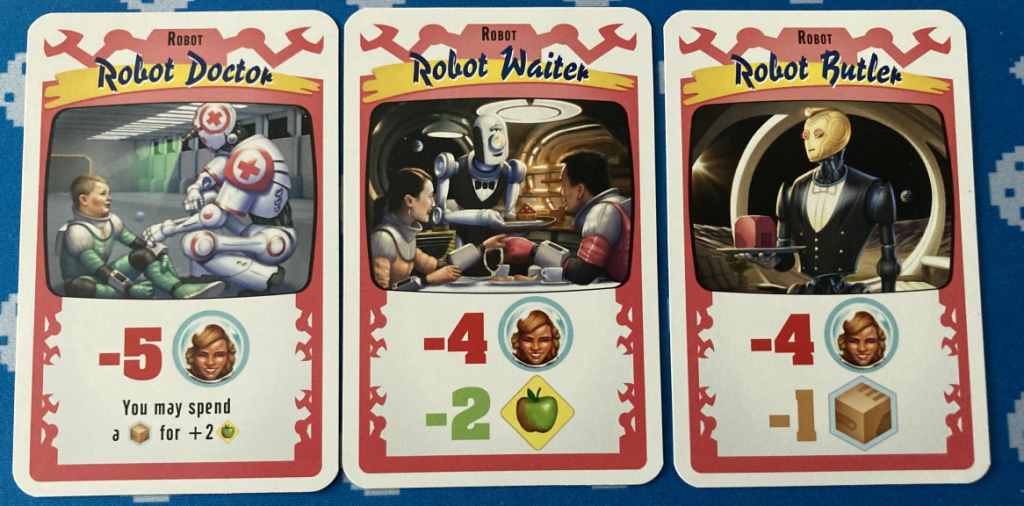
    Moon Colony Bloodbath is a tableau builder where you build up, and then lose your tableau. Well, you do if you’re me. If you’re winning, less of said tableau ends up blown away by accidents, infighting, and malfunctioning robots. The player power graph goes up, and then it goes way, way down.

    My feeling on Moon Colony Bloodbath is a decided sense of “Hmm.” I don’t know if I disliked playing it because it’s a bit undercooked, or because I just lost every game horribly. During the back half of the game, once my starting supply of colonists had been whittled to nothing, and I was forced to liquidate buildings, there was a sort of dull sense of a boredom instead of a comedy of overconfident self-destruction.

    Moments before everything is liquidated and destroyed.

    It felt like the final turns of a game of Terraforming Mars, where instead of doing anything interesting, you just min-max for victory points, as there isn’t enough time for any grand scheme to actually come to completion.

    I also have a really weird complaint about the game’s art and theming. The game feels like it wants to be doing a sort of 1950’s-60’s pop-sci/science fiction style. I think this is a really good theme, and standing alone the art is fine if not great. But in conjunction with the rest of the game’s mechanics, it feels like the artist was never in on the joke. Every location is played fairly straight, and every robot just looks like a generic robot. It feels like no one told Franz Vohwinkel that each of these colonists was going to meet a horribly grisly death.

    Anyway, with those two finished, I switched over to a few quicker games. This included a few rounds of Tiger and Dragon, a quick playthrough of the first level of the Lord of the Rings Trick Taking Game, and a short game of Combo. No notes here except maybe a reminder to myself that I should actually do a writeup on Combo one of these days.

    After all of that, I played Panda Royale. I don’t like Panda Royale. This might be a bad game. It’s got an aggravating draft order system, dull dice types, pointless and tedious arithmetic, and the theme has absolutely zero connection to the mechanics of this sloggy roll and write.

    This was followed up by doing a 4 person draft of Edge of Eternities to round out the day. Unlike the other several times I’ve drafted this set, I actually did quite well this time, and manged to win almost all of the games I played.

    And then it was time to leave.

    Oh…

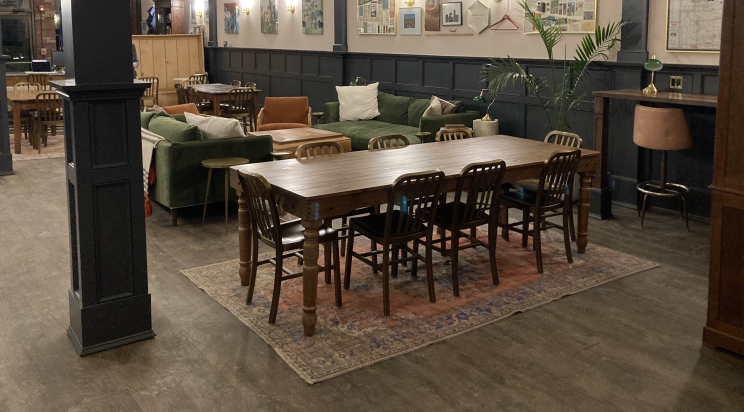
    The Barre Social Club

    This event was held in Barre Social Club, and I just want to note that it might be the single most beautiful space I’ve ever been in.

    There’s all this great old furniture, and the walls are covered in old maps, magazines, playbills, and other fun bits of old paperwork.

    Like, just look at it.

    Oh, and this bookcase?

    It’s a secret door!

    Okay, not that secret, it leads to a kitchen space, but like… still! Isn’t that cool?

    It’s a coworking space, so if you’re in Barre, it’s worth checking out. Anyway, that’s all for me right now. I’m gonna see if I can write something to put up for today about a specific game. Talk more later.

  • Brightcast

    I love Brightcast. It was my favorite new game from PAX Unplugged last year, and it’s easily my most played game from the show. I’ve brought it with me to pretty much every event I’ve gone to, from weekly Magic, to PAX East.

    I’ve showed it off to the local LGS’s I go to, and convinced at least one of them to stock it. I’ve done everything in my power to show it to more people… except actually write a review.

    So we’re gonna correct that now.

    The Game

    Brightcast is a 1v1 dueling game. There’s no asymmetry. Both you and your opponent are working with the same set of tools: six copies of each of Spellcasters, two copies of the dragon, and two copies of the Alchemist. You each get a single deck of 34 cards of 7 different types.

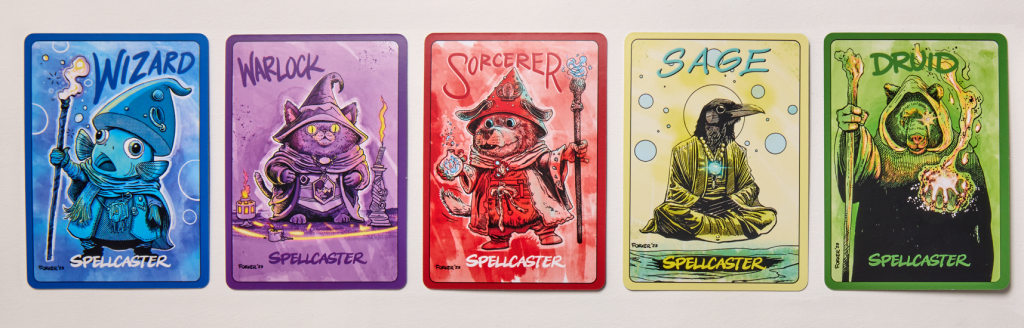
    Let’s start with the Spellcasters, since they’re how you actually win. There are five spellcasters: the Sage, the Warlock, the Druid, the Sorcerer, and Wizard. In order to win, you need to collect either one of each, or five copies of a single one into your tableau.

    How do you do this? Well, it’s quite simple. On your turn, draw a card, then pick a card from you hand to add to play. You get its effect, and if it’s a Spellcaster, you then add it to your tableau. (You can alternatively choose to draw a second card instead of playing a card, but you usually don’t want to.)

    Let’s talk about their effects. The Sorcerer is the simplest, destroying a single card in your opponent’s tableau when played. The Warlock works a bit in reverse, returning a single card from your discard pile to your hand. The Sage draws you two more cards, then requires that you discard 1, while the Druid makes your opponent reveal their hand and discard a card of your choosing. And then there’s the Wizard.

    The Wizard is a bit special. You can play the Wizard from your hand and just draw one card. Or—and this is what you’ll want to be doing most of the time— when your opponent plays a card, you can discard a Wizard and a copy of the card your opponent played to block their play. Sure, it’s a two-for-one, but it can be worth it to slow your opponent down.

    Then there are the last two card types: The Dragon and Alchemist.

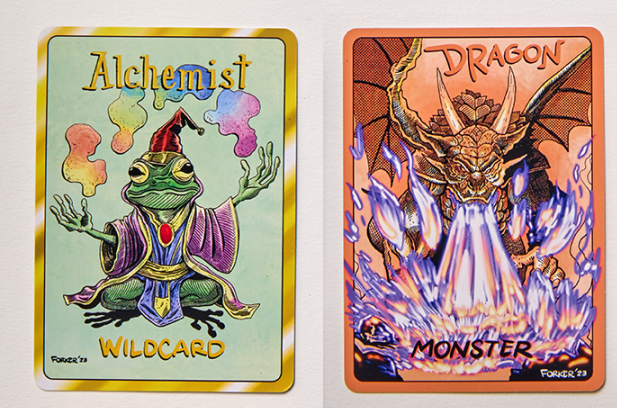
    When you play the Dragon, you can destroy up to 3 cards from your opponent’s tableau. When you play the Alchemist, you can copy the effect of a Spellcaster you already have in play in your tableau. Both of these are obviously a fair bit more powerful then the other cards, and as such they don’t go into the Tableau, and they also can’t be recovered with the Warlock.

    Why I love it

    Okay, so that was a lot of rules text, but importantly, that’s also pretty much all of the rules. You could take everything I wrote up above, make your own copy of Brightcast, and play it reasonably accurately. It’s the sort of game you can teach to someone in five minutes, and play multiple games for the next 45.

    Because despite that simplicity, Brightcast offers a lot of interesting choices. Do I play my dragon, knowing they might pull it out of my hand with a druid, or do I try to hold it for the perfect moment? Do I play Sage after Sage, trying to get all five out quickly? Should I daisy chain warlocks into having a bit of a buffer for completing a set of five, or just grab back a Druid to pull their Sorcerer out of their hand?

    I could go on! I won’t. But I could!

    Brightcast fits into a similar space as Tiger and Dragon for me. It’s not a full course meal on its own. But it’s the sort of thing that you can slip in a game of anywhere, or teach to a complete stranger. I’ve played a fair amount of it in between Magic games, or while while waiting for events to start.

    There’s a fascinating set of decision points from an incredibly simple set of cards, and it’s fun enough to play over and over. Also, and I’ll say this again, the art is just incredible.

    Overall

    The back of Brightcast describes it as “Deceptively simple, secretly deep” and I can’t think of a better descriptor. It’s quick to learn, and offers a interesting play choices all throughout the game. If you like Magic: The Gathering, or clever dueling games, I highly suggest trying Brightcast.

    Who knows. Maybe you’ll become as much of an evangelist for it as I have.

    Quick Note: Brightcast is currently only available from direct retailers, so the best way to get a copy is to ask your LGS to stock it, or check if they already have it available. If you’re up in New Hampshire like me, The Fourth Place has some copies.

  • A Quick Rant on 1 Star Board Game Geek Reviews

    A while ago, a friend of mine had just released a game, and was doing what all board game designers (as far as I’m aware) do post game release: stare in frustration at the ratings on Board Game Geek.

    The particular source of his frustration was a that the game had been rated with a 1 by someone who clearly didn’t own the game, and couldn’t have possibly played the game at the time. Shortly after he mentioned the whole thing to me.

    We quickly discussed various reasons that players will do this, and there was a smattering of the usual ones. Review bombing a game for ideological reasons. Rating a game that is rated “too highly” to bring the score down. Fights or problems with a publisher.

    It was at this point that I asked him if he’d just asked this person why they’d given him a 1. He had not.

    So messaged them. I’ll be referring to the rater as “Tim.”

    Reaching Out

    After looking at the profile for a bit, I quickly noticed that it had a very odd distribution of ratings. Virtually all of them were 1’s, with a smattering of 7-10’s, but the 1’s MASSIVELY outweighed the 10’s.

    So I messaged Tim, and asked them about their rating system for games. After a brief back and fourth, they responded, and I found their answer surprising.

    The Big Surprise

    The first thing was that Tim was not a single person, and instead was a group of players who used the account to collaboratively track plays and games for their gaming club.

    The second was that when they “rated” a game, they were not rating it based on playing it. They were giving a rating based on how they felt as a group, and if they wanted to order it for the group. So a game that wasn’t bad might receive a 1 for the reason that nobody in the group was interested in trying it. This was especially common for games that the group considered too simple, or didn’t have the right player count.

    There’s also one specific quote I want to pull out from their response, that I found quite telling.

    Regarding the not yet released (games) – we consider ourselves enough experienced so we do not need to play the game to know that it is not for us – one text or video review is more than enough.

    This is not an approach I would ever take, but I appreciated the clarity, and I think it gives insight on why this person had such a high number of low-rated games.

    I thanked them for their response, and moved on.

    The Takeaways

    The general vibe I have gotten from designers when discussing what I’d generally consider to be unusually low ratings is a sense that they’re being targeted in some way or another.

    There absolutely are folks in board game spaces who do what I’d call “hateful reviews.” The folks who hate others based on their sexual orientation, gender, race, etc. The whole nine yards. And because they exist in board game spaces, they also exist on Board Game Geek. And they will rate games badly as a way to harass and attack people.

    There are also folks who are picky or petty. They’ll rate a game low because a component was damaged. Or because it was rated too highly. Or it was shipped to reviewers before Kickstarter backers. Or any number of a variety of other things that I’d personally consider mundane and irrelevant to the experience of the game.

    But I think there is also a third category of folks who are just doing their own thing, and see nothing wrong with rating a game that they do not personally like much as a 1, and moving on.

    Does this usually ruin that designer’s day? Yes! Do I have any idea how to fix this problem?

    Not a clue.

    I don’t think many board game players recognize the impact ratings have on a game, or the folks who make them. At the same time, I’m not sure publishers and designers are interested in asking the less vocal folks who rate games weirdly why they’re doing it, when all available evidence (to them!) labels those folks as hateful or petty.