My LGS cancelled weekly Lorcana, and now the game is dead.

Non-Clickbait Title: Ravensburger has shot itself in the foot repeatedly, and it killed my local Lorcana scene.
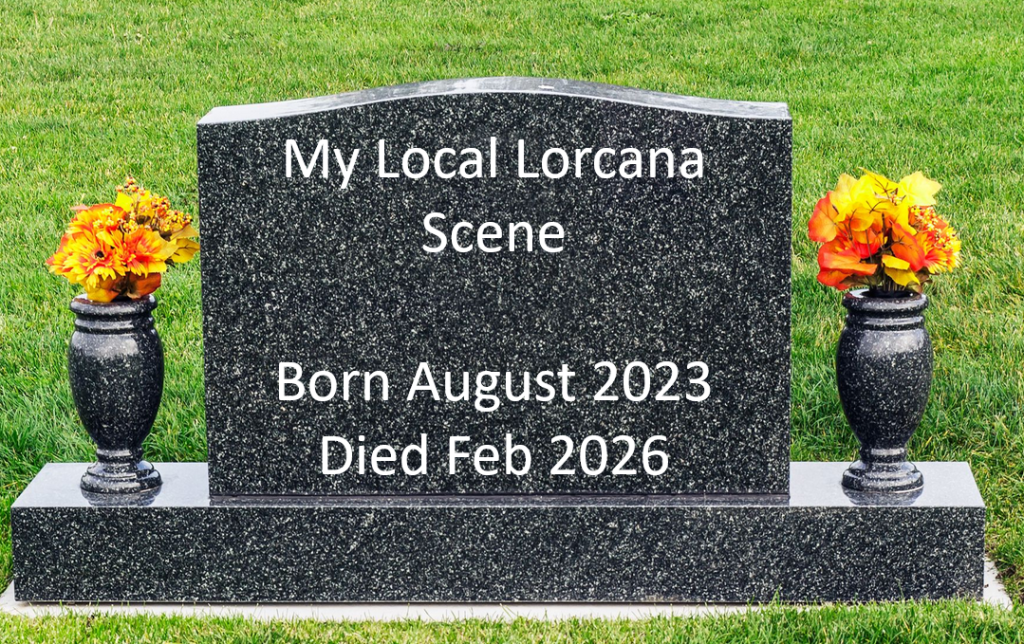
Okay, so that’s a little bit of a lie. My local game store (LGS) did cancel their weekly Lorcana events, but as far as I’m aware, the game isn’t dead. Yet. But the local population of players has cratered.

I like looking at weird things that happen in TCG’s, and Lorcana has recently given me an interesting little case study in looking at the folks who played LGS, and how/when the drop-off happened.

I also think that for the specific population of players I played with, I can trace back the decline to two or three fairly specific events, and that interests me! So lets talk about it.

But first…

Why does it matter that weeklies are cancelled?

The store I went to for Lorcana ran casual weekly events. These were non-prized, non-competitive freeplay events. You bought in for $7, got a booster pack of your choice, and were entered in a raffle to win some other organized play prizes.

These events were the lowest possible entry point to get into Lorcana and connect with the local community. If you are brand new to the game, if you’ve never played a card game before, if you didn’t go out to card game events… this was the easiest way to try out the game in the lowest stakes, most chill energy environment that was available.

Without these events, the first step on a ladder of getting into the game has been removed. It won’t stop weirdos like me who show up to sealed events for games they can’t play, but I do think it makes it much more daunting (and expensive!) for almost everyone else.

I think this is bad, but I think its especially bad for Lorcana. A lot of Lorcana players in our local were Disney fans first, and Lorcana players second. The traditional label for this would probably be “casual” players, but I don’t think that fits here. These were folks who came to every pre-release and bought cards by the booster box. They might have played the game casually, but they didn’t engage with it casually. They were more interested in making decks around their favorite characters then trying to break the meta.

Anyway, that’s a lot text to say the following:

  1. Loss of weeklies was bad because it removed the first step in on-boarding for new players or players who wanted to get more involved
  2. It’s especially bad for Lorcana because it removed the environment where a lot of players could play the sorts of decks they liked to make.
Cause #1 – Weekly Challenges
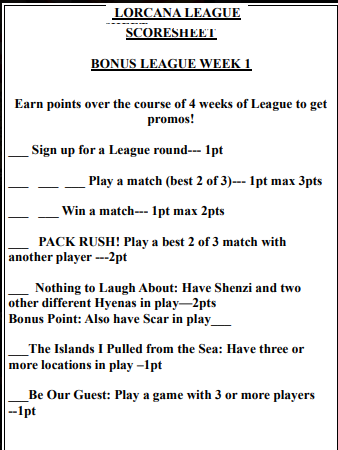
Prior to Lorcana’s set 9 (Fabled) releasing, Lorcana weeklies had a point a system. Each week, you could show up, earn points for doing a variety of different things, and at the end of the season, the folks with the most points got some special prizes.

I don’t want to focus on the prizes here, but I do want to look at the challenges. Notably, some of them rewarded making weird decks to beat them, and this meant that instead of everyone just showing up with their best deck each week, there was an incentive to build out a deck to try to meet that weeks challenges, or to play a multiplayer game.

In short: there was a reason to keep things fresh.

(And as a side effect, probably lower the power level of the decks of the players who really wanted to earn points.)

When Ravensburger got rid of this, it removed both the incentive to show up every week, since prizes were now just raffles at the end, and it also meant that there was no reason to even try to make a new deck every week. Meaning that on a week to week basis, every week started to feel the same.

Cause 1.5 – Prize Adjusments

I debated giving this a full sub-section, but I think its comparatively minor. A bit after the weekly scoresheet changes, Ravensburger swapped out their prizes. Previously, I think there had been things like playmets, pins, and cards. Right now, there are only cards and these really underwhelming card boxes.

How underwhelming? Underwhelming enough that I, the king of taking free stuff, the supreme sovereign of snatching up game adjacent garbage, paused before accepting one of these things. I mean, I still took it. But I was unenthused.

I don’t think that this on its own really did too much damage to Lorcana, but I do know that for specific players, this was highly demotivating. It wasn’t a bomb, but it was a surgical removal of another incentive for that set of player to show up and play.

Cause #2 – Set Rotation

Different games have different terms for the idea of set rotation, but all of them loosely follow the same idea: At some point in the lifespan of a TCG, older sets of cards removed from the standard play pool in order to make room for new sets of cards. It can be viewed as a necessity in order to prevent the game from becoming stale, or a way to get people to buy new cards.

Regardless, virtually every card game does it, and Lorcana was no exception. And after their rotation, it was required that decks at these weekly casual events be in the Core Constructed format.

I think this was a terrible idea.

I do think that Lorcana needed rotation from a mechanical standpoint. Set 1, while not committing any of the flaws of say, Alpha Magic, or base set Pokemon, has some flawed designs.
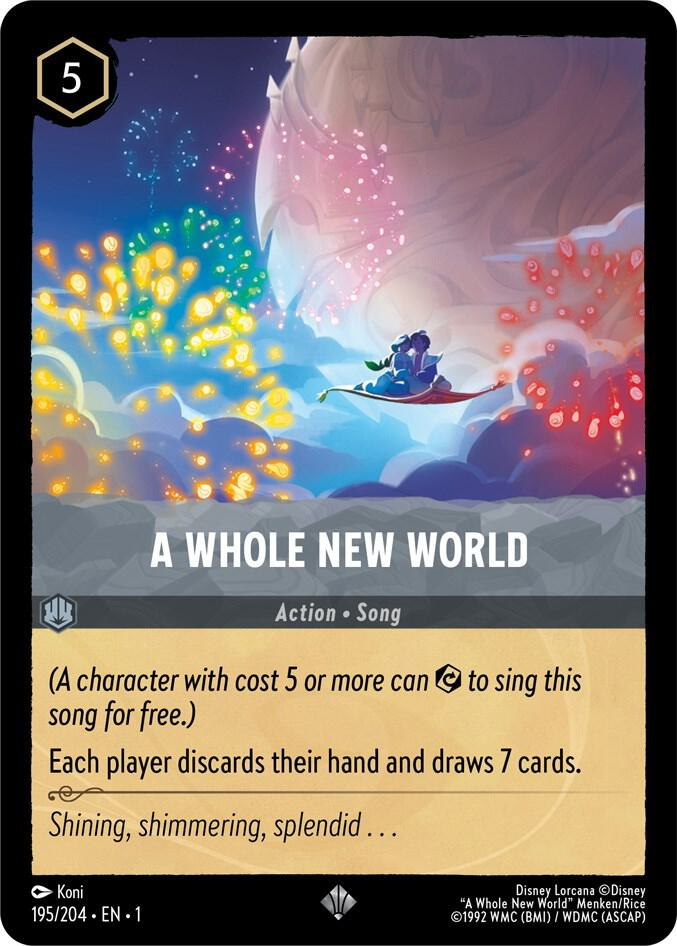
Honestly, on the grand scale of “Well that was a mistake”, free Wheel of Fortune still ranks lower then “What if land destruction is free?” or “What if you can take turn 5 on turn 1?”

So yeah. Rotation made sense from a competitive standpoint, and a design standpoint.

I don’t think it made much sense of a very larger subset of the player base who were Disney fans first, and Lorcana fans second. There were a fair number of adults and kids who could no longer play their favorite deck because those cards weren’t reprinted in Fabled, and so… they stopped showing up for weekly casuals.

Synthesis

The end result of all of this is that when my LGS held their final casual Lorcana event, I was the only person who showed up. I sat around for a bit, did some drawing, then went food shopping while the rest of the store was full of folks playing Riftbound.

The removal of weekly challenges and prizes disincentivized entrenched players from showing up to play, while also making the ones who did show up bring the same deck week after week. Set rotation killed off a lot of casual decks that didn’t need to be killed off, while making folks who’d never played a card game before feel a bit cheated, and question their investment of time, money, and energy in the game.

So here’s my guess as to what happens next.

The lack of casual play removes a critical part of the playerbase pipeline, so even events that are still supported will likely have lower and lower turnout, as it becomes less and less interesting to play with smaller numbers of people.

End result? No more Lorcana at the local game store.

Conclusion

Okay, so I know I called that part above this synthesis, but I think there’s a much more interesting takeaway here, and I think it’s that Ravensburger didn’t understand their playerbase, and treated them like they would a Magic: The Gathering player.

To be fair, I would have made the exact same mistake if I was in their position. No one has yet to put me in charge of a possible multi-million dollar TCG, based off a brand worth billions of dollars, but still.

There’s an assumption that the final form of the “hardcore” player of a CCG/TCG is out grinding tournaments, tracking their full collection, building copies of or iterating on meta decks, and just generally fully engaged with the game portion of the collectible card game. I think in the case of Lorcana, some of the meat and potato grinders weren’t doing that. They were collecting, they were buying tons of cards, they making fun weekly decks for character they liked.

These were the hardcore players. They attended every prerelease, they had built decks for store championships, they tracked every set. But the game was a portion of the experience, not the end state. Lorcana had core players, but they looked and behaved differently then they might in another game.

Or at least, thats my crackpot theory.

Magic player attends Lorcana Event with no experience. The results will shock you!

Non-Clickbait Title: I went to an Azurite Sea pre-release, and got 3rd.

I went to an Azurite Sea pre-release just about two weeks ago. I had never played in a Lorcana sealed event before. In fact, I’d never played in any Lorcana event before this one, and I’ve probably played less than 20 games of Lorcana total.

(Okay, that’s not counting grinding first chapter games with a friend about a year and half ago, but again, it’s been a while, and there game has had like 5 expansions since then.)

So why did I decide to spend $45 to play a sealed format for a game I don’t really play, for a set that I’d done no prep for? Well, because I make poor decisions when I’m bored.

Arrival, and Opening Boosters

I was relying on my expertise at Magic to carry me through the event. However, after cracking my boosters, I was hit with a few key realizations.

The first was that I had no sense of how “good” any given card was stat-wise, something that I can do with no effort in Magic. Is a 1/2 for 1 that quests for 1 worth playing? Should I only be running 2/2’s for 1? Something I take for granted (assessing stat values) was completely gone.

The second thing was the deckbuilding structure itself. In a sealed Lorcana event, you can use all colors of cards. This is a bit of a double edged sword, because what it actually means is that deck construction becomes a game of cutting 32 of the of the 72 cards you’ve opened.

Finally, I was confronted by the fact that I didn’t have a good sense of what the Inkable vs Non-Inkable ratio should be.

Faced with this dizzying array of choices, as well as not really knowing how locations worked, I decided to go back to my basics, and reach for my classic strategy.

BREAD

BREAD is a Magic strategy that dictates card value order in limited/sealed formats. It stands for the following:

B- Bombs
These are cards that will win you game if you resolve them, either due to high power, or just a very strong effect.
R – Removal
Cards that get rid of your opponents’ cards. Notably, there are far fewer of these in Lorcana than I’m used to, and they’re much higher costed. I actually only had a single card that could do any direct damage to a character.
E – Evasion
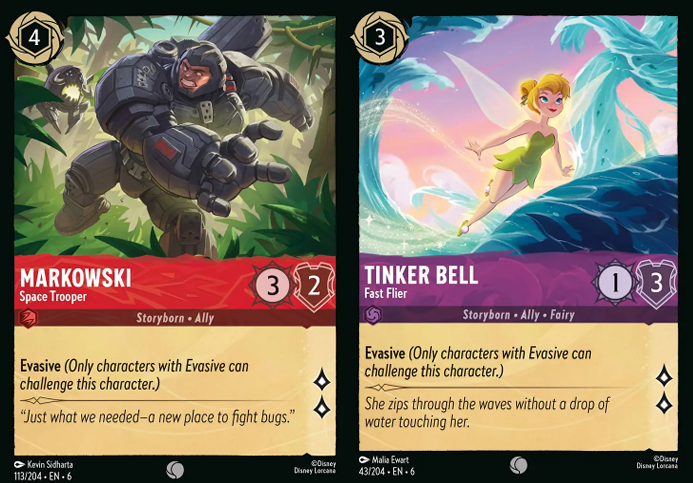
These are cards that get through to your opponent even if they have lots of characters out. Fortunately, Lorcana does have a good example of this: The keyword Evasive. These characters are tricky to remove and can safely build lore turn after turn.

I ran both of these in my deck, and they both did a LOT of work.

A – Aggro
Cheap cards that can be played early, and apply pressure.
D – Duds
Cards you just don’t want to play.

Deckbuilding

Confronted with an overwhelming number of cards, and 25 minutes to build a deck, I came up with the following plan:

  1. I would build out a pretty standard curve, prioritizing 1 and 2 cost cards, with a majority of the deck being under 4 cost.
  2. I’d try to run as many characters as possible, and few locations, but no items.

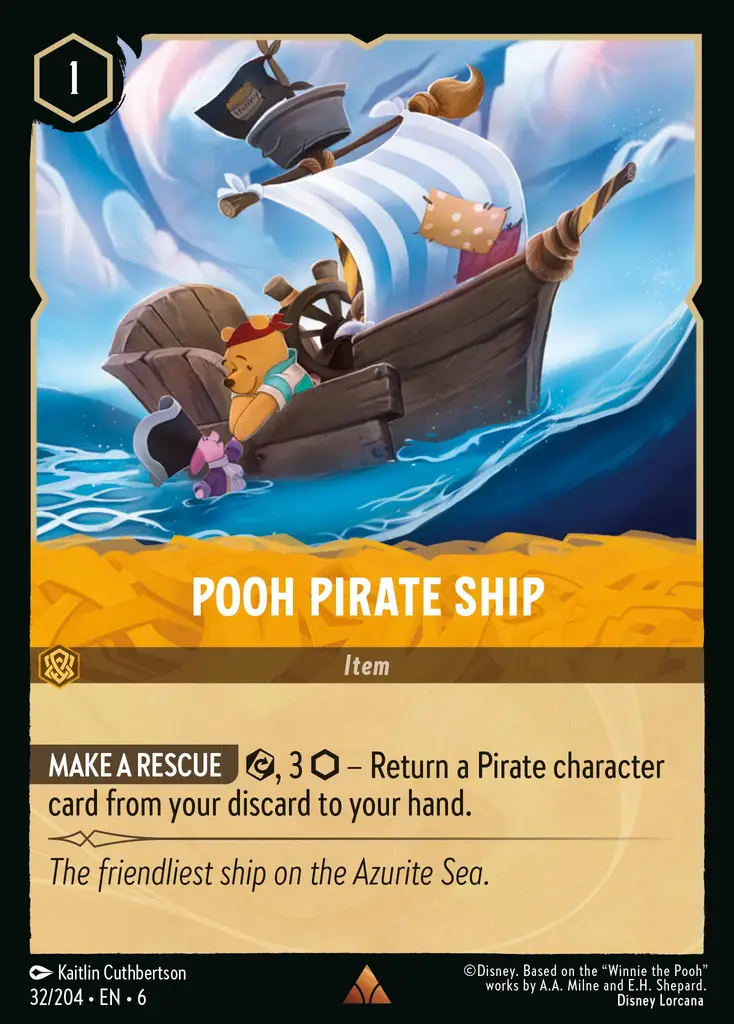
After building this deck, I made one last big decision, and probably the single decision responsible for my final result: I added in Pooh Pirate Ship.

Now, while this goes completely against everything else above, as it’s an un-inkable, type-specific item, I figured it could be worth it. Something that had become clear to me was that Lorcana had very little direct removal in the lower rarity slots, so I was unlikely to run into those sorts of cards. The second bit was that because Sealed formats for card games in general are at a much lower power level, they often stall out into top-decking.

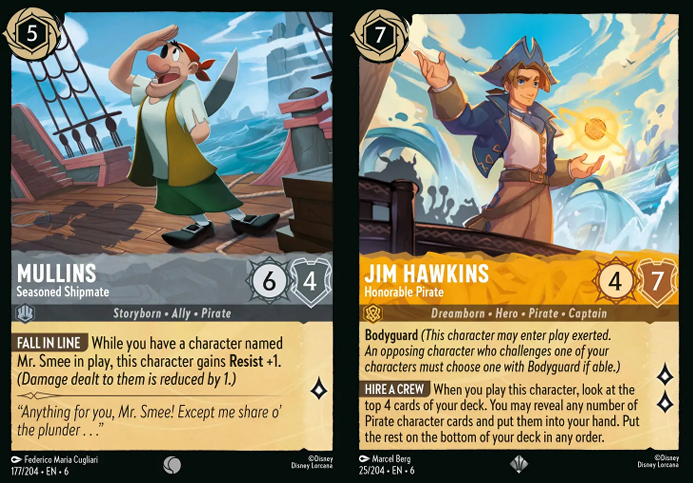
My thought was that Pooh Pirate Ship would be a siegebreaker sort of card, allowing me to continually challenge with my pirates, and then fetch them back to replay them. And while I only had 8 or so pirates, I had two pretty decent targets for recovery in Mullins and Jim Hawkins, both of which seemed to have decent stats for combat.

These two quite honestly carried the day.


With deck construction complete, it was time to play.

The Games

I didn’t take great notes on my individual matches. But I can talk to the effectiveness of the decisions I made.

I finished with a record of 2-1, with most of my matches going to 3 games.

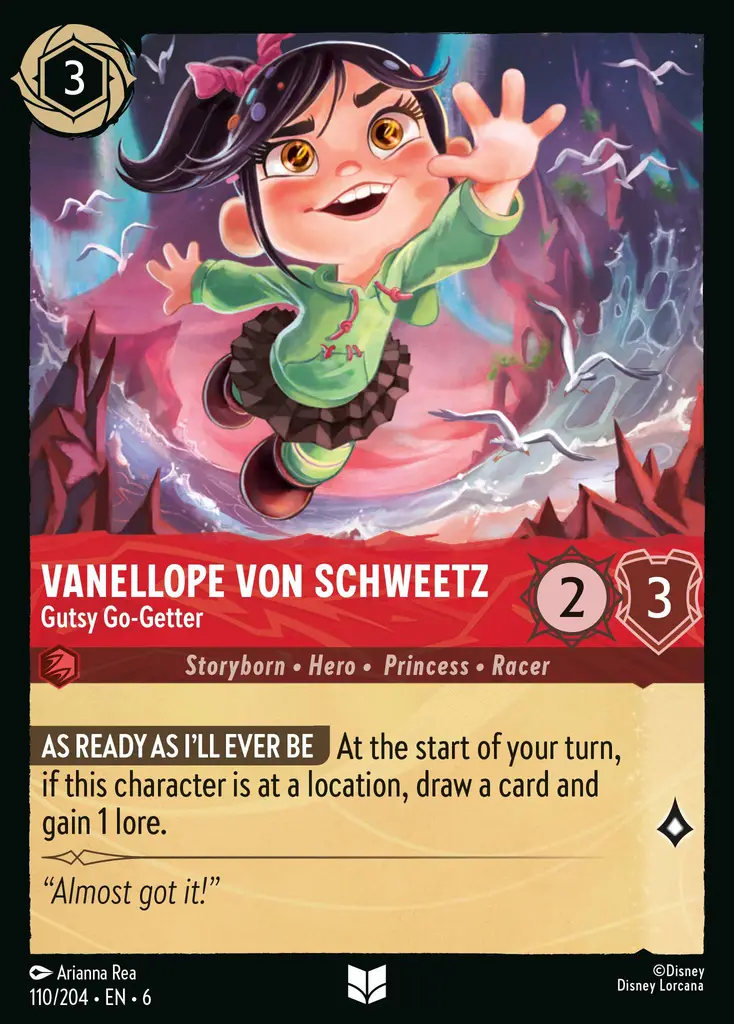
Match 1 wasn’t exactly a stomp, but I managed to pull ahead in the late game. Match 2 was my only loss of the three, and while it was possible I could have pulled out a win, I made some pretty significant misplays around my Vanellope Von Schweetz, choosing to Ink the locations that I would have placed her at.

That said, my game 2 opponent was also significantly better than me at managing the early game tempo, and outran me to the point that even when I had set up my board, I couldn’t clear their characters before they won.

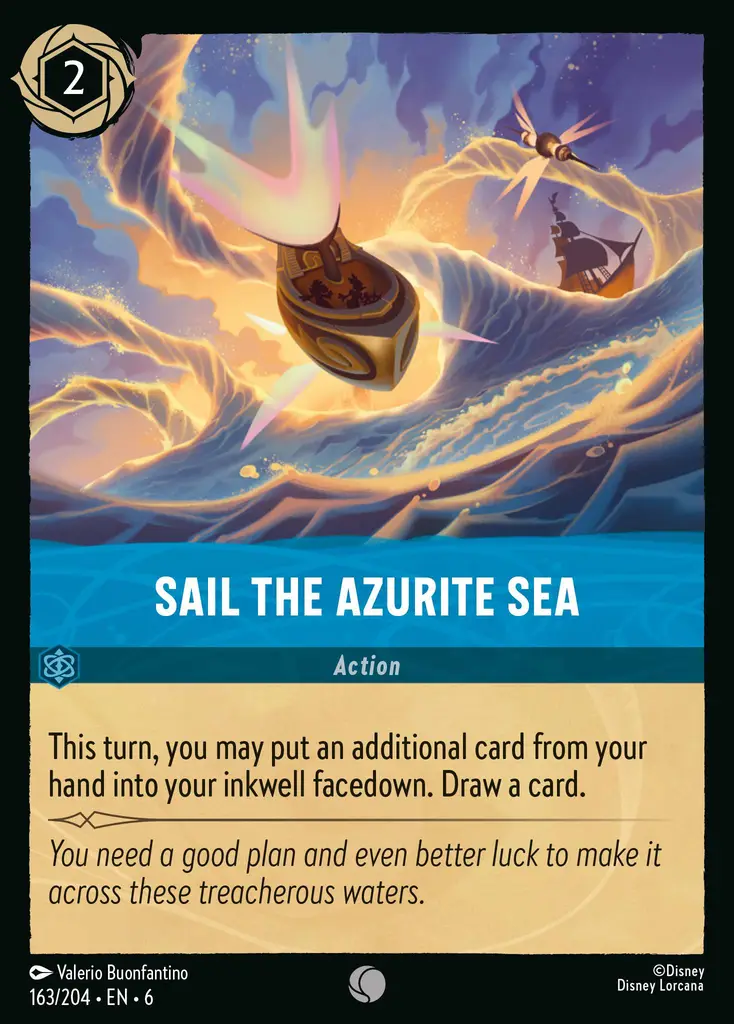
Finally, for match 3, I managed to hit two Sail The Azurite Seas back to back into an early Jim Hawkins. He refilled my hand, giving me the win early, and then I was able to use Pooh Pirate Ship in the second game to grab back my cheaper 2-3 drop pirates for another win.

Overall

The last time I wrote about Lorcana was about a year ago. I predicted that if it could weather the storm, it would be set up to become one of the larger card games in the space. Not the most shocking armchair prediction, but something that seemed unclear at the time, what with the pretty blatant scalping making it impossible for folks to actually buy the game.

As far as I can tell, Lorcana seems to have done that. I’m not really a Disney person on any level, and coming in with no knowledge of the characters or cards, I still had a pretty good time. Games felt tense and plays felt meaningful.

Some of my habits from playing a lot of sealed Magic did carry over (recursion and evasion is good!), while others didn’t (My single damage spell did VERY little work). I think that sealed Lorcana might actually be a more interesting experience than Magic sealed, because it allows combos that can’t be done in the normal game, whereas sealed Magic is pretty much just slower standard Magic.

Overall, it was really fun to see how Lorcana has developed since I last played it, and also to see the design space that’s getting used now. For example, typal is much more of a thing than it used to be. I’ll probably try to play a bit more Lorcana, as I am getting a bit burnt out on Magic, and Foundations didn’t really sell itself on its limited format.

PAX Unplugged 2023 – The Trading Card Games

Ah, Trading Card Games, or if you’re me, “The Money Hole.” PAX Unplugged is almost always awash in TCG’s of some sort or another, and this year was no exception.

Alpha Clash

Alpha Clash was the indie TCG of the show for me. Were there other small TCG’s at the show? Yes, but if you can afford a Disney license for your product, you’re not small enough.

It’s also the one I’m probably going to write the least about here. It’s actually interesting, so I’m going to play a bunch more and do a full writeup later. But as a teaser, here are some of the game’s mechanics:

  • Every creature effectively has haste. (Okay.)
  • All cards are lands. (We’ve seen this before, but still neat.)
  • The entire system for resolving combat has been blown up. There’s a secondary system to prevent the game from stalling out in a game of chicken with combat tricks. (Actually very new and interesting.)

As with almost all games, I do have problems with it. I dislike the the rarity system, and I don’t love the American comic book aesthetic. But the game’s actual mechanics are far more solid than pretty much every other indie TCG I’ve run into over the last few years. So this could be one to watch.

If this sounds interesting, here’s a link to the game’s webpage, and the game has a fully functional TTS implementation as well.

Star Wars: Unlimited

I’ve done some thinking about other Disney properties in Lorcana, but I never put my thoughts into writing in my “Future of Lorcana” writeup a while back. I was curious if Lorcana could potentially see Marvel or Star Wars cards, and the answer right now appears to be “No.” Otherwise I suspect Fantasy Flight wouldn’t have shelled out for a license for Star Wars: Unlimited.

I never actually asked anyone what the Unlimited in the name meant. Presumably the amount of money Fantasy Flight hopes to make with the game? Regardless, I did play a demo of Star Wars: Unlimited.

I don’t have much to say on the game itself. It’s not uninteresting, but the starter decks and demos often don’t translate into thrilling gameplay. Meanwhile, Star Wars: Unlimited doesn’t have any incredibly unique inherent systems if you’ve already played a ton of games.

The most interesting part of the game for me is how it handles the ever present “actions on opponent’s turn” problem. Star Wars: Unlimited makes it so that players don’t really have turns, they just have actions. Doing anything: attacking, playing a unit card, using a commander ability, or playing an action card all use up your action, resolve the effect, and then pass priority to your opponent. In addition, one of the actions that can be taken is to pass all futures for the round, and in exchange, get to act first next round, called seizing the initiative.

If I remember correctly, I think this sort of mechanic might have been in Star Wars: Destiny, another collectible game by Fantasy Flight.

My overall thoughts on Unlimited are kind of just “Okay.” Star Wars has negative brand loyalty from me, mostly because I just don’t care about the franchise. Also because I’m petty and billion years ago dated someone who cared too much. There were some elements in Star Wars: Unlimited that felt like fun flavor touches with how certain mechanics functioned, or characters worked together. But while I’d play more of the game, I’m not in any rush to acquire a copy. It launches March 8th, and I suppose I’ll see what state it’s in at PAX East.

Lorcana

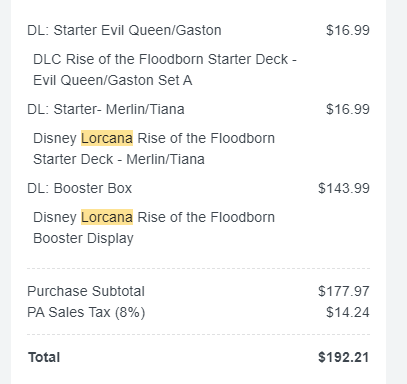
The most notable thing about Lorcana for me at PAX Unplugged was that the prices were “within expectations” as opposed to an “arm and leg.” Usually things are not notably cheaper at Conventions. Usually it’s the other way around. But booster boxes and decks were at MSRP. For comparison, single booster boxes are currently $207 dollars.

Not cheap, but yknow. Normal prices. Also 8% sales tax. The hell is that Pennsylvania?

I was going to say that I didn’t actually play any Lorcana at the show, but that’s not true! While I didn’t play any during the show, I did run into a very friendly group of folks in the hotel lobby Wednesday night, and spent a few hours chatting with them. And also beating them with their own starter decks that they’d just picked up. Because y’know, I’ve played the game before. A lot.

There wasn’t anything in the new set that immediately stood out to me. Looking back at it now, it does have at least one new keyword, and some new typal references. It also had a fair amount of space on the show floor.

Magic: The Gathering

Magic earns a slot on this just barely above Pokémon by virtue of the fact that I actually did play some Magic at Unplugged. It was a grand total of 3 games, they were all two-headed giant Ixalan drafts. Me and the friend I was playing with won every single one, admittedly some by the skin of our teeth. But win we did, and I was able to get a copy of one of the Dr. Who commander decks with our prize tickets.

There’s not too much to say on Magic, really. Ixalan is a fun set. Pasttimes is still running events in a way that makes no sense. You still have to use the terrible MTG Companion app whose one saving grace is that I can log in with my MTG Arena Account.

Pokémon

I didn’t play much Pokémon this year outside of looping by the Pokémon booth to get some pins. At this point, I’ve played those demos enough that I could probably run them. They did add a small raid battle mode which was almost cool, but unfortunately, doesn’t actually have any meaningful strategy.

As such, it’s hard to tell if Pokémon was mostly at Unplugged as a collector’s game, as opposed to a TCG.

Everyone else.

It was an interesting year for PAX TCG’s. There was a lot more support for mid-level entries than I was expecting. The show had at least semi-dedicated areas for Flesh & Blood, and One Piece. I think I saw SolForge fusion over somewhere as well. That said, I didn’t play any of these, and didn’t feel very compelled to.

Unlike last year, with Gem Blenders & Genesis, and last year’s PAX East with Nostalgix, it felt like a very light year for the true indies, with Alpha Clash really being the only one.

Still though. Lotta card games.

How to Get the Lorcana Starter Decks for Cheap

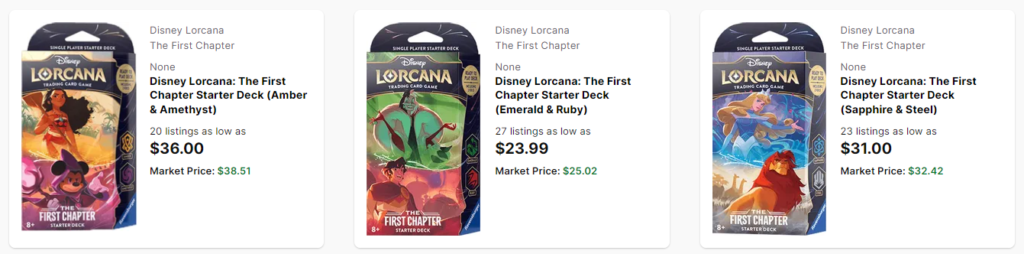
So, maybe you read the last post, and despite the fact that Lorcana boosters are currently going for a street value of $5 an ounce, (a ratio that really feels like it should be reserved for a different type of substance), you still want in?

All right. It’s a pretty fun game. But instead of buying those starter decks at prices people are selling them, we’re instead going to use the power of the free market in our favorite for once.

DeckSealed CostSingles Cost & TCG Player Link
Amber & Amethyst$34-38$24
Emerald & Ruby$23-25$16.28
Sapphire & Steel$30-32$24.37

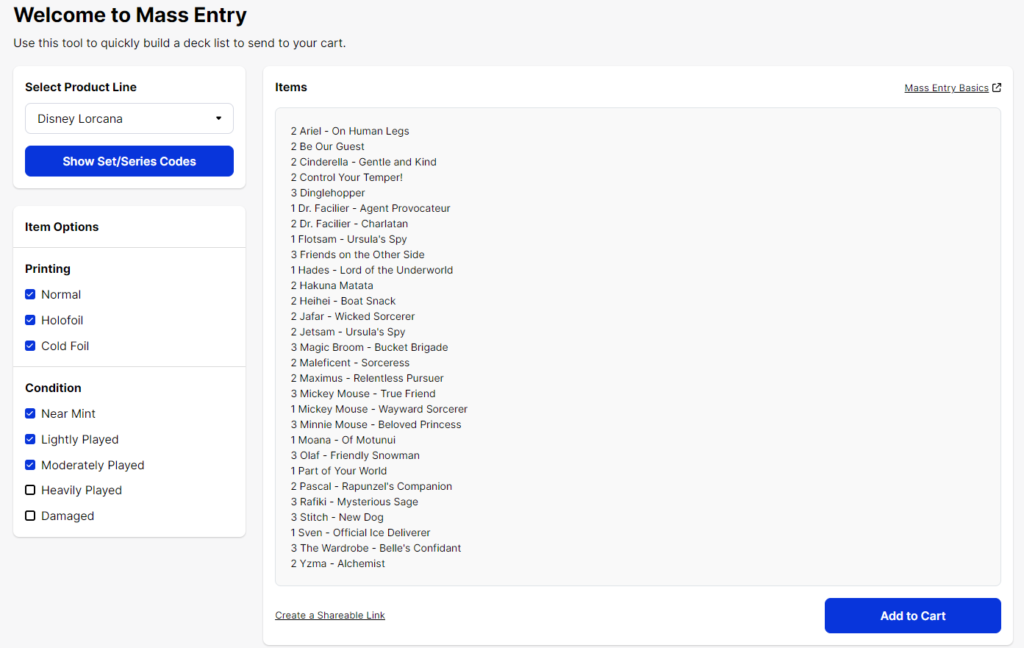
Here’s how it works. First, click on one of the above links. This will bring you to TCG Players bulk entry page. It will look something like this.

If this all looks good, click the add to cart button! And presto, we have a cart with all the cards in the starter deck!

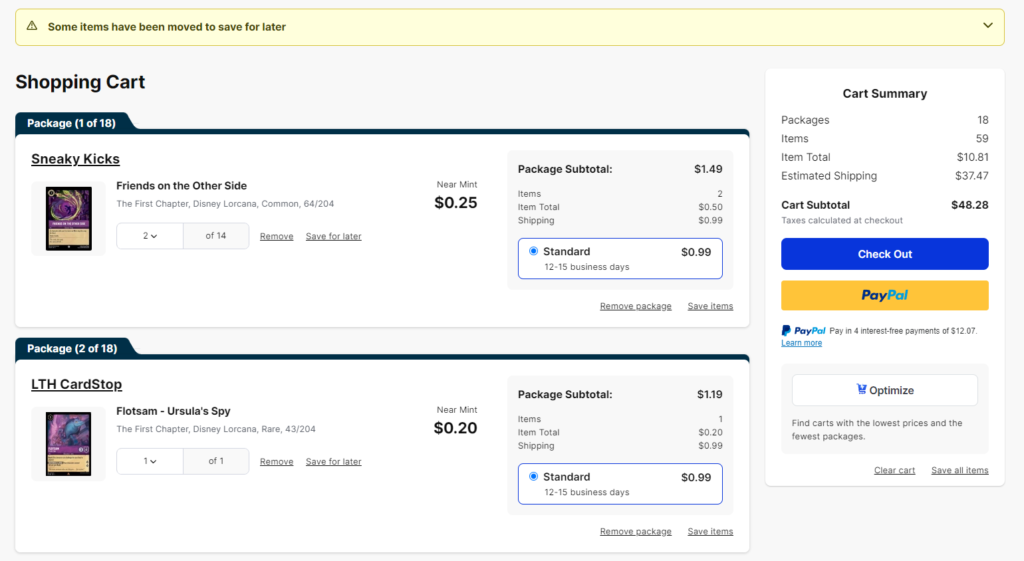
It’s also going to currently be costing you a lot more then the starter deck. No worries. We can fix that by clicking on the Optimize button in the lower left corner, right under the Paypal option.

After this, TCG player will try to optimize for shipping and buying from the fewest number of sellers. If everything looks good, you can send your purchase though, and end up with your very own Lorcana starter deck for less than a retail video game.

Ed Note: This writeup contains links to TCG Player, the management of which is a bunch of union busting corporate weasels. These aren’t affiliate links, (we don’t ever do that) and we don’t endorse their anti-competitive bullshit. That said, they’re owned by eBay, so it’s not like there’s a better place to go buy cheap singles that isn’t tainted by a desire to screw the employee.

Ed Note 2: This was written when Lorcana was being CRAZY scalped. It’s possible that the prices have gone down to a sane range by the time you look at this writeup. Such is the internet, and writing about collectibles. The general approach to using TCG Player, and the optimize functionality for buying singles likely remains the same though.


Lorcana’s Future

So far this week we’ve looked at Lorcana’s strengths (game design) and weaknesses (product allocation, rarity distribution). So now it’s time to get into the armchair, and pundit like no one has pundited before. What does the future of Lorcana actually look like? Will this game be around in 2 years? What factors will determine its future?

The House of Mouse and the Burg of Ravens

Lorcana’s wide ranging appeal is likely going to be seen as the result of the use of Disney property. Ignoring whether or not this is completely true, this puts Disney in the driver’s seat here for the continued production of Lorcana as it exists, with the use of the Disney intellectual property.

And there are sooooo many things that have the potential to go wrong.

It’s worth noting that for the other large card games with sticking power, they almost always completely own the art and IP they’re working with. Pokémon is owned by the Pokémon Company, Yu-Gi-Oh is owned by Konami, and Magic is owned by Wizards of the Coast.

Sure, other card games that have IP from other franchises exist. There’s things like Weis Schwarz and MTG’s Universes Beyond. But these are side products, augmenting an existing game.

Here’s just a short list of problems I could see happening:

  1. Disney refuses to license any additional characters to Ravensburger for use, limiting space for growth.
  2. Disney ups the price of the license to the point that production of the game isn’t worth it.
  3. Disney approval and checks of licensed designs require a large amount of sign off, extending the production schedule of sets, and causing Lorcana to product sets at a much slower pace than its competitors.

And I’m sure more exist. The short version is that any breakdown of corporate goodwill or licensing agreements could kill Lorcana real quick.

Community Building

Disney can’t kill Lorcana faster than the fanbase could, though. Trading card games need an active community of players to survive and thrive. Do you know what doesn’t contribute to an active and healthy community? Booster packs costing the same amount as another game’s starter deck.

Some dude once said something about people being unable to survive off just bread. You can quote me on this one: card games can’t survive off whales alone. Right now, I suspect a majority of would-be players are priced out of the market for playing this game. Lorcana needs a casual player base.

Right now, Lorcana is not in the position to have that player base. That’s not to say you can’t buy singles and play the game cheaply. But the players Lorcana needs are the players who haven’t heard of something like TCG Player, and maybe don’t even known what TCG stands for.

If Lorcana isn’t able to actually meet demand and start selling to players who aren’t hyper invested, and who aren’t whales, they’re very unlikely to actually build the casual player base that is the fundamental foundation of a community. Without a community large enough to sustain prolonged interest, attract new players, and weather down time and bad sets/designs (because it will happen!), I predict Lorcana will shrivel and die.

This clause in particular seems incredibly… hmm. Look, friendly local game stores are not a big money business, and requiring a store to purchase new product every 90 days for an unproven game just to be in your program feels like it could go badly.

Oh, and also because I’m that sort of person, I read through the entire set of terms and conditions for becoming part of their organized play program, and while I’m not a lawyer, I’m gonna be honest. Their whole thing seems smotheringly draconian compared to other programs I’ve seen of this sort.

Author Note: Just based off theming and demographics, I suspect the group that needs to worry about Lorcana coming for its lunch money isn’t MTG, but Pokémon. Lorcana has the potential for cross generational appeal in a non-threatening manner, which is much more Pokémon vibe than Magic’s. Y’know, given that the upcoming Magic set features people being eaten by a murderous village of candy, in a world suffering from the aftereffects of invasion by a group of sentient flesh robot hivemind. Other sets this year include the giant living horror murder hotel.

Expansive Design

But not every prediction for Lorcana’s future is a bummer.

The last thing Lorcana needs is design space to continue to release expansions and sets. And I actually think it has that in spades. First Chapter is a very restrained product, and if playing a game makes me think of 5-6 new mechanics, I guarantee the actual designer has a list including all of those, and an additional fifty in a text document somewhere.

There’s a lot of obvious space. Cards that care about color. Cards that are multicolor. More typal support, modal typal punish. Just going and borrowing twenty years worth of what Magic already did.

Now, because the people who make this game are likely smart, they also need to do this in a way that isn’t overwhelming, but I have confidence they can pull that off.

Conclusion

Lorcana has the potential to turn the big 3 of cards games into the big 4. However, it needs to surpass a significant number of challenges and risk to do so. Even ignoring their fans, Disney and Ravensburger need to maintain a good working relationship. But the biggest challenge is going to be Ravensburger’s ability to supply product to LGS’s and other stores where people can buy it at sane prices.

Funnily enough, the one area I don’t have any worries about is the game’s design and playability. It’s fun. It’s interesting. It’s relatively unique.

But it needs to be easier to get ahold of than, for example, illegal street drugs. And also have a lower price point.

If Lorcana can do all of the above, and survive the next two years, then Ravensburger might actually have made a popular, mainstream TCG.