Category: Puzzle Game

  • Animal Well

    Animal Well is a tricky beast. At its heart, it’s a puzzle game. Sure, it’s a puzzle game with some platforming elements, and a bit of a metroidvania progression structure, but ultimately it’s a puzzle game.

    I am not the best at puzzle games. I’ve never done a review of Baba is You, or Snakebird, and my review on Obra Dinn is by no means the most positive. The only reason Obra Dinn has a writeup is because I did in fact “beat” it.

    Quick note. Animal Well is the first game released by Big Mode, Dunkey’s publishing house. If this is the standard for the quality we can expect, awesome. It’s not game of the year for me, but it will probably be for someone.

    Return of the Eggra Dinn

    So, did I beat Animal Well? Well, yes. But actually no.

    Getting to the credits for Animal Well is not a very long journey. Both me and a friend who played it got there in about 8 hours. In this sense, Animal Well is not a very long game.

    But if you play the game like this, you are probably missing most of it.

    Like I mentioned earlier, Animal Well is a puzzle game. There is some platforming, but nothing incredibly difficult, and there are item pickups. But a majority of the game is trying to figure how to progress, and where to progress.
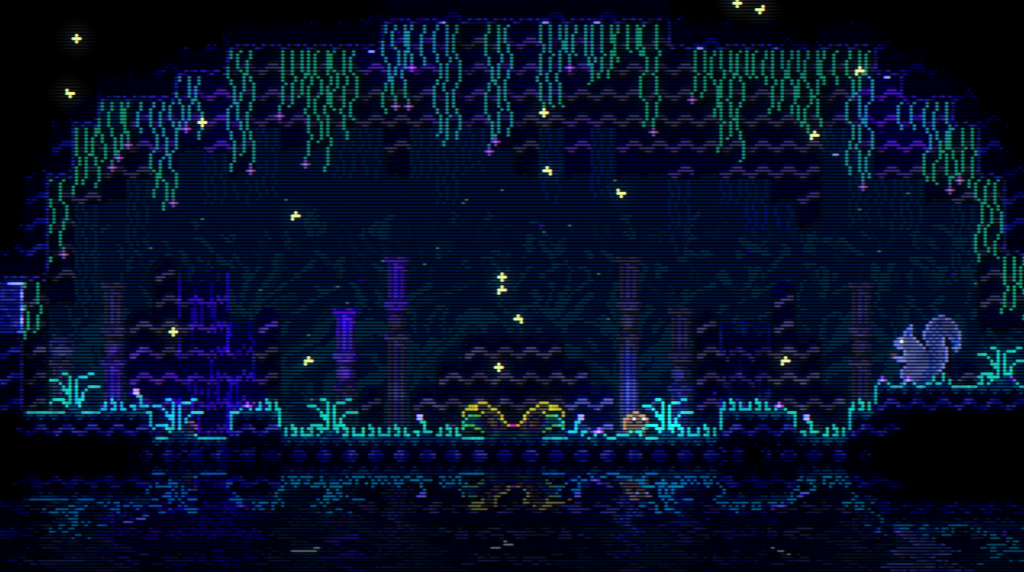
    True to form, the game tells you to go right when you start, but there’s a whole set of secrets and hints to secrets directly to the left.

    It’s a fairly unguided experience. After starting the game up, the player is shuffled through a set of semi-linear linked zones that function as a tutorial for the general mechanics (jumping, climbing, using items). But since this is a puzzle game, they also function as a sort of tutorial of what to be doing. There are zones hidden behind vines, there are small secret areas. Animal Well is trying to teach you its language.

    Even from the start, ignoring the obvious path and going left reveals a secret egg. The first few starting screens are chock full of things to return to, and secrets to find, once you have picked up the right items.

    This is the key lesson that Animal Well teaches: question everything. Check everything. Are there pixels missing on a map? It’s probably a secret entrance or area. Can you see something suspicious? You can get there. Come back later.

    It’s a brilliant sort of puzzle, and for a majority of the game, it works quite well.

    From here on out, any additional discussion of the game requires what I’d consider spoilers. If you love puzzle games, and clever hidden things, here is the time to stop reading. You can go buy the game, and discover them yourself.

    Spoilers, and the great egg hunt

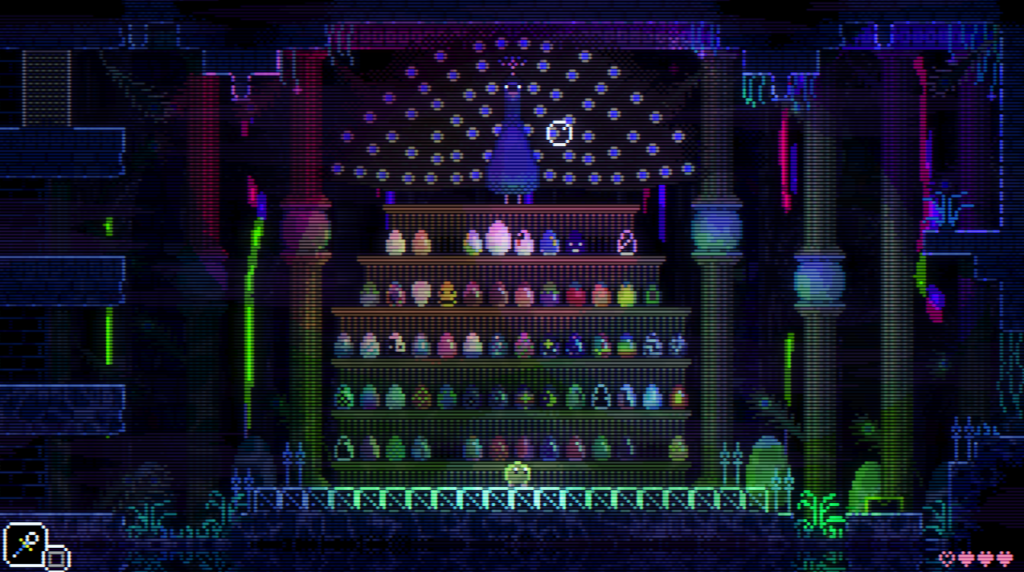
    Since the credits rolled, I have played a bit more, bringing me up to just shy of 24 hours. I have found 60 of the game’s 64 secret eggs, several other associated secrets, and generally just explored a fair amount. It’s that exploration and investigation that makes a majority of the game’s content.
    Most puzzle games are linear, or at least somewhat contained. Animal Well isn’t. Here’s an example. About halfway through the game, it’s possible to discover a set of Lynx cubs in cages. Playing music notes causes lights above their cages to blink. A bit further on, the player discovers a set of arrows on a wall.

    It’s not such a big leap to then try to play those music notes near the cages, and voila, one of them opens up. It turns out though that there are five sets of these patterns, and only the first is visible in normal light. The remaining 4 require special light sources to show up, specifically the lantern.

    Except the last pattern doesn’t show up with the lantern. It requires the blacklight. The game never signals that the black light exists. It’s possible to find 4/5 patterns, and then go insane searching for the fifth one, because you don’t have the right item yet.

    Digital Easter

    This is the struggle I have with Animal Well. It both demands a sort of breezy, as you go, come back later approach, combined with obsessive paranoia. Investigate every cranny. Search every nook.
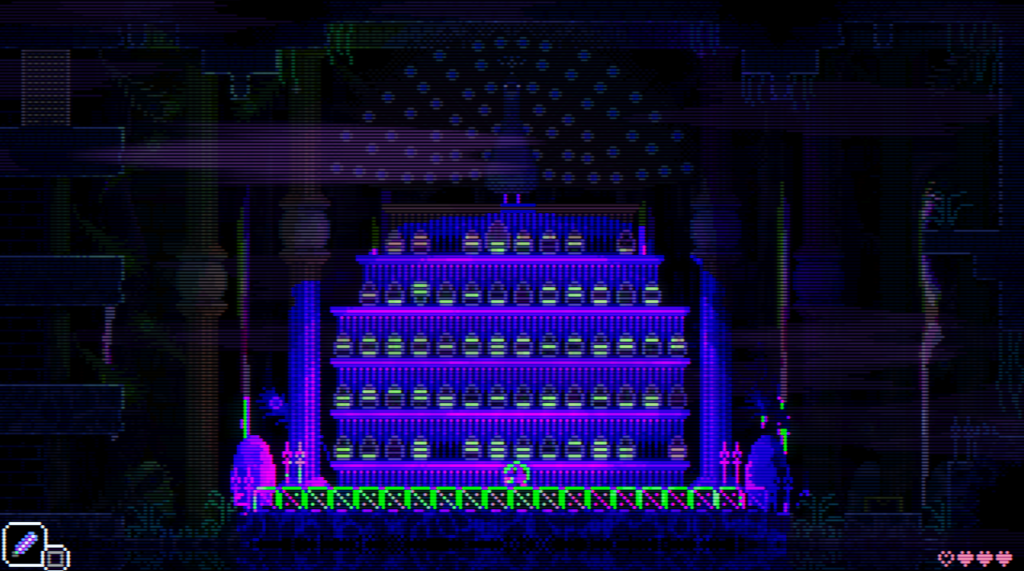
    Even the secrets have secrets! I am fairly confident the eggs have a hidden song encoded on them. If only I had all 64…

    For a majority of the game, that approach is rewarded, because there are secrets around every corner, hidden eggs behind every vine, bonus puzzles and secret rooms.

    But in the late game, that starts to dry up.
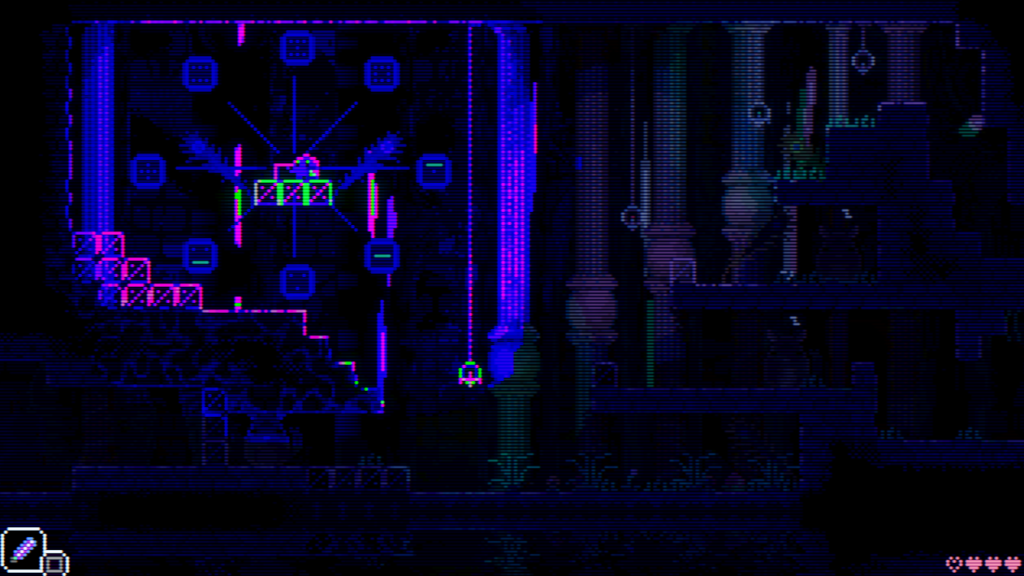
    A background detail that turns into a key code.

    The point at which I decided to call it a day was when I discovered a chest I didn’t know how to open. In the late game, the player gets a device called the remote. It can be used to activate switches remotely, and also scan for chests. It pinged a chest near a large patch of grass, so I decided to investigate. I tried every item. I wandered around looking for entrances. I tried to figure out how to get into this chest.

    What is the solution? To scan a piece of grass above the chest with a barcode scanner.

    I did not figure this out on my own. It’s entirely possible that the chest doesn’t even have an egg in it. But it’s there. It showed up when I scanned.

    The knowledge of this solution was the moment that I decided I was done with Animal Well. The game had won.

    Conclusion

    Animal Well is fascinating, but it demands a level of attention and effort I didn’t feel like I could give it to finish out the game. The correct way to play would be to screenshot the map, and then comb through it nook by nook, and cranny by cranny.

    And I don’t want to do that. There are other games to play, other things to explore, I do not have the patience or ability to continue to drive myself nuts searching for one last thing.

    Animal Well is $25 on Steam. If you loved Return of the Obra Dinn, maybe give it shot. And let me know your thoughts on twitter.

    ————————————————————–

    Post Script

    Since writing the rest of this article (Okay, 90% of it minus the conclusion), I looked up the locations of the 4 eggs I missed, and a few other things about Animal Well.

    With that cheating done, here are some additional thoughts.

    One of the eggs I just completely missed. I think I would have eventually discovered it.

    The remaining three eggs are based around a single interaction with a specific item: the rubber ball. This interaction is not explained, or even demonstrated in any way with the item. It is (somewhat) hard to discover, because it triggers only in very specific circumstances. Of those three, two eggs were in locations where I was confident there was a secret, but didn’t know how to access it.

    I then went and completed the final egg secret ALMOST entirely by myself, (it has a very clever final trick to it that I looked up). What was my reward?

    Access to hints about the meta-game puzzles and ARG in Animal Well. At which point, I called it a day. I might look these up at some point, and do some of them, but frankly, I didn’t earn them in any sense, and they’ve already all been solved.

    I think my ultimate take on the game, given that I’ve seen more of the structure now, is this: it’s built up in such a way that it tries to pull you in deeper bit by bit, first with searching for the flames, then the harder eggs, then the meta-puzzles. But because the whole game is a giant puzzle, I got lost easily

  • Escape Simulator

    Escape Simulator is a set of digital escape rooms. If you haven’t heard of escape rooms: 1. Welcome, I’m not sure how you ended up on this blog of all places, and 2. in real life, escape rooms are sets of chained puzzles and challenges, usually with the end goal being to “escape” the room you started in.

    Escape Simulator is a digital version of that experience, complete with full multiplayer for all official content. You and (possibly) your friends are all stuck in some sort of area, and need to solve various puzzles to get out.

    The game has about 10 hours of content of official content. There are four 5-part challenge rooms, each about 10 minutes per part, and 6 more official larger rooms, each about 30-60 minutes each. (Yes, some of them have 45 minute completion times. No I’ve never finished a single one of them that quickly.)

    Puzzles in Escape Simulator generally follow either a multi-chain or parallel puzzle structure. While there is a blueprint for how puzzles stack together in the structure of a room, the individual gameplay of a puzzle can vary a fair amount. Some arebased on decoding. Others are based on looking for hints in the environment.

    Is it worth it?

    Usually during a writeup, this is the part where I would explain game mechanics, and talk about their interactions. But since escape rooms consist of solving mysteries and puzzles, I’m not sure that does much here. Instead, let’s talk about something related for a moment.

    Many video gamers video gamers do a certain kind of math before recommending a game (and I count myself as guilty of this as well). If the ratio of time to dollars is under 1 hour/$1, that’s no bueno. A game can be a brilliant, innovative and cleverly constructed experience, but if it clocks in at only 3 hours for $20, that’s already a hard sell.

    It’s a bit weird, because I can’t think of another hobby group that actively does this, to this extent. Sure, the folks of Board Game Geek and the Board Gaming subreddits like to write about how much they care about replayability, while sitting on a throne of plastic wrapped purchases that they haven’t opened in the last four years, next to the other games they opened and never played more than once. But I don’t see movie buffs whining about the fact that Oppenheimer is $23 for only 180 minutes of film. Ski tickets can be $100 for just eight hours, and that’s not counting how much it costs to buy gear, get out the mountain, and the hospital bills after you fall off the chairlift.

    Escape rooms, for example, are not cheap. I looked up prices for the ones around me, and one charges $38 per person for a one hour experience. Another was $100 for 4 people, and 45 minutes.

    So, going back to Escape Simulator. It’s not really a “huge” amount of game. It’s also all puzzles, so it’s not really repayable. On the other hand, it works out to about $1.50 per hour, per person. Real escape rooms are about 20 times that.

    Mods

    Now, the other thing that Escape Simulator has on offer is fairly extensive set of mods. As good as the community content is, I have to view them as more of an addition than a reason to straight up recommend the game. The reason for this is that the quality and type of experience available in each one varies.

    One mod I played was pretty much a straight up horror game. While generally very well put together, it did have a puzzle made vastly harder by the fact that the designer had chosen to add a spooky effect that made it hard to even see the puzzle.

    Another mod had a particular brand of moon-logic in its answers. One room had a challenge that simply lacked mechanical feedback, rendering it incredibly confusing. And another was just a good solid puzzle experience.

    Stolen from dictionary.com

    The mods are amateur, in the literal dictionary definition. They are made by non-professionals for personal enjoyment. While the resulting experiences are interesting and fun, they often lack polish, or feel like they could have been playtested/tweaked to make a bit more sense.

    In no particular order, here are a few mods I liked.

    Karakuri Castle by namo_krub
    Laundry Day by namo_krub
    Little Emily by cico

    Overall

    I enjoyed Escape Simulator, but I’d mostly recommend it as a multiplayer experience. There isn’t any overall story or narrative to give meaning to the rooms. It’s just a set of fairly well designed puzzles with a surprising amount of high quality community content.

    Escape Simulator is $15 on Steam.

  • Return of the Obra Dinn

    Return of the Obra Dinn came out in 2018. It’s a mystery game combined with a logic puzzle. It got a lot of good press at the time. So I decided to finally play it this weekend. And I’m… frankly, I’m a bit underwhelmed.

    I don’t give out scores on this website. Usually I just say if I think a game is worth playing. But I’d give Return of the Obra Dinn a grudging 8/10. It’s not a bad game, but it isn’t excellent. This is weird because Return of the Obra Dinn ticks all the boxes to be excellent, but is somehow less than the sum of its parts.

    The premise of the game is simple. The player is an insurance claims agent sent to investigate the titular Obra Dinn. It’s a ship that was lost at sea and has just now returned to the shores of England with no passengers or crew. Your job is to determine the fate of everyone aboard. However, you are not empty handed. In addition to your own wits, a crew manifest, and some sketches, you also have a magical watch. Using the watch on a corpse transports you to a still moment in time/memory of when that person died.

    Within the memory you can walk around, hear a snippet of audio, and also get some information about who else was present. Using this, you need to reconstruct the full series of events and determine the cause of deaths of everyone who started aboard the Obra Dinn.

    Just a word of warning before you read any further. I will be spoiling the “experience” of playing Return of the Obra Dinn in the rest of this review.
    I won’t be spoiling specific gameplay
    .

    There’s one thing I’m going to rant about regarding one single death, but outside of that, reading this review won’t make you any better at playing the game. But it will probably impact your experience of the game. So, last chance to stop now, and read about a mystery game I like more: Lucifer Within Us.

    Okay, so I called Return of the Obra Dinn a grudging 8/10. That’s because it does everything in such a way that it should be excellent. It has a fantastic presentation and theme and a unique visual style. It has a decent story. And it has a unique game mechanic that I haven’t seen before or since. That means that this game is five years old, and no one ripped it off.

    Tick tick tick.

    But all of these things feel like they somewhat play against each other. Let’s start with the story. The story of Return of the Obra Dinn can be summarized as: a trading ship brought passengers aboard with a magical artifact. At one point, members of the crew tried to kidnap these passengers and escape on lifeboats, and steal the artifact. The artifact attracted mermaids, the mermaids killed some people, but then were knocked out. The mermaids were imprisoned back on the ship, more mermaids came to try to free them, but were killed. Then a Kraken was summoned to tear the ship down.

    Which is fine EXCEPT, this feels kind of like paint-by-numbers Lovecraft. It plays counter to my level of interest in rest of the mystery. What’s the magical artifact? Why are the mermaids attacking it? How did the passengers get it? I didn’t get answers to these questions.

    Instead I just got to figure out which crew member was killed by getting a spear through the head, and which one was killed by being strangled. That’s not actually as exciting as a mystical artifact.

    It felt like attending a dinner party where someone is served their mother’s head, and then being asked to determine which table settings had the wrong fork.

    Secondly, the story is experienced in reverse. Which means you get the big finale/setpiece of the Kraken attack first. Then everything else is a slower
    boil. There was no building tension past a certain point, because you see how things end up pretty quickly. The ending/beginning serves to refocus the story, which continues to remind me of a Lovecraft paint-by-numbers.

    Yes, this is very pretty. Yes, it is probably technically interesting. But it also makes details hard to make out unless you’re staring right at them.

    The game has a excellent theme and rendering, being done entirely in only two colors, with minimal detail. However, this hindered my ability to actually “play” the game. Viewing a death memory requires you to interact with a corpse of someone who died at that point in time. While the scenes themselves are fairly straightforward in how they’re laid out, you usually experience them in reverse order.

    This is frustrating, and it’s doubly frustrating when you want to view a scene in chronological order. On top of that, scenes also can take a bit to load. They play the audio clip once each time you enter the scene, but don’t let you replay it, so you have to load it again if you want a replay. It’s frustrating and difficult to navigate.

    Side note: the game also doesn’t have a resolution setting. So I had to use Unity launch flags to play it on my Ultrawide, because of course I did. Small gripe, yes, but this is from 2018, not 2012. I should not have to do this.

    You’ll notice I used the word “Frustration” a lot in the previous paragraph. For me, a thread of frustration carried throughout the gameplay. The game has a “Fate” system, where you enter how a given individual died and their name, and then once you have 3 correct, the game validates it, and permanently enters it into the record. As a result, in order to progress you need to solve the deaths of 3 crew members correctly.

    In theory this is a cool system that prevents you from making random guesses. And it sort of does that, but the structure of Return of the Obra Dinn meant that in the later 75% of the game I found myself doing a bunch of guess and check, just throwing things at the wall to see what stuck. I might not know which Chinese topman was struck by lightning, but I know it has to be one of them, so I might as well just slam different names into the journal until one works.

    The most frustrating thing for me was trying to figure out what was, and what wasn’t a clue. For example, one of the biggest hints you get at the start of the game is a set of drawings of the voyage of the ship at various points.

    These drawings include everyone on the ship, and for some of them, there are clues in where they’re standing, and what they’re wearing. For example, crew members of certain nationalities are bunched together, or wearing similar outfits, or only certain ranks wear some specific attire.

    I don’t understand why, in a game about identifying people and situations based on location and appearance, the developers decided to so stingily ration pixels. It’s not actually possible to identify who people are without right clicking them, and seeing their photo.

    It also doesn’t help that some clues require you to look out of game. Maybe the game is made for people who are smarter then me, but I don’t what Formosa is. While I might know what an Italian accent sounds like, I don’t speak Danish, or know anything about Papua New Guinea. So perhaps if you’re European, and did well in social studies, the game is more straightforward.

    The general feeling I had with Return of the Obra Dinn was frustration. Solving deaths in the later half of the game never had a “pieces falling into place” moment, where everything just clicked and made sense. Instead it was a perpetual slog of getting three more deaths, then trying to brute force my way via guess and check into my next set of deaths.

    I also do want to direct some specific enmity at one particular death, and the only one I ended up looking up. This individual was attacked with a projectile spike, crawled away, pulled the spike out of their body and is seen leaning against a wall prior to their death. In other cases, these spikes have been quite lethal. So how did this person die? Well, according to the game, they were shot through a wall. Which I was supposed to figure out by looking at their corpse, back tracking 5 scenes, and then seeing who could have fired the bullet.

    Have I mentioned that the game has an art style that makes it hard to see things? Things like small details, and exact outfits?

    Looking back at it now, maybe what I’m supposed to realize is that the watch can only transport you to the moment of death, and as such, I’m supposed to be looking for the exact cause of death at that point in time. I don’t know. Maybe I wasn’t smart enough for the game. But what I do know is that after 12 hours, I’m mostly just frustrated.

    I didn’t have fun. The game doesn’t give answers for many of its open-ended lore questions. When I beat it, there was less catharsis than a “Well, at least I have something to write about this week.”

    No, we shall not be.

    Return of the Obra Dinn is a clever, unique idea, executed with distinct visual style and theming. But those three factors clash with each other, and while they do create a unique experience, for me it was primarily one of frustration and exhaustion. If you think you’re smarter than me, you can buy it on Steam here.

  • Tricky Towers

    If I had to summarize Tricky Towers in one image, this is what I would use.

    Artist’s conceptualization of Tricky Towers. Stolen from XKCD, by the eternally funny Randall Munroe.

    Anyway, that would pretty much do it. Article over. You get the idea. Except that Tricky Towers has multiple modes, and is multiplayer, and… hmm.

    Y’know, maybe you could read the rest of the writeup.

    Anyway. Tricky Towers. Tricky Towers is kind of like Tetris in that it’s a game that consists of stacking tetronimos on top of each other. It’s unlike Tetris in that instead of lines disappearing when you fill them, they just sort of sit there. This is because your goal is different. Unlike Tetris, in which you try to clear the maximum number of lines possible, in Tricky Towers, you are trying to build a tower. (Okay, in most game modes, you’re trying to build a tower. More on the other game modes in a bit.)

    Also unlike Tetris, where pieces are always aligned on a grid, you can move your pieces in half block increments. Oh, and there’s a physics system! And these two additions combine to turn everything into utter chaos.

    Because there’s no easy way to remove placed blocks, you just sort of have to live with the consequences (much like how I’ll have to live with the consequences of how shit this writeup is!). Did a L block fall over? It’s now time to play some sort of warped sideways Tetris. Did a critical part of your structure just end up with a bit too much weight? Time to watch as your dreams crumble, and joy turns to ash. And also as your opponents build right past you!

    Oh, yeah, opponents, and game modes.

    Tricky Towers has variety of game modes, including single player, score attacks, and multiplayer. The first two are fine, but I don’t care about them much as I almost always only ever play multiplayer with friends.

    Yeah, I’m sure you really did get a score that can only be expressed with scientific notation you cheating fuck.

    Within multiplayer, there are multiple modes for games and types. Usually I play the Cup setting, which works kind of like Mario Kart scoring. You play a set of challenges, and get points based on whether you finished first, second, etc.

    Within those, there are 3 different modes, somewhat analogous to tracks. These are Race, Survival and Puzzle.

    Race is the most straightforward: be the first person to build a tower that reaches the finish line, and have it stay stable for 3 seconds. There’s some very clever design here as well, as the finish line actually moves toward the players. This makes it so even if you’re absolutely terrible, or the ratio of modern art to engineering embodied by your tower tends towards Jackson Pollock, the game will still end.

    Survival is somewhat similar, except your goal is to just last the longest. In this game mode, whenever a block drops off the side of your tower, you lose a life. Lose all your lives, and you’re knocked out. It’s also possible to win by placing all 66 of your blocks before your opponents, but in the 12 hours I’ve played, that has literally never happened once.

    Puzzle is the most unusual. Each player is given a starting block, and the same lineup of pieces, and the goal is to place as many of those pieces as possible, without going over a line. The catch is that if you drop a piece, the base of your tower is moved up, and when you place a piece that crosses the aforementioned line, it’s removed, and the number you placed beforehand is your final score.

    Overall, these three modes in multiplayer are why I enjoy Tricky Towers. And the multiplayer is non-negotiable. I play a lot of games, but Tricky Towers is one of the few that everyone in my group will actually want to play on game nights.

    Tricky Towers is $15.00 on Steam, but you can probably wait for it to go on sale, and get a few copies to play with friends for a bit cheaper.


  • Peggle Deluxe/Peggle Nights

    Author’s Note: Between various things, this week has been long and not entirely productive. As such, this writeup for Peggle is somewhat phoned in. With that said, Peggle and the two games I mentioned yesterday are worth playing, but this writeup is somewhat content light.

    I have a hard time writing a “review” of Peggle for the same reason I’d have a hard time writing a review of a jar of Peanut Butter. There’s a lot similarities between the two, mostly the fact that if you place either of them in front of me, leave, and then return several hours you will discover that I have consumed the entire thing, and upon asking for my opinion, I will respond with “It was pretty good,” and “Do you have any more?”

    The point is, like peanut butter, I like Peggle, and I enjoy it, but I can’t quite tell you why. That won’t stop me from trying.

    Some brief history: Peggle was published by PopCap games, back before they acquired by EA. I mention this not because “Ah, yes, the good old days” but more to give a sense of time, since that was back in 2007 when you could do exciting things like eat in restaurants. And also because the maximum resolution supported is not high.

    This image of the menu is maybe 80% to scale.

    So, if you expect things like “adjustable resolution” and “performance sliders” you may be about to have a bad time. Otherwise, let’s continue.

    You might notice that this review has two games in the title, Peggle Deluxe, and Peggle Nights. And you might wonder why I feel confident in reviewing two games at once, and the answer is simple: Peggle Nights is effectively just an addon pack for Peggle Deluxe. Peggle Nights has new levels to play, and one new character. And that’s it.

    The game has a variety of modes, including Adventure, which has you play through a series of levels as a character, duels, where you take turns with another player or a computer trying to get a high score, various challenges, and just a freeplay mode.

    Outside of the challenge mode, though, the various levels play somewhat similarly. You click to launch balls, and they bounce around hitting pegs.

    Green pegs give you a boost based on the character you’re playing, blue pegs give points, and the goal is to get rid of all the orange pegs. If you score above a certain amount of points, you get an extra ball, and if you get the ball to land in the pot at the bottom, you also get an extra ball.

    They say a picture is worth a thousand words, so I’m just gonna post this GIF and call it a day, since that has to be worth at least several thousand more pictures.

    Peggle is simple, enjoyable, and it’s incredibly compelling to going for a high score in a level, or to just try to beat it for the first time in adventure mode. It’s the same sort of pleasure as things like pinball, where it feels like a combination of skill and also just being at the mercy of the board, and as such you just keep playing.

    Peggle is something like 15 years old at this point, but you can still find it on Steam and various EA stores if you’re interested, and I am out of effort to continue writing about it, so I’m just gonna end this post here.