Hazelnut Hex Review

Hazelnut Hex is a fantastic shoot-em-up that knows exactly what it’s doing and executes on it perfectly.

Hazelnut Hex is brilliant. The game is a to-the-point shoot em up that knows exactly what it’s doing and executes on it perfectly. Some folks might call the game minimalist; I’m calling it precise.

For anyone who hasn’t heard of Hazelnut Hex, it’s a shoot-em-up/shmup for the Switch. In terms of tone, it feels like a pastel colored version of Touhou. Also like Tohou, the music goes far harder than it has any need to. This is track 4 from the game, Bite After Dark. Do me a favor and listen to that while you read the rest of the review.

But what I want to talk about is the gameplay, because to me this is where the brilliance of the game lies. I wouldn’t ever describe myself as a shmup person. I haven’t even played Touhou.

The core rules of Hazelnut Hex are simple. Shoot the enemies, and don’t get hit with projectiles. Do that, get to the boss, and beat the boss to win. After all, it is a shoot em up. But Hazelnut Hex isn’t random. Instead, each level follows a predictable pattern. And while you can restart if you die, you lose your score. I think this is a nice balance. Even if you’re terrible, you can still play the entire game.

Every subsystem in the game feels perfectly designed. Let’s start with lives. You start with 3 lives (or 5 if you turn the value up because you’re bad like me) and getting hit costs you a life. Get 500,000 points and get another life. This is one of the very few times a game has actually made me care about points. Sure, you can get points for just blasting enemies, but you can get more by waiting for your shots to charge and hitting chains of enemies with more powerful blasts.

In addition to getting more points, charged shots also destroy enemy bullets, and build your special meter. You can use specials to shoot a massive blast that gives you invulnerability frames and clears bullets off the screen. But at the same time, it also gives points based on the number of bullets on the screen. It can function as a panic button if you find yourself trapped, but it’s also a scoring tool.

All of sudden, instead of just blasting non-stop to clear the incoming waves, I found myself actually looking at enemy patterns, and trying to spot moments when they lined up for clean charge shots, so that I had extra lives going into tougher spots. I’d describe it as the difference between button mashing and trying to actually understand what’s going on in a fighting game.

And pretty much every subsystem feels like this. There’s a set of end of level scoring bonuses that include one for having your squirrel Sam with you when you clear the level. It’s 20,000 points which is a fairly large amount. Why is it so high? Because you can only pickup Sam before the boss fight. This isn’t just a bonus for keeping Sam alive, its a bonus for clearing the boss fight without getting hit! Other score bonuses are only applied when you clear a level. This makes it so you can get large payouts, but the level keeps you from getting them too early, and getting easy bonus lives.

Hazelnut Hex can be played through without understanding any of these systems. That’s how I beat it the first time, after all. But if you want to master it, the game also provides the ability to do so. You can start any level with any combination of weapon, weapon power, and health. Want to practice a boss fight without playing the first half of the level? Go right ahead.

Other people might criticize the game for not being very long, since you can play through the whole thing by just continuing after death. I don’t think that’s actually a problem. Hazelnut Hex doesn’t include any bloat. It’s not trying to be anything else other than an expertly crafted shmup. And playing it gave me, terrible as I am, a bit more of an appreciation for the brilliance of the genre.

Hazelnut Hex is $8 for Nintendo Switch. You can buy it here.

Ed Note: Images in the article are taken from the Nintendo Store page.

Omega Strikers

To my mind, soccer is one of the world’s simplest games. Put the ball into the net without using your hands. On the other hand, MOBA’s are one of the most complicated. Sure, the general goal is pretty simple: destroy the Ancient/Nexus. But everything else is a complex mishmash of systems, paved cowpaths, general fuckery, and meta-weirdness.

Omega Strikers is effectively a synthesis of these two systems. Score five points (or two more then your opponent in a tie breaker) to win. Score points by hitting the disc into the goal. A nice simple win condition, with theoretically simple gameplay.

But it Omega Strikers also feels a bit like a MOBA. Instead of being a generic soccer player, you pick a Striker in a pregame draft. There’s a not-quite leveling system based on picking up powerups from around the map, and some of your abilities do “damage” to enemy strikers. You can also temporarily knock out enemy players by depleting their health, and also by hitting them into walls.

There’s not too much else to be said for Omega Strikers. It has the same sort of art style as Eternal Return, with the 3D anime and sorta cel-shaded look. It has a battlepass. You can pay money to unlock characters, but it’s not just real life money, it’s funbucks which can only be purchased in random amounts.

Oh, and it has a “Rune System.” You know, that terrible system from League and Multiversus where you have to spend your in-game currency on passive buffs to put onto your character instead of, I don’t know, unlocking more characters to play.

You want my simple opinion on Omega Strikers? I think it’s fine. I think as a game that seems to run fairly well, it was fun to download and play with some friends for a bit. I don’t fully understand the game’s damage systems. I also don’t have any huge desire to return to it. I do think it’s by far the easiest MOBA style game I’ve ever played, and convincing non-gaming folks to try it would be probably be pretty easy.

Omega Strikers is Free* on Steam.
*If you get into its gonna cost you more than a triple A game, so good luck.

V Rising

V Rising is a solid survival/crafting game with a vampire theme and mechanics. I can’t think of a good vampire pun to put here.

I like V Rising. I don’t think it’s a perfect game. But it cost $20, and I’ve played 60 hours of it. If that’s not an easy recommendation, I don’t know what is.

V Rising is a multiplayer survival/crafting game in the vein Valheim or Rust. Instead of following their lead and being in a first person or over the shoulder camera, V Rising has a top down camera much closer to something like Diablo.

And instead of being a human unlucky enough to wash up on some random island, you’re a vampire.

The vampire thing isn’t just a theme. Sure, there’s a blood meter that replaces your hunger bar. But who you drink blood from also heavily impacts gameplay. Drink blood from a worker, and you’ll harvest more resources. Drink blood from a nun, and you’ll restore health when casting spells. Drink blood from a warrior, and you can parry some incoming attacks.

Also, you burn real hard during the daytime.

The general gameplay loop of V Rising is straight forward. After you get through the game’s equivalent of tutorial, and have a simple base set up, you’ll venture out to farm materials to craft better gear. Once your gear is good enough, you can go fight stronger bosses or “V Blood Carriers.” Defeating a boss and harvesting V Blood unlocks additional spells, powers, and crafting recipes. Then you can craft better gear! But that might require expanding your base, which requires more resources. So you rinse and repeat.

Of course, when I say “harvest resources” I mean less in a “harvest crops” sort of way, and more in a “humans in the Matrix” sort of vibe. V-Rising’s combat is probably closest to Battlerite (not surprisingly, given that Stunlock made both games). If you’re not familiar with Battlerite, I’d say it feels like a slower-paced version of League of Legends. Also, damage, health and “level” is all completely dependent on the level of gear you have equipped.

I never really had that “Power Fantasy” moment that I get from games like Path of Exile. Instead, you’re limited to 3 skills from your weapon, 2 spells, and an ultimate skill. Even when you outlevel an enemy, unless the difference is absolutely massive, you can still get put into the dirt. The combat is at its best in the game’s boss fights against V-Blood Carriers. It’s at its most annoying against packs or random mobs.

I don’t have too much to say on the multiplayer, mostly because I feel like you can play the game however you want. My first 50 hours were with a few friends on a publicly-hosted PVE server. The next 10 where those same friends on a privately hosted PVP server, and now we’re not friends anymore. Jokes aside, the multiplayer works well, and many of the factors like resource scaling are configurable. If you want a comfy base building setup with some friends, you can just join or host a PVE server with 5x resources, and the ability to teleport. And if you’re masochistic, you can join a 0.5 resource PVP server. Changing the pace and flow is pretty much just a server config setting.

I don’t think the game’s perfect. There’s a whole system for binding and turning humans into vampire servants, but their utility is limited outside of equipping them with a bit of gear, and sending them out on timed missions to gather resources. While the weapons are fairly diverse, the clothing options are a completely linear path, with no build diversity other than “big number good.”

Arise reborn, my servant! Now go get me copper.

Still though, there’s a lot more thought than often goes into games like this. It’s not possible to build a base in such a way that blocks off other players from a critical resource. The number of bosses is fairly high, and despite many of them just being random humans, the actual fights feel meaningfully diverse.

I think V Rising’s greatest strength compared to a lot of the other crafting/survival games is how complete the game loop feels. In 60 hours, I think I only looked at a wiki or guide 2-3 times, and I never encountered any jank.

V Rising is $20 on Steam. It’s a pretty good time. If you’re looking for a solid survival game, or a base builder, I feel comfortable recommending it.

Ed Note: Screenshots are blatantly ripped from the Steam Store page, at time of publishing. The game’s UI doesn’t look like this anymore, though. I still think these are decent representations of what V Rising looks like, even if the lighting in the screenshots is a bit nicer.

Cult of the Lamb

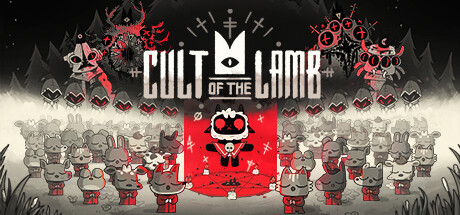
Cult of the Lamb isn’t a bad game, but it doesn’t commit to any of its single mechanics adequately to be an excellent game. The only area where it makes any real innovation is in combining the various gameplay loops that it consists of. But perhaps as a result of that synthesis, none of those loops felt very deep. As such, I didn’t personally enjoy it, and I don’t recommend it.

Let’s back up for a moment, so I can catch my breath from outrunning the screaming mobs. The game is getting a lot of good press and attention right now, and I suspect my opinion is going to be somewhat unpopular. Still, before you crucify me, let me explain myself.

Cult of the Lamb presents itself as a combination of a management sim and action roguelike. You play as the Lamb, resurrected from a sacrificial death by an elder god-like figure, The One Who Waits. Upon being returned to life, you are entrusted with two goals. To build a cult in his name, and to slay the four bishops who trapped him.

I’ll cover the slaying first. The action roguelike portion of the game follows the somewhat standard roguelite formula. Upon beginning a run (or crusade, as the game likes to call them), you’re dropped into a level and given a starting weapon and a curse. There are four or so base weapon types, each with varying speed and attacks.

The dagger is the fastest, but with low damage, while the hammer is the slowest, actually having a sort of windup before it swings. The sword and the axe sit in the middle. There are more variants applied to each of the base weapon types, but they don’t really change how the weapons play, just how much damage they do. Curses are just spells. You spend fervor to use them and they have some sort of damaging effect. You get fervor by killing and hitting enemies.

The system is pretty light on builds, so runs don’t feel that different. You can’t force weapon spawns to show up, and despite the variants, each variant feels the same as the base. For example, the poison dagger and the godly dagger don’t feel different to use, even if the second has much more damage.

Anyway, back to crusade mechanics. The goal of a run is to reach the end of the zone, which looks something like the map below. Along the way you’ll gather various resources and crafting ingredients.

While this might look a little intimidating at first, there are usually only 2-3 combat areas in a run. The rest are actually resource nodes, shops, or other small events.

Upon reaching the final area of a zone, one of two things will happen. One, you’ll face off against a mini-boss for a bit more loot and a recruitable. Or two, if you’ve already defeated the zone 3 times, you’ll face off against the zone’s boss: one of the four Bishops of the Old Faith.

I played the game on medium difficultly, and I’d say that none of the fights are particularly challenging. Only one boss fight in the game took me multiple attempts.

If you win the fight, you’ll get some bonus resources, and if you lose, you’ll lose some of what you’ve collected. Either way you’ll be sent back to your cult after. This is the management sim portion of the game. You can construct buildings with resources you’ve gathered. But you make the the most important building during the game’s intro: the shrine. The shrine is used to gather devotion.

Devotion serves the role that something like “Science points” would in another game. It’s used to unlock additional buildings and structures from your primary tech tree. The other resources you have to keep an eye on are the food and faith meters. While individual cultists have their own stats, these meters provide a sort of aggregate overview of the status of your cult. Keep your cultists fed, or they’ll start to starve, and get unhappy. Keep them loyal, or they’ll… I actually don’t know what happens to be honest. I never had any loyalty problems.

This might have been because the only time someone wasn’t loyal, I sacrificed them to be ritually devoured by tentacles.

Speaking of, rituals! Another building you unlock early on is the Church, where you can perform rituals and announce doctrines for your followers to obey. In theory, it’s kind of a neat idea. In practice, I never once ran out of the resource needed to perform rituals, so I pretty much just performed them whenever they were off cooldown. For some rituals the cooldown was several in-game days long.

The timing system itself is probably worth noting. Time passes the same regardless of if you’re at your cult, or on a crusade. And cultists can’t make their own food. So it’s somewhat necessary to either set things up so that they won’t starve while you’re away, or to try to minimize the time spent on your crusades.

This is as good a moment as any to talk about the cultists themselves.

While each individual cultist does have some of their own traits, they don’t offer much variety. I only ever saw cultists with a maximum of three traits, and most of them have fairly minimal gameplay impacts; things like “15% faster/slower gathering speed.”

The end result is that I never really felt incentivized to get attached to anyone, or to assign any specific cultist a specific task. The benefits to doing so were pretty much non-existent.

It doesn’t help that there are a bunch of other mechanics that discourage you from getting attached. Cultists can die of old age, which encourages constantly acquiring new members. But cultist death makes it feel bad to use gifts or invest any significant effort into leveling up a single member. There’s also a portion of the game where several of your cultists will be randomly selected to turn against you, and you’re forced to kill them. You can also unlock the ability to sacrifice members for various reasons, including to resurrect yourself after dying in the roguelike portion of the game, but I never used that feature.

This is the biggest argument for me on why Cult of the Lamb isn’t like Animal Crossing. Cultists aren’t friends or helpful NPC’s. They’re a resource to be used in your quest to slay the bishops. At their best, they’re pretty much slaves to your every whim. At their worst, you can sacrifice them to a pit of tentacles for emergency meat.

Since I’ve covered most of the game’s mechanics, let me try to wrap it all up into one neat package. The action roguelite section of the game doesn’t have the build diversity of other games like Binding of Issac or Atomicrops, or the mechanical challenge. At the same time, the cult management portion of the game doesn’t offer the mechanical depth of other sim games, like Cultivation Simulator or Dwarf Fortress.

At the same time it doesn’t have the comfy factor of something like Animal Crossing, since many of the mechanics apply pressure to your cult. It feels like a waste to construct various decorations and buildings when the same resource could be used to create another outhouse.

I’ve talked a lot shit, so before I wrap this up, I want to say some nice things. Cult of the Lamb has absolutely incredible art style, that it executes to near perfection. And while the plot twist is pretty easy to see coming, there were a few moments in the game that did creep me out. It’s not enough to change my opinion on the game. In 12 hours of gameplay, I can’t tell you the name of a single cultist or about a really cool run, but I do remember a small set of dialogue from an NPC that twisted the knife on how fucked up the game’s universe is.

So, yeah. I don’t personally recommend Cult of the Lamb. This isn’t because it’s a bad game. But what I personally tend to prize in games is either new weird mechanics/risks, or really fun moment to moment gameplay and systems. Cult of the Lamb doesn’t do either of those things. Instead, it’s a synthesis of existing mechanics, and watered down versions of their systems.

Cult of the Lamb is $25 for all platforms.

You shouldn’t play The Cycle: Frontier

This is less a review and more of a public service announcement. I was recommended The Cycle: Frontier several months back. Maybe not so much recommended as someone told me they were playing it. I asked them if it was good, and I got told “It’s like Escape From Tarkov,” which didn’t answer my question. In retrospect, that might have been a warning sign.

But it was free. How much did I have to lose?

The answer is “5+ hours of my life.”

Why do I hate this game? Well, a lot of reasons actually! Funnily enough, they’re not the same reasons most negative reviews on the Steam page offer. Those reviews have issues with the massive numbers of hackers, and the claim that the game’s secondary map is imbalanced. The hacker complaint actually somewhat surprised me, as Cycle Frontier has very invasive anti-cheat.

Anyway, I have my own reasons for hating this game. In order to explain them, I need to explain Cycle Frontier’s gameplay loop.

In Cycle Frontier, you are a “Prospector” who gets airdropped from outer space onto some planet. Your goal is to collect as much garbage loot as possible, get to an extraction point, call down a shuttle, board the shuttle, and survive until it takes off.

Of course, the other players are also trying to do the same thing. One of the big differentiators between this game and something like Hunt: Showdown is that all players aren’t spawned in at the same time. More players can drop in whenever. And as you might guess, it’s a lot less work to just kill other folks and take their stuff, than to try to find loot yourself.

Let’s start with my first problem with the game: the loot. Loot in Cycle Frontier is visually difficult to actually spot, so much so that every lootable item has a glowing sheen effect that plays on it. I’m assuming they did that so I’d be able to tell that this random alien shrubbery is loot, and this one is scenery. In addition, there’s no “Take All” option, so each time you open a crate, get clicking.

Loot is also incredibly uninspiring. It’s all random trash and garbage that gets used as part of inane upgrade trees to… give you more stuff with your daily login rewards. Oh, I’m sorry, they’re called “Crates” and they’re on a timer, but they’re pretty much just daily login rewards. And perhaps most importantly, you know what you won’t find as loot ever? ACTUAL WEAPONS.

And this is a problem, because you can’t get weapons except by buying them. So forget about just dropping in naked, scavenging what you can find, and making do, because you won’t find anything. Backpacks and weapons almost entirely seem to only drop from other players. In my time playing, I’ve never seen a single one that didn’t appear to come off a corpse.

Of course, this all starts to make sense when you realize you can “insure” your gear to get it, or its equivalent value back in credits. Just spend a bit of your Premium Currency! Because of course this game has premium currency. And while there is a way to earn some of it in game, again, it’s tied to the daily crate system.

Now all of this might be tolerable if the game’s gunplay mechanics were incredible, and genre defining, but they’re trash. On multiple levels. Let’s start with the game’s AI enemies.

There are enemies in games that are “Bullet Sponges.” I wouldn’t describe enemies in Cycle: Frontier like that. The enemies in Cycle are the fucking Bounty Wipes best value, soaks up more than the competition of damage absorption. This is to presumably make up for the fact they’re braindead, with all the tactical sense of a rock. I’ve had more exciting tactical engagements trying to get a cat into its carrier so I can take it to the vet.

But again, this is more “large annoyance” than fundamental problem. Bad loot, obnoxious progression, perverse incentives for combat engagement, and bullet sponge enemies are all individually frustrating, but on their own, are not the death toll for a PVP shooter.

However, bad sound design is. And Cycle Frontier has the worst sound design I’ve encountered. I’m not a big audio person, so I can’t give a good technical explanation of why it sucks, but I can give a few notable examples.

Whenever a player is dropped into your map, they’re sent down in a drop pod, and it makes a large sonic boom sort of noise. This would useful, except that it’s pretty much omni-directional, and gives no info about where it came from. In one game, I heard something like 13 of these in a row, and I have no idea if it was 13 players or a sound bug.

In another game, I was crouching around when another player used the audio wheel to talk to me. Based on the sound playing, I assumed the player was located above me, and hid in a bush. However, after waiting a decent while, I saw them emerge, look around, and then scuttle off. Where had they been located? Maybe 30 meters behind me in the same small strip of river.

Another really obnoxious one is how the movement audio plays. If you move, the audio plays the full stepping clip, except that the clip is LONGER than taking a single step forward. So if you move and stop, there will still be sound. This all gives the impression that there’s someone around you, even when you’re completely alone.

The sound design is the nail in the coffin of Cycle: Frontier. It takes something mediocre, and transforms it into something effectively unplayable. There are other annoyances and frustrations, but it could be argued they are part of the game’s design. But a game where you can’t hear your enemy coming has no business being a hardcore PVP FPS.

Editors Note: The Cycle Frontier is actually being shut down shortly as of June 2023. I’m honestly a bit shocked by this. The player numbers don’t seem to be that bad.