Bloodborne

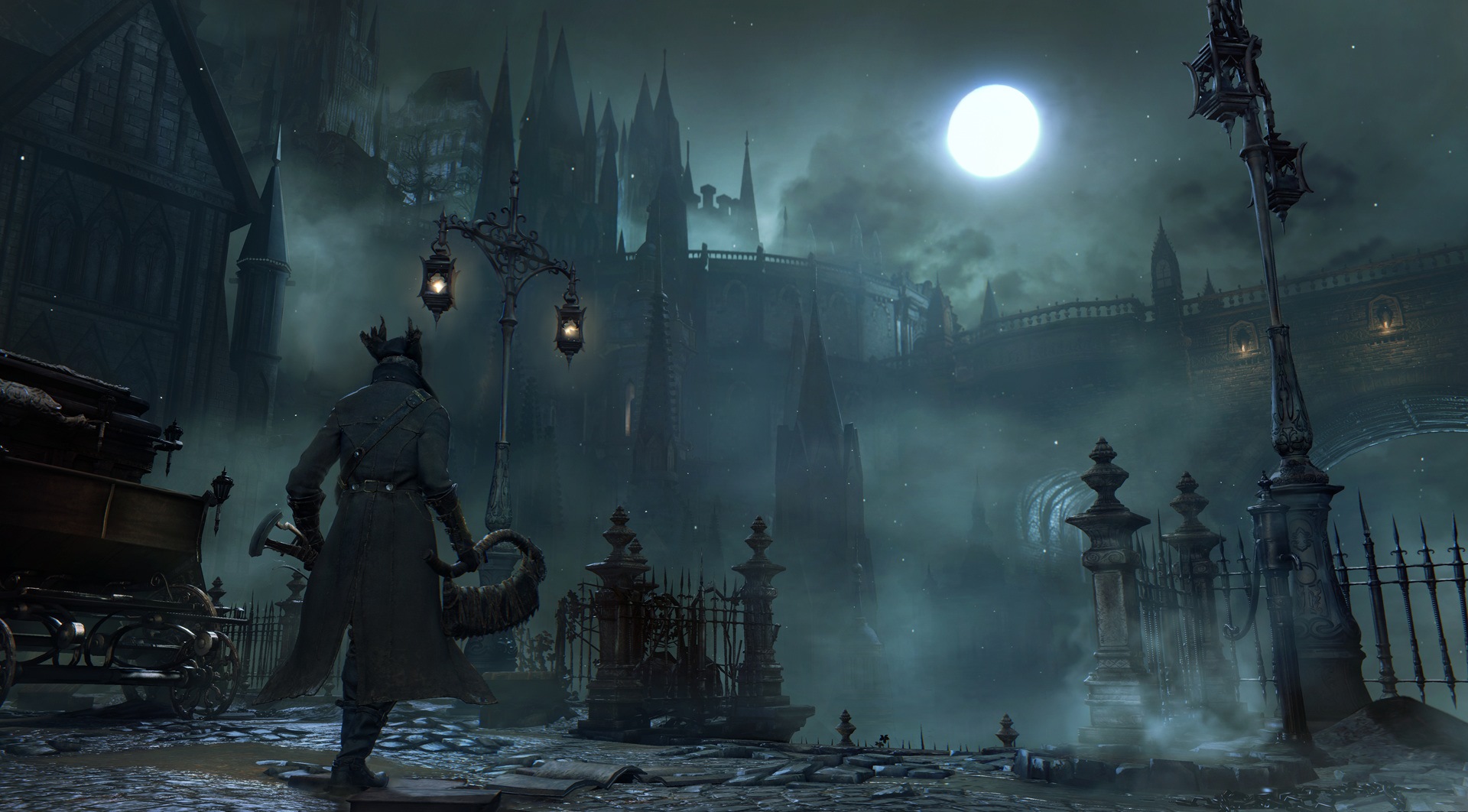
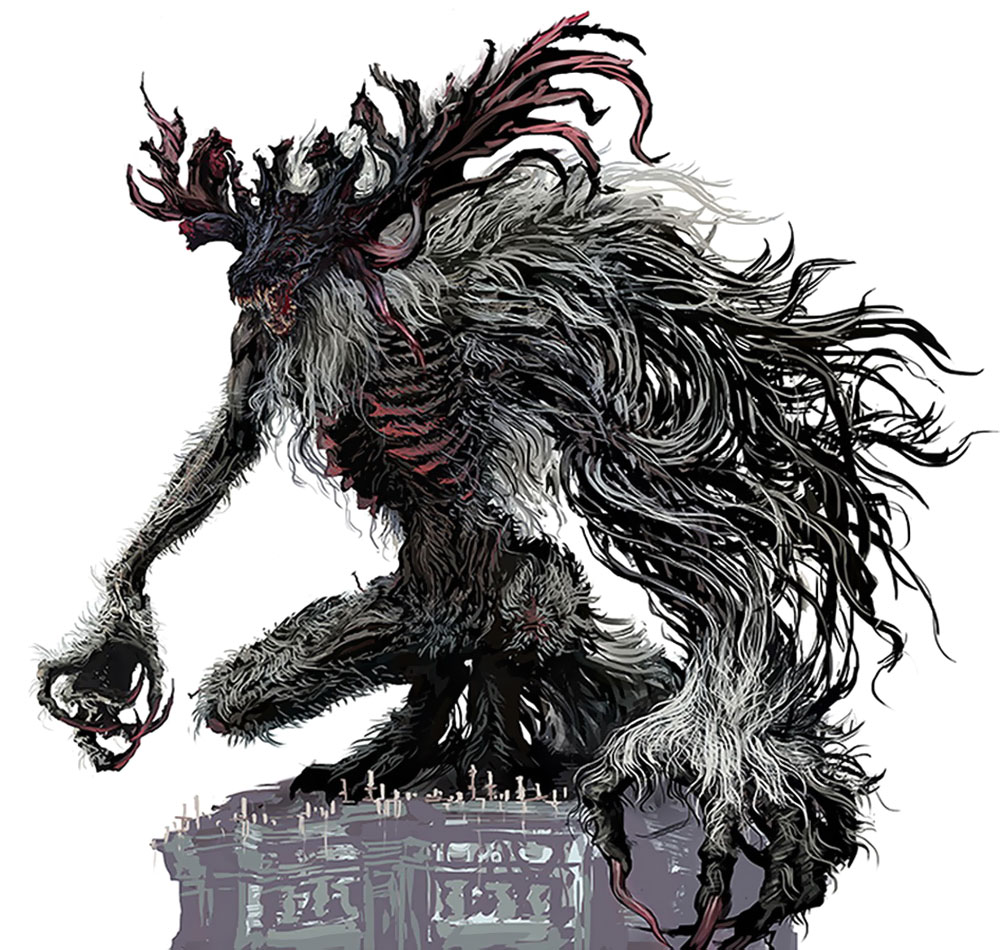
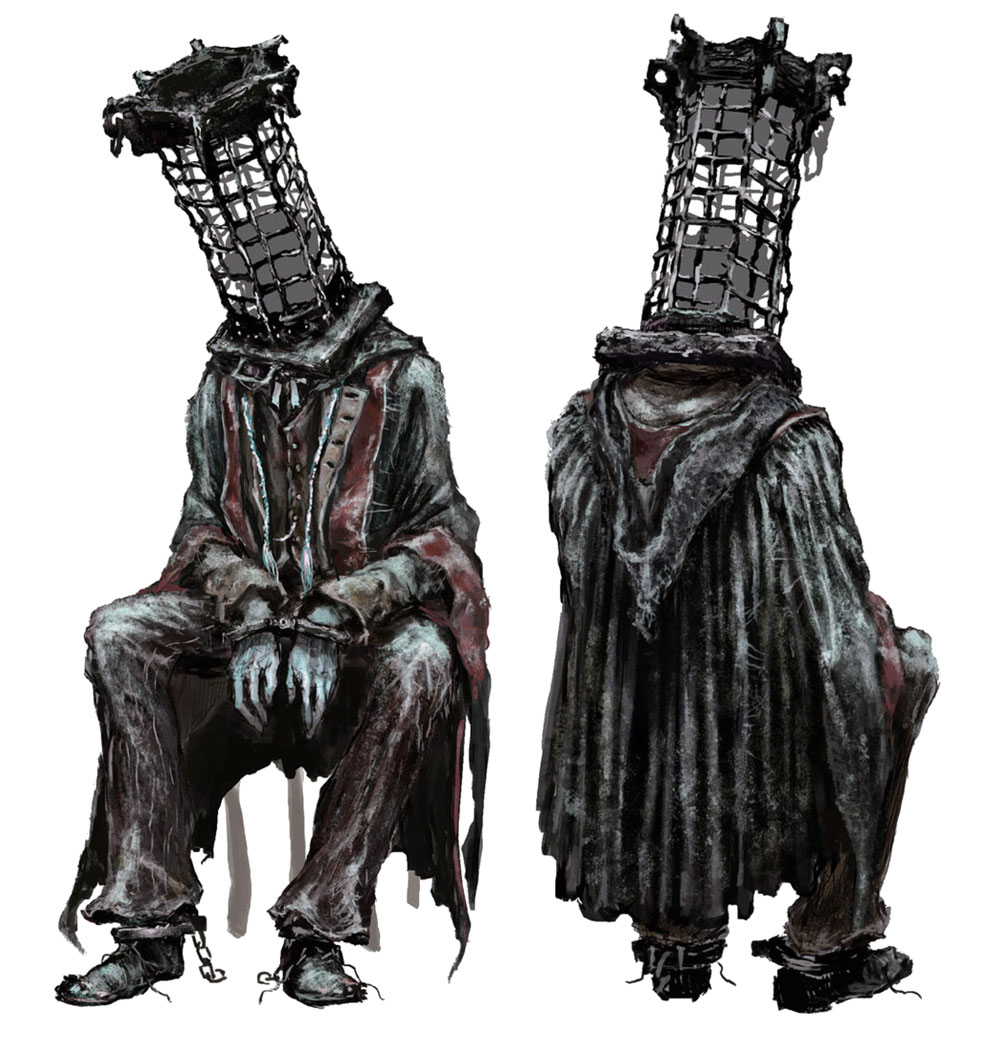
Note: The images in this article are from the press kit for Bloodborne, and the game’s concept art. Capturing screenshots from Bloodborne is annoying, and I’m not sure that a bunch more images would do too much for this writeup.

I like Bloodborne. I think it’s very much worth playing. With that said, writing about Bloodborne is hard because there is so much that I could write about. Almost every aspect, from the technology, to the multiplayer, to the art, to the story, to the lore, to just the design and mechanics could have more than its own article.

This article will not be digging into any of those topics to the level they might deserve. My end goal for anything I write for Gametrodon is to convince you, the reader, that a game has something interesting about it that makes it worth playing and engaging with.

In the case of Bloodborne, the game is 6 years old, and exclusive to the last console generation on PS4. I don’t think it really needs someone to advocate that it’s a unique experience, or a good game. The world already knows that it’s both those things. So instead, I’m going to advocate playing the game for folks who might have thought about playing it, but were put off by the game’s somewhat notorious pedigree and difficulty curve. It’s an article directed at… well… me. Me from 70 hours of Bloodborne ago.

First, a little bit of history for those who might not be familiar with Bloodborne, or why the game has the reputation it does. Bloodborne is made by From Software. If you look them up on Wikipedia, you will see the following quote.

FromSoftware, Inc. is a Japanese video game development company founded in November 1986 and a subsidiary of Kadokawa Corporation. The company is best known for their Armored Core and Souls series, including the related games Bloodborne, Sekiro, and the upcoming Elden Ring, known for their high levels of difficulty.

Wikipedia

“Known for their high levels of difficulty” is the key phrase here. FromSoftware’s Dark Souls series is responsible for naming an entire genre, the “Soulslike” game, in the same way that we get phrases like “Metroidvania.” The “You Died” screen is infamous.

At least in my case, this reputation meant that I had almost no interest in any of their games, despite the fact that they are almost universally praised on every level. This is because I think I misinterpreted “Hard” as “Unfair.”

It is not very difficult to make a game that is very hard to beat. Two examples I can think of would be Kaizo mods/levels for Super Mario Games, and the “I Want To Be The Guy” series. In the case of Kaizo, the difficulty often comes from requiring both near perfect inputs and an absolutely massive chain of them, all while having an almost perfect knowledge of its game. On the other hand, “I Want To Be The Guy” simply puts the player into situations where without knowledge about what is going to happen, the player simply cannot succeed, such as platforms that move when you try to jump on top of them.

Bloodborne’s difficulty doesn’t come from anything like that. Bloodborne doesn’t rely on cheap shots or perfect mechanics to make things difficult. Instead, the difficulty comes punishing you heavily for mistakes or misplays. But almost every time I died, much like with Spelunky 2, I understood why I died. Bloodborne wants you win. It’s just not going to give it to you for free.

Here’s an example: in an area that feels about mid-way through the game, there’s a large rolling log trap that if it hits you, will pretty much just instantly kill you. While this might seem like bullshit, there’re a few important elements about the area that make me view it as incredibly smart game design instead. The first element is that the trap is located incredibly close to one of the game’s respawn points (lanterns), and after only two enemies, making it incredibly easy to get back to your corpse after the trap kills you. The second is that when you look at the area, you’ll see that the trap is actually only triggered when you run across a large button directly in the middle of the road.

This means that after you spot the trap, it’s very easy to avoid it, travel deeper into the marsh, and then get killed by a second trap that’s almost identical.

So why is this first trap important? Well, because to my mind, it’s actually very generous. While deaths in Bloodborne can be punishing, this one isn’t. The purpose of the log trap near the respawn point isn’t to unfairly kill the player, it’s to introduce the concept of the trap to the player, to show the player what it looks like, what happens when they trigger it, and to warn the player that this is an element that might still be encountered farther on. In essence, it’s actually functioning as a tutorial.

The same is true of many of the enemies. Some of the enemies that can combo you to death are first encountered in areas that are either actively detrimental to the enemy, or very near respawn points. And for almost all enemies in the game, choosing to run away and simply not fight them is an entirely valid option.

Bloodborne is not unfair. It asks you to think, and to actively work to defeat it, but it’s rooting for you the whole time. If the pedigree and rumors have made you skip it, or some of the other games made by FromSoftware, I urge you to reconsider. Bloodborne is incredibly satisfying, and worth playing, and if you persevere, you can and will beat it.

And the sun will rise.

Author Note: A brief story for those that aren’t convinced. After beating Bloodborne, I found myself wondering if I’d actually gotten better at the game, or if the game’s small incremental stat buffs, weapon improvements, and other systems had made it so that I eventually made progress without improving. So I made a brand new character with the lowest stats, didn’t take any of the free weapons offered, and replayed the first portion of the game.

A section that took me about 8 hours initially only took me 2 hours with the new character. Two bosses that initially took me over 10-15 tries each took only 3 tries each with this incredibly weak character, and I was using a garbage weapon that I found on the ground and I’d never used prior to this run.

Bloodborne – The Other Post

There is another post about Bloodborne up on the site. That post’s goal is to convince people that they should play Bloodborne, because it’s a very good game. It sticks to definite observations, attempts to be fairly factual, and generally has a concrete set of themes and thoughts. It is also readable by people who don’t spend a lot of time thinking about games.

This is not that post. This is where I am going to put everything else that I thought about while playing Bloodborne. Consider this post to be a bunch of random thoughts, paragraphs and posts that didn’t fit into the first one. As such, it contains spoilers, non-sequiturs, and has no consistent tone.

Part 1. Bloodborne isn’t as hard as it wants you to think it is, and that’s to its credit.

When I wrote about Shovel Knight a while back, it stood out to me because while it attempts to stylistically copy certain things about old, tough as nails games, it didn’t quite go 100% in on it. Instead, it sanded off some of the edges and pointy bits, and made a game that gave you the sense you were beating something incredibly hard, while at the same time pulling quite a few punches.

Bloodborne gives me the same general vibe/sense. Yes, there are one hit death traps, but they tend to either have a straightforward tell, and/or the first time you encounter them they’re next to respawn points. Yes, you have to run back to the boss each time you die, but almost every area is laid out in a way that there is a conflict free route to the boss that is opened up as you explore the level around them. Enemies can be brutal, but are often introduced in 1 on 1 situations in small areas where you can observe and fight them. There’s no Kaizo or I Want To Be The Guy style gutpunches.

Part 2. Lore is interesting, incomplete, but not unsatisfying.

I like the lore and world of Bloodborne. I heard a story somewhere that I’m going to go try to verify later, about how Miyazaki bases some of the feeling of his games on experiences he had as a child, where he would read stories or watch movies in languages he didn’t understand. As a result, there would be parts of the story that he simply missed or couldn’t follow, because from his standpoint, they weren’t present.

To me, this feels like writing a story by writing the whole thing, and then tearing it up it up to be put back together. But before we put it back together, Miyazaki went through and pulled out and burnt a few choice pieces of information, so that info is missing when we start to pull things together. It’s not that the information was never there, it’s just that we don’t have it. And he’s careful to not remove too much, or to remove things that make everything break down or fall apart.

Part 3. Bloodborne does justice to the concept of Cthulhu mythos.

Something that I find a bit annoying is how much many modern interpretations of cosmic horror forget about the “Cosmic” bit. Yes, a slobbering blob of eyeballs rolling over each other making a wailing noise and oozing foul ichor is a nasty mental (or literal) image. But it’s not really where the interesting part of the horror comes from.

They say that humanity is but insects beneath elder gods, but many Cthulhu-inspired works don’t consider what that means.

When you kill a mosquito, or an ant, or a bug, you don’t have any real malice toward it (or at least any malice you have dissipates after it becomes a squashed paste). You might remember that it’s a thing you’ve done, but you don’t remember any given instance. It’s not that insects are meaningless, it’s that you literally do not care a good 98% of the time. When you do care, the caring is at most momentary. Insects are the white noise of reality, something so inconsequential that their existence often just doesn’t even register to you.

And that’s the impression I get from many of the elder god style beings in and their role in the story from Bloodborne. They can be terrible and horrific to look at, but they’re not terrible or horrific because they harbor some level of hatred toward you. They’re terrible because they have a sort of obscene majesty to them, and you are just inconsequential to them. They are impressive, and inspire revulsion, but they do so while being grand and terrifying and uncaring.

And the overall story reflects this as well. The city of Yarnham is not special, and the events of the game and the game’s world are not a unique occurrence. This has all happened before, and there’s no reason to suspect it won’t happen again. The movers and shakers of this world and of the tale are not cosmic evils, but men and women who thought they knew better than others, and who chased their own goals to madness. Human beings are responsible for the plague, the hunt, and the death and terror brought by all of this. Humans, not monsters, discovered things they did not understand, and then made the choice use them anyway.

Part 4. I played 60 hours of the game without realizing you could sprint and jump.

I don’t have anything more to add to this one. But yeah, it’s a thing that happened. And I still beat the game anyway. #JustGameJournalistThings

Part 5. I have mixed thoughts on limited use consumable items and weapon durability.

Pretty much everything in Bloodborne outside of weapons and clothes is limited use. This means your health potions, your bullets, etc., flame paper, shock paper, molotovs. Oh, and your weapons can break down, and deal less damage.

I think this is mostly a good thing, because it means that finding stuff is useful, except for when it comes to boss fights. With that said, it does definitely lead to hoarding problems on occasion.

Part 6. For some reason I attempted to write a sparknotes version of the background lore of the world of Bloodborne. It’s below:

Everything after this constitutes massive spoilers. You have been warned. It’s also incredibly skimmed down.

A very long time ago, there was an ancient city populated by a species known as the Pthumerians. At some point in their history, they either made contact or discovered the existence of the Great Old Ones. These are the elder gods of the story. They are immense beings of incredible power and unfathomable goals and vision. They are not inherently indestructible or immortal.

Anyway, after this contact and research began, something happened and ended up more or less wiping out the Pthumerians, leaving their civilization a ruined shell of its former self. They only continued living in the endless catacombs that become Bloodborne’s procedurally generated Chalice Dungeons.

Some time passes.

A group of scholars end up discovering these catacombs and being to explore them. They are led by a man named Wilhelm. Wilhelm and those working with him end up following basically the same path as Pthumerians before them. They want to study the Great Ones, and to some extent understand them. This leads to the founding of Byrgenwerth academy.

At some point, the individuals at Byrgenwerth discover an unknown substance in the underground catacombs. This substance is the “Blood.” While it’s unclear how exactly the blood is obtained, there are implications that it may be harvested from a great one. The blood has miraculous properties, including the ability to heal wounds and injuries that are completely untreatable by any other means.

And like any other miracle, it leads to disagreements. Wilhelm is of the opinion that the blood is dangerous and should not be used. A subfaction of the Byrgenwerth scholars, led by a man named Laurence, think that the blood can be used to bring about the understanding they’re seeking. While the disagreement hasn’t lead to violence (yet), Laurence and those that agree with him leave Byrgenwerth, and find a group called the Healing Church.

The timing of the next set of events is a little unclear, as is how long it takes for them to occur. More on that in a moment. But here are the big things that happen.

  1. The Healing Church becomes incredibly influential and powerful. They have extensive influence over the city of Yharnam.
  2. Two new organizations come forward from within the Healing Church. These are the School of Mensis, and the Choir. Just like with Byrgenwerth, these groups have the goal of understanding the Great Ones. They disagree on methodology and tactics. The Choir and School of Mensis do not trust each other. To outsiders however, all three organizations are still allied, and presumably working together.
  3. Word of the Healing Church and their ability to cure any disease and ailment spreads across the entire world.
  4. The Healing Church declares Byrgenwerth off limits, and forbidden ground.

And then things start to go wrong.

While Blood can heal injuries and sickness, it also has side effects. Overuse leads to a state described as “Blood drunk,” and potential dependency. In addition, blood is transformative. Unfortunately, it’s transformative in a “Turn you into frenzied monster” sort of transformation.

Upon realizing that their miracle cure occasionally leads to cases of were-wolfitis, the Healing Church decides to stop using it and give up their influence and power to protect the citizens of Yharn-

Just kidding. Of course they don’t.

Instead they set up the Hunters, individuals whose job it is to deal with the monsters that are starting to show up. The Hunter organization starts off as a sort of secret police force trying to keep everything on the down low. It’s not obvious to me how long they succeed at this for, or if they’re open secret by the time the next really bad thing happens.

Because things are about to get worse.

In an area of the city called Old Yharnam (it’s not clear to me if this is because it’s an older part of the city, or because of… well, the bit that happens next) there’s a massive outbreak of some form of infection. It’s not clear if the infection is caused by the Healing Church, or one of its subgroups, or someone just had a snack at an open air meat market, but the end result is that the area turns into a disaster zone. Whether it’s the infection, or the Church’s attempts to cure the infection with Blood, basically everyone living Old Yharnam either gets infected or turned into a monster.

Seeing the entire situation spiraling out of control, the Healing Church puts Old Yharnam under lockdown. When even this isn’t enough to deal with the problem, they go one step further, and use the Hunter organization to burn Old Yharnam to the ground and to kill every single person and monster living there.

And while the Healing Church is authorizing flambĂ© massacres, none of the other groups are really helping. The Hunter organization starts to fall apart for a variety of reasons, including members going into blood-induced murder frenzies, individuals deserting after having to barbecue citizens, and just everything generally going to shit. The School of Mensis is still real focused on that whole Eldritch Truth/Being thing, and they’ve started used the chaos to kidnap people to experiment on. The Choir are far more ethical, and so they’re not experimenting on victims of kidnapping.

No, they’re experimenting on all the children they have at their orphanage.

At some point, Laurence gets infected, and turns into a monster. And it turns out that all monsters are not created equal, because Lawrence turns into a fucking two-story tall wendigo-esque abomination. Fortunately, by this point, the Church has reformed the Hunter organization into their own group known as the Church Hunters, led by a man named Ludwig.

Either Ludwig or one of the Church Hunters manages to kill Laurence. But by this point it’s a bit late. The School of Mensis and Choir are outright hostile to each other, spying on each other, and killing members of the other groups. The Church Hunters do not have the manpower to suppress the outbreaks and monsters are showing up across the city. The Healing Church is now led by Vicar Amelia, and it’s unclear what she’s actually trying to accomplish. Unaffiliated Hunters are either hunkering down with their families, trying to take out other Hunters who have gone crazy, or just trying to minimize the carnage. The citizens of Yharnam, having had enough of this have armed themselves with whatever they can get their hands on, and formed armed mobs, patrolling the city and killing anyone who seems infected, even as they themselves show increased signs of infection.

And somewhere around this time is when “you,” the player character shows up.

Part 7.

Bloodborne is played from an over the shoulder view of your character. You have health, and stamina. Stamina regenerates over time when not being used, while health does not, but can be restored with Blood Vials. When you get hit by an enemy, while you immediately lose health, a portion of the bar stays lit up. Damaging an enemy while this portion is still lit up will recover a portion of that health. This mechanic is called Rallying. Your character can have up to two weapons equipped at once, a primary and a secondary. Primary weapons can be trick weapons, which have the ability to switch form. They have light and heavy attacks based on their form, and you can also dodge and roll. Dodging, rolling, and attacks consume Stamina. Secondary weapons tend to be ranged weapons of some type, mostly guns. While secondary weapons usually only have a single attack, when used correctly, they can interrupt an enemy’s attack, and knock them down. This is called a Parry. Enemies in the knocked down state can be Visceral Attacked. This is a short attack that does a large amount of damage, and restores health to the player equal to whatever portion of their health bar is still lit up, while also pushing enemies near the attacked enemy back. Once you commit to an attack, or part of attack combo, you cannot stop or interrupt the combo.

Tanto Cuore

A deckbuilder that will have you collecting anime maids, and also judging looks from anyone who sees you playing.

I like Tanto Cuore and I’m not afraid to say it. Many of the mechanics feel like a upgrade over Dominion, and while it doesn’t have some of the variety of Ascension, it does avoid the randomness. If you haven’t played either of those games, that’s okay. I’ll talk more about the mechanics in a bit. But first, a brief diatribe.

Something I thought about while preparing to write this article was the fact that I have different standards for when I feel like I can write about a game based on format. For board games, a single full play session is usually enough for me to feel like I can offer an opinion. On the flip side, I’ve recently played like 40 hours of Bloodborne, but because I haven’t beaten the game, I don’t feel like I can offer thoughts yet.

It’s an interesting dichotomy, and it would be relevant to the rest of this article, because while I’m playing the digital edition of Tanto Cuore, the game itself is a board game. So even though I haven’t beaten all the single player levels, or even a majority of them, I’ve played several more rounds then I might have if it was a standard board game. At the same time, I would usually feel a bit weird reviewing a game with only five hours played.

The key phrase here is “would usually.” Because 98% of the human population is going to decide that they don’t want to play Tanto Cuore after the next sentence:

Tanto Cuore is a deckbuilder in which all of your cards are anime maids.

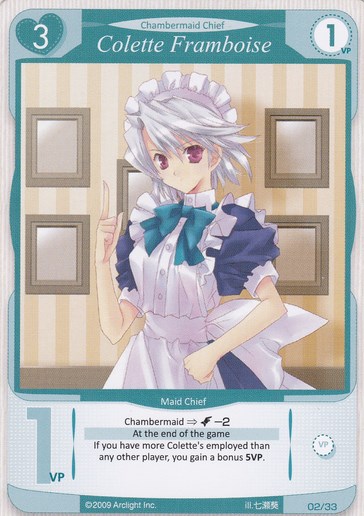
Have we scared off the normies with this photo? Good.

Cool, so yeah, now that no one else is going to read the rest of this article, let’s get going, starting with a short definition of the deckbuilder genre.

If you haven’t played a deckbuilder before, they generally work something like this: each player starts with a simple deck of cards. On your turn, you play those cards to take actions, and generate resources to buy more cards from some form of central supply to add to your deck. Cards you buy or play go into your discard pile, and when you run out of cards to draw from your deck, you shuffle your discard pile and it becomes your deck again. Unlike a traditional collectible card game like Yu-Gi-Oh or Magic: The Gathering, with deckbuilders you create your deck each time you play the game. You start from scratch with the same deck of simple cards each time you play.

The goal of Tanto Cuore is to have the most victory points at the end of the game, because of course it is. Now that we’ve talked about the most boring part of the game, let’s move onto the maids cards.

Tanto Cuore has four types of cards. There are love cards, general maids, private maids, and events. Of those four, private maids and events are the simplest to explain, so we’ll start with them.

Private maids don’t go into your deck. Instead, they go into a scoring zone. When you buy a private maid, it enters your scoring zone, and until you buy another private maid, or something else special happens, you can use its ability. They also tend to be worth victory points at the end of the game. While the abilities can appear small at first, they tend to be mechanically impactful.

Events also don’t go into your deck. In fact, they don’t go anywhere related to you at all. When you buy an event, you play it onto another player, or one of that player’s maids in their private quarter. Events tend to either disable abilities, or be worth negative victory points.

Of the remaining two card types, the simplest cards are Love cards. Love is the currency you use to hire maids, and love cards can be played without spending any resources. In any other game, these would be called “Gold” or “Money.” But yeah, here it’s Love.

Which brings us to the last card type: the maids themselves. The maids are the most complex and as such covering them all in detail isn’t possible. Instead, I’m going to give a general overview of the sort of things they do and how they get used.

There are three resources that you have on your turn. They are Love, Hires, and Servings. Love is used to pay the cost to get maids. However, in addition for each maid you get, you also need to spend a Hire. The last resource, Servings, actually has two uses. You can spend Servings to play maid cards, but you can also use them to send specific maids to your scoring zone. Doing this removes the maid from your deck, but allows it to potentially also score bonus end game victory points.

It’s this mechanic that I think really makes Tanto Cuore stand out to me as a different from other deckbuilders in a meaningful way. Almost all deckbuilders have some form of victory point card that sits around and does nothing, or cards that are useful in the early game, but clog your engine in the late game. In Tanto Cuore, many of those cards are actually your primary method of scoring. Colette Framboise is the best example of this. You can spend two Servings to remove her from your deck, which scores you points. And since your deck starts with only 10 cards, removing her can vastly increase deck efficiency.

So, now that we’ve finally finished talking about Tanto Cuore’s mechanics, let’s talk a bit more about the digital version of the game, since it’s probably the easiest version of the game for you to currently get your hands on (and forcefully gift to your friends in order into guilt them into playing with you).

Overall, I think it does a fairly good job as a digital port of a physical game. While some things do feel a bit barebones, none of those are the actual game itself. There’s also an extensive singleplayer mode/tutorial with a variety of levels that seems to unlock foil versions of the cards as you clear the levels will completing various objectives. The video and audio sliders actually work really well, and the game has ultra-wide monitor support for some reason. Protip: After launching the game, go in and just… slide that slider for voices all the way off. Thank me later.

I do have one gripe with the digital version of the game though: as far as I can tell, there’s no way to see a list of all the cards in the game. See, at the start of each game, you pick several different maids to be placed into the central buy row. The rest of the cards aren’t used for that game. But this means it’s entirely possible to start a game and see a few cards you haven’t ever seen before. It’s not a massive annoyance, but I really wish there was an in-game card browser, or like… a PDF.

So yeah, that’s Tanto Cuore. A really cool deckbuilder about collecting maids that none of your friends will play with you, either because you had no friends before getting the game, or you won’t have any after trying to get them to play it. Remember kids, Settlers of Catan and every other Euro-game that promotes colonialism and hyper capitalism is a-ok, but god forbid you have skimpily dressed anime women. That’s simply a bridge too far.

Tanto Cuore is $10 on Steam, $42 on Amazon on the physical copy, and apparently like $1800 for the Japanese edition? Yeah, I don’t know either. It’s good though, and worth playing (although probably not for $1800).

Fishards

Become a Fish Wizard. Fight. Kill. Collect silly hats.

Ed Note: We requested and received a few free keys of Fishards after watching the trailer, and being interested. This review is based on the experience with those pre-release game keys. Images are from the Steam Page.

When I saw the trailer for Fishards, I thought it looked neat, and convinced 3 other friends to play it with me. Of that group, I’m the only person who was kinda “Eh” on Fishards, with everyone else generally liking the game, even if they had some criticism. But they’re not writing this article, so lets talk about what I thought about it, and what the game generally is first.

In Fishards, you are a Fish Wizard. By combing the 5 elements, fire, water, earth, slime, and goo, you will cast spells, and defeat your enemies. Each combination of elements produces a specific spell.

While its tempting to compare Fishards to Magikca, I think this is a fairly inaccurate comparison. After going back and playing some Magicka for this writeup, while both games have a concept of “Combine elements for spells”, they both do it very differently. In Magicka, the elements you combine have various properties and rules. While there are specific spells that require you to enter a given combo of elements, just randomly pressing buttons will give you something. For example, if you combine lightning and beam, you get a beam that does lightning damage.

That’s not the case in Fishards. In Fishards, any two elements correlate to a specific spell, with it’s own specific cooldown. It reminds me a lot of playing the character Invoker in Dota 2. Because each spell instance has it’s own cooldown, you can’t really spam the same thing over and over again. There are a few exceptions to this rule, with the fireball and goo-spread spells that let you cast them multiple times. But a vast majority of them cannot be multicast, so you’re forced to switch up spells fairly rapidly.

Another way it’s unlike Magikca is that Fishards is technically stable and runs fairly well. While this is to it’s credit, I also never really found myself super engrossed in the game. If this article sounds kind of…. “Eh” on Fishards, that’s because it is. I don’t really feel strongly about Fishards. It’s neat, but right now, I didn’t really have a huge amount of fun with it.

Here’s the thing though: That’s just my thoughts. Of the group of folks I played with, other folks had some more positive thoughts. One friend generally liked the combo system, even if they thought the spells and other factors needed some tuning. The other two had issues seeing the cursor, but after the Dev’s were told about this, there was a patch that resolved this issue fairly quickly.

You can get Fishards here on Steam for $7. And y’know, that’s probably the right price for it. If the idea of a weird indie top down arena brawler interests you, I’d encourage you to give it a look, and see if you think you’d have fun with it.

Arknights

A mobile tower defense game where you run a PMC of anime furies. No wait, it’s cool, please come back.

Arknights is a mobile tower defense game. It commits some of the sins of mobile games in general, such as a gacha system for acquiring your “towers,” and an upgrade system that requires you to loot an entire RadioShack worth of gear to do anything. That said, it does enough unique and interesting things as a tower defense that I want to write about it, and I recommend it.

There’s a funny story about how this article wasn’t actually going to be an article about Arknights. It was going to be a list of some of some phone games that I’ve been playing. Part way through writing that list, I realized that I had written two paragraphs on Arknights, and nothing for the others. Then, when I tried to write about those other games, I realized that my reasons for playing them were, in no particular order:

  1. To collect fox girls.
  2. Because I’m desperately starved for anything pinball related.
  3. Sunk cost fallacy.

Arknights was the only one that I was actually playing because it was fun.

That’s not to say the game itself is perfect, by any means. As I mentioned above, I have problems with it. First, you have to roll what amounts to a slot machine in order to permanently unlock your units. Second, powering and leveling said units requires a shit ton of time. And the third, the game’s general story and lore is on par with Dota: Dragons Blood (which is to say, a mess).

But it does a bunch of other stuff right. For one, I really its “Stamina” system. Like many mobile games, Arknights has a Stamina system where you have to spend Stamina to enter and play a given stage. Unlike most mobile games I’ve played, if you wipe on stage, or choose to quit, it refunds a portion of that stamina. While this would be fine by itself, the bigger portion of this is the “Plan” system.

Plans are a parallel resource that refills to 30 at the start of each day. Plans can be used to enter a stage without spending any stamina, but you won’t get rewards for beating the stage, nor will beating it actually count as clearing the stage. In essence, they function as free “test” runs. If you haven’t played many games with a stamina system, their purpose might not be apparent. Plans allow you to constantly make attempts on content you’re stuck on, but without any risk of “wasting” your precious Stamina until you’re sure you can beat the level.

I really like this because it makes it into much more of game. You’re encouraged and enabled to try multiple strategies and ideas against levels you can’t clear. Instead of being punished for failure, you can practice and end up feeling 100% sure you’ll clear a level. You can safely try cheese and other weirdness to pass a level with no risk other than your time.

Actual Arknights levels tend to be structured similarly to normal tower defense levels. There are entry points where enemies spawn, and will follow a path to get to an exit point. If an enemy makes it all the way there, you lose a life. Run out of lives, and you fail the level.

That’s where a lot of the common genre tropes go out the window. You can’t just put down as many towers as you can afford. Instead, you can only have up to a given number of your operators on the field at any one time. Most operators can also only either be placed on ranged or melee tiles, based on their type. Once you place an operator down, you can’t move or reorient them without retreating them, waiting out their redeploy period, and then paying an increased cost to place them down again.

Almost all operators have a skill or talent of some kind. These range from stat buffs, to summoning a shadow clone copy of themselves, or just nuking the area around them.

And you will want to move them. The cost to deploy an operator is different from character to character, so you’ll often want to start by putting some of your cheaper units that generate additional deployment points into play, only to remove them later to free up space in your unit cap. And even if an operator is knocked out, after waiting out their redeployment, you can use them again on the same map. Did an enemy get past your defenses? You might find yourself having to toss someone down to block them from getting to the exit. Figuring out when to retreat unit, and when to play them is a big part of managing enemy aggro. Because of this system, Arknights is the only single player tower defense game I’ve ever played where I’ve straight up put units into play knowing they’ll die just to stall for time.

The enemies are also a bit more unique. While many of the starter enemies are standard, the game pretty quickly introduces some really neat types. Here are a few in no particular order:
Sentinels – A weak flag waving enemy who isn’t that big of a problem… except the second you shoot him, he goes into alert, buffing the rest of the units on the maps. Perhaps more interestingly, they tend to travel in routes where they ignore going toward the exit, and instead go on a grand tour of the rest of the map.
Grudgebearer – Grudgebearers start in Standby mode, which means unlike most enemies in tower defense games, they won’t attack. Even once they start moving, they won’t hit you. Unless you hit them or one of the aforementioned Sentinels, at which point Grudgebearers turn into giant tanky balls of pain. Figuring out how to aggro them in manageable ways before they all wake up is a neat challenge.
Maintenance Drones – Just because something shows up in the enemy list doesn’t mean it’s actually a threat to you. Take these very helpful little fellows. Of course, just because they’re helpful doesn’t stop your units from opening fire, which will be a problem, because you really want these guys to activate sanity restoring beacons. Why? Well…
The Entire Sea Terror Family – Have you ever wondered what what trying to fight the deep ones would look like in a tower defense? Well, worry no more, because now you can! And by “Can,” I mean you can watch your units go insane, and get stunned from trying to deal with any of the enemies from this archetype. Hooray!

There are civilians you’ll have to try to stop from getting butchered, leader enemies that will blast half your operators with a grenade launcher, and then cheerfully pull out a shiv when they get into melee range, and cloaked little shits who don’t care if you block them. They’ll just wander on past your entire defensive line if you can’t damage them down quick enough.

And that’s just a little taste of the enemies. There’s an equally large set of interesting map mechanics and setups. My personal favorite are maps where you can set up your units to just straight up shove the enemy into pits or off rooftops. But there are also maps with air vents that can boost or weaken stats based on if you’re facing into the wind or away from it, maps that let you maze like a more traditional tower defense with massive bricks, and even maps where your units are constantly being fired on by ballistas.

I will finish this Under-Tide furniture set someday.
Ed Note: He never finished it.

There are some other subsystems, including an upgradable base, daily challenges, and some semi-survival raid-like sort of things, but they’re all additional modes and features, so I’m not going to talk about them here.

So yeah, that’s Arknights. A neat mobile tower defense game with a bunch of cool mechanics and enemies, and some less cool decisions around getting new operators. But overall, some really nice twists on the format.

Ed Note: Rate up is a lie.