Tag: VideoGamesWeLike

  • Holocure

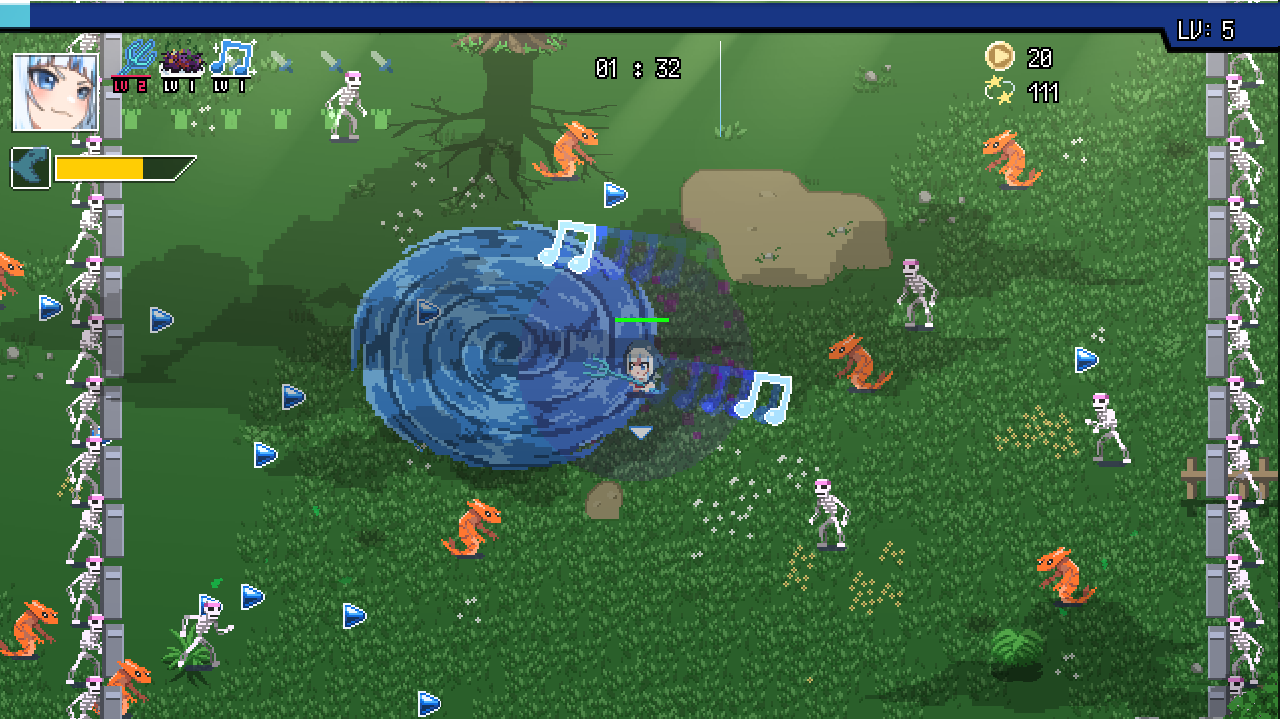
    Holocure is a Hololive-inspired fan game in the shape of Vampire Survivors. If you haven’t heard of Vampire Survivors, it’s a 2D roguelite where you try to survive as long as possible. If you’ve never heard of Hololive/Vtubers, I’d suggest this video by Gigguk. While some of the specifics are bit out of date, the general coverage and explanation of virtual idols is handled really well.

    If you’re already into Hololive, Holocure is a fantastic sort of love letter to the talents, and the fandom around them. All the enemies are mascots of the HoloEN branch, and all the items are in-jokes, or reference to various moments from Hololive history. The level of care put into everything is fantastic. I watch a lot of Hololive content, and so perhaps unsurprisingly, I also enjoy Holocure quite a lot.

    That said, even if you have no idea what Hololive is, or don’t care to learn, Holocure is still worth checking out for its core gameplay. So let’s talk about that!

    You start by picking a character to play as. There are 11 characters, 5 of which are unlocked from the start, and 6 of which can be unlocked with an in-game lottery system (don’t worry, it doesn’t use real money). After this, you’ll pick a game mode. Currently there are two modes, Stage and Endless. In Stage, your goal is to defeat the boss that spawns at 20 minutes, and in Endless, your goal is to just survive as long as possible.

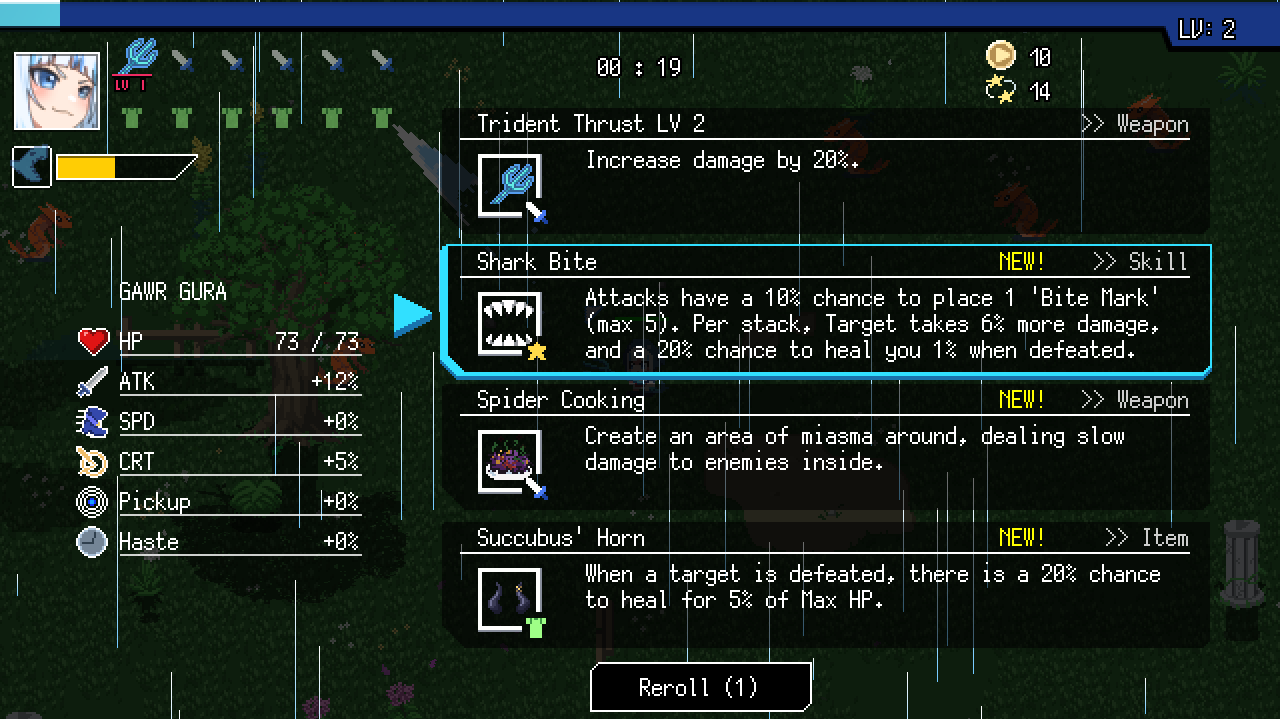
    Regardless of which mode you pick, you’ll get dropped into a large field, and the game actually starts. Enemies will spawn in, and move toward you. If they touch you, you lose health. Lose all your health, and it’s game over. When you defeat an enemy, they drop exp. Pick up enough experience, and you’ll level up and get presented a choice of several items and weapons.

    This is as good a time as any to cover the aforementioned systems. Each character starts with the first level of their unique weapon, but can hold up to six more. Weapons fire automatically. Some fire in a direction determined by the player, and others fire in a completely random direction. This is actually a good thing, because you don’t have to spend as much time aiming, and can just focus on dodging everything being thrown your way.

    In addition to weapons, there are also items and passives. Each character has 3 unique passives they can level without taking up a slot, and 6 items slots. Items have various passive abilities, for example, one gives regenerating shielding, and another buffs your damage if you go an amount of time without being hit.

    The end result is that each run of Holocure feels different, while still giving a fair amount of agency in choosing between the various items and weapons that show up to pick from.

    As a fangame, Hololive doesn’t cost anything, and you can download it on itch.io here! The game also has an official twitter here, and a larger content patch is expected later this year, sometime around September.

  • Garfield Kart – Furious Racing

    The bar for franchised game tie-ins is a moving target, but it’s rarely above sea level. Often, it spends time in the Mariana Trench. I’m lucky in that the franchises I love started as games, so the games are usually pretty good (or in the case of Pokémon, “Yes, it’s the same thing, but I bought it and it was okay the last 5 times so I guess I’ll do it again.”)

    There are exceptions, of course, coughMagic:Legendscough but on the whole, I don’t actually play many games based on “Things I liked when they weren’t games.” I’m much more likely to buy a shirt because you wrote Undertale on it in comic sans, than I am to buy a game because it has LeBron James, or Rick and Morty in it.

    All of this is a lead up to say that my expectations for Garfield Kart – Furious Racing were low. Very low. And while the game does exceed my expectations, the fact that it doesn’t crash constantly and runs on my Ultrawide monitor at all is already miles above what I expecting. My expectations were right next to the funny looking fish with the glowing bulb attached to its head.

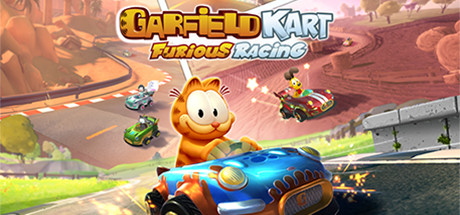
    Garfield Kart – Furious Racing is a a cart racer based off the Garfield comic strip: the fat orange cat who hates Mondays, loves lasagna, and made its creator Jim Davis a fortune. As a child, I actually liked Garfield if only because a cartoon where the cat actually wins made me happy. A a teenager I thought it was incredibly stupid, and not actually funny. But a stronger understanding of how syndication works, and how easy it is for a comic strip to get kicked from a paper at least makes me respect the effort it must take to tell 20+ years of mildly inoffensive “jokes” and not upset anyone.

    Anyway, the theming is skin deep. Garfield Kart is fairly straightforward cart racer. If you’ve ever played any Mario Kart, you’ll pick it up quickly. If you haven’t played any Mario Kart, well, it’s a cart racer, so you’ll pick it up in like 5 minutes tops anyway.

    Mechanically, Garfield Kart isn’t hugely technical. Press a button to go forward, toggle your drifts on curves to get a mini-turbo, and hit item boxes for consumables. The consumables range from a lasagna (a single use speed boost), to two variety of pies you can throw at your enemy (one type homes, the other type you have to aim). And it wouldn’t be Mario Kart without an item to royally screw the first place player. In Garfield Kart, that’s the UFO: a trio of three alien spaceships that fly ahead on the course, lay down tractor beams, and grab the first person to pass through.

    Strangely enough, the UFO is fairly good for illustrating perhaps my biggest gameplay gripe with the game. Once a player ends up in first place, it’s incredibly difficult to catch them. A lot of the speed loss in Garfield Kart comes from crashing into other carts, and once you get ahead, it’s incredibly easy to just chain mini-turbos. And because of how item rolls work, it’s unlikely that the second place player will get the red shells homing pies they need to close the gap.

    Outside of that, we have the actual racing tracks. Garfield Kart has 16 tracks, all of which are fine. There’s a fair amount of asset reuse between them, but that’s not really a big deal to me.

    What is a slightly bigger deal to me are the bugs. Garfield Kart is mostly stable, but has a fair number of bugs. In the 10 hours I’ve played, here’s a sampling of what I’ve seen: 1. Item display from item boxes not updating, and showing you as having an item after you’ve used it. 2. Cart collisions acting inconsistently. 3. Netcode resulting in other carts clipping into you, and launching you through the ground. 4. Hitting geometry at weird angles can easily result in carts getting stuck tilted up at 90 degrees, and unable to move. 5. AI getting permanently lodged on rocks.

    Garfield Kart isn’t a bad game. It’s effectively just a low budget Mario Kart clone with a more boring theme, fewer tracks, and less polish. And while I would normally say “Just go play Mario Kart,” what sets Garfield Kart apart is its price point and system.

    See, Garfield Kart regularly goes on sale for about a $1.50, a price at which you can buy 10 copies, send them to all your friends, and have an amusing cart racer to play with everyone for under $20. Compare to Mario Kart 8, which is $60 for the game alone, and another $50+ for each controller, and all of a sudden Garfield Kart is an absolute bargain.

    So yes, while I do recommend Garfield Kart, it’s a conditional recommendation based on having 3-4 other folks to play it with, and spending about as much as a Snickers bar per person on the game itself.

  • Perfect Heist 2

    I like Perfect Heist 2. It’s a fantastic asymmetric deception game about robbing, or preventing the robbing of banks. So does that mean the game is as perfect as its name implies? No. It has a lot of problems. But it’s fun, and that’s really all that matters.

    Writing the intro paragraph for this article is an exercise in deciding what watch list I want to get placed on. Do I make the joke about how the game is unrealistic because you get punished for killing civilians as a cop? Do I talk about how I love games that let me lie my way to victory? Do I talk about how my favorite thing in games like Project Winter is convincing someone to work with me, only to bludgeon them to death in an enclosed space once they’re out of earshot of the rest of the group and no one can hear their cries for help?

    Do I just make all of them?

    Oh right, I’m supposed to be writing about a game.

    Perfect Heist 2 is a multiplayer deception game about robbing banks. Players join either the robbers or police, with the robbers trying to get as much money out of the bank as possible, while the police try to stop them. If the robbers successfully extract a certain amount of money and make a successful escape, the robber team wins. If time runs out, or all the robbers are killed, the cops win.

    You’ll note that I didn’t say, “If the robbers kill all the cops, the robbers win.” It’s technically true, but is incredibly rare. This is because Perfect Heist 2 isn’t a game about running and gunning; it’s a game about being sneaky.

    In addition to the human players in a game, there are also dozens of AI-controlled civilians. They generally just meander about, and don’t do very much, but they provide the cover for the robbers to infiltrate the bank. However, there are some things the AI won’t do. They won’t ever sprint, they won’t ever pick up money, and they open doors.

    Perhaps most importantly though, they’ll never go into areas they aren’t supposed to be in. There are two general types of AI units: bank employees and civilians. Both types have different clothing patterns, and wearing the wrong outfit for the area you’re in is a great way to get shot in the head.

    As a general rule of thumb, cops have more damage mitigation, and better guns, which means that if you, as a robber, get into a fair fight with a cop, you’re likely going to lose.

    Secondly, unlike robbers, when a cop dies, they just respawn. There’s a shared a pool of lives for the cop team, and a recently respawned cop now knows where you are and what you look like. Cops can’t just go trigger happy though, because if a cop kills a civilian AI even by mistake, the cop instantly dies and can’t respawn.

    Team balance also influences the general sneakiness of the game. The police can never have more players than the robbers, and usually have 2-3 fewer members. As a result, the teams consist of a larger number of players with no individual respawns and generally weaker stats (robbers) against a smaller number of players, with superior firepower and respawns, but a heavy penalty for misusing them (cops).

    So let’s talk about how you actually steal money. Maps in Perfect Heist consist of the bank, the area surrounding the bank, and a few generic buildings around the bank that can’t be entered. The bank is the interesting part though, as it contains vaults, where a majority of the gold and cash needed to win is kept, along with jewelry, and secret documents, all of which can also be picked up for cash.

    There are also ATMs, which can be hacked once to drop money. While the vaults need to be either blown open with charges, or unlocked with various specific classes, the other valuables can usually just be grabbed, albeit with some risks. For example, jewelry is usually in glass cases, and the sound of breaking glass is great way to broadcast where you are to every cop in a 3 mile radius.

    TLDR: there are valuables littered all round the bank, and different classes have advantages for going after various types.

    Speaking of which, let’s talk about classes. There are a lot of classes, both for the cops and robbers. Each class has starting weapons, a passive, and an activated ability.

    In terms of actual playability, classes vary pretty heavily. Some are straightforward, like the Demo who can carry explosives without them being visible, or the Tech who can open all vaults after hacking three computers, and has a drone that can carry money bags. Some offer alternative playstyles, like the Crypto-Enthusiast, who can hack computers to install crypto miners, and generate passive cash, or the Fed Chairman who can quite literally print money.

    Others are situational, like the Sniper. And some are just bad, like the Pickpocket, or Safecracker. It’s a pretty even split between those four groups. There’s enough variety to keep things fun, but some classes just don’t really function.

    The same is pretty much true for the cops. Classes like Riot Control and Spy offer straightforward and always-useful mechanics. IT is situational: useful against classes that want to hack computers or ATMs, but doesn’t do much otherwise. Fed Chairman (no, not a typo, both cops and robbers can use this class) can increase the amount of money robbers need to steal in order to win and offers an alternate playstyle. And then there’s the Digital Forensics officer who…. can see how long ago a computer was hacked. It’s pretty pointless.

    I do think the classes are part of the reason why I enjoy Perfect Heist 2, though. The different playstyles and options available mean that you’re not locked into a single strategy, and you can switch between rounds if it feels like something isn’t working. It adds a lot of replayability, and there’s also some interesting synergies (though these synergies tend to be more in favor of the robbers than the cops).

    With all that covered, let’s talk about what I don’t like about the game. First, the game options menu is practically non-existent. Resizing your screen is advanced technology, so I hope you like playing in permanent fullscreen forever. Second, game balance. As a general rule, the game feels balanced. HOWEVER, the way team selection works means that you can get locked into having two teams of the same players go against each other over and over, with one team just crushing the other. Finally, the guns. The guns kind of suck. They feel slow and laggy. Aiming down sight is buggy and doesn’t always actually aim down sight, and shooting without aiming down the sight results in firing bullets somewhere within an 180 degree radius of where you were pointed.

    These aren’t deal breakers. Honestly, if I could change anything about the game, it would be to fix some of the bugs, clarify wording for mechanics for a few abilities, and fix the options menu. If they did all of that, the game would be fantastic, as opposed to the ‘pretty good’ it currently is.

    If this sounds fun, and the issues don’t sound like deal breakers, you can grab Perfect Heist 2 for $10 on Steam.

  • Super Auto Pets

    Super Auto Pets is pretty neat. Overall I like it, and I recommend it. It’s available on mobile and PC, but unlike most mobile games doesn’t have the sort of monetization that makes you feel like you’ve given your phone an STI by downloading it, and just offers expansion packs instead.

    No really, this is the extent of all microtransactions in the game.

    So now that I’ve said that I like it, what type of game is it? There’s a whole discussion you could have about its genre, but most people would call it an Auto-Battler. Because I’m a contrarian, I’d call it an Auto-Chess. Regardless of your preferred genre name, the goal is to construct a team out of units, each with their own stats and synergies, and last long enough to beat out each opposing team you play against.

    Most other Auto-Something games I’ve played have had a fairly high learning curve. This is because they tended to be mods, or based off mods for games like Dota.

    Enter Super Auto Pets.

    Super Auto Pets keeps the general structure of the Auto-Chess genre, but replaces the complicated units with much more understandable versions. You still spend gold to buy units, you still combine units to power them up, and you can still re-roll the buy row, but instead of dozens of potential stats, Super Auto Pets units have just attack, health, and an ability.

    So let’s talk about the flow of a game of Super Auto Pets, and then the two different game modes that are available.

    At the start of a game, you’ll be given 10 gold, and a market of three pets from which you can buy. Each pet in the market costs three gold, and you can spend one gold to reroll the available pets. There are also food items, which give a variety of buffs. They can range from temporary stats for the next round, permanent stats, or an equipable item.

    You have five slots for pets, and you can rearrange them however you wish for free. You won’t have a full five pets until after the first round or so, but after a little bit, your screen will look something like this.

    When you finish, and hit the end round button, you’ll go to combat. And this is where the “Auto” part comes into play. Going from right to left, your pets will fight against another player’s team of pets. Making simultaneous attacks, combat is pretty simple. Each pet loses health equal to the attacker’s attack stat, and when they run out of health, they faint, and the next rightmost pet moves up to take their place. Whoever runs out of pets first loses, and if you both run out at the same time, the game ends in a draw.

    Losing a single round won’t lose you the game. Instead, after each loss you lose a number of lives that increases as rounds pass. This is one of the interesting differences between Super Auto Pets and other Auto-Chess games I’ve seen. Most other entries instead have you lose a scaling number of lives or HP based on how many opposing units remain when you get knocked out.

    I am very used to seeing this screen at this point.

    The amount of lives you lose isn’t the only thing that changes as rounds pass. The pool of available units and food for purchase changes as well. Higher tier units tend to have stronger stat lines, and in many cases, stronger abilities.

    So why wouldn’t you just always purchase them instead? There’s two reasons. First off is that while their base stat lines might be higher, they may not fit well into your overall strategy. The second is that base stats doesn’t always translate into actual stats.

    Like with other Auto-Battlers, Super Auto-Pets allows you to level up your units by fusing additional copies into them. This increases their base stats, but vitally also often buffs their abilities.

    Abilities are one of the biggest parts of the game I haven’t really talked about yet. Almost all pets have an ability, and they do a lot of different things, for different triggers. Some like the grasshopper create extra units in combat when the pet unit faints. Others might give a stat buff to another unit, such as the ant. Others function outside of battle, like the giraffe, which buffs other units permanently at the end of each round. As a side note, another interesting thing is that many of these abilities work in both battles, and the buy menu.

    As an example: The horse’s “Friend Summoned” ability triggers both when you buy units between rounds, and when units are brought into play during a battle.

    There are a few more things I want to talk about with Super Auto Pets before I wrap this up. The first is how the game avoids becoming stale. When you first install the game, it may take a little while to learn the default pool of pets and food, but past a certain point there becomes a fairly clear path to victory, and winning becomes more of a matter of “Can I complete my engines/strategies before my opponents complete theirs?” To deal with this, the game has the aforementioned expansion packs, and also a weekly pack that changes out the units and food items available, effectively creating a new meta to be solved each week.

    The closest parallel is probably how something like Dominion works. You have a larger pool of total cards, but in a given game, only a subset of that pool is in play. As a result, the skill shifts from memorizing meta strategies to being able to read a pool and spot synergies.

    The second is the game modes. Super Auto Pets has a standard Auto-Something mode, where you play against live players with 60 second buy rounds, but it also has a mode called Arena. In Arena, there’s no timer, and no hard pool of players. Instead of being the last player standing, your goal is to get 10 wins. You have as much time as you want to think and buy. When you choose to end a round, you’ll be matched against another player’s team from same level and round as you’re currently in, and play against them.

    Arena mode is probably the biggest thing that sets Super Auto Pets apart from other Auto-Somethings, because it lets you play the game at your own pace, while skipping having to wait for matchmaking.

    I don’t have anything else to say about the game. Truth be told, I like Super Auto Pets, but I don’t “like” like Super Auto Pets. I think it’s an accessible and friendly entry to the genre. The only in-app purchases are expansion packs, and they total about $15.

    If this sounds interesting, you can grab it for free off the relevant app store for your phone, or for PC on Steam. Or just play it through a browser over on itch.io.

  • Elden Ring

    The first thing George RR Martin finished writing in the last 10 years.

    Elden Ring came out on February 25th. As I write this, it’s currently June 19th. I purchased the game upon its release. Since then, it’s been 119 days. For a large portion of time, this article has been sitting in my drafts post, with just the following text.

    “I have not beaten Elden Ring.”

    As of today though, I can finally update that text. Instead, it can now read:

    “I have beaten Elden Ring.”

    So now what?

    There are three separate tacts I feel I could take with reviewing Elden Ring. I’m going to try to stuff them all into this article, but I’m going to start with the most straightforward one. Having finished the game do I recommend it? Do I like Elden Ring? Is it fun? To which my answers are “It depends, yes (but not as much as Bloodborne), and sometimes.” Let’s expand those answers a bit, but first, let’s talk about what Elden Ring is mechanically.

    Mechanics

    Much like its predecessors, Elden Ring is an over the shoulder action game. You could also just call it a Soulslike, the genre From Software effectively invented. It shares many other traits with other From Software games. These range from how bosses are handled, to a large portion of older games’ equipment systems, to the most infamous: the fact that when you die, you drop all your unspent currency/experience, and get one chance to run back and pick it up. And if you fail, you kiss all your experience goodbye.

    There are a massive number of differences as well, though. Unlike previous games, Elden Ring is open world, and when I say open world, I really mean it. There were three separate occasions in my playthrough where I thought I’d seen the entire world, only to then walk directly into a brand new zone. And because it’s so big, you get a horse (best value; Torrent legit looks more like a yak) to traverse the world. There’s also a brand new crafting system, which I never touched, and the ability to summon spirits, which I used a lot.

    To my mind, the biggest ramification of how open the world is, is that there isn’t strictly speaking a single path to the end of the game. There are some required bosses, but the early game is open enough that it only requires you to beat two out of a fairly large set of bosses. Anyway, now that we’ve covered the game’s general mechanics at least slightly, let’s go back to those three questions I answered above.

    Answer Ye These Questions Three

    First off, do I recommend Elden Ring? Here’s why my recommendation is an “It depends.” Elden Ring is a Soulslike, and it’s a From Software game. This means the game is hard, not by being unfair, but by just being very punishing for mistakes. I talked about this sort of design in my Bloodborne writeup, if you want to read about this design philosophy in more detail.

    Elden Ring could almost be taken as a synthesis of the games From Software has made. So if you enjoy those games, it’s an easy recommendation. At the same time, it’s a very unique experience. I’d argue that if you’ve never played a Soulslike, Elden Ring is currently the pinnacle of the genre, making it a good entry point.

    With that said, if you’ve played them before, and didn’t like them, or simply don’t like action oriented combat games, Elden Ring is likely a bad fit. The ability to beat Elden Ring isn’t something reserved for only the most elite gamers, but it is a game that demands far more patience and tolerance then any other AAA title I can think of. There’s a reason the “Easy Mode” mod has 40,000 downloads.

    Next, question two: do I like Elden Ring? Yes, I generally like Elden Ring, but, I still don’t like it as much as Bloodborne. The reasons for this can be grouped into a few big reasons: (A) weapons, (B) combat, and (C) “I just don’t like open world games.”

    A. Weapons. I simply like Bloodborne’s weapons more, specifically their trick modes. The ability to spend resources on a single weapon, but to swap between modes based on the enemy you’ve encountered was something I enjoyed quite a lot. Elden Ring has a much greater number of weapons available, but none ever actually really clicked with me the way Bloodborne’s Threaded Cane did. In addition, although I found a lot more weapons, I simply didn’t have the stats for many of them, and thus ignored them.

    B. Combat. In Bloodborne, when you get hit by an attack, if you can strike an enemy back fast enough, you can recover a portion of your health. This lends the game a very aggressive tone, encouraging offensive play. In Elden Ring, you do not. This simple difference sets an incredibly different tone, and frankly, I like fighting more than I like waiting. This brings us to the other thing I liked better about Bloodborne combat: parries.

    In Bloodborne, your secondary weapon is almost always a gun. Guns are not really ranged weapons. Instead they’re used to perform parries/counters, and you almost always have access to them. Elden Ring doesn’t have guns, and while it does have parries, Parry is a single special attack option available only on shields, and using a shield means giving up two handed weapons, and also many other combat options. Look, I just liked my shotgun okay?

    C. I just don’t like open world games. This one is pretty self explanatory. I just don’t. Elden Ring is an open world game, and it uses a lot of the common open world tropes, including various repeating objectives and structures, having to collect maps for new areas, and in the latter half of the game, a fair amount of re-used bosses. Also a crafting system.

    I do not enjoy getting lost. I do not enjoy crafting shit. And I really don’t enjoy trying to find a specific reagent. Yes, I could use a wiki, but I didn’t for reasons we’ll cover later. I mentioned this in my earlier Elden Ring writeup, but it also made it feel much harder to figure out if I was just bad at a fight, or if my character’s stats weren’t high enough. Is skill too low, or is number too low?

    Next, question 3, the most important question: Is Elden Ring fun? I had fun with Elden Ring. I was also frustrated, annoyed, bewildered, and pissed off. Those two sets of emotions aren’t necessarily exclusive. Elden Ring, and Soulslikes in general, are satisfying because of how obnoxious they can be, and how good it feels to finally dunk an enemy that’s been wiping the floor with you for several hours.

    (We’re about to get into spoiler territory, so if for some reason you want to avoid spoilers, now would be the time to leave.)

    With that said though, I would say I had less “Fun” in the second half of the game, and closer to the end. The environments are far more sparse, and bosses are heavily reused. In addition, the final section of the game is effectively a boss rush, where you have to face FIVE bosses with no other zones or content between them. Of these five bosses, I’d argue the first and third bosses you encounter are more impressive and interesting than four and five, which gives the game a weird tone.

    Also, while I don’t want to be too direct, the “Final” boss of Elden Ring is one of the worst fights I’ve ever seen in a From Software game. This is for several reasons and I’ll cover them quickly. First off, the final boss is large, which would normally be fine, except they’re so big that getting close enough to attack them requires that you’re also so close that you can’t see the tells for their attacks. Second, they only have one lock-on point, directly in their chest. This makes it hard to stay focused on them, and hard to see their tells, which come from the head and arms. Finally, despite being an absolute chonky lad, they spend most of the fight just running around the arena, and getting close enough to them to hit them is the primary challenge. It’s incredibly annoying.

    There are quite a few awesome bosses in the game, but the final boss is not one of them.

    So now that we’ve answered the big important questions, let’s move on to the other thing I wanted to talk about, and perhaps the biggest issue coloring my experience with Elden Ring.

    I’m pretty sure I played the game wrong.

    I Played Elden Ring Wrong

    That sounds pretty weird, doesn’t it? After all, arguing that someone is “playing it wrong” is usually used to perpetuate elitism. It smacks of explaining why someone you don’t like, usually because of gender, skin color, or both, isn’t a “Real Gamer.” So using it to describe yourself is weird.

    So why do I think I played it wrong? Funnily enough, it actually has nothing to do with in-game behavior or mechanics.

    My playthrough of Elden Ring was completed with as few spoilers as I could feasibly make it, and completely solo. I never once looked at a guide, wiki, or any form of information or tutorial. I also played in offline mode and never used an online summon. The extent of my exposure to information from outside the game was one or two offhanded comments from my friends (“Mimic tear is good”) and a few small memes that I encountered accidentally.

    I did this for my pride. From Software games are hard, and I wanted to be able to say to know that “I beat Elden Ring without having to look anything up, by myself.” That’s literally the entire reason.

    And in retrospect, it was a pretty stupid decision.

    Everything about how Elden Ring works feels like it’s designed to be “experienced” as a game in some form of multiplayer. Not in-game multiplayer, but exchange of information multiplayer. You find something cool about how various mechanics work, and share it with your friend. They tell you how a certain symbol on the map always indicates it’s an area where you get resources to upgrade your weapons. It’s a virtuous cycle of phased discovery within a group.

    The game is built of a million small riddles and puzzles, but once you solve them, you can share them with someone else. This is true of many From Software games, but Elden Ring being open world takes this to a whole new level. There’s just so much stuff, and a massive amount of it is easy to miss.

    I kind of regret doing everything completely on my own, and I think I would have had more fun if I played more earlier, and chatted with friends about stuff, rather than the grinding slog I took to do it all myself.

    There’s probably a lesson there, but let’s pretend this was a one-off thing, and wrap this article up. There are a few other issues I have with the game, including the crashes and boss re-use, but I already wrote about those a few weeks ago, and I’m not sure it’s worth re-hashing.

    In Conclusion

    Elden Ring is an advancement of the Soulslike genre, and synthesizes many of the mechanics and environments from previous From Software games. Even so, there are several weak portions of the game. While it deserves the acclaim and praise it gets, I wouldn’t call it perfect by any means. If this article has inspired you, and you’ve now decided you want to become Elden Lord, it’s available for the current gen consoles, and also PC.

    But you’re gonna have to beat me for it.