Tag: VideoGamesWeLike

  • CRIMESIGHT

    CRIMESIGHT is an asymmetric social deduction game, and it’s fantastic. It might be my favorite giga-brain moment sort of game, and it makes you feel very smart, as long as you don’t scuff up wins that you have in the palm of your hand.

    Which I’ve done a few times to be honest.

    In order to talk about what I like about CRIMESIGHT, I’m gonna briefly cover how the game works. There are going to be several paragraphs going over the game’s mechanics. If you don’t want to read any more, here’s my summary of why I like the game: it’s full of incredibly clever mindgames and bluffing linked to an interesting balance of resources and information between the two competing sides.

    A screenshot of a game of CRIMESIGHT in progress. I think I lost this one.

    A game of Crimesight is played over up to 10 rounds, on a single map consisting of multiple rooms and areas, and with 6 pawns. One pawn is the Killer, and one pawn is the Target.

    First, a little bit more about pawns. Pawns start the game with nothing, regardless of their roll. Each pawn can carry up to two items, and has two health slots. They can also carry a single weapon. Weapons do not take up an item slot, and cannot be dropped once picked up. Every three rounds, the day ends, and pawns need to eat, or else they will become hungry. Hunger, like any other injury in the game, puts a token into one of the health slots. A pawn with one slot occupied can only move up to two spaces per round, and pawn with two slots occupied can only move 1 space per round, and is also blinded.

    Each round, the players in the game may issue a number of commands to pawns, determined by the player’s allegiance, and the number of other players in the game. These commands consist of a movement command, and an action. First, movement. Each pawn can move up to three areas in one round. If they move more than two areas, though, they get fatigued, and will only be able to move twice in the next round. Then the pawn does an action. The action can be to search an area for food, to use an item on a location or another pawn, or to interact with an object. Pawns always move, and then take an action; they cannot do otherwise.

    Let’s talk about the two allegiances, Moriarty or Sherlock, and the differences between the two.

    The Moriarty player wins if they can have the killer pawn murder the target pawn. In order to do this, three conditions must be met. The killer must have a weapon, the killer must be in the same area as the target, and there can be no witnesses with line of sight. If the Moriarty player fails to pull this off in 10 rounds, the best they can hope for is a draw.

    The Moriarty player also has several special advantages. They can see which nodes on the map contain food, weapons, or special items/objects. They start the game knowing the target and killer. In addition, if both Sherlock and Moriarty command the same pawn, Moriarty’s commands always win out, and will overwrite Sherlock’s. Moriarty can also always command pawns to move up to three spaces, even if the pawn is fatigued. Finally, they have access to a single special command, “assail,” which can only be used by the killer. When the assail command is executed, the killer will delay their action until the end of the round, and then move as close as they can to the target, and if their end location meets the criteria for committing murder, they will do so.

    There are downsides to the assail command, however. Using it will reveal the killer and target, and if the killer does not reach the target that turn, there is a single final turn, after which if they cannot pull off the murder, Sherlock wins.

    The Moriarty player also has one weakness: they cannot issue commands to the pawn designated as the target.

    The Sherlock player has none of the advantages listed above. They start the game being able to see that 2-3 of the searchable areas have food in them. They don’t know anything about the rest of the nodes. They also start out not knowing who is the target, and who is the killer. There are only three advantages that the Sherlock player has over Moriarty.

    For reference on why I included this photo: I played a game as Sherlock that went to 10 rounds. There was one obvious target, and an obvious villain. But, I thought to myself, what if the “target” wasn’t the villain, and the obvious villain wasn’t either, but Moriarty was instead using them to make us move the actual villain right next to the real target? AND I WAS 100% CORRECT. And this victory screen is from that game. Gigabrain strats.

    The first is that the Sherlock players can issue more commands to pawns than Moriarty. The Sherlock player can also command any pawn, including the target. At the end of every day, they get additional information from “deductions,” where the game will tell Sherlock if the Killer is within 3 areas of the target, and based on that, narrow down potential killers and their victims.

    The game has a really interesting balance of power and information going on. When the game starts, Moriarty knows everything, but has almost no “resources” (i.e., the killer doesn’t have a weapon, all of the pawns are fairly bunched together to prevent murder attempts, and they’re also all healthy making it easy to run the target away from the killer). On the flip side, the Sherlock player has the board state where they want it, (no wounded pawns, pawns all close to each other so Moriarty can’t move a single witness away from a murder attempt, no gas leaks, dogs, etc) but zero information about who they need to protect from whom.

    As the game continues, the balance of power starts to shift. The balance of resources and board state shift into Moriarty’s favor as pawns split up to search the map for food, pick up weapons, or end up hungry if they fail to find any. However, Sherlock gets more and more information: each time the two clash by commanding a pawn, more info is revealed to Sherlock about can’t be the target. The end of day deductions also potentially cut out large swathes of possible murder/target combos.

    I do want to talk about the game’s multiplayer modes a bit though. There can be multiple players on the Sherlock team, or multiple on both teams. So far I’ve played the 1v1, 2v2, and 3v1 modes, and I vastly prefer 1v1 and 3v1.

    While the game supports up to four players, there can only ever be one player aligned with Moriarty, in 2v2. The second non-Sherlock player controls Irene.

    In the 1v1 modes, the game is fairly straightforward, since each player knows who the other player is. 1v3 is where things get interesting, because as a Sherlock player, you start the game not knowing which of the other 3 players is playing Moriarty. I find this neat because it lends an extra level of trying to read other player’s moves and actions, which isn’t present in the base game, and also lets you play more mind games as Moriarty.

    This brings me to 2v2, and why I don’t enjoy it or the Irene roll very much. When playing the Irene roll, you effectively play a weaker version of Sherlock, but on the side of Moriarty. You can only command one pawn, you can’t see the location of items, you do know the victim and target, but you can’t use the assail command. It can be amusing, but it still feels like a fairly weak roll.

    On the flip side, it’s not much fun to play against Irene either. Unlike Moriarty, if Irene issues a command to a Pawn at the same time as Sherlock, it’s a toss up on whose action goes through. And even if Irene wins out, it doesn’t give any information to the Sherlock player about who is/isn’t a target.

    Outside of that one thing, I don’t really have any issues with the game. The game’s text display can be a bit frustrating, and there isn’t really a good option between “Tell me all the rules each time something happens” and “Tell me nothing,” but that’s pretty much it.

    So that’s CRIMESIGHT in a nutshell, an asymmetric social deduction game for up to 4 players. I find it incredibly fun, and setting up either clever kills, or blocking them makes you feel smart. If all of this sounds like your cup of tea, you can buy CRIMESIGHT here on Steam. It’s $20, and it’s worth it.

  • Stacklands

    Click this image and get the game!

    I like Stacklands. Like many things that I enjoy, I wish there was more of it. But for what it cost, and what I got, I’m satisfied, and I feel confident recommending it. I have a few minor gripes, but in my time playing, I didn’t encounter any major bugs or flaws. So yeah, I recommend it.

    Stacklands is also the first time I’ve played something by Sokpop Collective that I’ve really liked. Before Stacklands I’d kind of written them off as an indie arthouse studio, partly because I’m an asshole, and partly because they didn’t seem to make games with gameplay.

    I’ve used the word “Engine Builder” more than I usually would in recent writing, at least for writing about video games, but I think it’s pretty accurate for Stacklands. I guess you could call it a progressive management game instead, but that just sounds like your boss decided switch the team to a 4 day work week.

    A clean, untouched board. Don’t worry, that won’t last long.

    In any case, here’s how Stacklands works: to start, you’re given a single booster pack of cards. After opening it, you’ll get a few different cards, and a villager. The other cards are also important, but if all your villagers die, you lose.

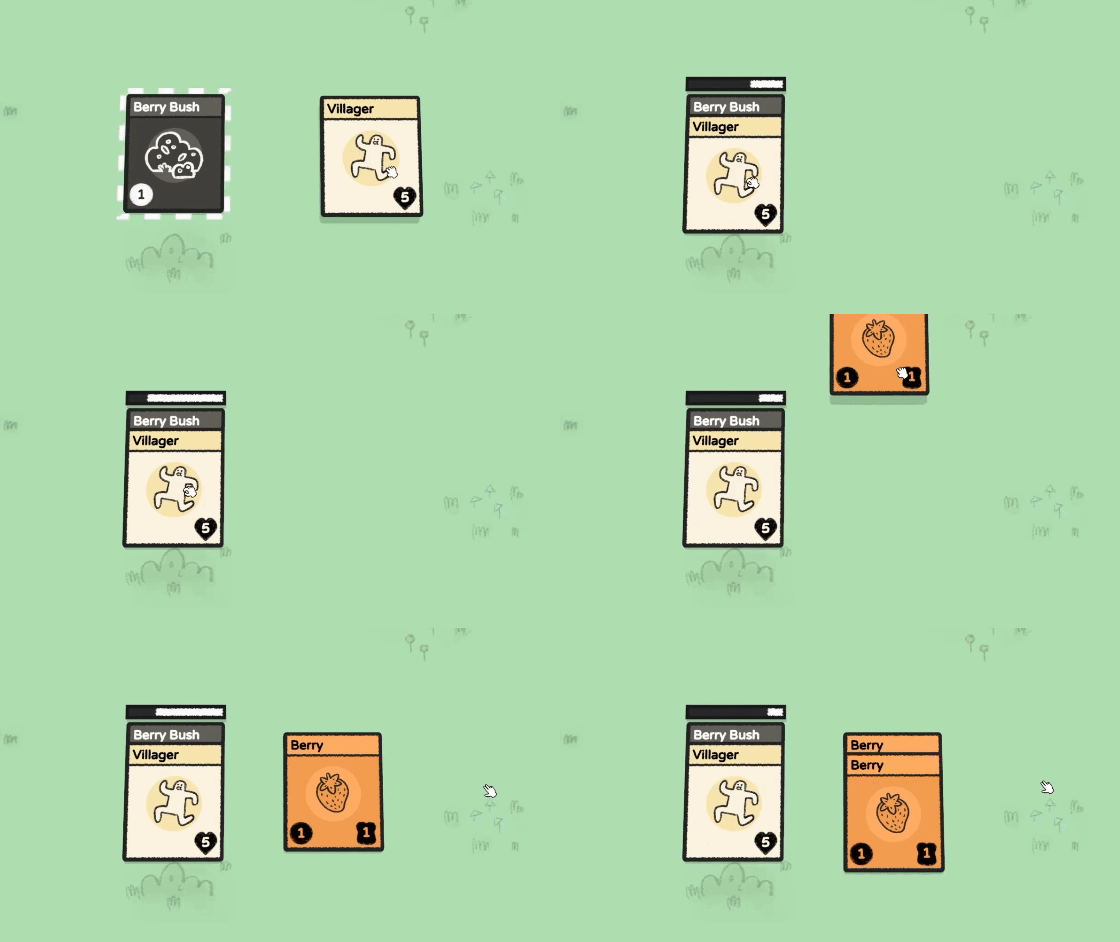
    At least to start, most cards require you to place a villager on them to generate a resource. That’s kind of a cop out, but let me give a few examples. The Berry Bush card does nothing on its own, but when a villager is placed on it, the villager will harvest 3 berries from that card before it disappears. The same is true for cards like the iron ore vein, or trees, though they give different resources. However, some cards like the lumberyard and quarry, can’t be exhausted. They can be harvested any number of times (though usually slower then the impermanent cards).

    Villager working on a Berry Bush. Gif shamelessly stolen from the Stacklands itch.io Page.

    So, how do you get cards ? There are two primary methods. The first is to buy card packs. You buy them with coins, and almost every card has a coin value. You can unlock several types of card back, and even if you die, pack types that you unlock stay purchasable. Each pack gives different subsets of cards, and while some are available in multiple packs, most pack types have at least one or two unique cards. They also have ‘ideas’.

    Ideas are the game’s recipes. You only have to unlock them once in order to be able to use them in future runs. In order to use them, you place the required items on top of each other. A countdown starts, and when it finishes, you get the item from the recipe. One minor annoyance I have is that while you can use a recipe without discovering it, the game doesn’t reveal those recipes if you find them by luck or clever experimentation. You still have to get the idea card.

    I like farms and carrots. Can you tell?

    Villagers can die in a couple different ways. It’s possible that you don’t have enough food to feed them all at the end of a round, and so they starve to death. It’s also possible that an enemy just murders them. Enemies can spawn from exploring certain locations, or buying certain card packs. They can also be spawned by a mysterious portal, which show up on specific numbered rounds. There is one more way to spawn an enemy, but that one’s a bit secret, so I’m not gonna spoil it here.

    There are also some other mechanics that I haven’t really covered here, including exploring, villager promotions, and storage limits, but I also don’t have anything useful to say about them in the context of this review.

    I do have two gripes with Stacklands, one of which is legitimate, and the other I think might be a design choice, but it’s a design choice that I find really annoying! The second strikes me as something that might have been intended to function like that.

    First, the legitimate gripe! When you mouse over a card pack to buy it, you’re given a slowly scrolling list of text in the bottom left corner that lists what you can get in the card pack, and I hate this. I hate having to wait for the scrolling to see what I could get, and I really wish I could either click on the card pack to see a list, or have the text box expand or something. I really wish I could see everything at once.

    Second, the “I just don’t like this design choice” gripe. There are a variety of cards that produce cards either when you put a villager to work on them, or when you place various resources on them. It’s never really clear to me where the produced cards will end up. Let’s use the farm as an example. You can plant a crop on top of the farm card. When the farm card finishes ticking down, a new card is created. But when a farm produces, the new card(s) appear someplace next to the farm. Since I was growing carrots by the truckload, I then had to 1. Replant the carrots and 2. Keep moving carrots around to keep everything organized.

    Like. A LOT of Farms.

    Stacklands as a game isn’t long enough for this to become super tedious, and I feel like this is a specific design choice to make growing certain crop types more mentally taxing, but I did find it annoying.

    Stacklands is $5 on itch.io, and $5 on Steam. Gametrodon editorial policy, dictates that “The people that make games should be the people that make money.” So buy it off itch.io rather than Steam. Look, you’re probs gonna buy off Steam anyway, so I’m going to make you google it.

  • Satisfactory

    I like Satisfactory. There are a lot of other things I could say about it, but I spent days playing shapez.io, and Satisfactory is Shapez.io in 3D. That is to say, it’s a game about automation and factory construction, and the optimization of those systems.

    The story of Satisfactory is that you are [EMPLOYEE#7190] for some gigantic space megacorporation called Ficsit, pronounced Fix-It, and you’ve been dumped onto some lush untouched wilderness to turn it into a giant factory. The reality is that it doesn’t matter that there’s a story, because there might as well not be one.

    In any case, after being dropped down onto a planet, there’s an opening segment that amounts to a tutorial. After being introduced to the ability to construct buildings and craft parts, the player is free to do things at their own pace. There’s no real time pressure to get anything done. There is some hostile enemy wildlife, but even those are pretty non-threatening. Let’s talk about those for a minute, because Satisfactory is a game about building things, specifically giant factories, and everything that doesn’t contribute to that feels fairly vestigial and pointless.

    Sure, there’s some hostile wildlife, and trees, and rocks, and whatnot, but they only matter to the extent that they get in the way of building. The AI for this wildlife is laughably stupid. The primary enemy, a sort of dog/armadillo thing, has constantly gotten stuck on loops trying to charge me, and then running in endless circles. It’s ineffectual enough to be forgettable, and annoying on the few instances when they actually do manage to connect a hit. The weird murder bumblebees are frustrating, but mostly pointless. Combat is just not very good.

    Exploration is a somewhat similar boat. You can select from 4 different worlds to spawn into when you start the game, but they’re all fixed, not random. There are a few things that you can pick up as you venture around the world, and some crashed ships to find, but even those crashed ships are only interesting because they can give you access to hard drives, which give you research. Research lets you pick between various sidegrades/unlockable recipes.

    Research is the game’s primary internal motivation. Most additional buildings, structures and tools are unlocked by research. The game itself consists of tiers, and completing the previous tier’s mission unlocks the next two tiers or so, and those tier’s associated missions. All of these missions involve feeding resources into something, usually your space elevator or remote dispatch drone.

    Research serves a sort of tutorial gate, forcing the player to get familiar with what they currently have unlocked before they get access to more complex buildings. Let’s look at how the game handles electricity as an example.

    Almost every building in the game requires electricity to actually do anything, from auto-miners to assemblers, to constructors. At the start of the game, after building the HUB, it comes equipped with two biomass burners. These can be powered by stuffing them full of leaves, and wiring them up to whatever needs power. Additional power requires building more biomass burners, which will also need to be kept supplied.

    When you get far enough along the tech tree though, coal becomes available. Coal-powered generators can be set up to have coal routed directly into them with conveyors, so manual refills are no longer necessary, but in addition to coal, they also need water. This means pipes, and potentially, pumps or a pump system to make sure that water is getting where it needs to be fast enough.

    Getting the most out of your power setup with coal can be a bit more involved than biomass burners. It requires at least 3 building types, a miner to dig up the coal, a coal burner, and a pump to supply the water. You might find after building your first set of generators that you need more power, and end up setting up a few more, only to realize that you’ve underestimated the amount of coal to keep things stable. Or maybe you redesign things, and forget to connect your pumps to the rest of the grid, causing a network wide outage, and forcing you to restart the coal plants semi-manually with an attached biomass burner. Maybe you’re burning too little coal, so you set up more burners, only to realize you’re now behind on water.

    At its heart, Satisfactory is a game about optimizing systems. Optimize your inputs and outputs, remove bottlenecks, and try to make sure you have enough power throughout it all. While the exploration and combat feels rather week, the building gameplay is incredibly enjoyable. The game is still technically in Early Access, with a fair amount of “WIP” content, but nothing to make me hate it. You can find a link to the game’s site here, and I heavily encourage you to check it out.

    P.S. When I started Gametrodon, I did so with the intention of not wanting the site to turn into the game equivalent of those baking websites that open with 3 paragraphs about how this recipe was the last surviving thing they have from their great grandmother, who got it from a mysterious shop next door that disappeared the day after they purchased it. But Satisfactory really makes me want to do one of those writeups, because it has a lot of things you could write about related to the game that aren’t really related to the game.

    You could cover the fact that the game had timed Epic Store exclusivity when it first came out about 5 years, still requires some sort of weird ghostly cross-play solution to play online, and that switching that behavior requires you to contact customer support for some reason. You could point out how it’s kind of weird for a game to still be in “Early Access” after 5 years of development and patches, and the weird things that exist in the game because of that, such as the creepy fucking alien artifacts that will speak to you, and make scary noises, but have been a work in progress for over 3 years. Or maybe you could cover the sort of weird tone the game takes around construction and its theming. “Here’s a perfectly vibrant planet, full of unfucked nature, get down there in the space suit you’re renting from us [VALUED EMPLOYEE#3719] and fuck it up.” I’m not sure that the lyrics “Paved Paradise, Put up a Parking Spot” was supposed to be a How To guide. It’s vaguely uncomfortable, much like any worker placement board game where you realize that the “workers” you’re placing, based on the game’s setting and historical context, would have all been enslaved Africans. Not uncomfortable enough to make you stop playing immediately, but it does make you pause the next time you’re about to pull it out at family game night.

    In short, there’s a lot of interesting hot takes you could make about Satisfactory. Fortunately the preceding paragraph of extended one-liners has gotten my desire to be Yahtzee Crosshaw off my chest. I don’t need fame and fortune from writing snarky hot takes about video games.

  • Pokemon Legends: Arceus

    I like Pokémon Legends: Arceus. Does the game have so many technical problems that I’m going to devote at least a paragraph to them below? Yes. But is it also the first Pokémon game that we’ve gotten in 25 years that is actually mechanically different than the other games in the series? Yes. Yes it is.

    The rest of this article is going to assume that you’ve played a Pokémon game at some point. If you haven’t, reading this post first will make the rest of this review make more sense.

    As mentioned above, Arceus is significantly different than previous Pokémon games. In brief: the game now takes place in a semi-open world. Story progression is based around a combination of catching lots of Pokémon, and mission completion, and there are no gym battles or equivalents. While battling and catching Pokémon both remain, the battle system has been significantly trimmed down, with held items and abilities being removed, and most status effects/stat buffs have also been changed to be simpler. The game does offer the ability to use moves in different styles, but this mostly boils down to “Do more damage, but take longer to act again, or do less damage, but act again quicker.”

    You can fight multiple enemy Pokemon at once.

    As the game now takes place in an open world, there are no more random battles. Instead, Pokémon just sort of go about the world, doing as they please, with most having a set spawn location. As such, catching Pokémon has changed, with many not even requiring you to battle them. Instead, you just need to get close enough to throw a Pokeball at them and hit them. Pokémon also don’t share the same set of behaviors either. Some will happily watch as you walk closer and closer prior to beaning them in the head with a well placed shot, some will turn tail and run, and some will see you and just start swinging/blasting bubbles/trying to poison you—you get the idea. For Pokémon in this last group, once they notice you and engage in combat, you’ll have to fight them with your own Pokémon if you actually want to catch them. The alternate option is to truffle shuffle your way through the waist high grass and wait for them to look away so you can lob a ball at the back of their head. The game actually encourages this, because back hits have an increased catch rate.

    You will never have enough Apricorns, and when you think you do, you’ll be wrong.

    Also, because this an open world game, there’s a crafting system. You can craft Pokeballs, revives, and various items with the rocks and berries you find lying around. It’s actually generally not as tedious as it might sound, primarily because the same few mats are used for a bunch of different things, and there also aren’t a ridiculous number of them you have to gather. cougheldenringcough

    The open world itself is split up into 6 or so areas, and each area is self contained. For example, you can’t go from the ruin swamp zone to the ice zone without actually going back to town, and then going to the other area on the map. You likely won’t be able to explore every part of a map when you first unlock it, as portions will be locked behind ride Pokémon, the game’s version of HMs. These are various Pokémon that you’ll make friends with and will give you the ability to swim across water, fly across the sky, and scale rock cliffs. Yes, I know it seems like flying would make climbing redundant but it doesn’t really work like that in practice.

    Realistically, these open world zones are fine. I’m gonna be honest, you could probably fill a grey box with lots of Pokémon and I would enjoy it. Pokémon Go put Pokémon on top of google maps, and I liked it. With that said, this isn’t Elden Ring or Breath of the Wild, there are no hidden secrets and crevices to find, and each zone itself is pretty small. They’re habitats for the Pokémon that live in them, and not much else unfortunately.

    So what do I like? One thing is that Pokémon are actually rendered to scale in this game. This is a small thing, but it really does build the feeling of them being actual animals in the world instead of the “Wailord is the same size as Skitty” that we’ve had from previous games. It also gets used in two of the game’s mechanical systems, where catching Pokemon of different sizes can be a goal for various surveying missions and to distinguish Alpha Pokemon, which I’m just realizing we haven’t covered yet.

    I just realized Dusknoir has red eyes by default, making this a terrible example of what this sorta thing looks like…

    While you’re journeying around you might find a Pokémon that seems much bigger than you’d think it should be, with glowing red eyes. These are Alpha Pokémon, and they’re great. Outside of the immense bulk, there are few other critical differences. They tend to be much higher leveled then anything in the surrounding area, sometimes have special attacks, and have zero chill. They can’t be captured except by battling them, and until your Pokémon are in the 60-70 level range, they can and will thrash you into the ground.

    I really like this because in most Pokémon games, catching Pokémon is pretty much a zero risk process, and you’ll never actually be able to go back to an area and be challenged. Alphas are a nice change of pace, and one of my most memorable moments in the game was wiping my team multiple times into an Alpha Tangrowth, then reviving them while it tried to put me six feet under. Alphas also tend to be Pokémon that could only have been obtained via evolution in previous games, so its just cool to actually fight and catch them in their already evolved forms.

    Yes, that’s a wild Empoleon. It fainted from recoil damage. There was some salt.

    Now that we’ve covered the actual game and mechanics, let’s talk about the game’s massive technical failings.

    First, a brief statement. Creating games is a complex process with multiple disciplines and processes involved. That said , I consider most of the things in the paragraphs below to be effectively statements of fact. Maybe mimicking Super Mario 64’s performance and art style is a design choice, but I don’t give a shit. The game should not look and have performance issues this bad.

    Most of the environments in the game look like garbage, and they feel incredibly static and stale outside of the Pokémon inhabiting them.
    The Pokémon/NPC’s look good, but if you get more than 4 NPC’s on the screen even during a cutscene, the framerate dips. Because of this, there are very few situations where you can have large numbers of different wild Pokémon on screen, and the end result is that the game’s world can feel underpopulated.
    The game has an amount of pop-in/fade in that’s comical on everything, and when you’re flying around looking for a specific plant, or a Pokémon that might be the size of that plant, this actively screws with your ability to find it. Of everything on this list, this one is biggest hindrance to actively playing the game, and pisses me off the most.

    See that little hill in the distance, with nothing on it, and nothing anywhere around it?
    It’s the one we’re hovering over right here.

    In addition to all of this, the game has one of the most screwed up systems for animation level of detail that I’ve seen. It’s most visible on any of the flying Pokemon such as Gyrados, Togetic or Crobat, but you can actively see the point at which they get far enough away from you for the game to start dropping frames from their animation cycle.

    Anyway, that’s Pokémon Legends: Arceus. If you’re someone like me who’s always wanted a Pokémon game where you run around massive open environments trying to catch Pokémon, and see them at actual scale, this game is pretty much exactly what you’ve been waiting for. You’ll be able to ignore the game’s flaws and have a lot of fun.

    If you’re someone who played the games primarily for the battle system, or for engaging with the secondary mechanics like breeding for perfect IV’s and competitive move sets, those systems have been either stripped out or massively simplified, and I suspect you won’t have as much fun. I don’t personally think that the removal of things like abilities and held items is made up for by the games strong/agile move styles.

    And perhaps you’re neither. Perhaps you’re not a Pokémon fan. If that’s the case, I would say that your enjoyment is going to depend heavily on what you want out of the game. You want a game with a mediocre open world, but a bunch of really cool monsters to catch? This could be for you!

    If you want a game with an open world that tells a subtle story via its environment and mechanics, with a focus on difficult combat and challenging gameplay? Well, you probably want Elden Ring instead.

    You want a large underwater eel? That’s a moray.

    Pokémon Legends: Arceus is $60 for Nintendo Switch, and only Switch, because the day we get a mainline Pokémon game on a non-Nintendo console is the day we look out the window and see a flock of pigs sailing unimpeded across the clouds.

  • Nobody Saves The World

    Nobody saves the world is pretty great. Between its use of its ability combo and form swapping mechanics, I found it to be an incredibly fun game. The only problem I have with the gameplay is that it mouse/keyboard simply doesn’t play well. A controller is basically required. Otherwise I had a fantastic time with it.

    Nobody Saves the World is played from a top down perspective, where you take on the role of the Nobody, a short, blank eyed sort of blob person with no memories of their past. After waking up in a dilapidated shack, and “borrowing” a magic wand from the home of the great wizard Nostramagnus, you set off on a quest to find Nostramagnus, save the world, and figure out how exactly you got here in the first place.

    I was gonna post a real zoomed out picture of the world map, but then I realized since this was from my NG+ file, it gave some pretty massive spoilers. So have a smaller one instead.

    The magic wand you ‘borrowed’ ends up being the key to all of this, granting you the ability to shift forms. You start out only being able to swap between your pale blobby self and a rat that’s somehow still better in combat than your blobby self. But you’ll start to unlock more forms fairly quickly, such as Knight, Ranger, Magician (the rabbit-from-hat kind) and Egg.

    There are 18 total forms available, of which I’d say 17 are meaningful and useful. (Plot twist: the useless one isn’t egg.)

    There are two big things about the transformation system in Nobody Saves The World that I like, but explaining them is going to require a little bit more discussion of the other half of the game’s title: the “Saves The World” bit.

    See, it turns out that two big problems have popped up at about the same time. The first problem is that the great wizard Nostramagnus who you “borrowed” the magic wand from has disappeared. The second problem is that a giant hivemind flesh blob thing called the Calamity has showed up and is trying to eat the entire world. Presumably Nostramagnus would deal with this if he wasn’t missing.

    Anyway, since you have the magic wand, a few other characters decide that you might as well help collect pieces of the gem needed to reseal the Calamity, while they search for Nostramagnus before the world gets treated like a buffet.

    Finding these gem pieces, all of which have ended up in large dungeons around the world, sealed by wand stars, is your primary goal. In order to unlock the dungeons, you’ll need to get enough wand stars, and occasionally convince the people guarding these places to let you in. As it turns out, “I am a very legitimate individual, let me through” is actually a pretty terrible way to get into a sacred mausoleum.

    The Headquarters of the New League of Wizards. (The New LOW)

    I think that’s enough background to give a good picture of the game’s primary gameplay loop. Explore to find locked dungeons, towns, and other stuff. Do side quests and mini-quests to get more wand stars, and unlock the game’s main dungeons. Clear the main dungeons to get MacGuffins to advance the story, giving you more areas to explore. I don’t think explanation quite does justice to how much fun doing all of the above is.

    But anyway, remember when I mentioned several paragraphs ago that I like the game’s transformation system for two reasons? Let’s get back to that for a moment. A lot of games with transformation systems seem to use them as glorified keys. Turn into a penguin for the ice zone. Turn into a ninja for the stealth zone. Turn into a cop for the donut zone. But outside of the respective zones, each of those forms is often fairly useless.

    NSTW doesn’t do that. While there are a few situations for where you need a form to travel, even those tend to be fairly open (i.e., if you need to get over a large body of water, the turtle, ghost, dragon or mermaid are all equally viable.) But the meat of the transformation system is all about combat, and it feels fantastic.

    Form swapping can be done from both the menu screen, and by using the scroll wheel on the fly.

    NSTW resembles an action RPG. Each form in Nobody Saves the World has a basic attack, and a passive ability, in addition to its base stats. These two abilities are locked onto that form, and they are fairly varied. As an example, the horse’s basic attack is a kick that hits behind the it, while the slug’s basic attack is a series of small projectiles that are fired after a brief charge time. The strongman has large slow attack that hits most of the area in front of him, while the ranger fires arrows. All these basic attacks regenerate mana when they hit an enemy.

    But the forms aren’t limited to these attacks. As you rank up a form by completing its quests, you’ll unlock additional attacks, and when you hit various thresholds for just leveling in general, you’ll unlock additional passive slots.

    Both the additional attack slots and passive slots aren’t locked however. You can switch them out with the attacks and passives of other forms that you’ve unlocked.

    My maximum zoom horse loadout.

    Here’s an example: the slug has one of the lowest base movement speeds in the game, but gets access to an ability that grants it 150% movement speed, and leaves a trail of slime on the ground behind it. You could equip the slug with the generic ability that raises its base movement speed to flat value that can’t be lowered. But you could also take that speed boost ability and put it onto the horse, who has one of the fastest movement speeds in the game, boosting its speed to ridiculous amounts, and traverse the map exceedingly fast. Of course, that still risks you running out of mana, so you’ll equip the ability that lets us spend health as mana, and now you have a turbocharged horse leaving a trail of slime behind it as it rockets across the map.

    Maybe that’s not good enough though. Perhaps you want to add the strongman’s passive that makes it so that whenever you would bump into an enemy while slime sliding, you knock them back and deal damage to them if they collide with anything. Maybe you want to add the rat’s passive to build poison on hit, or the dragon’s that increases crit chance against the already slowed enemies.

    Nobody Saves the World is absolutely chock full of interactions like this, and it encourages you to use them. Every single form has uses, and is fun to play, giving you a heavy amount of customization while also keeping the forms different through their built in basic attacks, and single locked passive.

    And perhaps most importantly, Nobody Saves The World knows this, and it tries to show you these combos and tricks. Many of the quests to rank up a form require you to do something that the form’s basic skills won’t allow, and you have to figure out how to mix and match to best meet that requirement.

    In addition, not every trick will work in every dungeon. Some dungeons won’t have healing items. Some dungeons will have enemies that are status immune. In one particularly interesting one, all damage dealt both from and to enemies is multiplied by 9,999, and this dungeon isn’t a gag or a joke! It’s a puzzle to be solved with clever ability usage and munchkin tactics.

    There’s a few parts to the combat system I’m not even covering here, such as status effects and elemental wards, but I want to talk about another thing the game does as well.

    Purely on its combat alone, Nobody Saves The World would be great. However, in addition to that, it has some incredible art, and great writing. The feel of the world reminds me of something like Gravity Falls: a bright, vibrant place but with some bite to it. There are a lot of fairly funny moments, and also a few pretty powerful ones.

    Okay, so let’s wrap this up.

    I personally think that the highest form of praise that can be given to any piece of media is to engage with it, and for games that means playing it. For Nobody Saves the World, I played through the whole game, and then started the game’s New Game+ mode, and played through all of that. I’ve hit the game’s level cap, gotten every single Steam achievement, and completed every quest. The game is just incredibly fun, and the world, writing and art is so good that I went out of my way to play the whole thing twice.

    Nobody Saves the World is available on Steam, and various consoles. It’s like $25, and its absolutely worth it.

    PS: For anyone wondering how the egg could possibly be useful… Despite its incredibly low stats, it has a self heal ability. The heal doesn’t heal too much HP, BUT when you shift forms, your HP % stays the same, and if you equip the “Spend life as mana” passive, you heal more than you take. So you can switch to the egg, heal up to full, and then switch back to another form and be back at max health.

    PPS: The second highest form of praise (and probably the first highest if you’re actually the developer) is buying the game for other people. I did that too.