
When I got home yesterday, the first thing I did was to eat a sleeve of oreos. Calling it a sleeve is bit of a verbal trick, because it makes it seem reasonable. Acceptable almost.
If I say that every day I eat 13 oreos in under 20 minutes, you’d be more worried.
I could pull off the same verbal trick again by saying I then played some 9 Kings, when the truth is that I sat down and played the game for about 6 hours straight. I played it until the batch job I have on my computer ran and shut my computer down.
The thing is, if you asked me, I’d say the same thing about the oreos and 9 Kings: I’m not sure that I particularly like them.
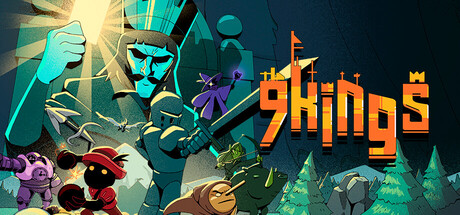
9 Kings is a city builder/card drafter/roguelike. There are multiple modes, including single player, competitive asynchronous multiplayer, and special scenario quests, but I’m
mostly going to focus on single player.
You start a run by picking one of the nine kings, and possibly some perks, then you’re thrust into the run. There are 9 kings, each with 9 different cards in their pool.
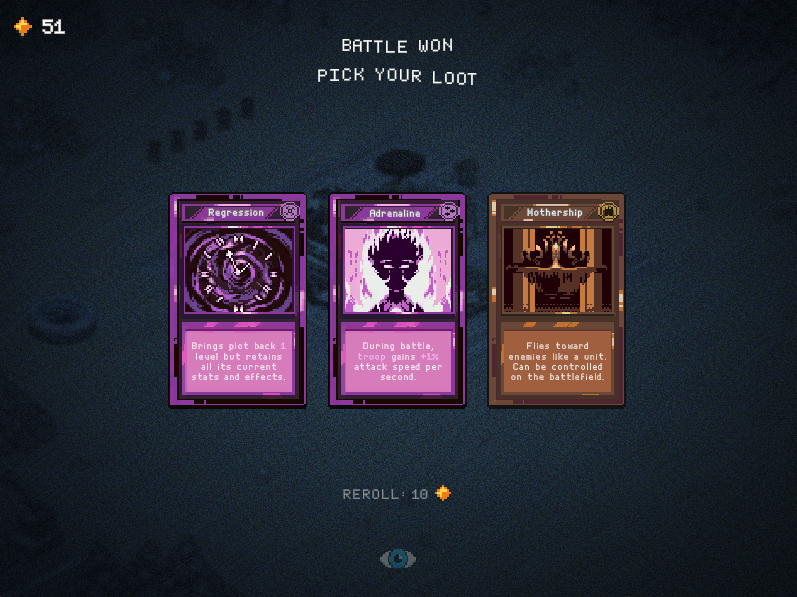
Each round, you’ll pick 1 of 3 cards being offered, which gets added to your hand, then you’ll place cards from your hand onto the grid until you have two cards left, at which point the next attack starts. The grid starts at 3×3, and can be expanded to a 4×4 as the game goes on.
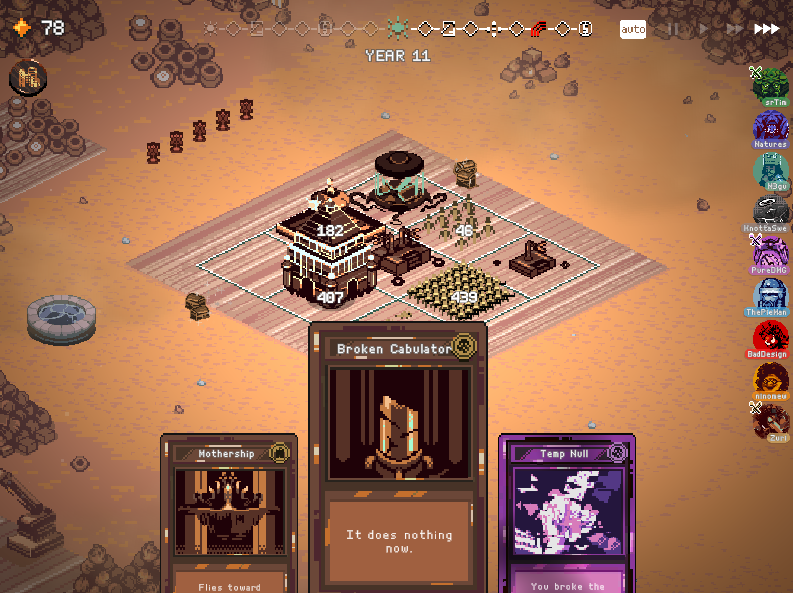
Cards fall into four-ish categories: Troops, Buildings, Enhancements, and Spells.
Troops are you little guys who fight for you. Maybe they’re wizards, maybe they’re demons, maybe skeletons. They have some stats (HP, Attack, Attack Speed, Movement Speed) and they might have some sort of special ability or property.
Most interestingly to me, they also have a stat for Troop Count which is how many of them are availible. They replenish to their max troop count after each fight.
Buildings are… well, they’re buildings. They don’t have an HP stat, and they can do a variety of things, from summoning troops during a fight, to buffing units around them when conditions are met, to just being large siege towers.
Spells are mostly what they say on the tin. They’re generally single use, they provide some sort of benefit, and then they go away. Sometimes they have interesting interactions or rules, but they’re often just fairly straightforward.
Enhancements are… well, they’re spells that you put troops. They might give them chaining lightning attacks, or a heal over time, or whatever.
You can also stack copies of a card on top of another card to level them up, up to a level of three by default.
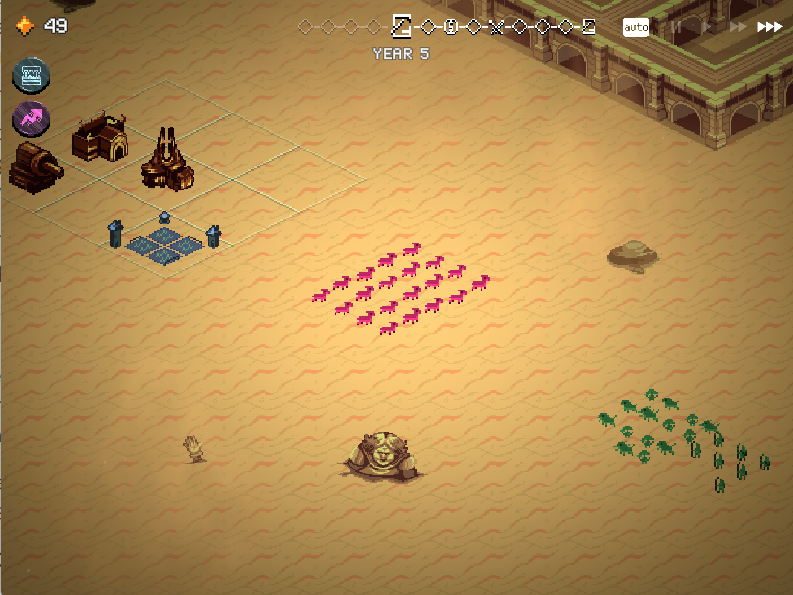
Combat works by spawning in all your troops, spawning in enemy troops, and (in singleplayer) going until you’ve killed all them, or they’ve reached your base. If you kill them, great, go next round and draft another card. They reach your base, you lose a life. Lose all your lives and the run is over.
There are actually a lot of things that annoy me about 9 Kings now that I’ve managed to put more time into it.
The Problems
I’ve got a number of problems with 9 Kings.The first problem has to do with how little information the game gives you make choices with, primarily as it relates to stats.
You can’t see the stats of units you place on the board until you place them, unless you choose to open up and check the compendium. But you can’t open the compendium during the 3-pick-1 draft after each round, which means you’re making your decision either off vibes or their special abilities. But it gets worse.
In singleplayer and quests, you also can’t actually see the stats of the units you’re fighting against. This is kind of a huge problem, because it means it’s actually impossible to vibe out “what” exactly you’re playing against in any given run, and more importantly, when you lose, it’s very hard to tell why you lost. Especially because unlike many singleplayer autobattlers, you can’t pause and look at your opponents unit composition, and their stats.
The result of all of this is that I found that every single game, match, and quest, I played effectively the same strategy: Just make a single huge unit stack.
It doesn’t matter if you have 25 summoners who chain summon units, 36 backline archers, and 73 frontline tanks, if I have 50 guys, but they’re all bigger then yours by an order of two magnitudes. If I have 1000 hp and 50 attack on each of my guys, and you have 50 HP and 8 attack, you lose, I win, next round. This meant mostly ignoring neat stratgies, and building around unit buffering structures and abilities. Making a balanced force of different units is a waste when because of how the percentage buffs work, there’s more value in just putting them all on one unit stack. There’s also no real counter-play to this that I found. (Except in multiplayer where it probably loses at semi-parity to Steel Skin Adrenaline Warpers, but that still requires them to be at semi-parity, and you to not have lightning.)
The end result of all of this is that the game became kinda mindless after a while, and stopped being fun.
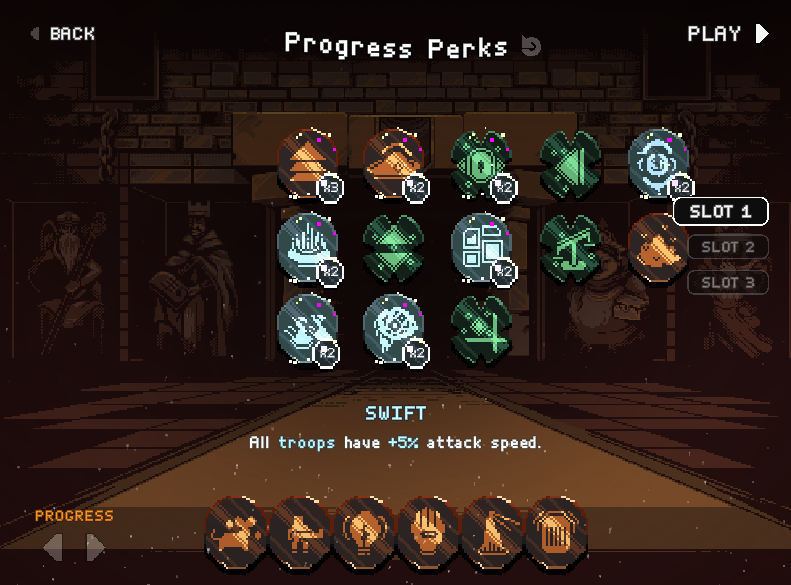
Next up, perks! Perks are the games meta-progression system, they’re buffs you place on a 3×3 grid at the start of the run, and they give you buffs. While the individual design of perks are neat, as a whole they just serve as flat power buffs. I found I mostly didn’t think about them. They often just feel like they exist to offset poor play. For example, there’s a two perk combo that just doubles your starting lives.
I especially dislike them in multiplayer, because as far as I can tell, you can’t actually see your opponents perks. Which if, y’know, they were build defining, seems really stupid.
I also want to briefly talk about the starting bases. These are all starting towers, but unlike other towers they can be auto-targeted, or manually targeted, but the auto-targetting is a bit wonky for some of them. It felt like King of Nothing in particular was especially crap at actually targeting it’s AoE on full groups of units. There have also been multiple situations where I’ve won rounds I would have lost if I hadn’t use manual targeting.
Frankly, I don’t like that I have to micro them, and I really don’t like that the auto-casting is a bit shit.
Multiplayer
Now, multiplayer fixes a lot (but not all) of these problems. You can see who you’re matched up against in the next round, and see their builds and stats. The “Meta” of hyper scaling seems to still be present, but at least now you’re trying to outrace other players while surviving, so that’s more interesting.
However, unless I’ve missed something, the problems with not being able to see perks, and having to manually target with the starting bases remains. Multiplayer is much better, and at least somewhat more interesting, but so far it’s also still felt like the winning strategy is still to just have the biggest number.
Overall Thoughts
Overall, I don’t quite know what to think about 9 Kings. First I really liked it, then I disliked it for reasons I couldn’t put my fingers on, then I liked it again, then I figured out why I was disliking it, and then it turned out that multiplayer sorta solved some of the problems. It’s a very solid autobattler, but with a lot of frustrations. It’s enjoyable, but lacks much in the way of non-telegraphed strategy. A solid 8/10.
If you have a weekend to kill, and have $10, you could do worse. At the same time, if you don’t play it, I don’t feel like you’re missing out on much.