Like some monster in a horror movie who is defeated, only to return for the sequel, I am back! And I’m back in the Omegathon. Also, I saw this rad card game, and I played some sealed Riftbound, and I helped run the Pokecrawl!
Woo. Very busy day. Lets start at the top shall we?
My morning was dominated by two things: Getting the most I could out of media hour on the show floor, only to be followed by competing in round one of the Omegathon. For media hour, I mostly bumped around the show, chatted with a few folks, and I want to call out two things.
First up, Brother Ming is out demoing Re;MATCH! It’s got a Kickstarter1running right now. Longest time readers will know that I have been waiting for this game since 2020, and that it has been a long and interesting road to get her, but I’m thrilled that it’s gonna be a real thing I can own.
The first big discovery of PAX East though, the first exciting new thing, is Eidol.
It is Path of Exile crafting meets a card game. It is fascinating, it is ambitious, and I am so deeply hopeful that it works out. I recognize that asking you to put your trust in me, and join a Discord for a game that doesn’t exist yet, and even the Discord server is a bit sparse, but trust me: this thing has stupid amounts of potential, and if I could have you play this demo, I would.
And as I final brief aside: Orna has a booth! I wrote about Orna almost 4 years, but since then the game has evolved immensely. I’ve been told the game now has a queuing feature where you can “collect” encounters, check ins, and events, and then play them all at once later, solving my primary issue with the game: Trying not get hit while a bus while playing classic RPG combat is actually kinda difficult, so I may have to give it another try.
Which brings up our next topic of interest: Round 1 of the Omegathon.
Okay. So.
It was Rocket League. I am quite bad at Rocket League, but in what is becoming a bit of a running bit, I was carried by my awesome teammate Dizzybelle. I would also like to note that unlike last year, I DID practice rocket league. I played like 10 hours! I’m just very bad at rocket league.
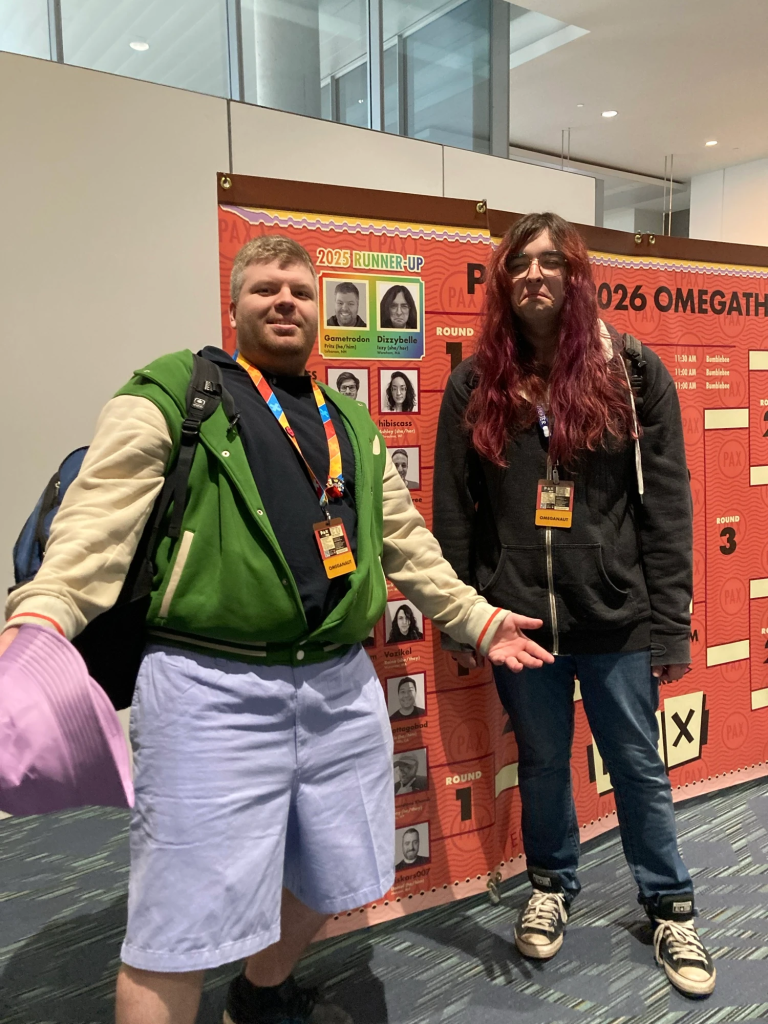
Witness the faces of the returning “were very close to being champions”.
Anyway, after that I grabbed some lunch, and did a little meandering before sitting down for my second competition of the day: a sealed Riftbound event.
I haven’t played anywhere near enough Riftbound to have a good set of thoughts about it yet, but what I’ve played so far has been interesting, and I generally like it. I didn’t do incredible, winning round 1, before getting cleaned out in round 2 by a much more experienced player who was kind enough to help me fix my deck after.
I find Riftbound much challenging then many of the card games I’ve gotten into recently, as there are a lot more play lines then I’m used to considering, even compared to magic in some situations.
Anyway, I had to drop from that early to get over to help run the Pokecrawl! I’ve done this about 3 times now, and it’s always a fun event, and it’s even more fun to help run!
And now I am back home. And I am tired. This reads a bit more like a journal entry then it does a full writeup, but I think that, and unpacking a million cards is all I have energy for now, so I’ll end it here, and I’ll be heading back to the show tomorrow!
P.S: If you’d like to try out the newest Card City Critters puzzle, keep an eye out for me around the show! I’ll be wearing the same goofy green sweatshirt, and possibly a ditto bucket hat!
Quick Disclosures and Whatnot: I’m a Kickstarter backer for the this. Do your own research before deciding to back Kickstarter projects, because my risk tolerance my not match yours. Okay, back to normal writing.↩︎
pls pls pls pls let this proclamation age well. ↩︎
So, I got the chance to compete with the Omegathon last year, but before I talk about that, I’d like to tell a quick story.
A long time ago at this point, I had a friend who loved the musical Hadestown. I’ve never seen the whole musical, but there’s a line from it stuck with me far after we’ve fallen out of contact, and I can no longer quite remember them as well as I’d like1.
And it’s this.
But that’s just how the story goes.
Much like the story of Hadestown, I already know how this story ends even before writing this.
I still think about it and that friend a lot. Perhaps more then I’d like to admit.
Prologue
Now that we’ve gotten that somewhat grimmer then expected opening out the way, lets talk about the Omegathon! It’s an event that takes place at PAX where a set of random attendees are selected to compete across all the days of the show in a set of single elimination games. The winner gets $3000, and the runner-up gets to compete in the Omegathon the next year.
PAX East is also a little special in that it’s all teams of two, which means that one of the first things I want to do here is introduce my kickass teammate, @shiraffetopus.
As such, something really important I want to note going forward is that while I’ll be purely speaking about my experience, and my thoughts, there was ZERO chance that this run got as far as it did without her as a teammate. I’ll also be introducing a few other key folks in the journey as we reach them.
Act 1 – F-Zero X – Thursday
The first game was F-Zero X, a game that technically was released when I was alive, but not much else. As such, I’d never played it or another F-Zero game at all before.
I would like to tell you that with this information, I practiced F-Zero X hard for the month prior to the event, mastered the game, cleared all the expert difficulty stages, and came in ready to compete.
Unfortunately that would be lie. I spent the last month playing Blue Prince, Skin Deep, FragPunk, and a bunch of other games all of which were not F-Zero X. I did download the game off the Nintendo Online, and play a bit, but I mostly sucked.
Fortunately, as noted above, this is a team tournament, and so I had a teammate in Shiraffetopus. And unlike me, she had been practicing.
Of course the spirit of the Omegathon is to always spice things up just a little bit, and as a result, this wasn’t going to be any old F-Zero X race.
No, this was on the F-Zero X Japanese exclusive expansion pack, with a custom course made just for the Omegathon. And in addition to that, we had a choice of driving either in tandem, each player having a hand on the controller, or switching off between laps.
After some quick discussion and evaluation of our options, we decided that it would make more sense to have Shiraffetopus drive the first and third lap, as she was the much stronger player of the two of us, and to have me… just mostly try not to crash during lap two.
I did my job, I did not crash, and we made it to round 2!
Act 2 – Push Me Pull You – Friday
After reviewing my non-contribution of Day 1, I was determined to not let that happen again. As such, the next day I pulled out my chunky gaming laptop, a pre-COVID purchase from when I still traveled for work, downloaded Push Me Pull You, plugged in a controller, and realized that I needed at least one other person to play with. After a few postings across the various PAX discords, I was able to find another Omeganaut who was also looking to practice, and we ground out a few rounds.
We also managed to get a few rounds in as a team, so I was feeling fairly confident, and that confidence was mostly well placed! We managed to shred our opponents, and so I sat down feeling very satisfied with myself.
Then the next match of Push Me Pull You happened.
As a side note, I’m finishing up some of this several months later, so I apologize for any mistakes here, but I believe the next match was Guys Being Dudes vs Party in the USA.
And just… holy shit.
Had these two teams been matched into literally anyone else, myself and Shiraffetopus included, it would have been a bloodbath. They were far and away the strongest of anyone else who played that day. I did not think of Push Me Pull You as a solved game, but it turns out if you have the right coordination and tactics, you can absolutely just play in such a manner that once you set up, your opponent can do nothing to stop you.
It was mildly horrifying.
Did I mention that whichever of these teams won would end up being our opponents for the next round?
Act 3 – Wavelength – Saturday
Saturday’s game was Wavelength, a fairly well known party game that I had never actually played before. I’ll go over briefly how it works, before I go over the strategy me and Shiraffetopus used to squeak past this round.
Wavelength’s main component is a dial with a set of scoring zones. The dial is spun randomly, and then hidden. A card is drawn with two polarities and one player has to single to their teammate with a single word clue where to place the dial.
Image blatantly stolen from the Dicebreaker review of Wavelength by Charlie Theel, before the site was thrown into a blender by IGN.
Enter Stage Right – ?????
I’m gonna call this person ?????, because I have no idea if they want to actually be named. If they do, I’ll have to rewrite this section, but I suspect they don’t.
I asked them at one point if they would have done the Omegathon with me, and they responded by saying that “Being up on stage in front of people playing a game is my version of hell”. Anyway. ????? is very good at games, is a friend of mine, and had played Wavelength before, and they had a theory about the game.
In their mind, the primary problem with Wavelength is one of alignment of scale. Lets say you pull a card that reads “Hot/Cold”, and the dial is set to the far left, so very cold. I might say Antarctica, because that’s the coldest place on earth, but you might think that I mean only somewhat cold, because of the vacumn of space is much colder.
This is the alignment problem.
What ????? had Shiraffetopus and I do before we played was agree on a “scale” to use if we got clues or questions that we didn’t have a good reference for. And that scale was Pokemon, as it was something we both had a shared interest in.
And this meant that when we found ourselves with what might be the single worst card ever made, “Push Me/Pull You”, I gave the clue of Ivysaur, keeping us in contention with a perfect guess from Shiraffetopus. This was followed by Shiraffetopus also nailing a guess on our opponents “10 Minute Game/10 Hour Game” to win us the round, and push us into the finals.
Act 4 – Killer Queen – Sunday
The final game of the Omegathon is a secret, up until the last moment. And when it was announced as Killer Queen, I was ecstatic.
See, I’ve actually played a fair amount of Killer Queen Black, the not-quite-sequel to Killer Queen. Not a huge amount. But as the only person on the team who had played before, I thought I had a pretty good shot at winning the game, as I’d be familiar with the strategies and tactics.
A few big wrenches would immediate be thrown into the plan though. First up, both teams were granted a backup player in the form of a someone far, far more familar with Killer Queen then I was:
Jyro, one of the developers on Killer Queen, and Daphane, a professional Killer Queen player3.
Secondly, it turned out that despite my initial confidence, there were large number of differences between Killer Queen, and Killer Queen Black. This included mechanics, tech, and movement of units, and how killing units worked. Not super important if you’re playing a game casually…
Somewhat more important if you’re playing for $3000.
After some discussion, my plan with Shiraffetopus was pretty simple. I would play the Queen, we would call up team members from the audience, and we’d go for a more aggressive military victory. Our plan was to try to crush our opponent before they had time to get more familiar with the controls.
It almost worked.
We managed to take game one and two with some fairly aggressive positioning. I was feeling pretty good about things.
And then we lost game three.
And game four.
Game 5
After game 4, I called a quick huddle, and asked for everyone go for a pure military victory. Given that we’d previously had pretty good luck with pulling that off, I figured that if we put everyone onto warriors, and aggressively chased the queen, we might have a chance before they outplayed us.
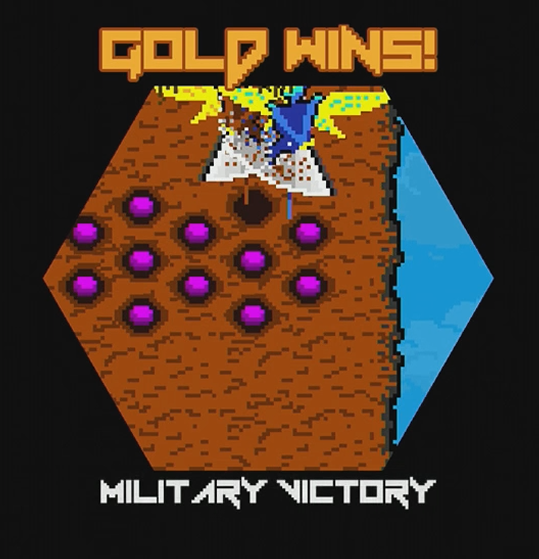
Unfortunately for us, they took a strong economic lead, and I didn’t do an effective enough job of controlling the gates. With two berries left and both of us on our last life, we boxed in their Queen, and I went in for a clash.
One of the core mechanics that Jyro explained to us beforehand was how combat works. In Killer Queen, the higher unit will always kill the other unit if the attack connects.
In some sense then, in this exact moment, I lost the Omegathon to a height difference of about six pixels.
But y’know, not quite.
The reality of though is this: I didn’t have to go for this Clash.
I could have been more aggressive earlier in the game, or tried to do zone control purely for our side of the map.
I could have done something other then call for the military rush I asked for, and that my teammates delivered on.
Dragula Slammers won because they forced us into a position where I took risky play to try to avoid certain defeat, and still failed.
And that’s how I got second place in the 2025 PAX East Omegathon.
Epilogue
I don’t like losing. I don’t think anyone who plays games really does.
That said, losing in front of a crowd of hundreds of people on a massive stage is still a bit of a new one. In order to finish out this writeup, I’ve had to watch myself fail over and over on Twitch.
It is a deeply novel experience.
That said, second place gets to compete again. So, next year, I’ll be back. This was still an incredibly fun experience, even if I got so close only to miss out on being a champion.
I also want to offer some small quick thoughts on strategy, what worked well, what worked less well, and what I’d do again.
Play every game beforehand! It doesn’t matter if it’s for five minutes. It doesn’t matter if it’s with the wrong controller. Do whatever you can to play the game beforehand. Any experience will go further then no experience.
Strategize with your teammate! A bad plan well executed is better then no plan at all. The Omegathon at East is a team game, and you can’t win without your teammate.
Expect the unexpected. If you can try to figure out what the twist will be for a specific game, or at least be prepared for the twist, it’ll help when it comes up.
Play it out, even if you think you’re losing, or don’t think you can win. The reality of it is this: You don’t need to be better then everyone else. You just need to be better then your opponent for just a few moments. Comebacks can happen, and you might not ever get another chance to compete in the Omegathon.
So just give it your all and see what happens.
That said, if you happen to get picked next year, I am going to do my best to crush you.
If this post at any points seems a little melodramatic, it’s because I wrote the majority of it last year immediately after losing, then spent several months just sorta sitting on it. Today might be the last day it’s relevant, so I figured I’d just put it out there, and call it a day.↩︎
If it’s not obvious, I don’t like losing. I don’t like it one bit. The best way I can put it is this: I can (and do!) lose gracefully, but inside it tears me up a bit, and based on discussions with friends, more then most folks.↩︎
So, I don’t know that Daphane plays Killer Queen exclusively as a job or anything, but she was introduced to us as a pro, and calling her a “semi-pro/high level player” seems to somewhat understate the achievements of the person who is going to straight up butcher me in the next 30 minutes. Spoilers, I know.↩︎
Edit 3/27/2026: For various reasons, I would like to quickly elaborate that I think Once Upon a Galaxy is a good game, and you should play it. It’s cool. I don’t intend to change my actual writeup, but uh, rereading this today, I think it comes across a little less enthusiastic on it, and slightly more caustic then I actually feel.
We all remember Storybook Brawl, right? It was a cool card based auto-battler with a fairy tale theme by way of Shrek meets Grim. In 2022 it sold to scrappy little company called FTX, and in 2023 it was shut down when everyone involved in FTX was being prosecuted for 16 billion dollars in fraud.
As far as I can tell, at least some of the people in Good Luck Games went on to make Once Upon a Galaxy. It’s a cool little card based auto-battler with a fairy tale theme by way of pop culture references meet Grimm.
Write what you know I guess.
Making a game, getting it popular, selling it to a Crypto company1, then making a new company to make a new game that is pretty much just a better copy of your old game is a bold strategy. It seems to have mostly worked out for Matthew Place and the team at Million Dream Games, presumably because everyone who might be upset about them doing this is currently in prison2.
But I’m not here to recount the one time in the last 20 years that financial criminals were held even remotely responsible for their actions. I’m here to talk about Once Upon a Galaxy.
I’m gonna be honest, I feel like I should put an in-depth explanation of the games mechanics here, but I’d just be rewriting paragraphs 3 through 5 of my Storybook Brawl write up, so just go read those real quick. We can pretend I put them here.
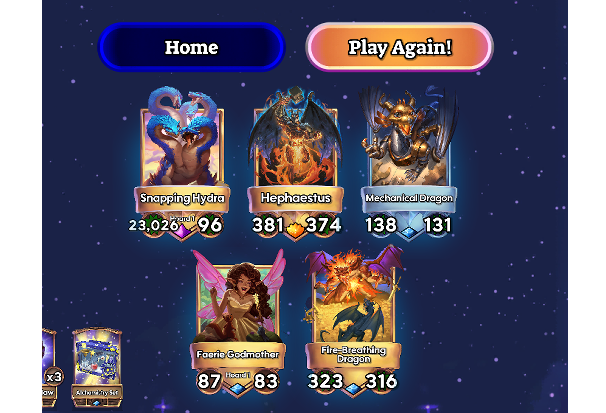
It’s actually a little tricky to find good images of Once Upon a Galaxy, because the combat screen and shop screen look pretty much the same to anyone who hasn’t played the game. Anyway, please appreciate my 23k Snapping Hydra.
There’s a lot of things in Once Upon a Galaxy that were copied over from Storybook Brawl. The core conceit is pretty much the same: Pick a captain3/leader card, build a team of units, have them fight each other, stay alive the longest to win. But there’s also a lot of fat trimming going on here, places where Once Upon a Galaxy looks at Storybook Brawl and goes “No, I don’t think we need that.”
Most notable is probably board size and reserve. Storybook Brawl had 7 combat slots, and 3 reserve slots. Once Upon a Galaxy has 5 slots. There’s no gold to managed for buying units either, instead every shop is just a 4-pick-1 rogue-lite style set of choices.
Of course, there’s also a fair amount of stuff I haven’t seen before, or things that are tweaks from existing mechanics. Treasures existed in Storybook Brawl, but they were limited to a max of 3 per player, requiring you to throw one away when you got your fourth. In Once Upon a Galaxy, they are no longer locked down in that way, opening up a whole bunch of interesting space, such as dragons that care about creating them, and get buffs based on the number, to characters that manipulate the stat buffs they grant.
I could probably write multiple paragraphs about Candy, a cross card type mechanic that influences a global “Sweetness” value, and is used as both a modifier of spells and card abilities. It’s also a good example of how the game creates glue for it’s archetypes, with various candy cards adding the Candy type to non-candy cards, allowing them to be slotted into an archetype they otherwise might fall out of.
Generally speaking, the game feels fun to play even if a few strategies feel over represented, or good across multiple captains.
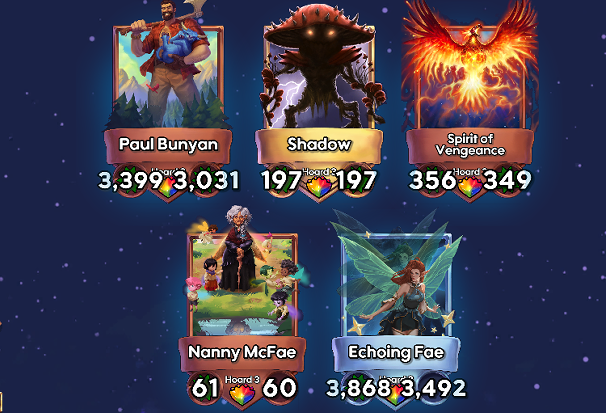
This was supposed to be an image of a Animals comp, but then I got this CRAZY Paul Bunyan/Echoing Fae synergy combo off, and I had to see what happened, and then I realized I needed to stop playing if I wanted to actually finish this article.
Probably the biggest mechanic (or the one I will attempt steal at some point) is slot buffs, where buffs can be applied to a slot, and not the characters in the slot, so that you can replace them without losing the picks spent on those buffs. And of course, some characters interact in a cool way with those buffs!
One of the genres core mechanics has also been adjusted in a pretty clever way. Most auto-battlers have a mechanic where drafting multiple copies of the same unit powers that unit up, usually three copies. This could put you in a difficult place if you got the first two, but never found a third. Once Upon a Galaxy, banishes this, instead making each copy after the first a promotion, first to silver, then gold. Picking a silver unit gives an extra shop, and picking a gold unit gives a treasure.
There are some things that are just copied, like the Slay4 keyword, which has been renamed to Hunt. I’m okay with that. I think it’s fine to copy your own mechanics.
Then there’s the things they copied that I wish they didn’t.
I have a limited number of complaints about Once Upon a Galaxy. Many of them are small to medium sized annoyances, like how some Captains have a single line of voice acting, and others don’t.
The games UI is clunky5, and signing in to make an account has been the biggest stumbling block to actually playing. Every time I press the launch button, there’s a 2/3 chance that Steam doesn’t actually launch the app. I’ve gotten a few bugs where the games just kinda… crashes out a bit, and shows me a card named “404 Shop Not Found”.
But none of these quite compare with the monetization.
The monetization is “hmm”. I dunno even know that it’s bad, in a traditional way? I am a sucker for garbage6. Despite the fact that I’ve played 15+ hours of Once Upon a Galaxy in three days, I’m uninspired to buy anything it. Partly because it feels like a bit of a bad deal, with characters/decks running for about five to six bucks each. Partly because it feels a bit pay to win.
It just feels kind of off.
Most of these are small things. The monetization isn’t even egregious. There’s no gacha, the battlepass is easy to farm, so while there is some FOMO, there’s no limited daily progression. Still, I wish it was a bit better.
I generally like Once Upon a Galaxy. It gives me the play experience that other people get from Balatro, that of just sinking into a small math puzzle of upgrades, builds, strategies and signposts.
I do think there’s a bunch of cool stuff here as well. A bunch of vestigial stuff that Autobattlers have involving things liked gold/level management has been cut. There are neat new mechanics.
So yeah. Go play it before it turns out Million Dreams Games hasn’t figured out how to monetize the genre yet, and they have to sell themselves to an AI company, then remake this game a third time.
Also, if two of your use my pyramid schemereferral link here7, I can get 500 more gems total.
Or maybe not? Sure, Sam is still in prison, but some of these people only got 2 years. They say crime doesn’t pay, but apparently it does if you’re white collar enough about it. ↩︎
Captains grant some sort of permanent build around passive or trigger-able ability.↩︎
Slay/Hunt is a trigger-able keyword that occurs whenever the unit attacks and kills another unit. The important bit here is “Attacks.” If a unit with slay is attacked, and kills the other unit on the defense, that doesn’t trigger the keyword. Using slay effectively means either gambling that your unit will get the first attack, or buffing it high enough to be able to take a hit, and smash back.↩︎
I had one friend who I showed this game to, who immediately stopped playing after 10 minutes because of how aggravating he found the on-boarding/UI to be. Knowing it was his sort of game, I persuaded him to give it one more shot.
He proceeded to play for literally 12 hours in a row. I went to bed, woke back up, and he was still playing. The game is that good, and the UI is that bad. ↩︎
I spent $50 on an arcade versions of Minecraft Dungeons yesterday, because it spat out collectible trading cards. The bright side to being an unemployed miser is that I now have a lot more free time to spend the money I spent the last 10 years shoving into a pile.↩︎
This is the only referral link in the article. All the other links are normal ones, and will just link to the Steam page. Figured I’d just put that disclosure out there. ↩︎
I went to a Pokemon Perfect Order prerelease this weekend. Could I have spent that time doing a Pokopia or Slay the Spire 2 writeup? Yes. Did I? No. Still, Pokemon is a bit weird as far as prereleases go, so I figured it would be interesting to go over what makes it different from so many other card games that have sealed events.
Almost all sealed events for TCGs are pretty much the same. You get a bunch of booster packs, you crack em open, and you build a deck with what you get. Then you play a bunch of games. Based on the game, some rules are probably adjusted or tweaked, but the general idea remains the same across Magic, Lorcana, and One Piece.
Today I’m mostly looking at those specific tweaks.
Magic sets are designed around these limited formats to a large extent, so all Magic needs to do is drop minimum deck size from 60 to 40, and the format works. Lorcana, on the other hand, normally has additional deck building restrictions based on the color of cards. It just removes those color restrictions, and drops max deck size. One Piece pulls a similar trick, dropping deck size down, and giving all players a special leader that counts as all colors and all leader types/names.
Pokemon though… well, Pokemon is in a bit of a tricky spot here for multiple reasons, so Pokemon has to make a lot of changes. Some of these changes are similar to the ones above, such as dropping the deck size from 60 to 40. Some are made to speed the game up, like dropping the number prize cards required to win from 6 prize cards to 4 cards.
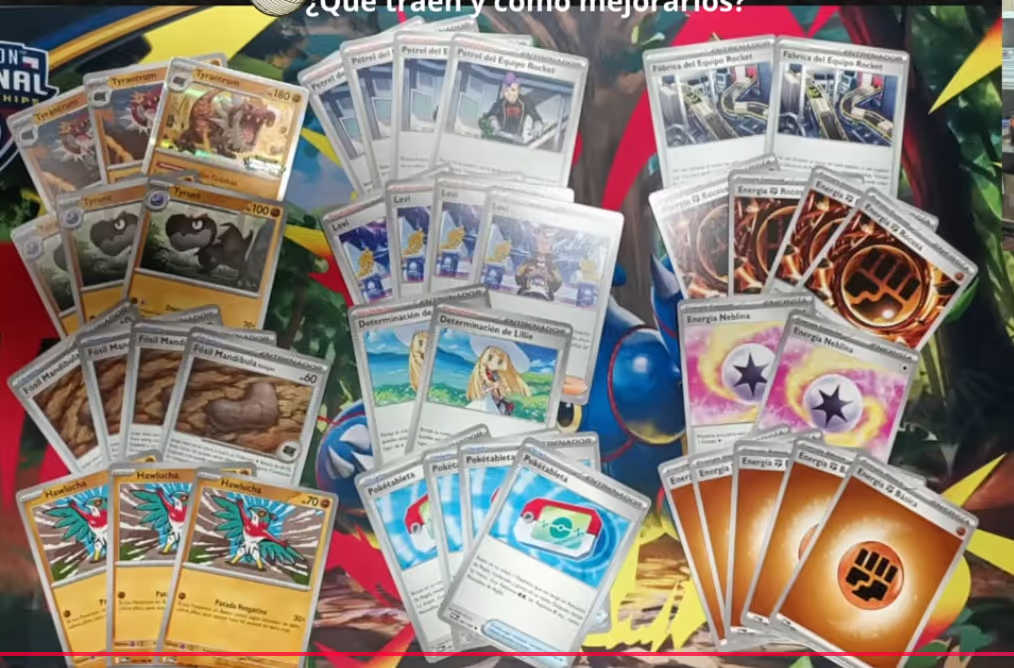
And then there’s the big one. Yesterday’s prerelease came with what was effectively a 40 card full precon deck.
Something like this has always been the case for Pokemon prereleases, as long as I’ve been playing as an adult1. The exact form factor has changed over the years,2 but the general idea has remained the same: give players something resembling a starting a deck, instead of requiring that they build something out of their booster packs.
The question I think a lot of people have here is “Why do this?” and that’s what I’m going to answer.
The Reasons
There are two sets of reasons that Pokemon does this. The first is mechanical, and the second is for their playerbase. Mechanical reasons are to make the Pokemon TCG actually work for limited environment. Playerbase reasons are to make the prerelease product appealing to their players3.
Let’s start with the mechanical reasons. First up, typing. Pokemon’s primary resource system is an inverted version of Magic: The Gathering’s land system: putting cards into play is free, but using their attacks and abilities requires placing energy onto them. Except where Magic has 5 basic land types, Pokemon has 9. This means you’re going to have a very hard time building a basic deck out of a set of boosters, perhaps even more so than any other TCG.
Next up is evolution. Evolution is another core game mechanic where strong cards require that they be placed on top of weaker cards into order to put them into play4. If you are opening random booster packs, there is a no guarantee that you will get a complete line, and there is no easy way to cheat the system.
As a result while you can make a deck that can be “played” from cracking a few boosters, and grabbing some energy, it is not going to be a fun deck. It’s going to be a grindy slogfest where whoever can set up something even moderately powerful is going to win.
So mechanically, it makes a lot of sense to give players something to build around, as it puts everyone on a somewhat even power level, means that no one has to go and make a 4 color deck, and allows people to splash things up a little.
Except while that’s what Pokemon used to do, these days they straight up give everyone a 40 card deck. So why do they do that as opposed to giving them only a few cards to build around?
I think it’s because Pokemon understands its actual player base, and a very important part of that playerbase is children5. And while I’ve seen children playing almost every card game, they’re almost always the children of adults who are also attending the event, or at least play with their kids at home.
This is not the case for Pokemon. Many Pokemon events will have parents who attend to watch their kids, but don’t know how to play the game themselves, and don’t intend to learn.
Children are still learning, and asking a 6 to 12 year old to read 60+ cards, understand them, come up with a strategy, and build a deck with them in 30 minutes is a lot. Even giving them part of a deck can still be asking a lot of them.
Giving them a prebuilt deck that they can upgrade? Now that’s a lot more reasonable.
The end result of all of this is that Pokemon prereleases are a bit more of a precon tournament then a sealed event these days. This does not bother me much, if for no other reason than that prerelease events are my only opportunity to play much Pokemon these days6.
Anyway, that’s why Pokemon is different. Hopefully you learned something. I’m now going back to looking at job boards, and repeatedly rewriting my resume for each one until it makes the AI happy.
Previously, prerelease kits had a foil stamped card, maybe 2-3 copies of a specific evolution line, and a few trainers, but not energy cards or anything that was ready to be a full deck. At least some deckbuilding was required to turn this small package into something you could play. Magic players might be familiar with the special themed sixth pack that came with Avatar: The Last Airbender sets. Pokemon used to be a bit like that.↩︎
I think whoever designs the Pokemon TCG play experience actually knows its playerbase MUCH better than games like Lorcana, and seems to care about them more than Magic. ↩︎
If you have ever wondered where I stole Card City Critters’ evolution mechanic from: this. This is where. ↩︎
The primary requirement for being a Level 1 judge in Pokemon is not being knowledgeable about the TCG. It’s passing a background check to make sure you can safely be around children. In addition, Pokemon is the only card game that separates players based on age. This is a good thing. I don’t feel good beating 12 year olds at card games and I feel even worse losing to them. ↩︎
Yesterday’s prerelease kit was $30, and everyone got 3 booster packs at the end for completing all three rounds. Buying the content of that off eBay right now would run me something like $80-90 USD.↩︎
Ed Note: I wrote most of this back on Feb 27th, then got busy with a few things, and didn’t finish it until today.
Another Magic set, another prerelease. There seem to be a lot of those these days, don’t they? And apparently we have Secrets of Strixhaven in like 6 weeks? Jesus Christ.
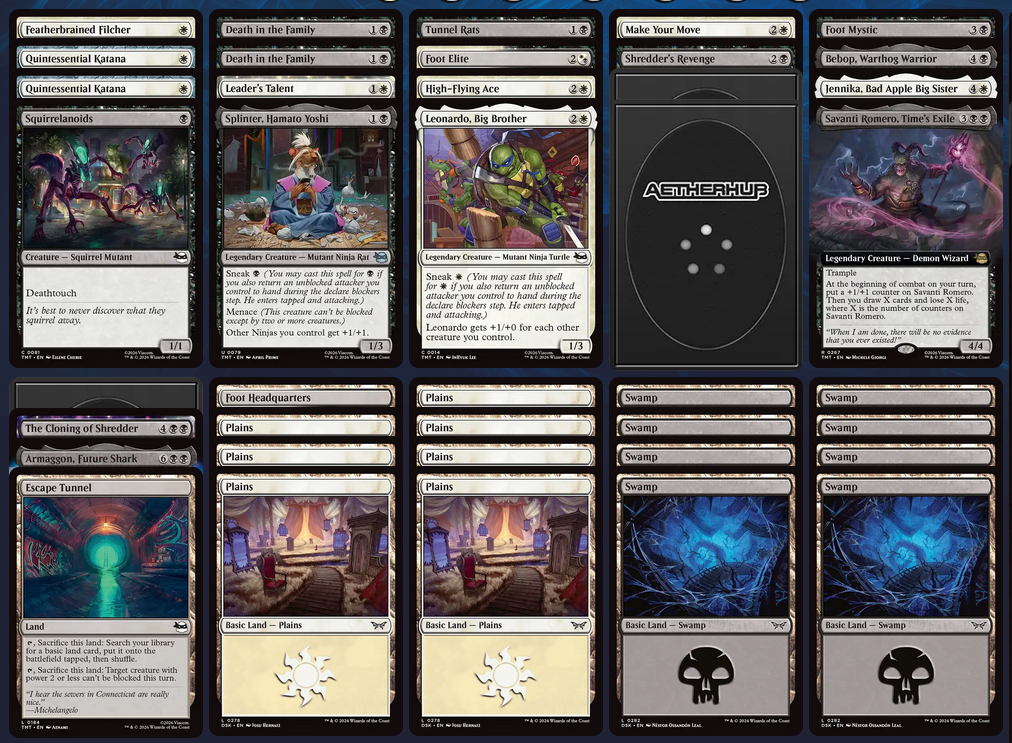
Anyway, Teengage Mutant Ninja Turtles. I’ll be doing a little bit of UB ranting as I do this, but I mostly write these after-action reports for myself, and so other folks can take a look at my pool and prepare themselves for limited events, so let’s pull that pool up.
Apologies for the slightly scuffed image; the missing cards are two copies of Anchovy and Banana Pizza (sorcery speed artifact that kills) and Krang and Shredder (late game bomb).
As a side note: only 5 people showed up for this release. This meant that each round, someone got a bye, which was a bit disappointing. At the same store, Lorwyn sold out.
Deckbuilding
I am deeply ambivalent about this deck. On the one hand, all of my strong bombs were black, I had 4 pieces of removal in black, and I had a reasonable amount of decent white stuff. Plus I had Quintessential Katana, which did a ridiculous amount of work.
On the other hand, post release I sat down and realized I had some pretty good red stuff. And as we’ll see, it’s not like the deck I made performed great, so it’s hard to feel like I really made the best choices here.
In any case, this was a set where I didn’t get a chance to test dummy pools, and I did less prep than I probably needed to. It will be borne out in the results.
So lets talk about the matches!
Matches
Match 1 was against Red/Blue artifacts. This got off to a good start, when I manged to take a fairly decisive game 1. Perhaps a bit too decisive, as I was confident going into game 2, and not as worried as I should have been when I lost.
And then there was game 3. Oh, game 3. Game three was a mess. I made several critical misplays, most notably where I whiffed a Make Your Move on a Ray Fillet, Man Ray that my opponent removed a +1/+1 from, causing both the spell to fizzle, and them to grab an extra card. This was compounded when they dropped a Donatello Mutant Mechanic that was I completely unable to remove.
End result was a board state where I was chunked down by artifact creatures until I died.
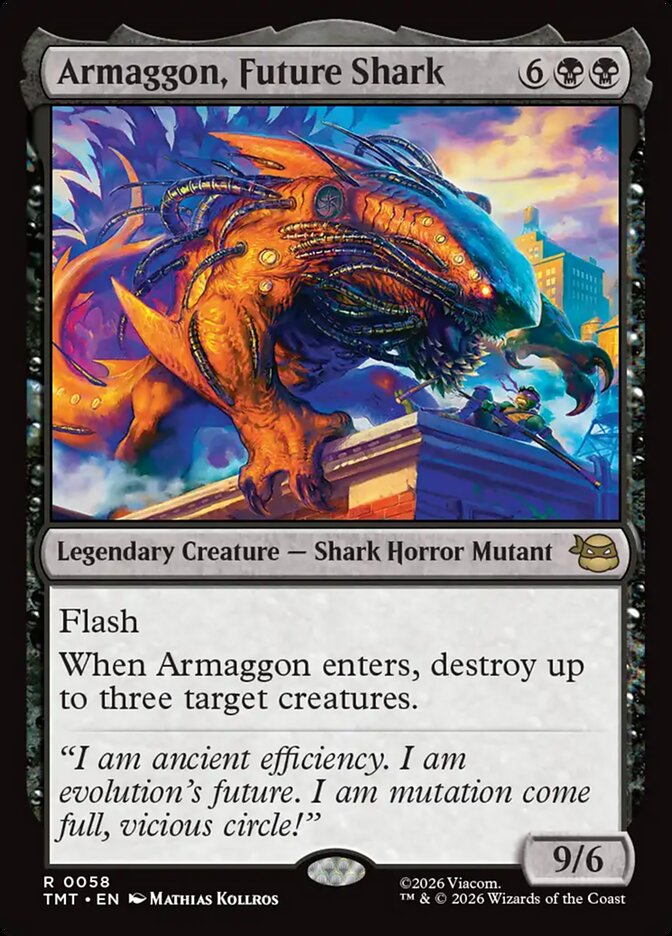
Game 2 was another match against… Red/Blue artifacts! This time I managed to win, but I’ll be honest, I don’t remember exactly what happened, and I didn’t keep great notes for this one. I do remember that I managed to play Armaggon, Future Shark to wipe their board.
Game 3 was… a bye. Yeah, remember when I said that we had a total of 5 people show up for this prerelease? This was the result. A 2-1 record, that really was more of a 1-1.
Overall Thoughts
I’m obviously unhappy with my performance in this pre-release. A 2-1 record isn’t great, I made a bunch of avoidable misplays that potentially cost me games, and then I got a bye so I didn’t even play a third match. I usually like byes, but only when I’m already winning and I get a break.
I’m also really unhappy with how TMNT plays in Sealed. I’m pretty sure I used the set mechanics less than I played games. Disappear and Sneak are cool in theory, but I had none of the core support cards like Dream Beavers to enable them. The end result was a very bland experience, one where I spent most of my time just playing a very dull game of Magic.
There’s a temptation to paint all of Universes Beyond with a broad brush, and while the product as a whole likely comes from a CFO’s desire to Scooge McDuck into a vault of money, the individual sets have been varied in quality. I’ve really enjoyed Avatar, Lord of the Rings, and Final Fantasy.
TMNT was not like those sets for me. It was a fairly mediocre experience.
Post Script: This is going up a bit later than I had intended, but since release I’ve done a few drafts, and… yeah, draft is better, but I still can’t say I love the set.
This set has convinced me that I’m probably good to skip most of the Universes Beyond sets for the rest of the year. There’s too many of them, and I’m just not interested in playing them in paper. If they’re actually good, I’ll just draft them. But I’m tired of pre-releases every 5 minutes for sub-par turnout.