Author: MrBlueSky

  • Secrets of Strixhaven – Prereleases and Thoughts

    Secrets of Strixhaven – Prereleases and Thoughts

    Another month, another Magic: The Gathering set. This month, it’s Secrets of Strixhaven. The OG Strixhaven was a magic school-themed set with a focus on instant and sorcery spells. Secrets of Strixhaven is another swing at those themes, bringing back the same colleges of magic with new mechanics.

    Set mechanics, and other context

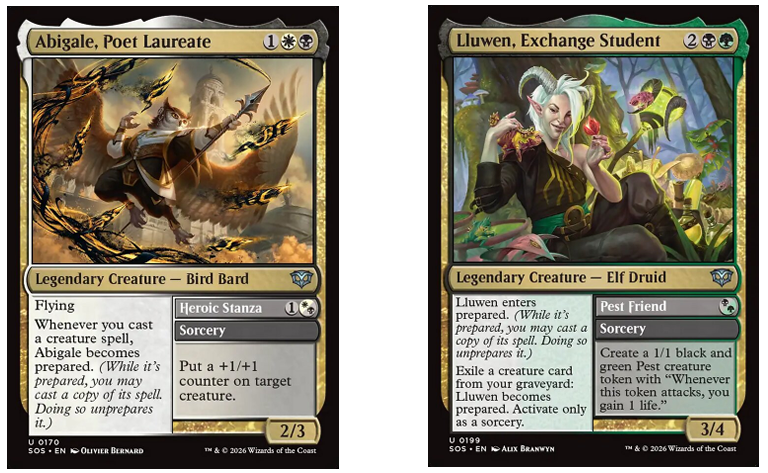
    Secrets of Strixhaven’s marquee mechanic is prepared. This is a mechanic that lets your creatures cast copies of instants or sorceries printed on them under certain conditions, a bit like an inverted version of Adventure. All colors get some prepare cards, and some are a bit better then others.

    An image of the Magic: The Gathering trading cards Abigale, Poet Laureate, and Lluwen, Exchange Student.

    Here are the schools, and the single color mechanics!

    Quick Overview of the 5 Archtypes in Secrets of Strixhaven.

    Lorehold – Red/White – Flashback/Repartee; Graveyard manipulation payoffs

    Prismari – Red/Blue – Opus/Increment; Payoffs for casting spells, bigger payoffs at +5 mana.

    Quandrix – Blue/Green – Increment; Get +1/+1 counters, and slow the game down a bit by flicking things back to your opponents hand.

    Silverquill – Black/White – Repartee; Very aggro beatdown decks that reward going on the offensive.

    Witherbloom – Green/Black – Lifegain; Get rewards for gaining life. Gain more life. Stall out the game until you have advantage.

    Also, this set brought back common two color tap lands, and Terramorphic Expanse, so splashing a third color is fairly reasonable.

    A splash image of Green text over art. The text reads "Secrets of Strixhaven".

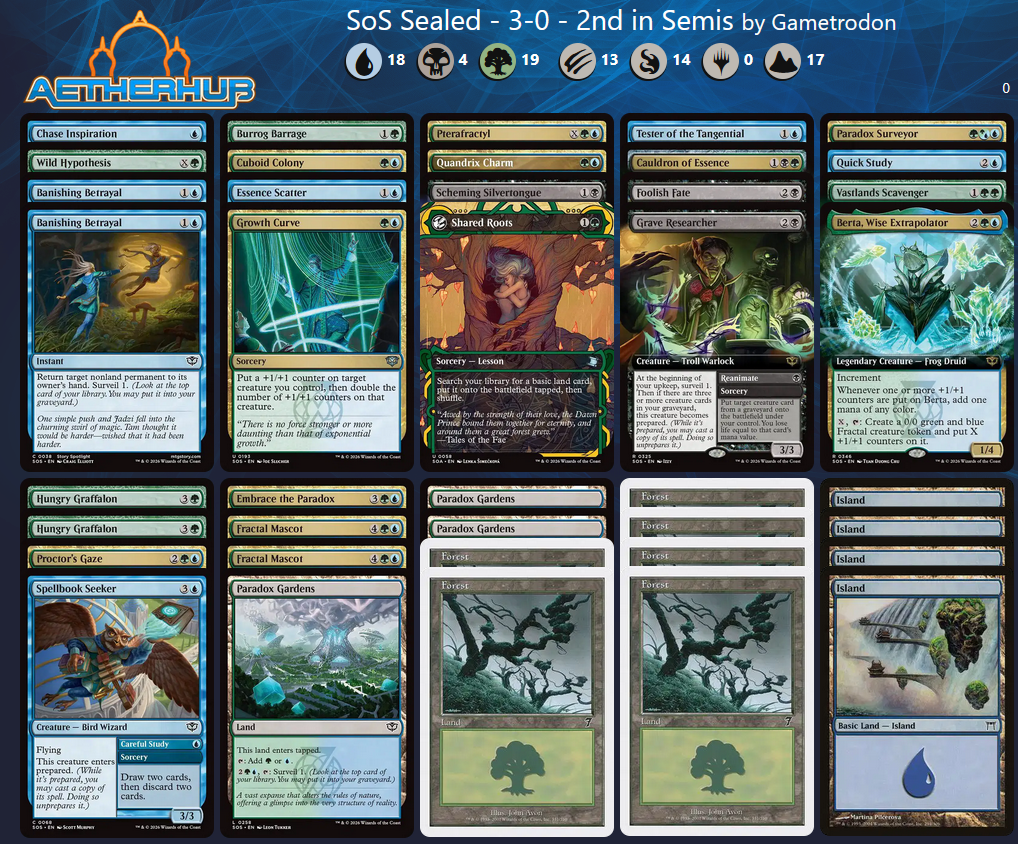
    I went to two Strixhaven prereleases. Let’s get right into it. Here are the two pools.

    Event 1 Pool – 1 win, 2 draws. – Witherbloom splashing blue

    Event 2 Pool – 3 wins, went to top 4. 2-1 in semis, knocked out 0-2 in finals – Quandrix splashing black

    An image of all the cards in a Magic: The Gathering decklist.

    Pre-Event Prep

    I didn’t do any test pools this time around, which came back to bite me. Secrets of Strixhaven sealed could turn into some really grindy matches, and if I’d known that earlier, I might have adjusted my strategy.

    I also might have recognized that Silverquill was the aggro deck.

    Going in, I thought Secrets of Strrixhaven would be bomb-heavy, with a lot of removal. I think that was generally a correct read! What I didn’t fully anticipate was how that would impact game pace.

    Event 1 – Lessons Were Learned

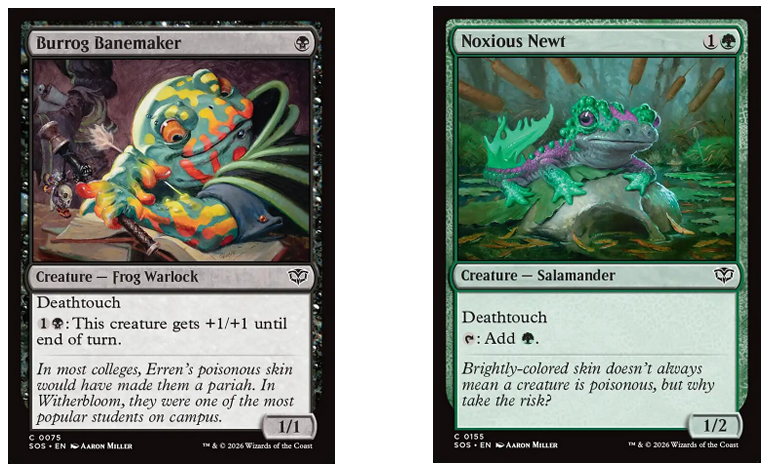
    There’s not much to be said on this event that isn’t really said by the pool itself. In matchups into non-Silverquill decks, games tended to get slowed down, mostly by small deathtouch creatures. Burrog Banemaker, and Noxious Newt were responsible for a lot of this.

    An image of the Magic: The Gathering cards "Burrog Banemaker" and "Noxious Newt"

    Everyone had combat tricks, but no one wanted to drop their combat tricks first. And in a set where every color pair has a mythic flier, using hard removal on little guys feels like it might be a bad idea. So games tended to stall out until someone dropped a bomb.

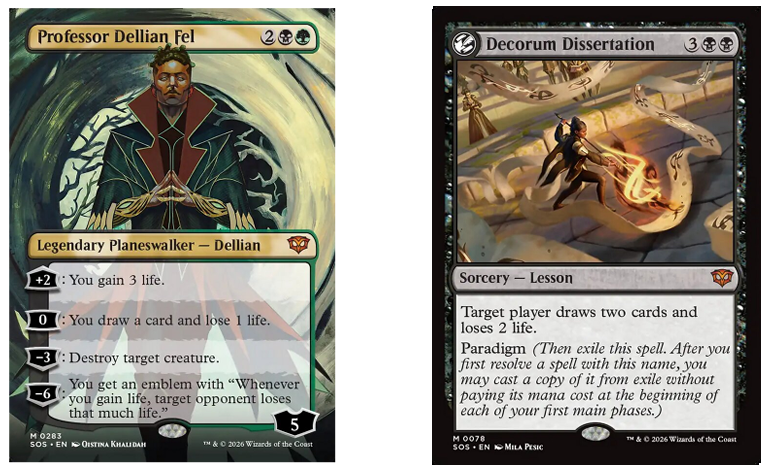
    For example, my first opponent had a Dellian Fel. As far as planeswalkers gon he is fairly vanilla. But it turns out that being able to gain life, draw cards, and destroy creatures, while having a synergistic emblem you can get on your second turn after playing him is pretty good! I’ve also seen a few other matches where the paradigm cards just kinda shredded people; mostly Decorum Dissertation and Germination Practicum.

    An image of the Magic: The Gathering cards "Professor Dellian Fel" and "Decorum Dissertation"

    Anyway, I wasn’t the only person getting match draws. The friends I went with also got some, and other folks also drew. It was pretty weird honestly.

    Long term readers will know that I consider anything less than complete victory a loss (this is not a good character trait!), so having “lost” like this, I wanted redemption.

    Event 2 – Back to School

    I’d learned a few things at the first event. Primarily: I needed to find a way to aggressively close games out before they went to time.

    Usually in a sealed event, there aren’t many ways to influence your pool. But Strixhaven has a seeded pack for each college in each prerelease kit, and the Fourth Place (my store) allows trading sealed kits with other folks in the event before it starts. So I swapped my Witherbloom kit for a Quandrix one.

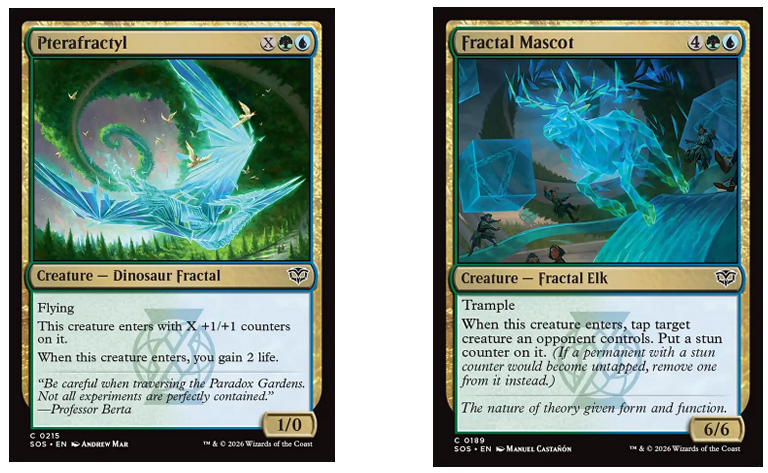
    Witherbloom wasn’t bad, but it wasn’t good. Even running pretty half of the rares, they just didn’t do enough to actually win me matches. So I needed an additional source of bombs, and I thought Quandrix could do that for me with cards like Pterafractyl and Fractal Mascot

    An image of the Magic: The Gathering cards "Pterafractyl" and "Fractal Mascot"

    I was mostly right! I managed to convincingly smash my way through my first two rounds, then struggled a bit in round 3 before managing to take the win. This put me into top 4, where I pushed through semis to finals.

    And then I got absolutely butchered in the finals. Some of this was the Silverquill deck I was playing into. Some of this was just making a large number of blunders. I’m of the opinion that Silverquill, with just a few good cards is much, much stronger than almost every college in this set, because it’s the only one that really gets rewarded for going on the offensive. Repartee and Prepared spells are just incredibly synergistic, much more than having some +1/+1 counters, or a bit of lifegain. And with games stalling out, cards like Summoned Dromedary and Inkling Mascot just do so much.

    Overall Thoughts

    I generally liked Secrets of Strixhaven. That said, I have some thoughts about the seeded packs.

    I haven’t minded seeded packs previously. Both Khans and Avatar used them, and I thought they were pretty good. To be more specific: I didn’t feel like I lost games in those sets because my opponent had a ended up a with a better color of seeded packs.

    That’s not really true of Secrets of Strixhaven. Both events I went to, Silverquill just absolutely cleaned people out. I did some free play against a friend’s pool yesterday. He rebuilt it into Silverquill, and… I got cleaned out again.

    Some archetypes are going to be better in some formats, and some pools are going to be stronger. But it felt like some Strixhaven sealed pools would always go to time, and some would absolutely run over anything in their way with value commons and uncommons. And you could sway your odds if your pool was Silverquill-seeded.

    I didn’t like that much.

    Also, bring back foil year stamps on promo cards! I know you can do it Wizards. Wizards said they did it to “reduce the number of cards that store owners have to care about, and to make things easier if release dates change” but like… they are doing special versions of Japanese-only alt arts exclusively found in collector boosters.

    You can add a single special card to prereleases, you cheap weasels.

  • Chico’s Rebound

    Chico’s Rebound

    I’m just kinda sitting here, staring at my screen and trying to figure out how to introduce Chico’s Rebound. You can probably tell that it’s not going great, and that I’ve been forced into meta-narration. Because otherwise I am going to sit here until the flesh rots off my bones and the sun burns out.

    An image of the header screen from the Steam Page for Chico's Rebound

    Chico’s Rebound is a sort of follow up to Chico and the Magic Orchards, a game I wrote about a few years ago. It’s also not really a follow up, because while the characters are the same, the core gameplay isn’t at all. Magic Orchards was a light puzzle game with some exploration elements.

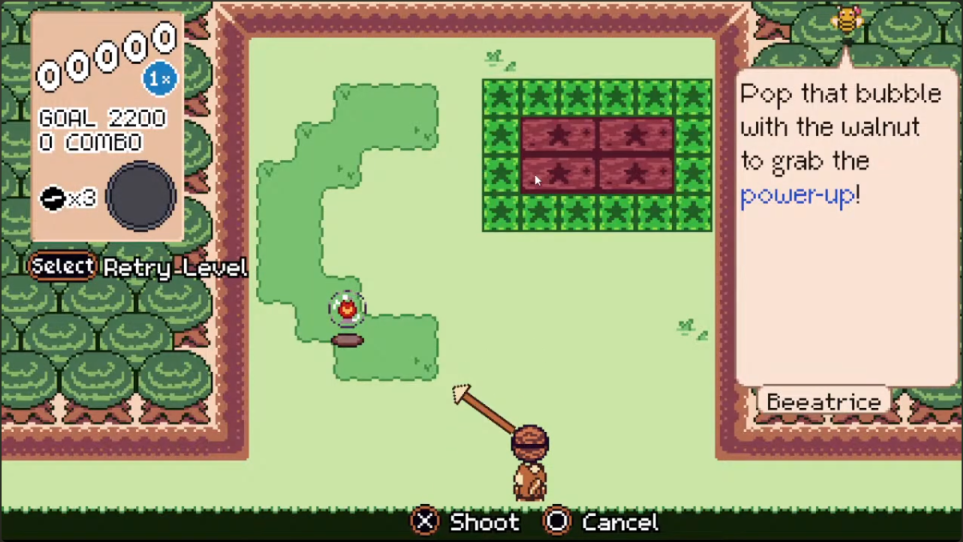
    An image of the player in Chico's Rebound. The screen is one of the early levels, with the player setting up to bounce the nut around, and tutorial text on the right.

    Rebound instead takes its inspiration from that classic iPod1 game breakout. If you’ve played Breakout, you know the basic deal. If you haven’t… well. It’s pretty simple. You have a ball, and at the bottom of the screen you have a paddle of some sort. You bounce the ball off the paddle, and when it hits bricks, they disappear. Get rid of all the bricks to clear the level. Pretty much just PvE pong.

    I really hope we all know what Pong is?

    Anyway, that’s what Chico is cribbing off of: a souped up version of Breakout with more mechanics. It also has some other mechanics, including overworld exploration and some puzzles, but the less said about these, the better. They’re not particularly fun, and I found myself struggling a fair bit with them when it felt like I shouldn’t be2.

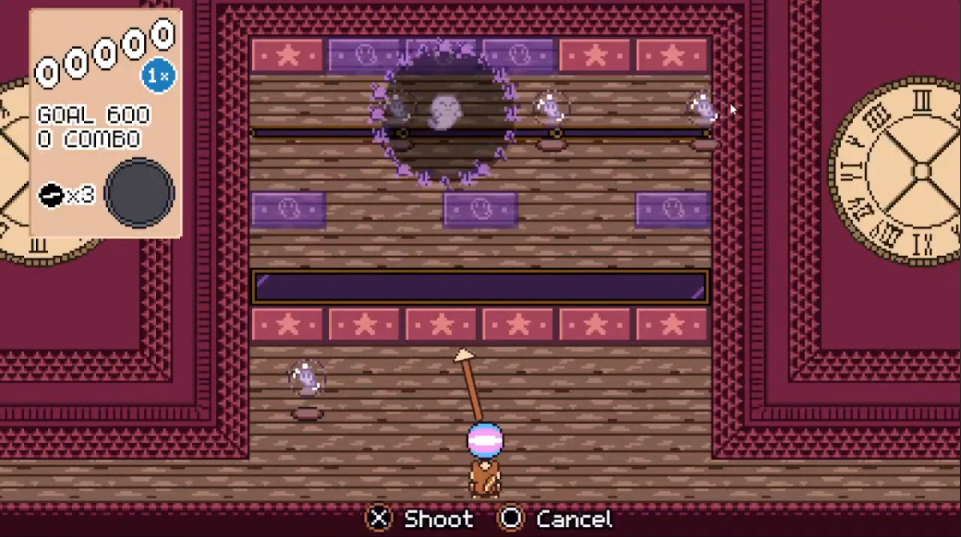
    Instead, the main gameplay is the variants of Pong. There are a lot of fun ideas here. One world has fire and water powerups that interact with growing and burning down plants. Another ghost themed level lets the ball swap between corporeal and phantom states, ignoring platforms in the other modes. Another world has a set of mushrooms that swap colors when hit, and can only be destroyed by hitting a matching colored switch.

    An image of the game Chico's Rebound in one of the games later worlds. Several blocks are ghost blocks, demonstrating that worlds mechanic.

    These are good, and pretty fun. Unfortunately, this is where most of my praise ends, because Chico’s Rebound is doing some really weird stuff with its controls. To explain why, we need to talk a bit more about Breakout and how progression in Chico’s Rebound works.

    Most of the time in Breakout, any connection of the paddle to the ball launches the ball back up. The ball only resets if you drop it and it goes off the screen. In Chico’s Rebound, however, you can regrab the ball by just touching it. If you want to keep the ball bouncing, you have to do an input to do a tailspin. If you fail to do that input, Chico just grabs the ball, and then you can relaunch it.

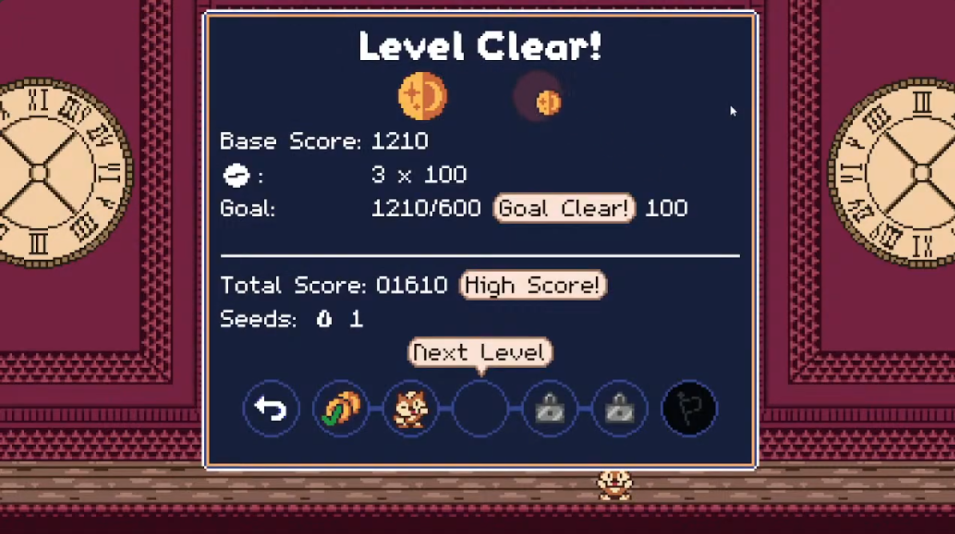
    This would make the game trivial; you could just clear all the blocks with no risk. Except Chico’s Rebound has a scoring system, and to cut to the chase: unlocking more levels ultimately requires beating previous levels at certain score thresholds. Getting higher scores requires high combos, and losing the ball offscreen or catching the ball both drop the combo.

    An image of Chico's Rebound scoring screen, showing how a certain score is necessary to get the games seeds.

    The end result is that you need to do the tailspin input constantly, and if you mess up at all, even if you were in the right part of the screen…. you probably have to restart the level.

    It doesn’t help that the controls feel inconsistent at times, and I found myself dropping hits I’d thought I’d done an input for. I found that the frustrating controls overwhelmed most of the enjoyment I got out of the game’s unique level mechanics.

    The game also has bosses. I generally liked them, but some require you to patiently regrab the ball and wait. Those are a bit less enjoyable.

    Chico’s Rebound was $8 and 4 hours long. I don’t really regret it, but I wish I could recommend it more strongly.

    1. Apparently iPods are retro now. If this makes you feel old, you are welcome to join me in this shallow grave I will be digging for myself shortly. ↩︎
    2. There’s nothing intrinsically wrong with Chico’s Rebound’s overworld, but it’s so disconnected from the game’s main mechanics. Imagine each time you wanted to play a level of Mario, you had to solve a crossword first. That’s the energy here. ↩︎
  • Welcome to the slightly newer and mildly improved version of Gametrodon.

    Welcome to the slightly newer and mildly improved version of Gametrodon.

    Hello there.

    You might be looking at the website today, and wondering if my WordPress installation has finally been compromised by Russian bots.

    Have no fear. This is still the same old Gametrodon you politely tolerate and read occasionally. For better or for worse, I’m not planning to change anything about how I run this blog. Well, mostly nothing.

    Gametrodon has been an interesting project, probably approaching 5 years in length. Like any project, that means it’s been around for some ups and downs in my life. I’ve posted on it with remarkable stability all things considered.

    That said, there’s a ridiculous amount of cleanup that could be done on the site. There are close to 430 posts, and more than 800 images. Most of the posts are lacking in metadata and featured images, and virtually none of the images have alt-text for folks who are visually impaired.

    This layout adjustment is mostly so that I can start changing things up; I’m aware not everyone wants to hear me talk about game events I go to every two weeks. This is a game review site, and I’m sure you’d rather read my thoughts on games, even if they do sound like they’ve come out of the mouth of a slightly concussed sloth.

    The end goal is turn Gametrodon into something a bit more user friendly with a modern theme (I will figure out how to add search bar to mobile) and let folks see all my recent posts, while ignoring stuff they might not be interested in.

    It’s been a weird 5 years. Here’s to another, better, 5.

  • Single Player Magic The Gathering

    Single Player Magic The Gathering

    Recently I promised a friend that I would make them a single player Magic: The Gathering experience. This is funny for a lot of reasons. Mostly that the person in question is a game designer who loves single player games, and I’m a game player who hates them. But a promise is a promise, and so I spent a lot of time playing single player magic.

    And I have some thoughts.

    I’m going to detail those thoughts, various game modes, and my experiences with them. I’m pulling them from this list on Board Game Geek.

    Also, in case anyone who made any of these ends up reading this: please keep in mind, I’m a hater. I already don’t like single player board games. I’m doing this mostly for research on my end. Don’t make changes to your mods to try to please me of all people.

    The Wrath of Zorr

    The first one in the list, Wrath of Zorr, is possibly the least interesting to me, both from a play and design standpoint. It’s a standard game of Magic where you roll against a series of tables, resolving effects and creating tokens for the AI opponent.

    Notably, it appears to be from 2013. The problem with this is that creature power has been substantially pushed up since then. I was able to grab one of my commander precons, shuffle in the commander, and beat it to death with ease.

    Zorr’s turn 3 best outcome is arguably to get a 1/1 flier and kill spell, or a 1/1 flier and a 2/2 bear, whereas a 3/3 for 3 is practically the floor for creatures in the precon I was using.

    Wrath of Zorr also requires the player to make a lot of decisions about what to kill, when to attack or block, and redefines existing magic terms, notably completely changing what “Exile” means in context.

    I suspect that 15 years ago with creature power level much lower, this could have been a more interesting experience. As it was, I found it dull and clunky.

    Aaron’s Solitaire – Moonfrog Edition

    Aaron’s Solitaire is another single player variant that uses a single deck between the human and AI player. The player plays a normal game of Magic, and the AI plays cards off the top of the deck for free.

    Aaron’s Solitaire suffers a bit from the same problem, despite coming out in 2019: creatures are too strong when they aren’t controlled by mana costs. This time though, it happens in a slightly different direction, because it allows cards like this to pop out on turn 1.

    Valgavoth, Terror Eater (Duskmourn: House of Horror #120)

    Do you know what happens when this occurs? You lose.

    Same for this guy.

    Again, I didn’t find this mode to feel very much like playing Magic, and I didn’t exactly have a great time.

    Horde Mode + Garruk the Slayer

    Horde Mode was the first one of these I’ve played that offered something that felt a bit closer to standard Magic experience. While the player plays a standard game of Magic, the opponent plays with an 80 card deck, and that deck also functions as their life. On each of their turns, the AI player resolves up to the top 3 cards of their deck (Stopping early for mythics/rares/uncommons) and then swings in with everything.

    I’ll give Horde Mode some credit here. It was more fun than the other modes. But it was still not very fun, because I found it to mostly be a deckbuilding puzzle rather than a gameplay puzzle1, and the deck I built was this abomination.

    Still, the deck as life was cool! I liked that.

    Takeaways

    Based on playing these, I came up with a few specific design goals for my single player variant.

    1. The game should play like Magic (no custom cards, no redefining keywords, all rules work normally), but it shouldn’t feel like a standard game of Magic.
    2. The player should have to make some interesting decisions about how to “play” the game. Meaning you shouldn’t be able to win with just deckbuilding. (Also, boardwipes and control lists should be at least somewhat pressured.)
    3. The AI’s actions should not be super random, and if anything, should be telegraphed to player within reason.
    4. The AI and player should be on roughly even power curves. The AI should be limited by mana costs to some extent.

    Anyway, I made a prototype of it. The result was something I’m calling Spiderman Vs The Portal Master. It was well received, and probably violates a lot of copyrights. Given how well it went over, I’ll probably go back to it at some point and make a version I can release for folks to play if I find the energy.

    1. And despite what some people think, I do think Magic is a game about piloting decisions, and not just deckbuilding. ↩︎
  • Spring Cleaning Write-up

    Spring Cleaning Write-up

    It’s been a little bit hasn’t it? In the interest of cleaning out my backlog of unfinished work and making it so that I don’t have to look at 18 drafts every time I log into this website, here’s a bunch of stuff I played enough to have opinions on, start write-ups, and then just never finish them.

    Order is going to be how good the games are, because one of is these is simply one of the greatest games I’ve ever played, some are the greatest games I played last year, and some were only marginally better than taking the money I spent on them and setting it on fire.

    Without any adieu or whatever, let’s begin.

    Blue Prince – The greatest puzzle game of the last 10 years.

    I started a Blue Prince write-up after “beating” the game, then went back and played another 50 hours, and I have still not beaten the game.

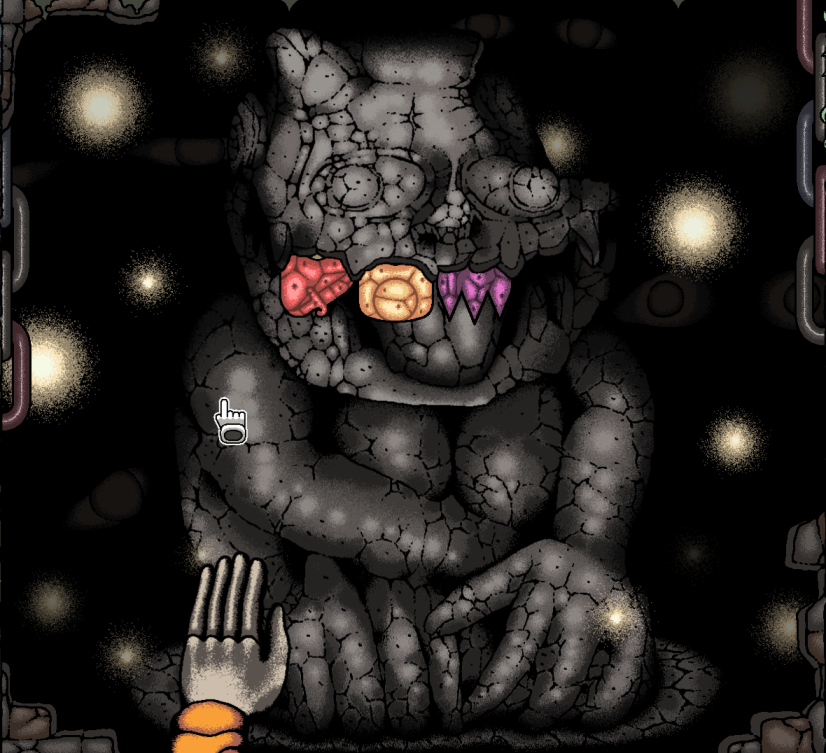
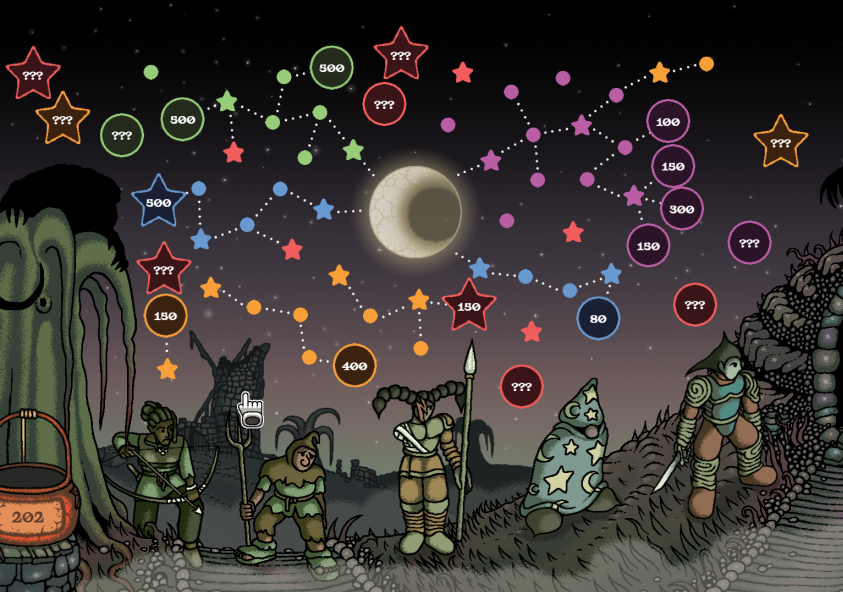
    Blue Prince is one of the greatest games in the last 10 years. It is easily the greatest puzzle game I have ever played. If you have not played it, and you like puzzle games at all, go play this. I took notes playing this game, and even with the screenshots, my Blue Prince google doc is 170 pages long. And yet the game never felt overwhelming, or extensively frustrating1.

    Blue Prince is a masterpiece. It is brilliant, and you should play it. The rabbit hole goes as deep as you want it to.

    UFO 50 – 50 incredible games from Derek Yu and other collaborators for a video game console that never existed.

    You know what was great last year? UFO 50. I played a bunch of UFO 50, I was going to try to review it, then it turned out that was going to be too hard, so I was going to review a single game from UFO 50. That was Avianos, a dinosaur themed 4x game with action selection mechanics, and I couldn’t even get that done. So yeah. UFO 50. It’s incredible. You will find something you love in it, and that’s ignoring all the other secrets and collectibles, and a billion other things I never even touched.

    High Tide – Abstract tile movement game by Marceline Leiman

    I don’t know how to write a good review of an abstract ocean themed game about hexagon movement, but I’m not a full time game reviewer. Dan Thurot is, so I’m just going to link to his review, and hopefully that makes up for stealing the images from it.

    One thing I do want to quickly note is that it now has a commercial release, instead of having to make some sort of eldritch deal to get one of the very limited night market copies!

    Hytale – Minecraft, but not finished, but also designed by people to whom “quality of life” is not just 13 random letters in a row.

    What if Minecraft was designed by someone who cared about player experience on all levels of the game, instead of keep in a perpetual state of stasis by suits at Microsoft who are so scared of ever making any adjustments to their 2 billion purchase that Roblox already ate their lunch? You’d probably get Hytale, and if the game goes and manages to actually ship all of its content instead going back to development hell, it is going to be the best one of these crafting games.

    It’s a big IF though. Like a HUGE fuckin’ if.

    Gundam Card Game – I keep thinking it’s spelled Gundum, but I guess that’s wrong?

    It’s fine. Resource structure similar to One Piece, mostly entertaining to play, and nobody’s scalping it quite as hard as some of these other games, so that’s cool.

    Donkey Kong Bananza – I keep spelling “Bonanza” correctly, which is wrong.

    I was going to put Donkey Kong Bananza here, but then I realized I’d mostly already finished this writeup? And never posted it? I think because I got laid off almost immediately after getting it to 80% complete. Anyway, you can read that write up here.

    Highguard – Lessons should be learned here, but they won’t be.

    It lived, it died, we hardly cried. The most notable thing about Highguard to me is that it’s not the very bottom of this list, but you can’t even play it if you want to, so who cares?

    Age of Darkness: Final Stand – The worst RTS I have ever played.

    It is rare that I play a game that fails on every conceivable level, while still somehow making it to release. Age of Darkness is that game. It is so shockingly bad that even just thinking about it again, more then a YEAR after I last played it brings to mind a list of problems burned into my brain. Here it is!

    The game’s networking is awful and it disconnects in multiplayer constantly. The game is micro intensive while requiring equally expansive macro. The units are both hard to control and incredibly dull, with no single character matching the personality of zergling, space marine, or zealot. There are no alternate build paths, the campaign difficulty is a brick wall, the game just looks bad, and as a result of all of these it just isn’t fun to play.

    There is nothing redeeming, and nothing it does better than its ancestors or contemporaries. It’s not even bad in an interesting way, it’s just awful and I want my $28 back.

    I’m not even going to link to it. They don’t deserve it.