
It’s been a strong 12 months for games about are coin flips. Unfair Flips was ultimately about taking a coin that always flipped tails and beating on it until it flipped heads. Q-Up was a game about taking a coin that could flip heads or tails, and trying to bend the world so it didn’t matter which happened.
To continue this metaphor, Sol Cesto is a game in which you want a coin to flip heads. You can manipulate reality to try to make it more likely to flips heads. But it’s necessary to plan for what happens when it flips tails 10 times in a row.
After about 12 hours, I’ve found that while I like what Sol Cesto is trying to do, I don’t know that I love how it does it.
Gameplay
The idea is simple. The sun is gone, lost at the bottom of the dungeon, and someone must get it back. That someone is likely to be one of several unfortunate souls—your first choice is the peasant, and you’ll unlock additional characters via meta-progression.
Each character is a bit different, but they generally have a set of starting consumable items, a passive ability, an active ability called a talent, and a stat score for wisdom and strength. It’s these last two that will determine how most interactions go.
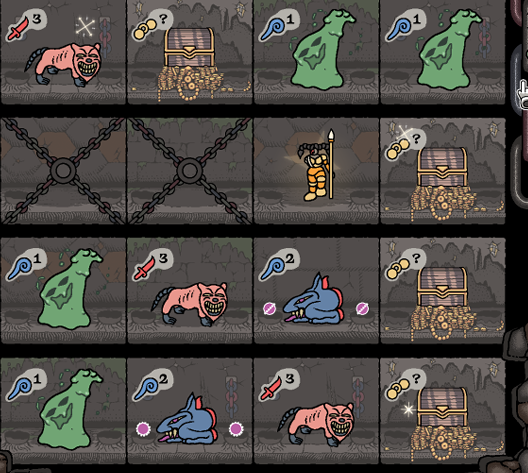
You’re dropped onto a dungeon floor, and you have to visit a certain number of rooms to unlock the door to the next floor. Each floor is a 4×4 grid of tiles. Each tile is a room that contains either a monster or a treasure.
Here, then, is the coin flip. You don’t choose which room to visit. Instead you choose a row. The game then randomly drops you into one of the open rooms in that row. If it’s a treasure of some sort, great! Heal yourself, or grab some gold. If it’s a monster, it’s time for combat.
Combat is simple. You will always kill the monster in the room, but as it dies, it will inflict damage to you equal to the difference between it’s stat and your stat. If you have three strength, that means you can take out three-strength and below monsters for free. If you only have a single wisdom, every three-wisdom monster is suddenly a loss of two health. Given that most characters have six or less starting HP, damage starts to add up quickly.
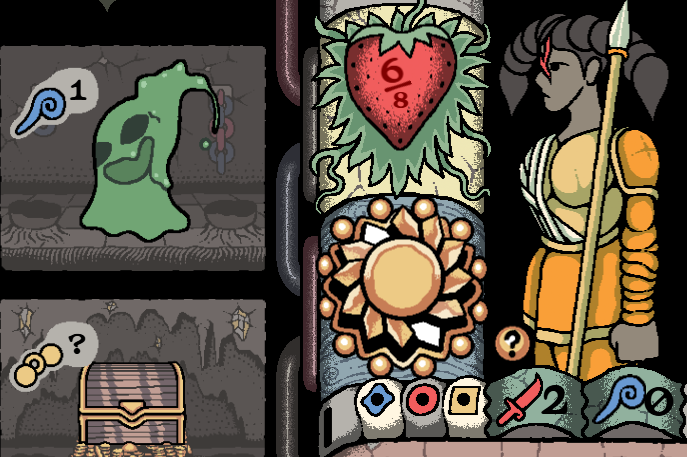
The primary loop of Sol Cesto, then, is simple: look at the screen, and make the best choice to maximize your odds of keeping things going in a favorable way. Run out of health, and you die, being sent back to the surface to begin again.
And again.
Then do it again.
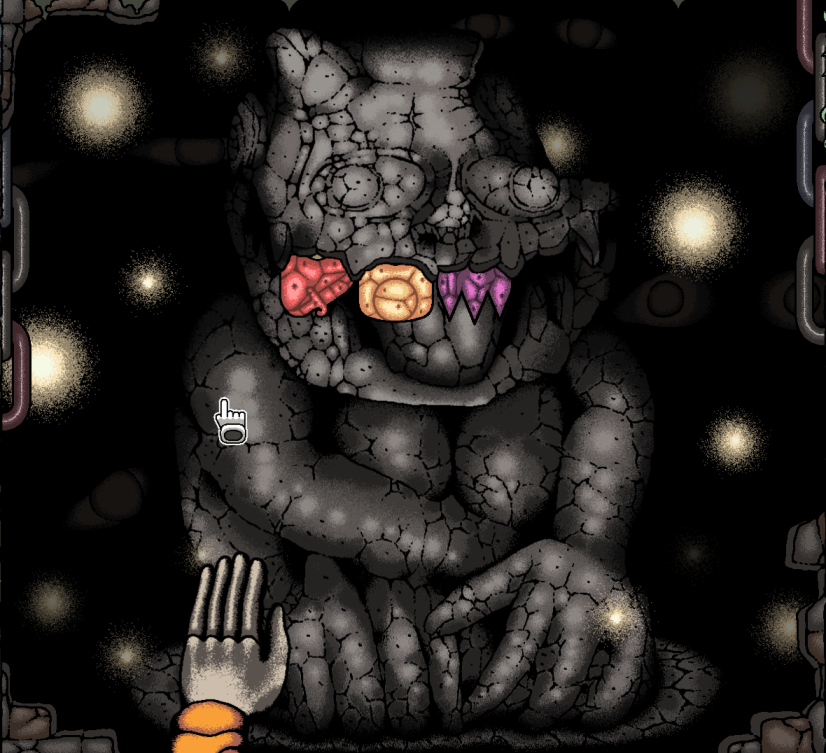
There are, of course, more twists to it, but they are just that: twists. As you get deeper you’ll encounter monsters that buff other monsters, monsters that get bigger as you kill other monsters, dark screens that can only be lit up by killing other monsters. There are consumable items that you can use to tilt choices in your favor. The characters’ unique talents charge up as you clear rooms, and can be used to shift choices; the wizard links two rooms together and the knight can select a column instead of a row. There are teeth to be wrenched from stone statues and jammed into your own jaw, modifying the odds at which you’ll be dropped into certain rooms.
Despite all this, I don’t find myself wanting to play more.
Metaprogression
The game that keeps coming to mind as I play Sol Cesto is Spelunky 2. It’s probably a bit of an aesthetic similarity, as both trade in some sort of sacrificial Aztec temple theme. This theme is one of the things I actually have no complaints about with Sol Cesto, as I find its unearthly wall-carvings-come-to-life art style as quite appealing.
No, the problem is gold.
Opening treasure chests gives you gold, and gold is both the currency used to both buy items from shops during a run, and they way you unlock meta progression options AFTER a run. And as you can see below, there is a LOT of metaprogression.
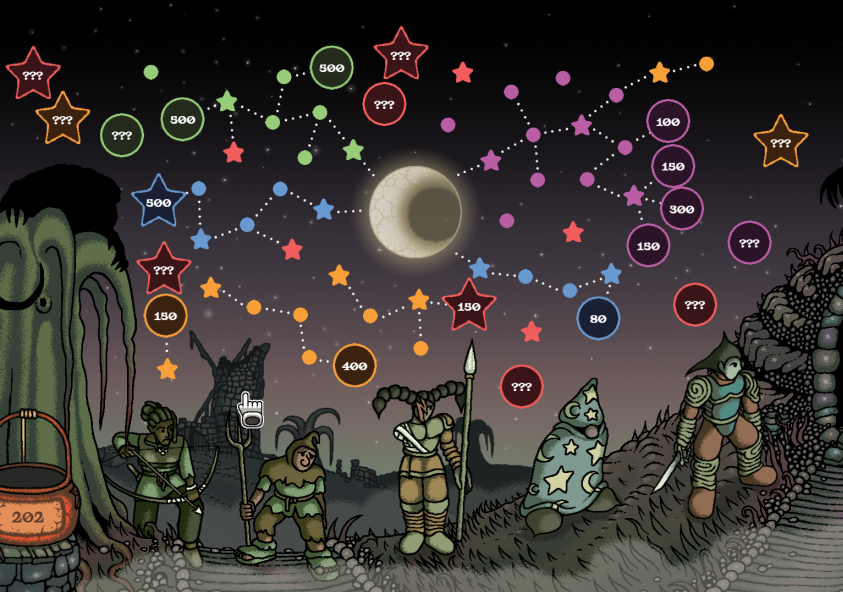
This is, frankly, a tension I find deeply unfun. Do I try to win and push my current run forward, or do I just cash out so I can keep unlocking more options, unlocking more abilities, and generally increase my chances of eventually succeeding? Do I take teeth that make me more powerful and tilt the odds in my favor, or do I take the ones that give me more gold?
My goal on a run of a roguelite/roguelike is to win the run. When I fail, I want to fail because I made a mistake that I need to learn from, not because I haven’t farmed enough yet. Spelunky was the king of this, because when you died in Spelunky, it was always your fault. Somewhere along the line, you made choices or took risks that resulted in your own demise. With Sol Cesto, that doesn’t seem to be the case.
The other thing is the length of runs. Sol Cesto runs are not short, and if there is some sort of shortcut, I haven’t found it yet. My first run to get through 100 floors was something like 40 minutes, and I had to spend the first part of that piloting through floors of enemies I’d already seen at least a few dozen times.
I’ve already proven I can solve these, so why do I have to keep doing them again and again?
I’d be ready to put Sol Cesto down if it wasn’t for one other thing.
Secrets
Edit: 4/30 – Someone pointed out that this next section has spoilers, so if you’re playing and enjoying Sol Cesto, or decided you want to try it yourself, you may want to skip this bit.
Spoilers ahead! You have been warned.
Fairly early on in Sol Cesto, I figured out that you could grab the shopkeeper’s nose. It was a neat little visual thing; a little Super Mario 64 inspired goof.
Except then I realized that if you drag it back far enough you can launch it into his head to stun him for a few seconds and steal everything in the shop.
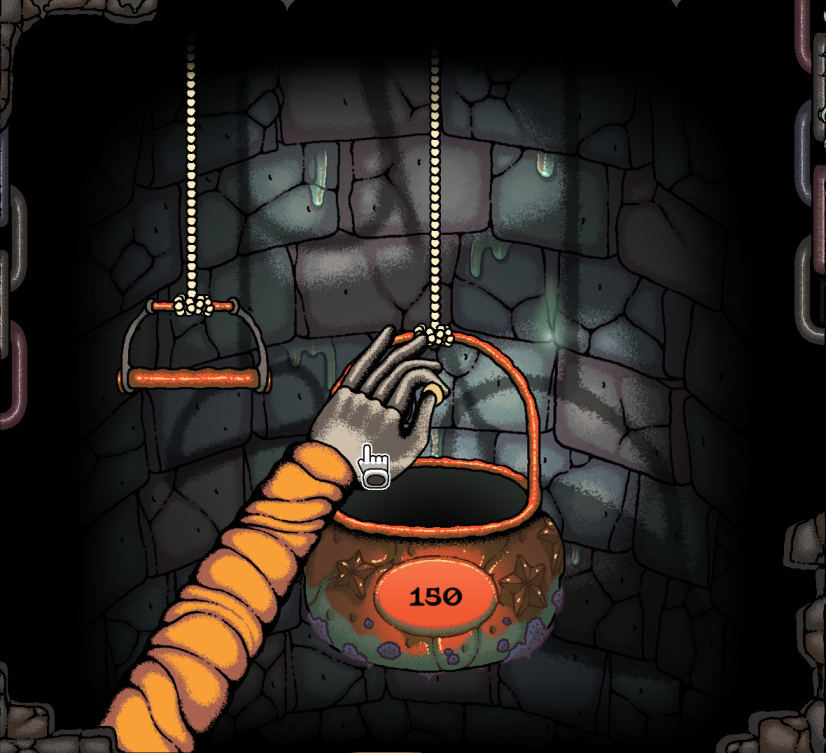
Then I noticed that on the pail that lets you cash out gold for use in a future run, one of the bricks in the background was a different color, and leaning out of the wall. So clicked on it until it fell out, and I found some more cash.
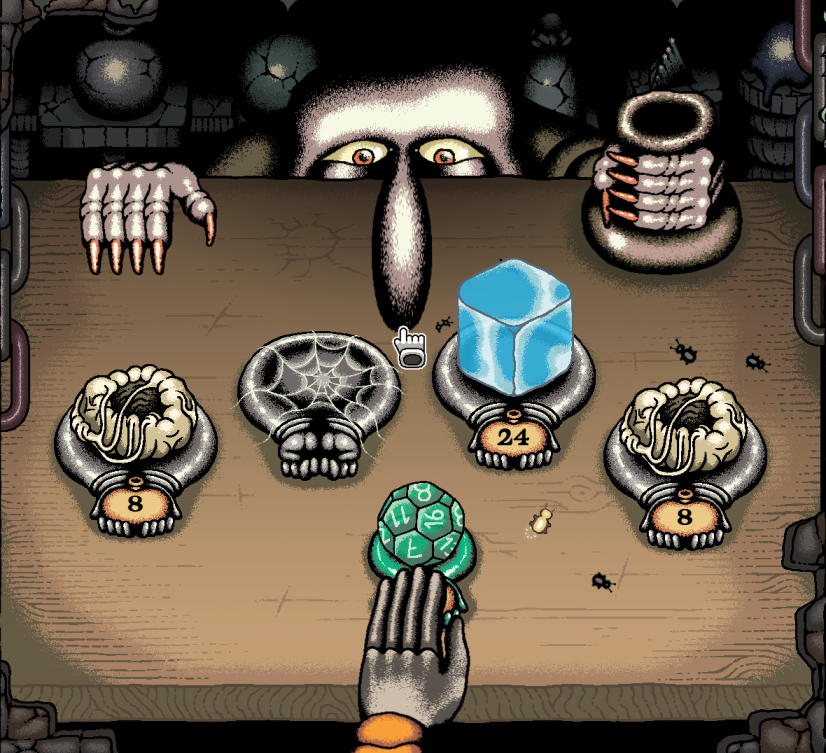
There’s more of these sorts of things. Some elements on the screen can be clicked on for gold when they show up. Full clearing a screen gives a single extra gold coin. You can bomb teeth statues to get buffs, and use reroll dice on most screens.
And this is why I’m hesitant to entirely give up on Sol Cesto. I keep wondering if there’s some secret that cracks this thing wide open… some trick I haven’t spotted yet. Something I’m missing that changes everything.
Maybe clicking on a specific tile secretly increases your odds of landing on that tile?
Maybe using items on the smith can let you get extra stat points?
….
Maybe this dungeon is just making me go crazy. I think I need some sunlight.