Welcome to part one of my PAXU 2023 writeup! If you’re mostly here for game coverage, you can skip this one. If you’re willing to indulge me in a bit of rambling on air travel, Philly, and the new OLED Steam Deck, feel free to stick around. Unlike most of the other posts in this series, this is just going to be some thoughts about everything that didn’t fit anywhere else.
First off, air travel! I actually don’t mind flying, and I used to do a fair amount of it for work. But I haven’t flown for work in years, so every time I think about it, I feel like the guy who talks about how he was great at high school football. But anyway, point is, I’m pretty familiar with airports, flying, and the whole thing.
Except this time I flew Cape Air, a smaller airline that services the New England area, and it was a bit of a doozy. First off, all the planes are Cessnas (I think—plane people don’t kill me please), which are very small. My flight back had 3 people on it, and one of them was the pilot.
It was an incredibly different experience than I was used to, sometimes in a good way, sometimes in a weird way. The plane was much louder than I expected even with earplugs, and I could see out every inch of the plane. Honestly, it was pretty staggering. I’m fairly jaded on flying at this point. Doing it bi-weekly for 3 years will do that. But coming up through the fog and into the massive sprawling plain of clouds was just incredible. I have some photos, but they really don’t do it justice.
Also spent some time in a fancy airport lounge, and felt more upper middle class than I ever have before.
Some of this airplane and airplane adjacent time was spent testing out my new Steam Deck. I’ll probably do a full writeup once I play through a few more games on it, but in brief: good battery life, good screen, don’t love the controls, currently still mixed on it as a system. It’s also a bit bulky, but I wasn’t going to get a better chance to try it out than this weekend. I played a bunch of Shadows Over Loathing, which I’ve found to be quite good!
However, the Steam Deck didn’t get much time to shine because I spent very little time waiting in lines this week. That’s not say there weren’t lines, but they were mostly for food rather than games or demos. As always, I’m obligated to shout out Reading Terminal Market, and I’d like to specifically call out Sweet Nina’s, which makes killer banana pudding. Is Reading Terminal Market reasonably priced? Not quite, but the quality of the food is so much better than anything you’d get in any convention hall, I don’t know why you’d ever buy anything from the convention.
Seriously though. If you’re at PAX Unplugged, you should either be 1. Bringing your own food in, or 2. Going out and getting food. If you get convention hall food you’re being gouged for terrible food, at terrible prices, in terrible lines.
Speaking of terrible lines, here’s a riddle: what do you get when you try to have 10,000 people use a single escalator to enter a convention hall? Answer: a mess! There was a line stretching around Reading Terminal just to get into the line to get into security to get into the queue hall line. No, I didn’t mistype that last sentence, and you’re not having a stroke, it was that bad. Whoever thought having a single entrance with one staircase and one escalator to actually get in was an idiot.
Outside of that though, I was able to avoid most of the awful lines this week, and I’d consider it to be a pretty good show. My notes are a bit more chaotic, and I feel like I spent less time just grinding things out than I normally would.
Anyway, now that I’ve covered everything else, it’s time for board game posts! Which will be going up slowly over the rest of this week.
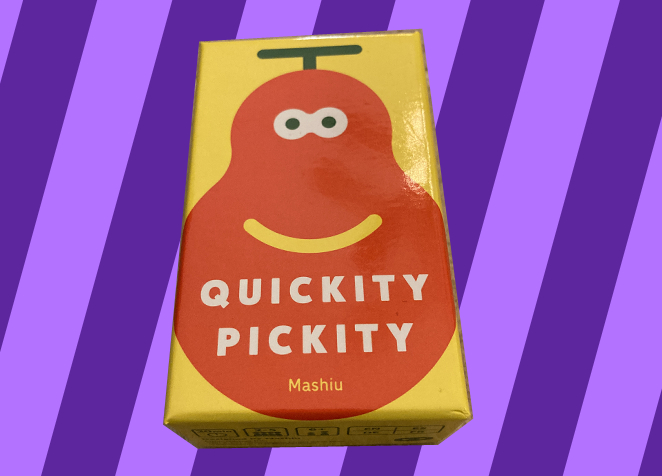
I spent some time dragging Dragonwood over the coals recently. As such, it seems fair to spend an equal amount of time talking about another very simple game that I actually really enjoyed. That game is Quickity Pickity.
Quickity Pickity is a manual dexterity, real time set collection game. The goal is to be the first player to win 3 rounds. Here’s how rounds work.
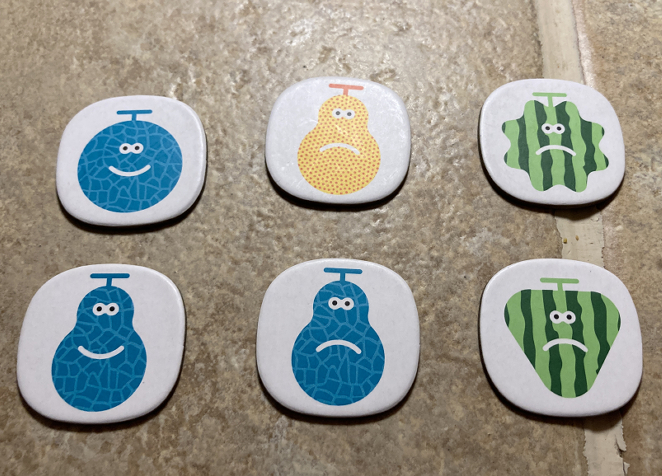
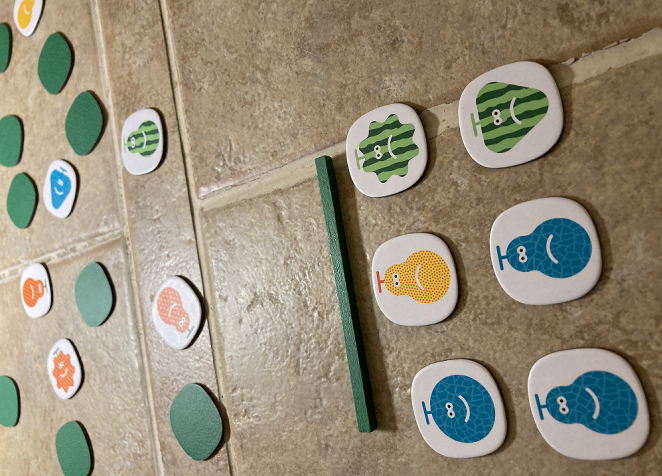
Each round, the goal is to build sets of fruit. Fruits have 3 characteristics: they can be smiling or frowning, they have a shape, and they have a color/pattern. A set of fruit is multiple fruit tiles that all have the same expression and either the same color or shape.
All the fruit tiles start face down. Once the round starts, players flip up fruit tokens in real time, and take them to place into their own sets. The catch here is two-fold. First off, once you place a fruit in one of your sets, it can’t be moved or removed. Secondly, if you take a fruit, you must place it in a set.
But while the general gameplay is the same each round, the scoring changes.
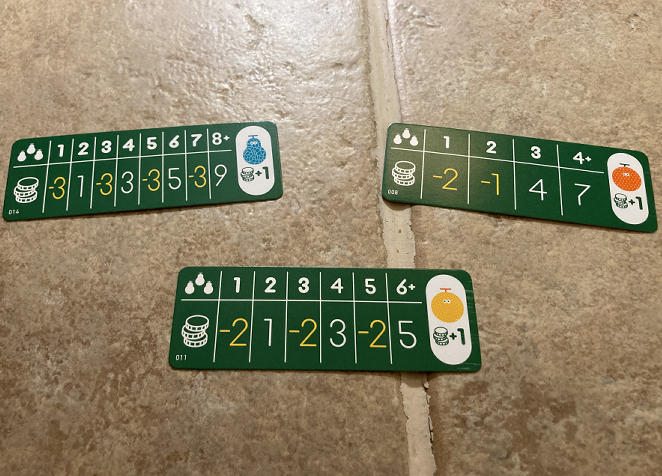
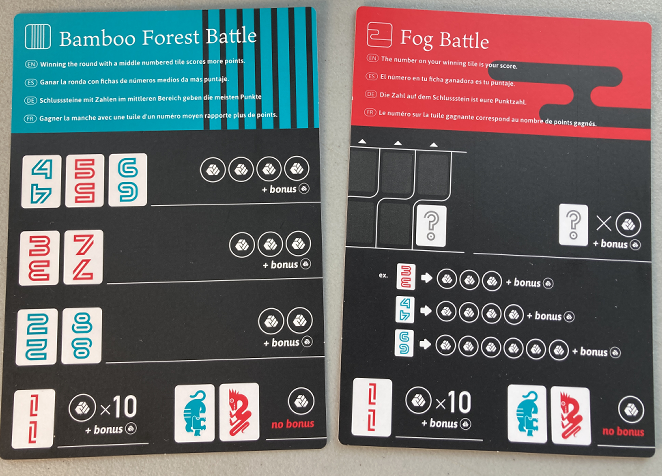
At the start of each round, the players flip up a score card. These determine how points are awarded for the round, and are fairly variable. They might payout aggressively for large sets, or instead just reward a large number of points for medium sets. They might even punish for sets that are too large, or only payout for sets with an even number of fruits.
In addition to this, each round has a special fruit: a specific color and shape that rewards bonus points. Bonus fruits give yet another thing to keep track of and switch up.
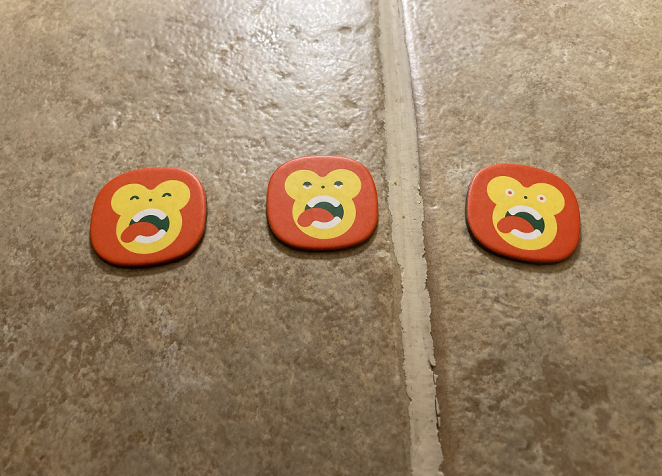
The round ends when all three of a set of monkey tokens have been flipped up, at which point players stop and score points. Now remember when I mentioned that fruits can’t be moved? Well, if you accidentally placed a mismatched fruit into a set (for example, put a frowny face fruit in a set of smileys), there’s a massive penalty of minus 10 points per bad set. This almost always enough to lose the round.
While I liked Quickity Pickity, I do have one big gripe and it’s with the round ending monkey tokens. It’s very easy to flip one over, and not notice, and there isn’t really a penalty or reward for spotting that fact. Twice in the 9 or so rounds I played, we flipped all the monkey tokens up without realizing it. We only noticed later that the game was supposed to be over.
Monkeys also have an interesting effect of being an acceleration mechanic. If a player thinks they have a big enough lead, they can quickly try to close out the game by quickly flipping up tokens with no interest in collecting sets.
But these are minor complaints. The score cards do a really good job of actually making each round feel different. I had to actively change up my strategy each round based on what the payouts were. And this is while there’s room to improve the actual set building. Bonus fruits also did a good job of contributing to this, keeping the game from feeling stale.
I really liked Quickity Pickity. It’s simple, fun, and offers decisions that aren’t inherently complex, but are compressed into such a tight time frame that they’re still fun to try to solve.
If you’re looking for an interesting small game, it’s $23 on Oink’s website. As always, that not a sponsored link or anything. I just think think Quickity Pickity is good.
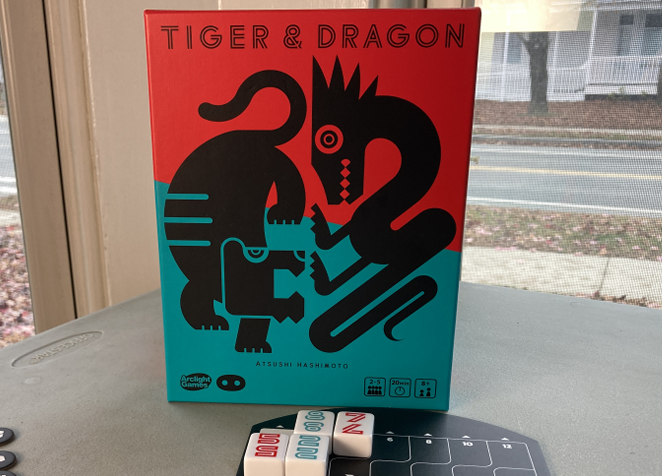
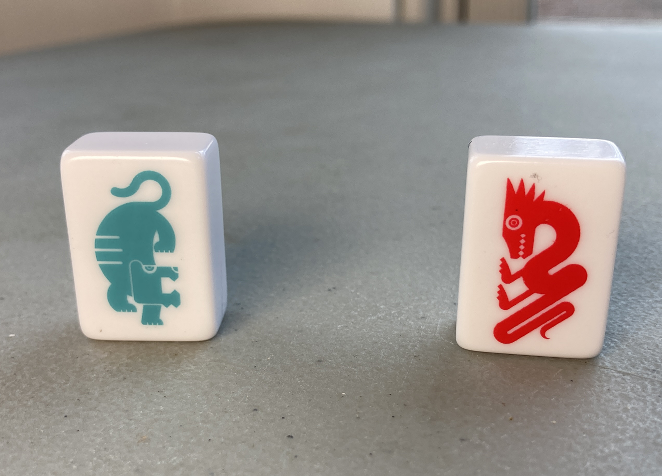
Tiger and Dragon my favorite game Oink Games has published. It’s also my favorite game with Dragon in the title that I’ve played recently. (The other two in that category are Dragonwood, and Dragon Castle.) It’s stayed entertaining even after playing 8 or so times, and is relatively simple.
Tiger and Dragon is sort of a trick taking game played with a set of numbered domino-like tiles, for 2-5 players. The group I’ve played with likes it best at four players, but I personally also really enjoy it with three players.
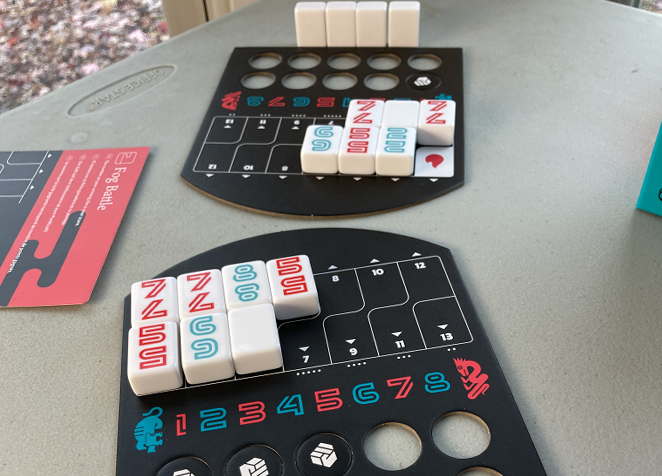
Here’s how a round works. Each player takes number of tiles based on the number of players, with the starting player taking an extra tile. Then the starting player places one of the tiles from their hand, as an “attack.” Going clockwise, any player can play a tile that matches that number to block. If they do, they then become the attacker, and choose a domino to play, and the process repeats.
But if none of the other players choose to block, and it cycles back around, the original attacker gets to place a single tile from their hand face down, and then attacks again.
The goal of the round is to be the first player to empty your hand. Whoever does so scores points based on the battlefield in use. Battlefields modify the games scoring rules, and the first player to get 10 points wins.
The strategy and fun of Tiger and Dragon comes from how the tiles are numbered. Each tile has the same number of copies as its value. There’s a single 1-tile, two 2-tiles, three 3s, and so on all the way up to eight. There are also two special tiles, the Tiger and Dragon, which we’ll talk about in a moment.
But let’s say another player attacks with a three, and you have a three in hand. You can block with that three, or you can decide to try to hold the three, and force another player to block. If another player blocks with a three, you now have the only three. This means that when you attack with the three, it will likely cycle the entire table, letting you play an extra tile for free.
Unless of course someone plays the Dragon.
The Tiger and Dragon are spoiler tiles. The Tiger can block any even tile, but be blocked by any even tile. The Dragon does the same thing, but for odd tiles. This makes them the strongest defenders, and the weakest attackers.
The end result is a very fun game of bluffing and hand management, that I highly recommend, and hope gets restocked at some point in the future. (I guess you could buy it off Amazon.)
I heavily recommend Tiger and Dragon. It’s incredibly repayable, has a fantastic level of planning and bluffing, and is just generally a very fun game.
Author’s Note: Apparently Tiger and Dragon is based off an old Japanese game called Goita from 1860. The amusing part of this for me is that the apocryphal designer of Goita has a Board Game Geek page, which for some reason I find very amusing.
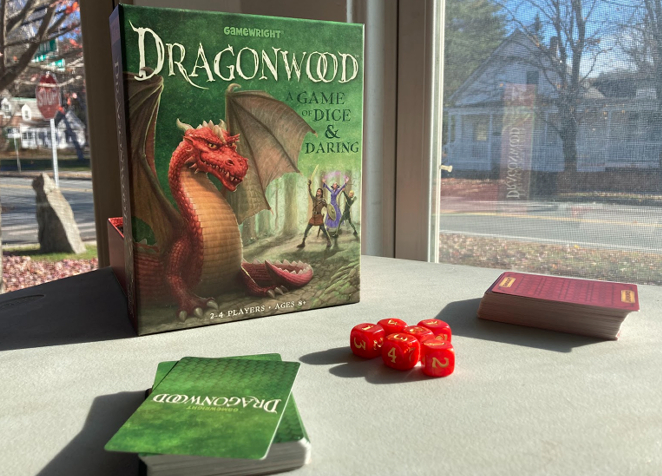
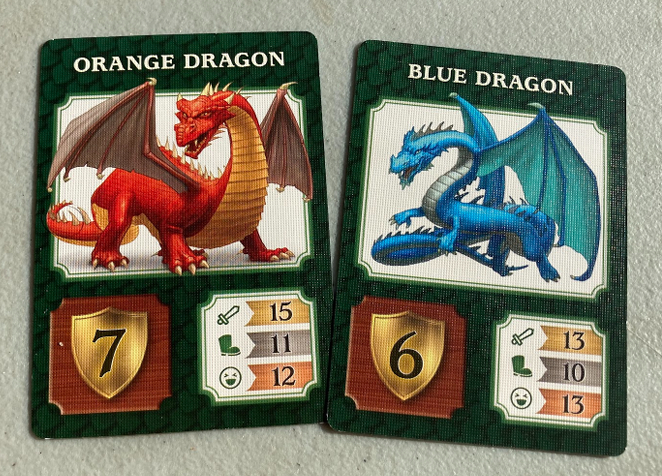
I’m supremely “Meh” on Dragonwood. The shrink wrap on my copy of the game had a sticker informing me that it won the Mensa Select award. This award is shared by Dominion and Set. I’m not sure why Dragonwood, of all games, was added to that lofty grouping.
Maybe there’s a high level of strategy present in Dragonwood and I’m not smart enough to understand it. Maybe the people giving out this award only play 5 games a year. If I had to guess, I would guess the second one.
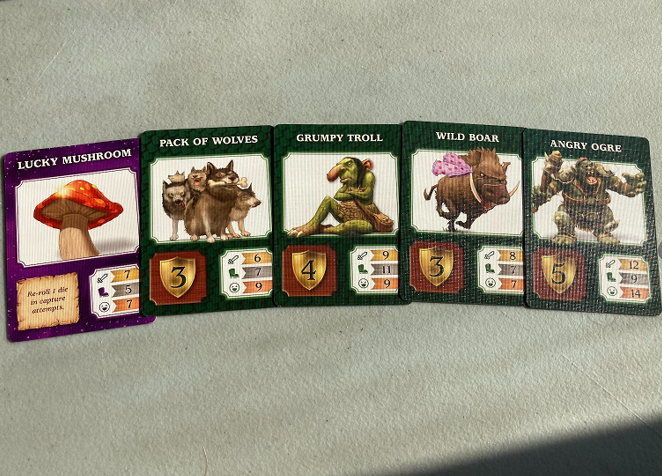
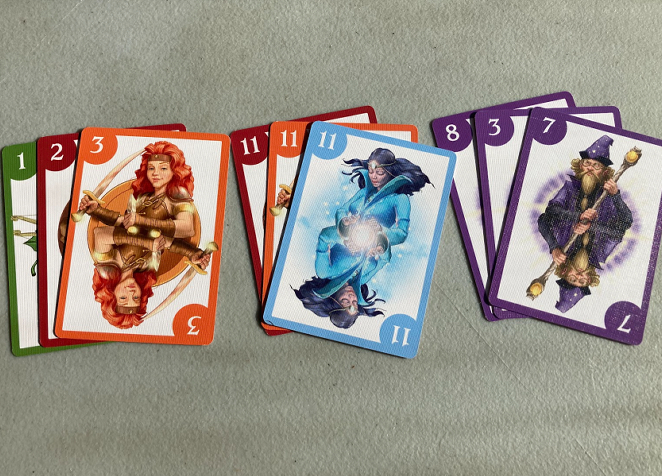
Dragonwood is incredibly simple. On a player’s turn, they either draw a card from a central adventurer deck to their hand, or play adventurer cards from their hand to try to capture monsters or obtain equipment from a central row. The adventurer cards have five colors, and are numbered 1-12, with a set of each.
Capturing a monster requires you to play a set of cards as a strike (a straight: 1,2,3), a stomp (same number: 8,8,8), or a scream (a flush: blue, blue, blue). Then you roll dice equal to the number of cards you played. If the sum of your roll value is higher than or equal to the value of the card you are trying to capture, you take the card. If not, you return your played set of adventure cards to your hand, and then have to discard a card as the cost of failure.
Monsters are worth victory points. Equipment gives bonuses to future roles.
This is pretty much the entire game. It’s also worth noting that game’s six sided dice have faces: 1, 2, 2, 3, 3, 4. The end result is a fairly narrow range of expected outcomes.
The game ends when the adventurer deck has cycled twice, or both of the dragon monsters have been defeated.
Frankly, the end result is rather boring. There are virtually no interesting decisions to be made. Instead, you just do a quick analysis of if the expected outcome is worth the victory points. The equipment is almost all beneficial stat sticks, or one time buffs.
The nicest thing I can say about Dragonwood is that if I was trying to teach someone that board games aren’t difficult to learn, Dragonwood would be a great example an easy-to-learn game. Not “easy to learn, hard to master.” Not particularly fun. But a simple enough game to learn to play from the rulebook.
I believe this is called damning with faint praise, but it’s all the praise I can muster for Dragonwood.
I liked playing Clank Legacy. After playing through the full campaign of 10 games, if you asked me to bring out my copy and play a game, I’d say “Sure.” If you pulled out a fresh copy, and asked me to play, I’d probably pass.
Let’s talk about why that is.
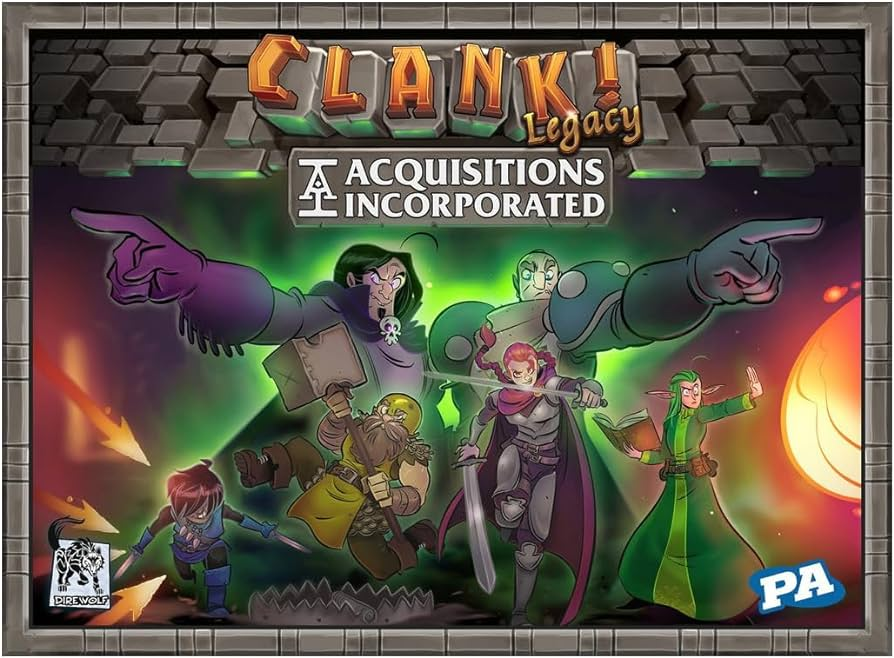
The full title of Clank Legacy is Clank! Legacy: Acquisitions Incorporated. I’ll just be calling this game Clank Legacy for the writeup. The subtitle does give us the game’s primary source of flavor and story: the Penny Arcade D&D Actual play. It’s an interesting enough story, but the entertainment value is carried by the humor and tone rather then the narrative arc.
It’s also an incredibly self-referential title.
Ah, yes. The Clank Legacy is Legacy Clank.
Clank Mechanics
Clank is a deckbuilder with a board movement component. The goal is to get the most victory points, but unlike Tanto Cuore or Dominion, the biggest source of those points is from moving around the board and grabbing artifacts, gold, and items instead of buying VP cards from the buy row.
In most senses it’s a fairly standard deckbuilder. Each turn you draw five cards and play them. When your deck runs out of cards, the discard pile becomes your deck.
As I mentioned, the game starts to diverge from standard deckbuilders when it comes to the goal. The end goal is to get from the starting zone, grab an artifact, and get back to the starting zone without dying. There’s more it than that, but it’s a decent general overview.
Cards generally give one of three resources: Movement, Skill Points, or Combat. Movement is used to move around, Skill Points are used to buy cards from the game’s version of the card market, and Combat is used to defeat monsters in the game’s version of the market.
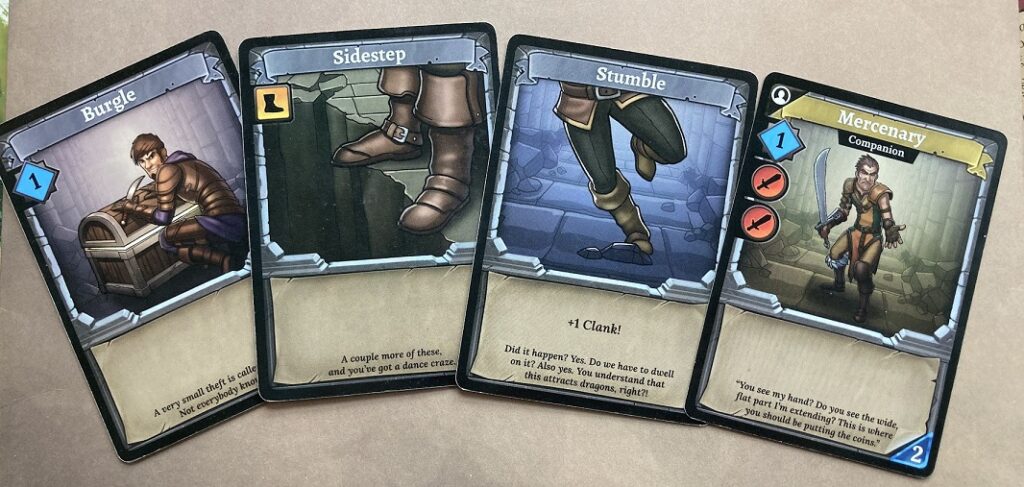
The next big place where clank differentiates itself from many other deckbuilders is that you must play every card in your hand each turn. And this is a bad thing because decks start with two copies of Stumble, a card that generates Clank’s eponymous mechanic: clank.
From left to right: Skill, Movement, Clank, and Fight.
Clank is a semi-random damage mechanic. Whenever you generate Clank, you put a wooden cube of your color into the Clank pool. Whenever a new card is added to the market, if it has a Dragon Attack symbol on it, all the Clank goes into the Clank bag, and then a number of cubes are drawn out. If your cubes get drawn out, you take them as damage. If you take all of your life as damage, you get knocked out, and may score zero points.
There’s another primary way for attacks to happen, though. Once a player does make it back to the starting zone, they score some extra victory points, and each time they would take a turn, they instead perform a dragon attack against all other players.
There’s a key interaction that I want to highlight here, because we’re going to come back to it later:
Clank has a buy row of random cards, and those are refilled after each turn when a player buys cards with Skill, or defeats monsters with Combat. There aren’t any other ways to interact with the row.
Clank’s primary mechanic to force players to end the game is that some of the cards trigger dragon attacks when they flip up into the buy row.
Just keep this in mind. It’s going to be important in a bit.
Legacy Mechanics
Time for the other half of the title! Legacy. This is a Legacy board game, and as such, it involves all the classic Legacy mechanics. Permanent powerups, permanently changing board state, and using the game’s campaign structure to perform mechanical scaffolding, slowly doling mechanics and ramping up complexity over the campaign.
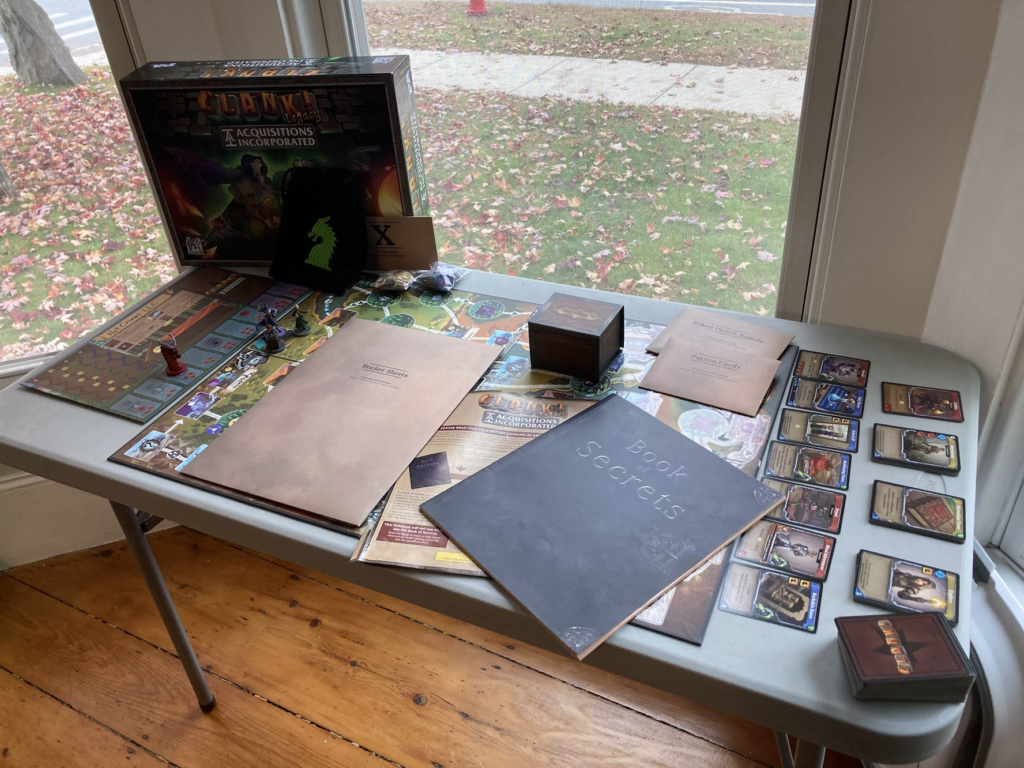
And because it’s a board game instead of a video game, it involves Legacy components and behaviors. Half a dozen sticker sheets, a bunch of envelopes with hidden contents, tearing up cards, removing tokens, and eating cardboard. That last one might just be me.
There are a lot of envelopes. Like, a huge number of them.
On the the whole, I found it a bit cumbersome. Not bad, just unwieldy. It also requires some additional components that aren’t included, notably a permanent marker of some sort. And maybe an x-acto knife to cut stickers in half for the parts of the game where you’re supposed to place them on creases on the board, and they don’t stay stuck.
I like the Legacy components. Now admittedly the game’s lookup book for events, the Book of Secrets, fell apart at the binding almost immediately. But I’ve had actual books do that to me, so I’m willing to ignore it.
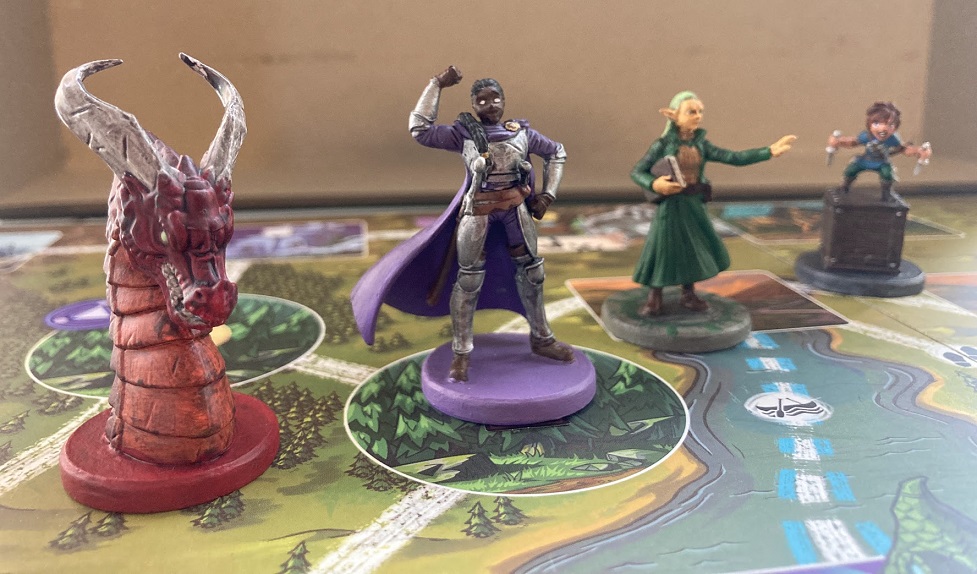
Yes, I painted the minis. Yes, I was much more proud of them before I looked this closely at this high resolution picture. No, the Dwarf isn’t done yet even though I’ve already finished the campaign.
The legacy elements themselves are quite fun an interesting. There are a few that are a bit underwhelming, for example one that is effectively just madlibs. But there are some really fun ones around upgrades, events, and expanding the board. They’re quite enjoyable, and very compelling to interact with and chase after.
Keep that bit in mind as well.
The Actual Critique
So, we’re now like eight paragraphs deep about game mechanics. In a moment, we’re going to discuss the game a s a whole. But first one last distraction.
Imagine a world where chess pieces are edible, and quite tasty. It’s not important why. What’s important is that if you choose to play chess, you’re going to be tempted to eat at least a few of those delicious, delicious pieces. So on your turn, you can play the actual game, Chess, or pull one of your own pieces off the board and have it as a snack.
This is a game design problem. Actively consuming your resources to do something that opposes the theoretically primary goal changes things. And if you play with an opponent who agrees that eating is more fun than playing, you might spend part of the game just taking turns munching on pawns instead of going for check. It’s a very different experience.
This is of course, a metaphor for the primary “problem” I have with Clank Legacy.
Stickers > Victory Points
It’s more fun to run around doing quests and unlocking legacy events than it is to to get victory points. Putting out stickers, reading things from a big secret book, and unlocking new cards and quests is really fun! It’s the whole point of Legacy games.
This means that in many of the games I played, the game stalled out. It wasn’t that we weren’t having fun… But we definitely weren’t optimizing for “winning.” We were optimizing for doing as much legacy “stuff” as possible. We would actively tell our opponent what our plans for the next turn were, and what cards needed to stay out. Often, we would give thoughts or advice on the opponent’s plan to try to help them have a better turn.
Clank Legacy is, in theory, a competitive game. But it wasn’t very fun for me to play it like one. Trying to “win” felt like it came at the expense of trying to actually have a good time.
The main issue here, is that when this happens, the game turns into a version of the Cold War, instead of a race. Because the advancement of threat and danger is dependent on the market row, and players buying from the market row, there’s no outside force pressuring the players to run home.
In addition, if one player wants to accelerate the pace of the game, they have buy cards from the market row. And if those cards aren’t good, they’re actively making their deck worse.
Overall
I liked Clank Legacy. I’d play more of my copy, because despite finishing the campaign, there are still interaction points, quests, and other special things we haven’t completed. And it also might be fun to actually go and play a round competitively! I’m not sure. I haven’t played it like that yet.
But if someone asked me for a fresh campaign, I feel like I’ve seen enough already that I wouldn’t be interested in starting from scratch, or replaying through some of the initial games with very simplified mechanics.
Spoiler Warning
You’ve been warned. From here on out, we’re getting into spoilers. You can still stop reading this sentence. Or you can stop at this one. Well, don’t say I didn’t warn you.
So you know that whole design problem I mentioned up above? The one where the game can be stalled out with no issues, because the buy row remains stagnant?
One mechanic I haven’t mentioned is the patron. Patrons modify setup and few other game mechanics, generally in a small and (quite frankly) often negligible way.
Except for the last Patron in the campaign, effectively the final boss fight. Instead, it’s the only Patron in the game that actively clears cards out of the row every turn. In addition to that, if it reaches a certain (very badly defined and poorly worded) threshold/trigger, it clears EVERY card out of the row.
It’s the only mechanic that does continually clears cards out of the market row in the whole campaign. And then, because this is a legacy game, you destroy that Patron, never to use it again. So the designers are clearly aware that they could induce the extra time pressure, and prevent the cold war stalling. But they actively choose to do it only once, for a single game.