Two event writeups in as many weeks? I know, it’s a real rarity. As always, I’ll be talking about what I played and what I saw, this time at the Green Mountain Gamers event from this past Saturday.
Perhaps most importantly, if you’re in the New England area, and looking for more folks to play games with, go join the Green Mountain Gamers facebook page for notifications about the various gamedays and events.
Necessary shilling out of the way, let’s talk about the games.
Morning
The day started off with Bullet♥︎, the only game I own that requires emoji to be displayed properly.
This was followed up by a quick game of Tiger and Dragon with a few folks. I’ve been playing a fair amount of Tiger and Dragon, and I’m very bad at it, but I generally enjoy playing it. It’s also fairly light, and easy to teach so that was fun.
Half of that group then went off to play Lords of Vegas, while me and a friend pulled out a copy of Dragon Castle, and played that for the first time. I enjoyed it, I think they had slightly less fun with it.
Then we went back to an age old classic, Race for the Galaxy, otherwise known as “The game I cannot win.” I have 14 game losing streak in Race for the Galaxy.
Yes, I’m counting. Yes, that includes yesterday’s loss.
Afternoon
After a lunch break that involved eating a sandwich the size of my head, it was time for some afternoon games.
This started off with Aegean Sea by Carl Chudyk, the same fellow who made Glory to Rome. Now, I have a policy on this blog of not doing writeups on games unless they I finish them. So, there will be no full writeup on Aegean Sea. There will be only the following statement:
I think I hate Aegean Sea.
Aegean Sea has the questionable honor of being the first board game I think I’ve ever effectively rage quit out of, along with every other player at the table. I found the action system grating, it seemed like everything I made immediately got destroyed, and it was just one of the most painful games I’ve ever played. We played a few turns, no one was having fun, and everyone decided to be done.
So then I went and played Everdell, while my friends played Spirit Island. Everdell is a tableau builder with more expansions than card types, and has so many components that I’d consider it a bit overproduced, but that’s just me.
I mostly liked Everdell, and I’d like to try playing it a few more times. I think that may not happen (for various reasons), but if I do get to play it again, I’d like to try a few more expansions.
Then, after a mere 11 hours of moving cardboard, it was time to head out. I’m looking forward to the next event like this, even if I don’t know the date yet.
Ed Note: I plan on doing writeups for a few more of the games on this list at some point in the near future. When I do, I’ll link to them from here.
It’s been a while since I covered an in-person event, hasn’t it? I think the last one was Granite Games Summit. I spent yesterday up in Manchester, New Hampshire at the Odd Tabletop Games New England event, hosted at the Boards and Brews game cafe.
As per my usual format for these sorts of things, I’ll be talking about what I played, and the event in general with a small amount of commentary not related to games at the end.
Author Note: I think my general enthusiasm for weirdness for is fairly well documented. For example, see this entire blog. That said, tabletop RPG’s are definitely my third category of focus when it comes to games, after video games and board games. So there may be some things here that I have different opinions on than most folks more in the scene.
Academy of Adolescent Monsters
Academy of Adolescent Monsters was the first game I played yesterday, and probably the most fun I had at the event. It’s a fairly rules-lite tabletop RPG with a simple premise and system for problem resolution. After creating the setting (the school), a starting situation, and the characters, the game starts.
Given how rules-lite the system is, it might just be faster for anyone interested to just go grab the rulebook and read through it. The general gist is that “problems” exist, and players state actions they wish to take to resolve the problems.
To solve problems, the player roles a D20, states what they want to do, and consults a sheet of outcomes. If the player used a positive trait, they can move around a personal bingo board grid and select a different value than the outcome they got. If they use a negative trait, they have to keep the outcome, but get to mark off an additional value.
The results of the lookup table range from solving the problem, to changing traits to positive traits, to just making things worse with various resolutions in between. Much of the fun from the game is the result of the players’ willingness to engage, really embroider the story, and buy into it being “The worst day of school ever.”
The designer, Daniel Jansen, ran the game for us and did a fantastic job keeping things smooth and on-tone. By the end of the school day, we had reconstructed a clock that changed time, convinced a car possessed by a hermit crab-entity to become the Driver Ed teacher, and stopped a camera that stole souls and teeth. In short, a great time.
I don’t think I have much valuable critique or issues with the game. During play, I incorrectly interpreted one part of the system involving changing dice rolls by consulting my bingo board, but it’s such a small confusion I’m not sure it matters.
A game like this feels like it works perfectly in a format like the event: as a one-shot with a bunch of players all willing to buy in and let everyone have their moment to shine, or embroider the fiction.
Overall, I had a fantastic time with this.
Side Note: There were definitely a few moments where I had to catch myself and step back a bit, because if given a chance to make up a monster, I really want to add all the details, instead of letting everyone else contribute.I tried to rein myself in.
Untitled DB Cooper Game
The second game I played was “Untitled DB Cooper Game” by Dr. Mary Flanagan and Max Seidman of Tiltfactor. I suggested the name “Cooped Up” and was told that no one likes puns, so sadly, I’m going to just have to refer to this as ‘Untitled’ for the rest of the writeup.
Untitled is a multiplayer story-telling and hidden details game. One player is the storyteller, one players is the accomplice, and the other players are the interviewer and FBI. The storyteller and the accomplice have agreed on a secret signal: an item in the room where the game is being played. There are also several location cards, and the storyteller tries to weave in details that will point the accomplice toward the correct location. The game is played over several rounds with the signal object staying the same, but the stories changing.
In short, the storyteller tries to secretly hint at a location with using a prearranged signal among the details of their story, while the FBI and Interviwer try to figure out the secret item.
It’s fun, if a bit challenging as the storyteller has a limited amount of time to talk. I got a few critical things wrong that led to me giving up the game a bit too early when I played as storyteller.
We Have Always Lived Here
The last game I played was Glen Given’s “We have always lived here.” It’s a solo journaling game about creating a haunted house.
It did not resonate positively with me.
One of the reasons may be that I’m not big on journaling. Another could be that as someone who isn’t an inherently positive person, I put a lot of effort into trying to maintain a positive mental attitude. As such, if you ask me to pick a sad, lonesome, or haunting song, there is part of me that stands up and suggests that the most appropriate choice is obviously “Macarena,” as a sort of self defense mechanism.
There are many design choices here that I find somewhat aggravating, but are also likely intended to aggravate. The game requires a high number of components and items to complete it, including dice, coins, a deck of cards, song, etc. The system for selecting items from lists feels deliberately cumbersome, involving counting down lists over and over and over, until only one choice is left.
There’s probably a longer discussion on art, catharsis, negative emotions, creation, ritual, and subjective experience. I’ll let someone else smarter than me write it.
Other Things That Happened
I chatted with Carly Dwyer, the founder of Intramersive Media, about some of their projects, including one named “Magical Help Desk” which I found particularly interesting, and really want to try. I also talked to Dr. Loretta Brady of Saint Anselm College about some of the work that she and her lab have done around games.
I also spent most of lunch talking about parasitic wasps, breaking teeth, and still finished my sandwich. I don’t have a link for that last one.
Dorfromantik: The Board Game, as you might be able to tell from the title, is an adaptation of the video game Dorfromantik: Doesn’t Actually Have a Subtitle Because It Was Made First. Admittedly, capitalizing every letter in the latter half of that last sentence was a stupid bit, but it’s about the quality that this writeup is going to have, so I’m keeping it.
I’m not sure I have much useful to add about Dorfromantik: The Board Game (a name I’m going to shorten from here on out). Both versions of the game have won a billion awards, and a sold a ton of copies. Instead, I’m just going to look at a few parts of the game that raise interesting points, and then wrap up.
First though, let’s talk about the gameplay. Dorfromantik: I’m Going To Misspell This is a co-op and singleplayer board game. On a player’s turn, they do a single thing: they pick up one hexagonal tile and place it connected to other tiles. This is the only thing they will do on 98% of their turns.
Before you decide that all you need to do to win the prestigious Spiel des Jahres award is buy a hexagonal holepunch however, know that there is slightly more to the game than that. There are two types of tiles: task tiles, and generic tiles. If there are ever fewer than three task tiles on the board, the player must draw a task tile on their turn. Otherwise it must be a generic tile.
When you place a task tile, you also place a score token on top it. This is the number of items that need to be connected to score that tile.
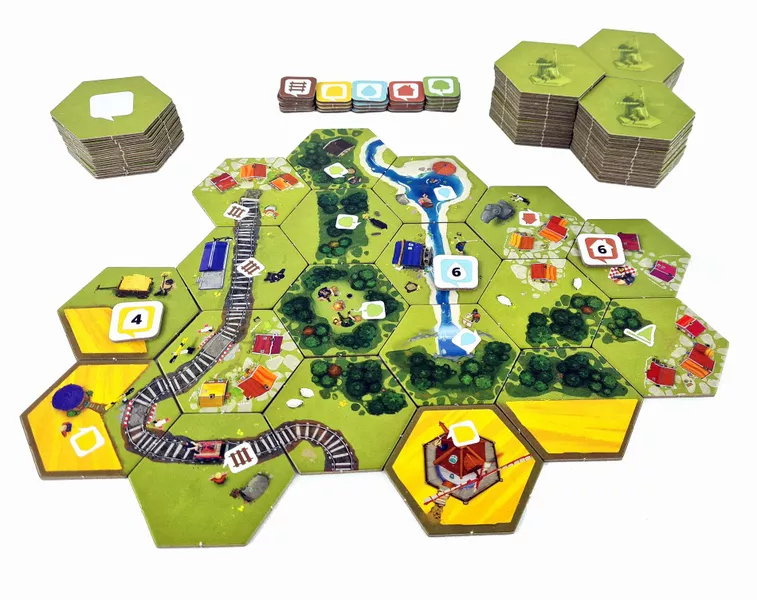
This image blatantly stolen from Gem Klub on BGG. Hopefully they’re cool with it.
For example, in the above image, the river has a 6-task on it. This means that you need a total of 6 connected rivers to score the task tile, and it currently has 4 connected rivers. The wheat on the left side however, only needs 4 connected wheat fields, and currently only has 2.
I’m skipping over a lot of ways of earning points, but this is the core gameplay. Pick up tile, play tile. Rinse, repeat, and try to maximize score by maximizing the number of score tokens you can remove before you run out of other tiles (among other unmentioned strategies). This brings up the first point: it’s kind of odd to me that this is considered a co-op game.
Don’t get me wrong. That’s not a bad thing. But Dorfromantik: The Are You Tired Of This Joke Yet is inherently multiplayer in the same sense that Sudoku is inherently multiplayer. There’s no individual resource, score or value whatsoever.
The game says it’s for up to six players, but there’s no difference in mechanics between a 6 player game, and a 60 player game, outside of maybe inconvenience. Unlike something like Beacon Patrol, Dorfromantik doesn’t even try to pretend to be a distinctly multiplayer experience.
The other interesting thing about Dorfromantik is that it’s a “Campaign Game.” It’s apparently not a “Legacy Game” because you don’t destroy the pieces.
In reality, all that means is that you unlock extra things, but you don’t get to eat any delicious juicy cardboard. While in theory you could put everything back into the tiny boxes it came with and start a new campaign, you’re probably not going to. Or at least I’m not going to.
Editor’s Note: Dorfromantik has put some thought into facilitating multiple campaigns at the same time by providing a pad of “campaign sheets” where different groups can track their respective campaign progress, but it would still be a hassle to sort out the unlocked components every time.
Look, I don’t see myself playing a board game 10-15 times, and then wanting to do it again but with none of the upgrades I spent the last 15 games earning.
I usually end these writeups with either a joke, or tying everything together, but I don’t really have either of those today. Dorfromantik for me is the perfect example of the 7 star BGG rating. “Good – Usually Willing to Play.” I don’t hate it, but I don’t love it enough to evangelize it. It deals with multiplayer and campaign setup in a way I haven’t seen before, but not one that’s unique or interesting enough for me to gush about it.
I moved recently, and one side effect of that move is playing a lot more board games. So this week while I try to avoid destroying the computers at my day job, let’s talk about some of the board games I’ve been playing.
Note: I’ve included links to their BBG page, less because I think BGG is some incredible source of wisdom, and more because I think linking to an Amazon page is pretty useless.
1. Root
Root is a 2-4 player asymmetric tactics game. It also has one of the most interesting problems I’ve ever seen in a board game, and that problem is that it is very cute.
No, really. The game is incredibly adorable, and that’s a problem because I think a lot of non-board gamers would look at it and go “Oh wow, that seems friendly and approachable.” A lot of hardcore board gamers would look at it and go “This didn’t cost $600 on Kickstarter, contains less then 50 plastic models, and doesn’t model industrialization in the 18th century. Get it out of my sight.”
Then you open the game up, and realize it has 3 rulebooks. A quickstart rulebook, an example and setup rulebook, and a rulebook simply entitled “The Law of Root” and references to things like section 9.2.9.
Long story short, Root possesses a level of depth and complexity that is very much not telegraphed by its adorable art.
I think my favorite thing about it is how different the factions are. When I played, it was a game where everyone else played Civilization, while I played Diablo, running around gathering loot as the Vagabond.
I really want to play more Root. It seems like a really interesting game.
2. Clank: Legacy
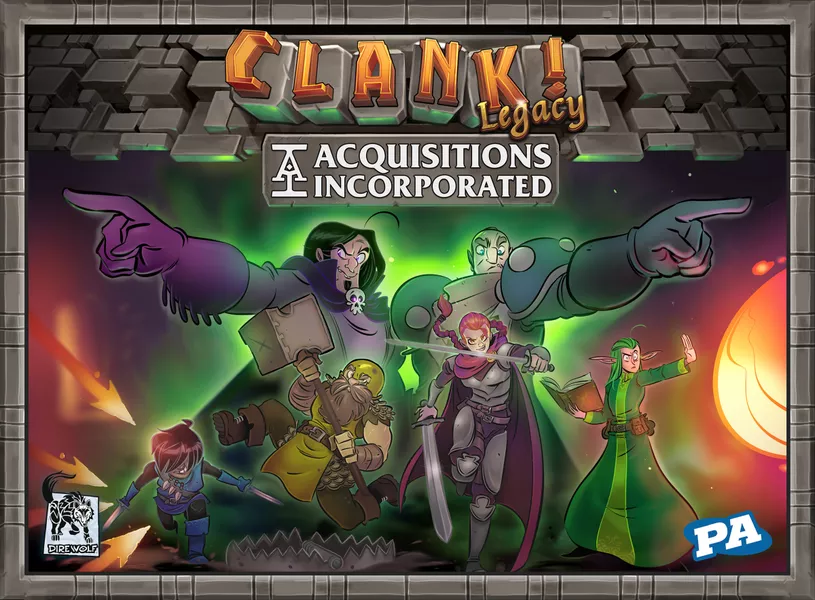
Of all the games in this list, Clank: Legacy is the one most likely to get a full writeup at some point. That’s because I’m playing through a full campaign with a friend, and we’re six games deep.
Clank is a movement based competitive deck builder where you build up your deck while adventuring around a board. As you do so, you collect items that get you victory points, and then try to escape with a valuable artifact.
Clank: Legacy takes that and adds a bunch of events and twists into the mix, as well as doing a bunch of the standard legacy stuff (using the legacy model to provide scaffolding, letting you put stickers on the board).
I’m enjoying playing it because I like the Acq-Inc theming, but I do wish the game itself was slightly more co-operative. There’s so much to search out and discover, but it feels like playing “optimally,” especially at two players, forces games to end incredibly quickly. This ends up being a detriment to the legacy system because you don’t get to explore much of it!
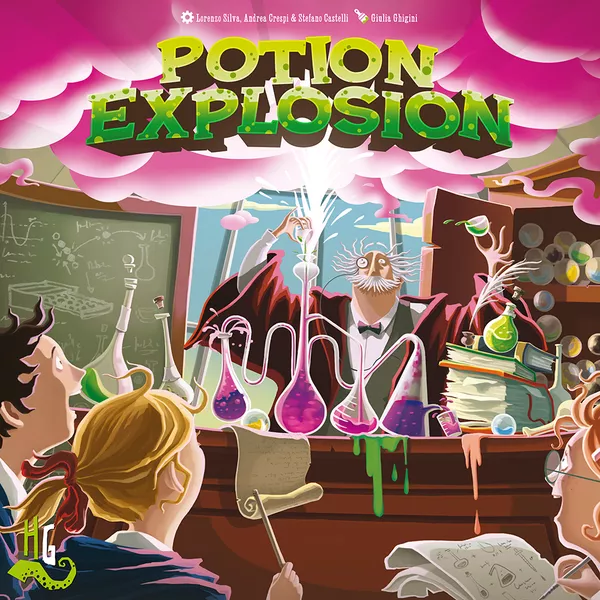
3. Potion Explosion
Potion Explosion has marbles. And unlike Gizmos (later on this list), it actually does a lot with them. It’s a variable set collection game, and the primary mechanic is pulling marbles from a central dispenser.
There’s a sort of match-3 element present as well, where if marbles of the same color touch after a match, you can pull and add all of those marbles to your pool in addition to one you pulled out. I’m not doing a great job of describing it, but it’s very fun, and actually takes advantages of the physicality of the marble dispenser.
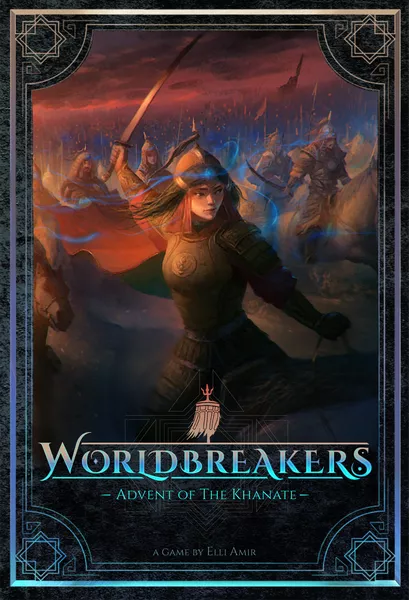
4. Worldbreakers
Worldbreakers describes itself as “a tactical card game set in alternate 13th century Asia.” I only played one game, and the structure felt very much like an LCG in the vein of something like Netrunner.
The big selling point for me would be the game’s relative mechanical simplicity, and count up structure for victory, where you win by scoring points as opposed to running your opponent out of life.
I won my game, and liked it enough that I’d play again. I’m curious to see how tactical and meaningful the choices are when I have a greater sense of the cards and their abilities. And also when I have to play an aggro into control deck matchup, as opposed to the other way around.
Note: I’m pretty sure Worldbreakers was a KS exclusive, with a limited pre-0rder for a second KS run. So getting a copy of this is probably quite difficult. I’d suggest finding someone else who already owns and just playing with them, or trying to find someone who would bring it to a convention.
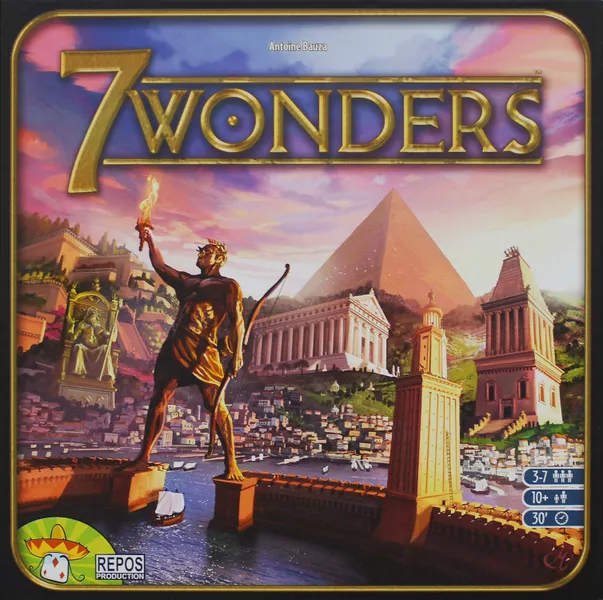
5. 7 Wonders
I liked 7 Wonders, but I don’t have too much else to say on it. It’s a tableau builder with a pick and pass drafting mechanic (like Magic drafts or Sushi Go).
I’ve always liked drafting games, I enjoyed 7 Wonders, and I’d probably play it again for its mechanics. But I wouldn’t say I was enthused by it. The theme is just sort of your traditional “build a thing wow.”
On the other hand, 7 Wonders is already so well known I’m not too worried that my one lukewarm take is going to any real impact on it.
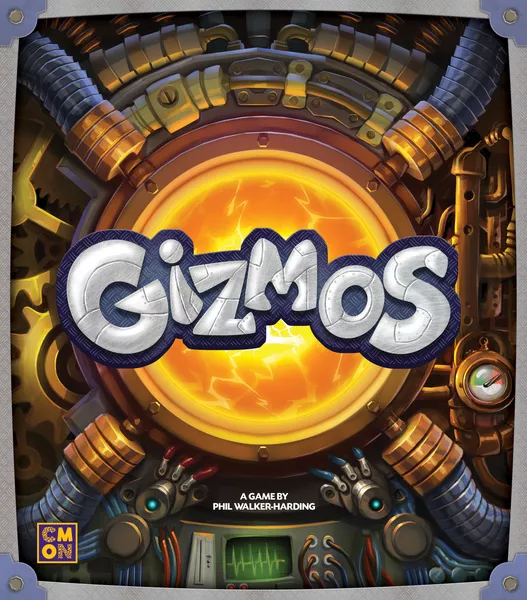
6. Gizmos
So Gizmos is a resource management engine builder.
There’s a big marble machine thing in the middle, but honestly, I’m not very impressed by it. They could have done the exact same thing if the marbles were just a deck of cards.
I’m pretty lukewarm on Gizmos. It might be because I never got anything to quite work, but it just didn’t feel very fun to play, and the marble components felt unnecessary to the actual mechanics of the game.
A few months ago I mentioned in my Granite Games Summit writeup that one of my favorite prototypes at the event was a deck builder with a working title of “Cubism.” I also noted that I didn’t really want to write about it while it was still in the prototype stage.
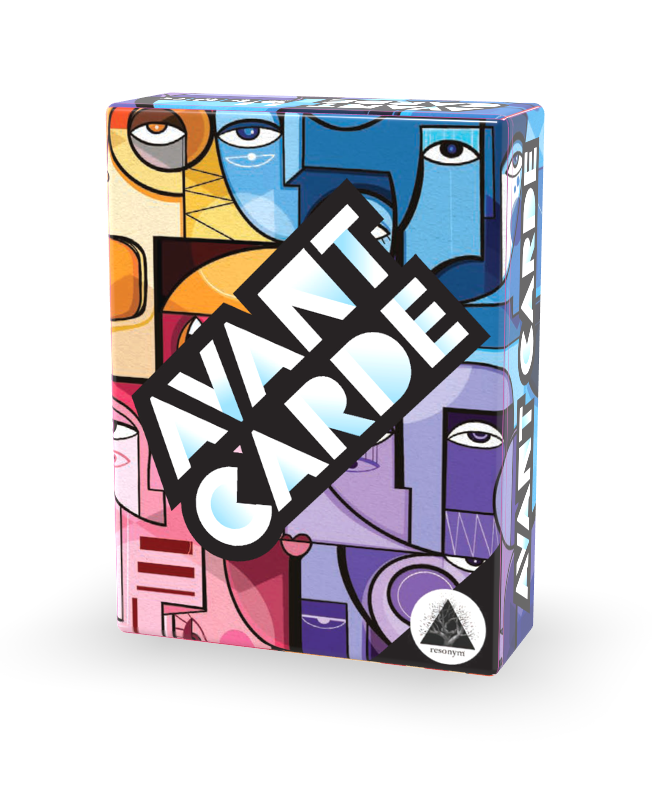
It’s been a while since then, but I’m happy to note that this week I can finally talk about that prototype. Mostly because it’s no longer a prototype, and it has a new final name: Avant Carde.
Avant Carde is a deck builder where players take on the role of collectors organizing shows of their artwork to score awards.
If you’ve played a traditional deck builder, you’re likely familiar with a lot of the base components of the genre. Players are given a (weak) starting deck that they make more powerful over time by using it to generate resources, and purchase additional cards to be added to the deck.
Where Avant Carde innovates, though, is in how it handles playing cards during a players turn, and also its scoring and buying system.
In something like Dominion or Clank, any card can be played in any order, though there might be advantages to doing things a certain way. Avant Carde is different.
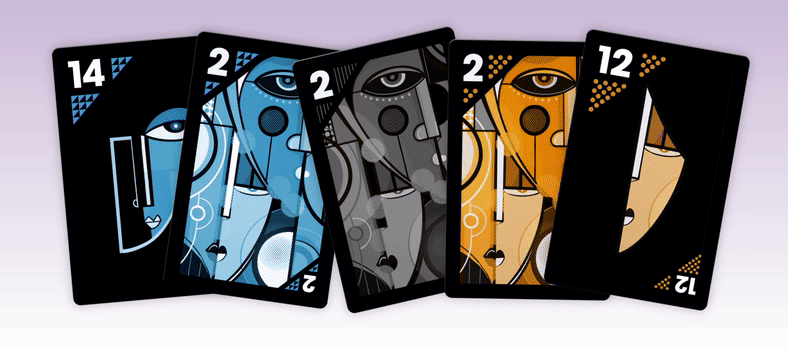
Avant Carde has a something more akin to an Uno style chaining system. Once a player plays a card for their turn, the next card they play has to match the previous card in either color or number to continue the chain. At the end, they count up the number of cards in the chain, and any other abilities those cards might have, and that number is the amount of money they have to buy with.
This chain, for example, would generate 5 money for the player.
This leads to a really interesting balance where the more expensive and powerful cards can end up being a bit riskier to play if they aren’t in a color that you’re collecting.
Avant Card also has some interesting changes in how it handles the buying area. Unlike Ascension, where a limited pool of cards are available at any point in time, or Dominion, where everything is always available, Avant Carde splits the difference in a pretty fascinating way.
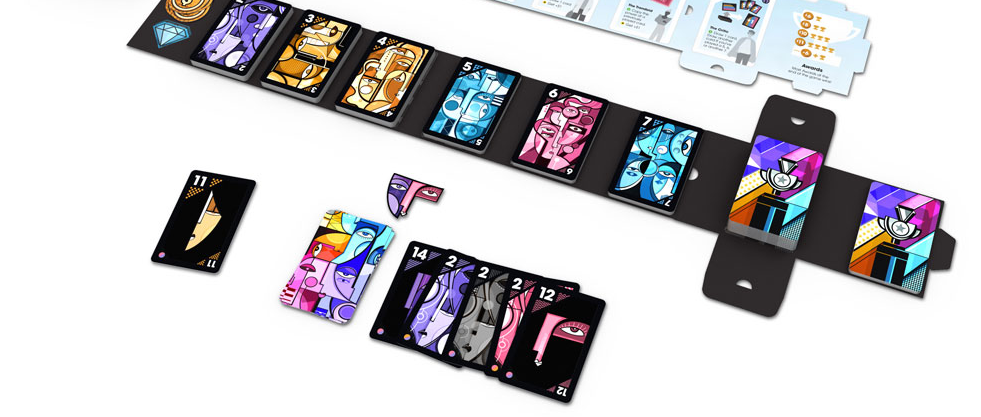
Another neat thing: The abilities in Avant Carde aren’t on the cards in your deck. Instead they’re on the cards you lay out above the buy row! This means you can change all of the cards’ abilities by just swapping out 6 cards.
You’re collecting cards numbered 2-7. Every number is always available, but the stack of cards for each number only ever has the top card flipped up and visible. And since the numbers come in different colors, even if you have the money to buy a high-cost card, it may not make sense to actually buy it if it’s completely off color, and would be hard to include in your future chain.
As tempting as that 5 might be, splashing into blue to play it could be difficult.
I’ve really enjoyed Avant Carde. It’s one of the few prototypes that I wanted to play every time I saw it over the last few months. I’m even more excited to see the final game. It’s a fascinating deck builder with some really neat mechanical innovations in the genre.
If any of this sounds cool, Resonym is currently running a Kickstarter for the game that you can check out.
Disclaimer: I am friends with the designers at Resonym, which is how I ended up playtesting it, but it’s honestly the best Resonym game I’ve played