Category: Card Games

  • TCG Card Shop Simulator

    I was having trouble finding something to write about this week, so I finally bit the bullet and bought a game I had hesitations about, but thought I’d enjoy: TCG Card Shop Simulator. And I was right on the money!

    And while I personally enjoy the game, it currently lacks depth in any of its systems. I don’t really want to recommend it in its current state.

    Side note: In that sense, it reminds me of MMORPG Tycoon 2, a game I purchased 3 years ago, and is now on version 0.2. Early access is a grave of ideas.

    But let’s say you do fork over $13. What do you get right now? A sort of abstract sim game with some card collection elements. Here was my experience.

    Tales From The Gameplay Loop
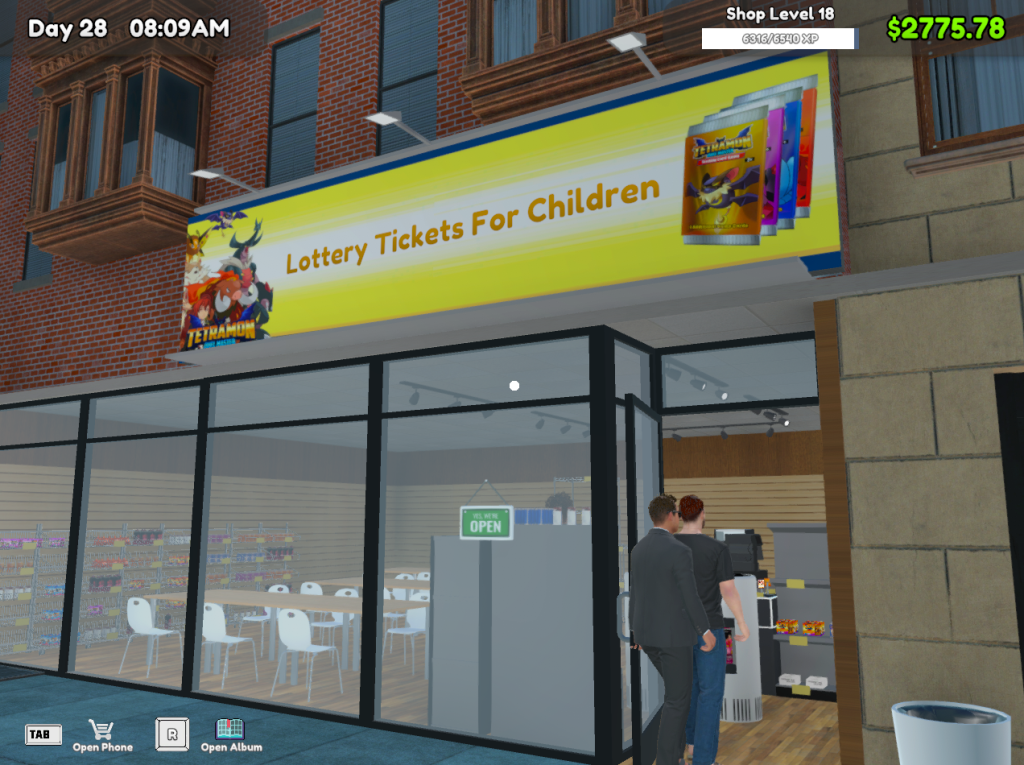
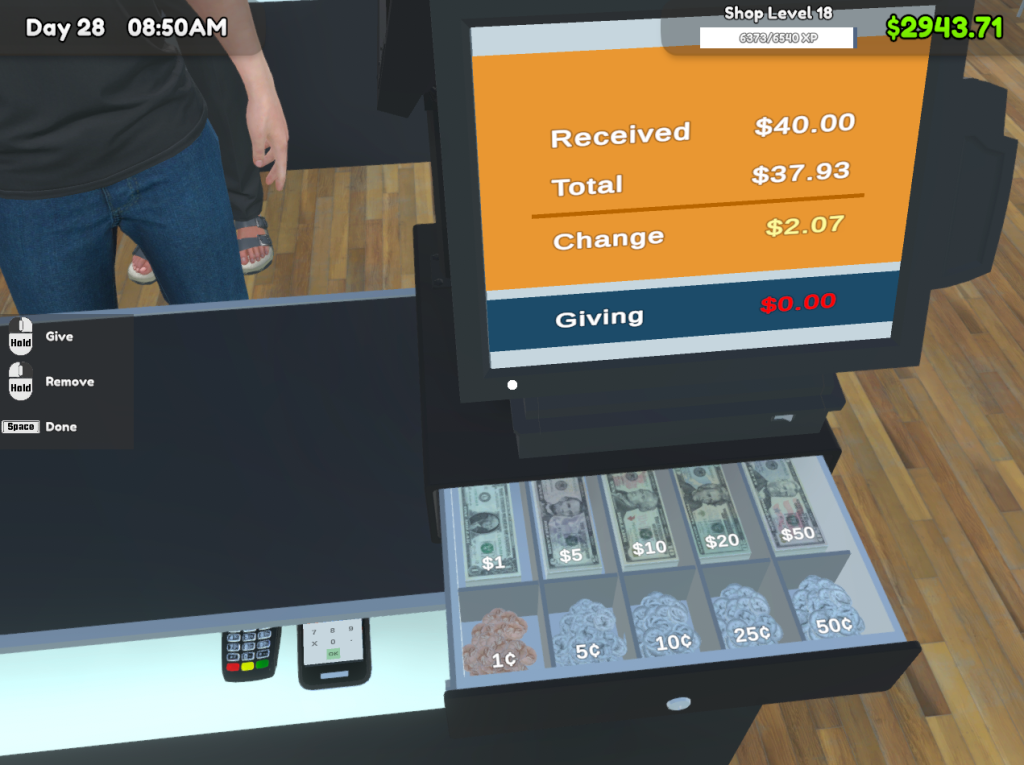
    After I named my store, I ordered inventory and waited for folks to wander in. When those customers finished their browsing, I went and checked them out. The checkout mini-game is a majority of the “gameplay” that I’ve seen so far. There is a small element where customers can show up smelly, and need to be sprayed with air freshener. I dealt with this by setting up two auto cleaners near the entrance to my store to double blast anyone who walked in, like it was a tower defense.

    While the player can hire helpers NPC’s to run the checkout, the only one I could afford was so slow that I just did it myself. It felt more practical to have them stock shelves, where it didn’t matter that they moved like molasses.
    The other parts of the loop involve buying new furniture and displays for the store, buying stock, adjusting prices, and selling singles. More about selling singles in a bit. First, let’s talk about the other parts.

    My general take on this game is that it functions mechanically, but lacks real depth to any single system. Employees don’t get better or worse as they work for you. There are a few different types of furniture, but they all function the same, and there’s only one type of play table. NPC’s don’t have names or preferences, there are no regulars, grinders, or “That One Guy.” The player can adjust prices, but it doesn’t seem to influence market value.
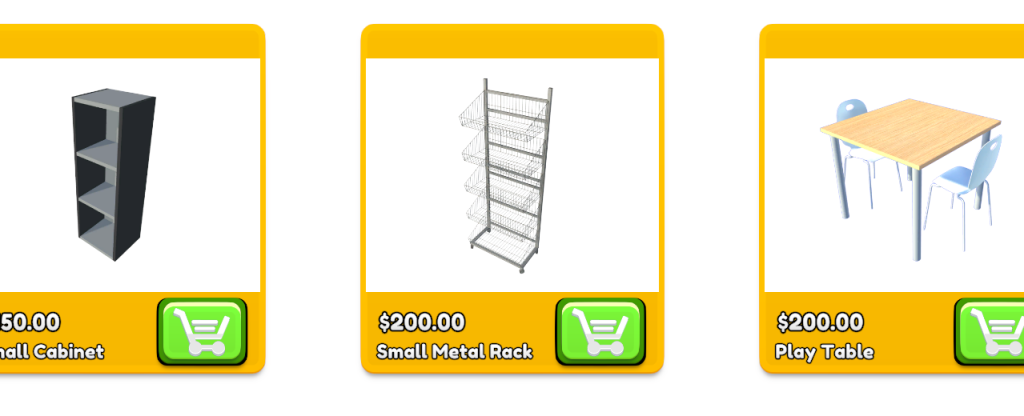
    Furniture is both deeply unaspirational, and as as my friends will point out, better than what I have in my apartment.

    In that sense, the game feels very static, almost like a clicker game. I would wait for things to happen, acquire money, buy a bigger store, buy more stuff to put in it. Rinse, repeat.

    A sort of capitalist zen garden.

    But I never felt like I was really working toward anything, or making more than incremental progress. That said, I do want to talk about one system the game has that did make me feel something.

    Cracking Boosters, and Selling Singles

    TCG Card Shop Simulator has a fairly reasonable system for opening booster packs to add cards to your own collection. It’s nicely animated, works reasonably well in partnership with the rest of the game, and is mildly compelling. But it’s not what I want to talk about.
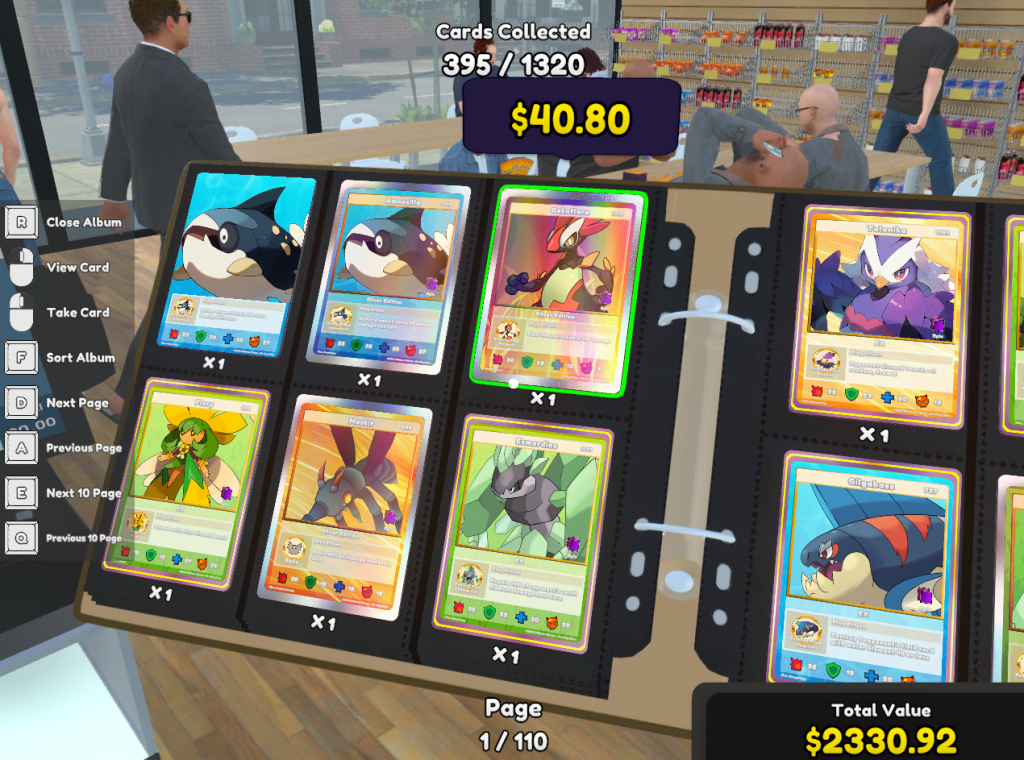
    No, what I want to talk about is how this game has finally made me understand why stores don’t like selling singles, mostly because the process is a huge annoyance for tiny amounts of profit. I never want to sell a single under $10 ever again.

    And this is in a sanitized, digital version of the process! I don’t have to keep perfect inventory, or look up pricing, or worry heavily about shelf space. But every time some unblinking digital homunculus walks up to the register with a card that’s a $1.27, and a $5 bill, I want to leap across the counter and chase them from the store.

    So in that sense, this game has made me feel a weird sort of sympathy for local game stores, and their equivalents. I now understand why no one wants to sell me 30 commons for $8.71.

    Overall

    Sure, TCG Card Shop Simulator is fun right now in a sort of zen/whiteout sense, but there’s no guarantee it will ever get all of the features it has promised, or even that I’ll remember the game exists by then. If you have $13, and need to just zone out from the world for a few hours, it’s great.

    After 8 hours, my card store looks like… well, pretty much any other card store on the planet honestly.

    But it lacks any real depth to any system, or even the aesthetic customization that would set it apart as a fun toy for designing a dream card shop.

    TCG Card Shop Simulator is $13 on Steam.

    Post-Script

    As far as I can tell, NPCs in TCG Card Shop Simulator don’t react to anything you do, including jumping on tables, throwing boxes around, and just generally nuisance in the store.

    Somehow while playing, this manifested into me envisioning my player character as a sort of long limbed, pale cryptid that always wears a flat cap covering their face, speaking only in curses and praise, clambering over counters and leaping across tables as it restocked and moved to check people out.

    It also made me realize that I would still probably shop and play at this store, even if the owner occasionally scuttled across the table in the middle of the match if the prices were good enough.

    This was followed by me roleplaying as this character for 30 to 40 minutes, including nodding my head, and saying “Blessings upon you, yes, yes!” whenever someone paid with exact change.

    This is not a thing I usually do in games. I don’t know where this came from. Also, at some point I decided they had a tail like a lizard.

    He should really be skinnier than this, all bones and sinew.

    Thanks for reading.

  • So I did a Duskmourn Prerelease…

    Duskmourn is here! I was trying to think of something witty to say about the set, but I don’t really have any insights on its implementation of modern horror.

    I was going to borrow some copy from the Wizards site, but the site was mostly about how I would have a “more thrilling experience” by pre-ordering boxes of collector boosters, something I decided to skip.

    I’m sure it would be a thrilling and horrible experience to look at my bank account afterward, but that’s not the sort of horror I’m looking for.

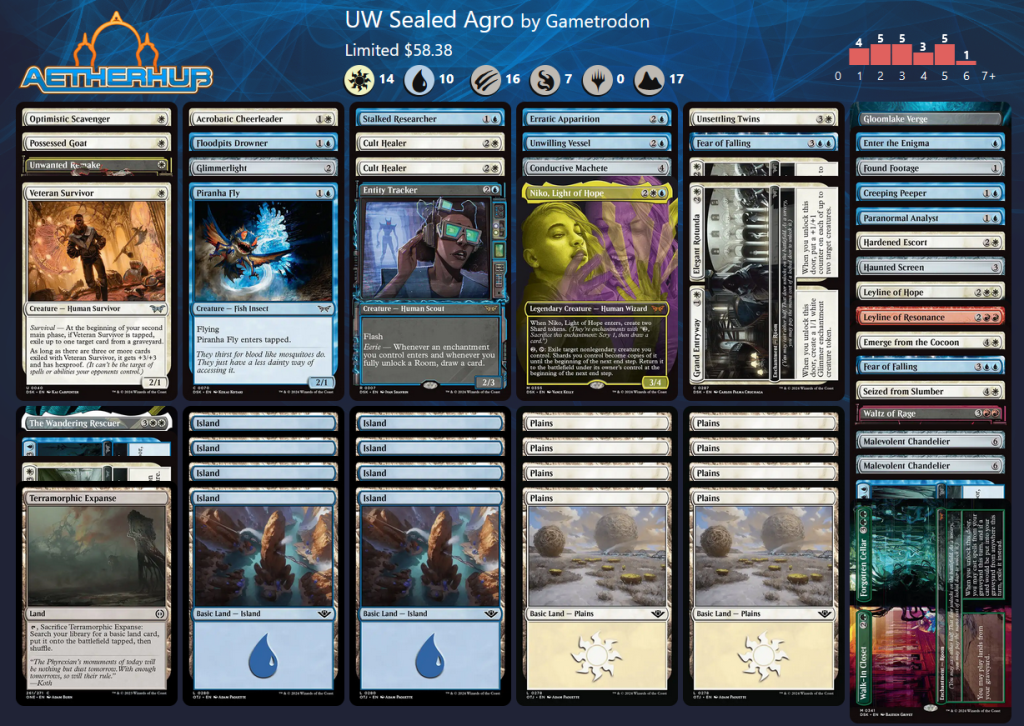
    Instead, let’s talk about some Sealed! Here’s what I ended up building.

    View the list on Aetherhub. As a brief note, I’ve included only rares and cards in my colors in the sideboard, but there were in fact more cards than this.

    While the rest of the pool was decent, it didn’t offer much in the way of a definitive direction. My two pretty mythic creatures (Niko, Light of Hope and The Wandering Rescuer) did give me direction, though!

    As a result, I ended up with a pretty straight forward Blue/White aggro list.

    Deck
    2 Cult Healer
    1 Optimistic Scavenger
    1 Piranha Fly
    1 Unsettling Twins
    2 Grand Entryway // Elegant Rotunda
    1 Stalked Researcher
    1 Acrobatic Cheerleader
    1 Unwilling Vessel
    1 Surgical Suite // Hospital Room
    1 Underwater Tunnel // Slimy Aquarium
    1 Glimmerlight
    1 Conductive Machete
    1 Fear of Falling
    1 Veteran Survivor
    1 Erratic Apparition
    1 Unwanted Remake
    8 Island
    8 Plains
    1 Possessed Goat
    1 Floodpits Drowner
    1 Niko, Light of Hope
    1 The Wandering Rescuer
    1 Terramorphic Expanse
    1 Entity Tracker

    Compared to my last pool, this one was far stronger and offered a definite direction to play.

    So how did it actually do?

    Better than last time! Still not great. But better!

    Match 1 was a set of games against Red/Blue control that I was able just roll over in two quick games. Possessed Goat put in a lot of work, and they were never able to drop a big enough creature to slow my roll of tiny dudes and pump effects.

    Match 2 was another 2-0, but a much harder fought one. They were running a Red/Green/Blue delirium deck. Game 1 was a bit of a brawl, but Niko and The Rescuer managed to turn things for me. Game 2 was closer, with them dropping a few Patchwork Beasties, but not managing to get the delirium up quite in time. This allowed me to finally sneak a board in, and pump the goat again for lethal.

    And then we get to Match 3.

    It might as well be a running bit at this point.

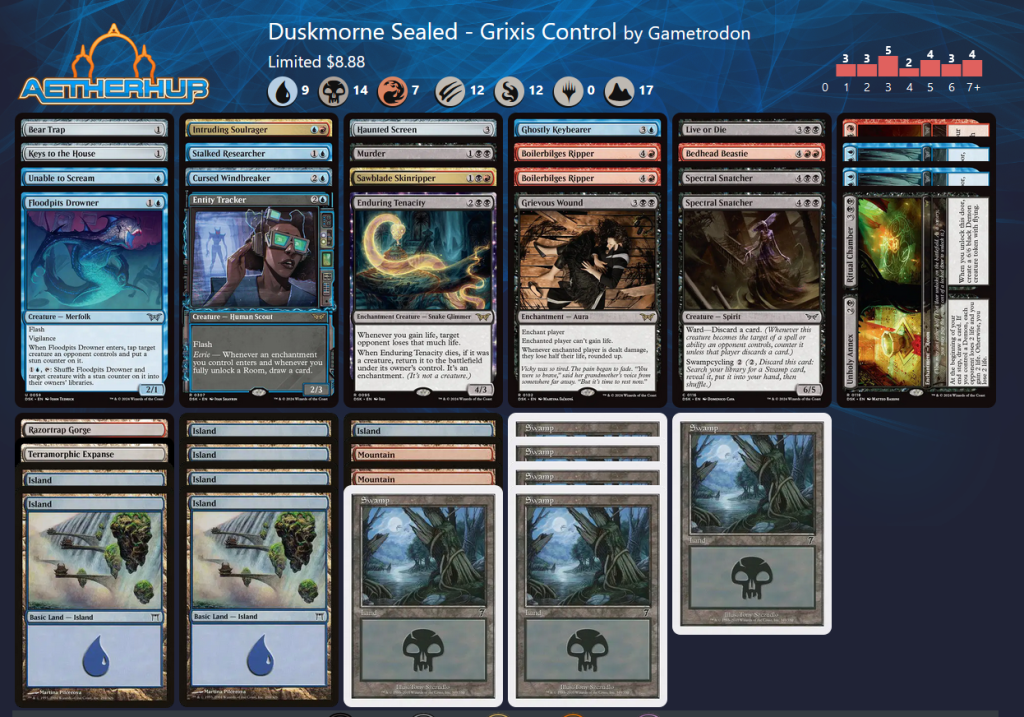
    For the first time in the night I experienced actual horror: my round 3 opponent was going to be my friend. Again. He was running blue/black control with splashed red for a few extra creatures.

    And just like last time, it did not go well for me. While I managed to take game 1 off of Niko and The Rescuer showing up, game 2 he managed to drop his Unholy Annex/Ritual Chamber for a 6/6 flying demon, after removing some of my early threats. A lack of hard removal combined with being pinged for two each turn while he healed up two meant that I did not last long.

    It was finally time for game three.

    It was not technically a stomp. I had him down to 4 life. But then Unholy Annex/Ritual Chamber came out again, and even though I removed the 6/6 demon, he just sacked the Annex with Boilerbilges Ripper. He then proceeded to drop Grievous Wound, and turn my “potential possible comeback” life total of 20 into 7 in one turn.

    Is there a moral to this story? Yes. Next time he commits to a three color control list, I’m not going to suggest he cuts aggro-fliers and adds the midsize bodies.

    Is there a better moral? Well, honestly, I think I probably should have side-boarded in a few more of my slightly cheaper cards after game 2 for game 3.

    But overall, how did it go?

    Some final thoughts

    I was generally excited for Bloomburrow, and I’m looking forward to playing Duskmourn. I’m not a huge fan of the theme, and there aren’t really any cards I want in the set, but it set itself apart mechanically. Rooms feel fantastic, which makes it a shame that we likely won’t see them again for a while after this. Manifest Dread can also be quite exciting.

    As a set, I don’t really have any big thoughts or worries, frankly. Historic Brawl is my primary format. I’m sure we’ll have things that shake it up, but it doesn’t look like there’s a Nadu 2.0 just yet.

    Some Friends’ Decks

    As is tradition, here are the decks of my friends at the event, and their records.

    This belonged to the friend who kicked my butt. Someday we won’t get paired in round 3, and I won’t get salty, but that was not today. They cruised to a 3-0 overall, only dropping 1 game.

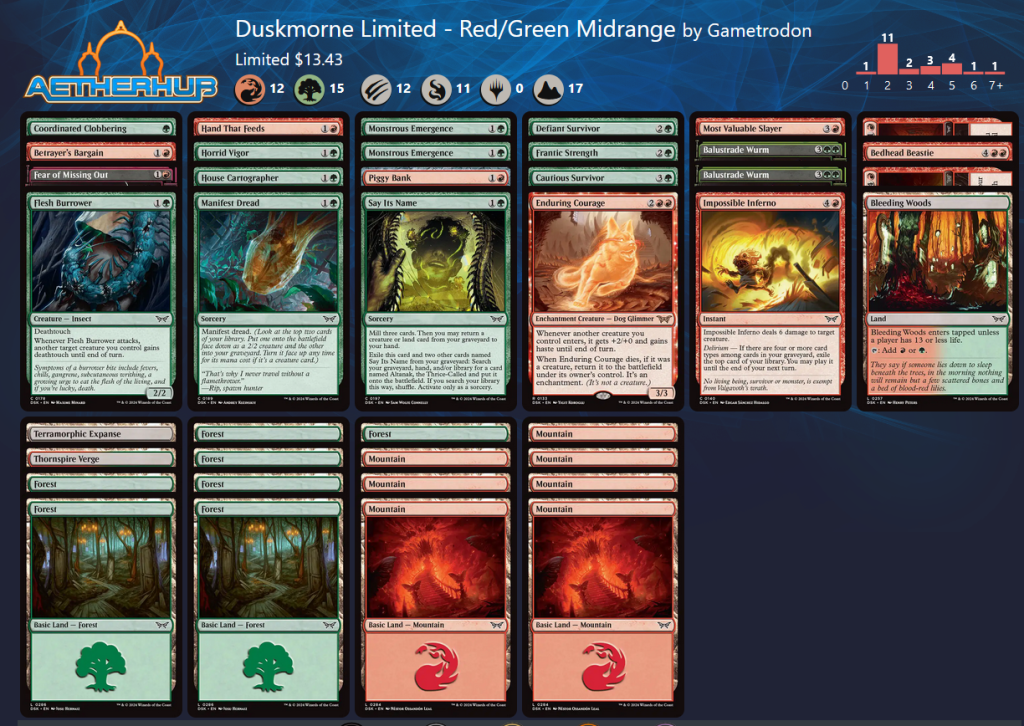
    Finally, we’ve got my other friend. They ended up going 1-1-1 off their midrange Red/Green list.

  • Bloomburrow Sealed Writeup

    It’s been a while since I really did any physical Magic tourney events. As I said two years ago:

    So in conclusion: I probably wouldn’t go to another physical prerelease. Magic: Arena and Magic as a physical card game are two competing ecosystems instead of a single synergistic one, and they’re both expensive.

    Me, 2022

    Note: When I say “physical magic” here, I’m mostly talking about the time involved in tournaments, or any longer form/multi-round events. No issues with kitchen-table or friendly commander at an LGS.

    Welp, I’m writing this, so I obviously did end up going to another one. And no, no one was covering my entry fee. That said, I was going with friends.

    Also, if you enjoy these writeups, you can do me a favor by following me on Twitter.

    The one good card I got at this event. Art by Jeff Carpenter, and you can actually get prints of this on his stop!

    Most of my general complaints about Magic as a physical thing remain. The last event I went to was Brothers War, and it went 5 hours. This event went just about 6 1/2 hours, going to 5 rounds, though there’s a reason for that. More on that later. But enough of that. Let’s talk about the deck!

    And while I don’t want to spoil anything, I will say that while I did fairly poorly, the friend I went with finished second, and I’ll be looking at their deck as well.

    The Cards

    It is a poor craftsman who blames his tools, and as the poor craftsman that I am, it’s time for some tool blaming.

    Here are the rares.

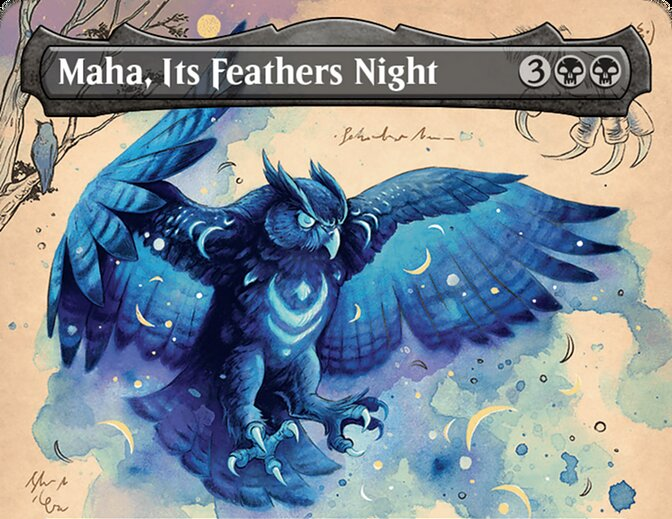
    Maha, It's Feathers Night
    Wick, the Whorled Mind
    Lunar Convocation
    Dawn's Truce
    Finneas, Ace Archer
    Salvation Swan
    Thornvault Forager
    Clement, the Worrywart

    This actually doesn’t immediately look that bad, especially with Maha being a huge bomb that almost always trades 2 for 1 on cards even if it gets hit with a removal spell.

    Except I did not get a single piece of Black removal. Adding insult to injury on that account, I did not get any of the changeling artifact creatures, and I only had a single rat. So while black looked promising at first, running it meant that I would have to have my other primary color carry the entire weight of dealing with threats.

    And those other colors were not doing great either.

    Black - Zero hard removal. 
    White - 3 hard removal spells, and 4 damage blast
    Green - A single Polliwallop, and a Pawpatch Formation
    Blue - 3 Hand Bounce, 1 counterspell
    Red - Two 6 Damage Bursts, and 1 4 damage spell. 

    So, with my truly incredible bomb ruled out by dint of just having the worst supporting set of cards in its color ever, I found myself in a bit of a rough place. The only two cards left to me that really had the potential to be bombs were Salvation Swan, and a single copy of Shrike Force. This combined with most of my good creatures being in Green led to deciding to go Green/White with a plan of grinding the game out and pushing through with pump spells and flyers.

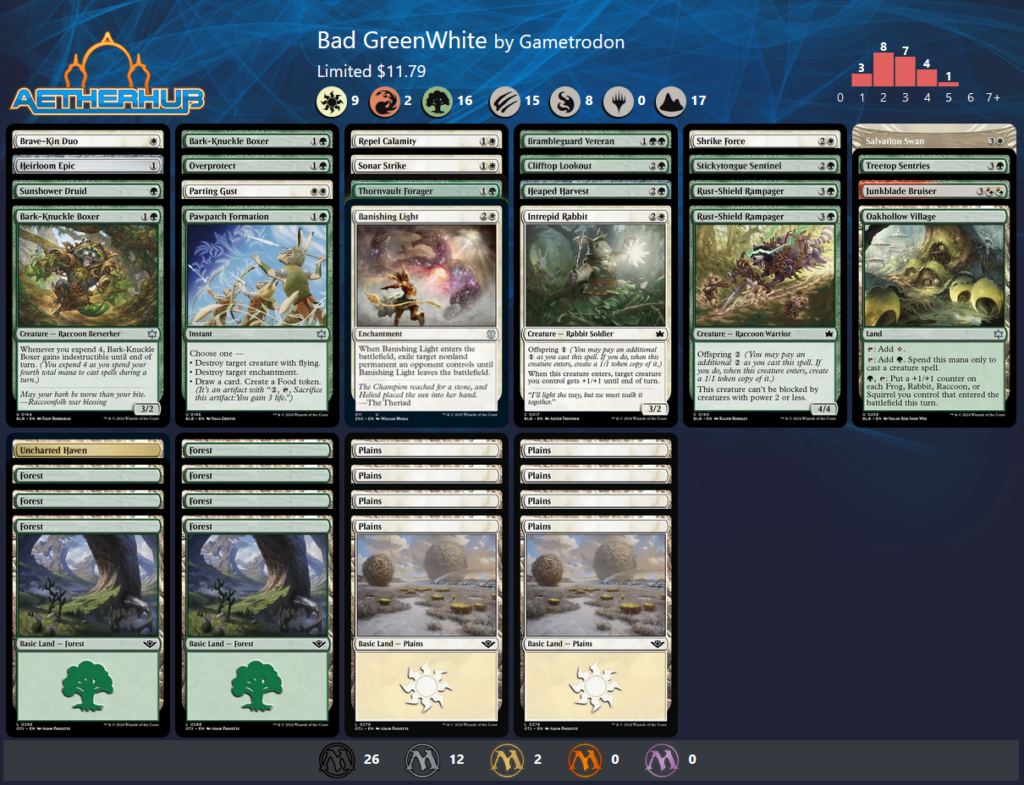
    Here’s a link to the list on Aetherhub.

    1 Sunshower Druid
    1 Brave-Kin Duo
    1 Heirloom Epic 
    2 Bark-Knuckle Boxer
    1 Overprotect
    1 Pawpatch Formation
    1 Repel Calamity
    1 Parting Gust
    1 Sonar Strike
    1 Intrepid Rabbit
    1 Brambleguard Veteran
    1 Shrike Force
    1 Stickytongue Sentinel
    1 Clifftop Lookout
    1 Banishing Light
    1 Heaped Harvest
    1 Treetop Sentries
    2 Rust-Shield Rampager
    1 Junkblade Bruiser
    1 Salvation Swan
    1 Thornvault Forager
    1 Uncharted Haven
    1 Oakhollow Village
    7 Forest
    8 Plains

    So. Not the finest thing. Not a terrible curve, but a real lack of actual big threats. I had a lot of expectations heading into Bloomburrow, and most of them were wrong. But I do think I was generally correct in my assessment that the general power/toughness of a lot of the creatures is much lower (or at least starts that way).

    The Games

    I did pretty badly, finishing with a 2-2 match record.

    Match 1 was a pretty even slog into a Black/Green deck that I ended up going 2-1 on, though game 3 was much, much closer. The turning point came when my opponent dropped Ygra, Eater of All, and I ended up blocking it with everything.

    We both completely missed that he could sacrificed his creatures to pump Ygra at instant speed before damage, but the miss went in my favor, and I managed to stabilize out despite having to trade most of my board.

    Match 2 was weird. It ended with me winning game 1, and drawing game 2. Game 1 I managed to sweep through very quickly with Shrike Force. Game 2 however took a much more brutal turn, and probably would have been a loss had we not gone to time.

    Match 3 was against the friend I came with. He stomped me game 1, and in desperation, I swapped all my white for red in game 2 to try to stem the tide. Tide status? Not stemmed.

    Match 4 went poorly on two fronts for me. Game one I mana-flooded, game 2 I got mana-screwed. Regardless, my opponent’s aggressive red/black lizard deck meant that I think they would have had the advantage either way.

    So, I did badly.

    My friend did not.

    The Part Where My Friend Cleaned House

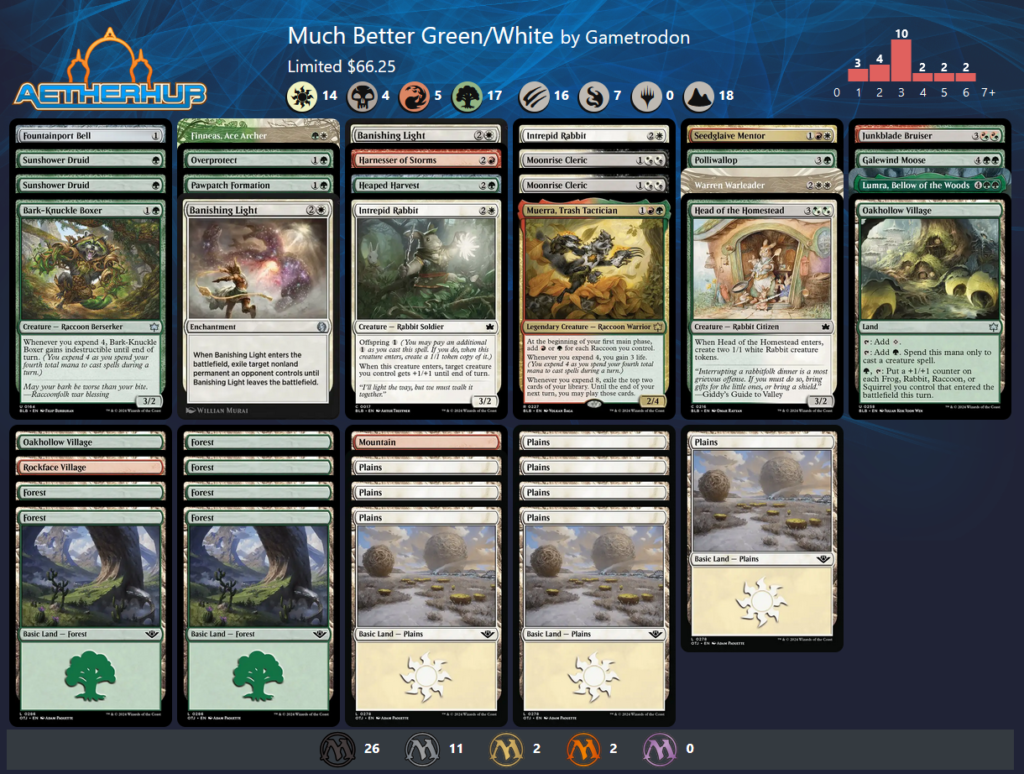
    This was my friend’s list.

    Please note the fact that my deck was valued at $11. His is $65.
    1 Lumra, Bellow of the Woods
    1 Warren Warleader
    1 Junkblade Bruiser
    1 Muerra, Trash Tactician
    1 Finneas, Ace Archer
    1 Fountainport Bell
    1 Heaped Harvest
    2 Banishing Light
    1 Polliwallop
    1 Harnesser of Storms
    2 Sunshower Druid
    1 Seedglaive Mentor
    2 Moonrise Cleric
    1 Bark-Knuckle Boxer
    1 Galewind Moose
    1 Head of the Homestead
    1 Overprotect
    2 Intrepid Rabbit
    6 Forest
    8 Plains
    1 Rockface Village
    1 Mountain
    2 Oakhollow Village
    1 Pawpatch Formation

    So, despite us both running similar colors, and many similar cards, he ended up going 4-0, going to top 2, and going 1-2 in the finals.

    I think there’s a lot going on here, but having lost to him, I think it’s also very hard in limited to deal with your opponent dropping bomb after bomb, especially the Warren Warleader. Still, his choice to go into three colors and build a slightly more aggressive deck with a lot more 3 drops clearly paid off.

    So. Somewhat different results between us.

    Final Thoughts

    One event isn’t enough to give opinions on the play-ability of a set, but it is a good chance to reflect on the general feel. I was concerned that Bloomburrow would either feel really fast due to the token creation, or very slow do the large grindy boards, and it ended up being neither.

    I do think this is going to be one of friendliest sets for new and newer players that we’ve seen for a while. It has a very broad appeal with it’s woodland Redwall-esque aesthetic, and the mechanics feel pretty simple compared to Thunder Junction.

    As the result of all of this, I’m really excited to see what Bloomburrow looks like as draft format, where it’ll be much easier to get a lot of the typal synergies online.

    Will I be doing more physical magic?

    Well, maybe in another 2 years.

  • Mottainai

    I have mixed experiences with Carl Chudyk games. I quite liked Glory to Rome. My opinion on Aegean Sea was brief, concise, and not positive. (Aegean Seas remains to this day, the only board game I have ever ragequit.) So it’s good that Mottainai swings back in the other direction.

    I’ve heard Mottainai described as Glory to Rome lite. I agree with some parts of that, and disagree others. For starters, Mottainai uses the same general structure of Glory to Rome. Every thing is card, and each card is everything. For example, a card is an action, crafting material, crafted item, and helper, but not at the same time.

    While I won’t go into the full structure of the game, the general gist of Mottainai is as follows: you’re trying to get the most victory points, and you get victory points by crafting items and selling materials. On your turn, you play a card from your hand to take an action, and then copy other players’ actions. These actions can get you more cards, let you craft items for their abilities, or perhaps get helpers, or sell various things.

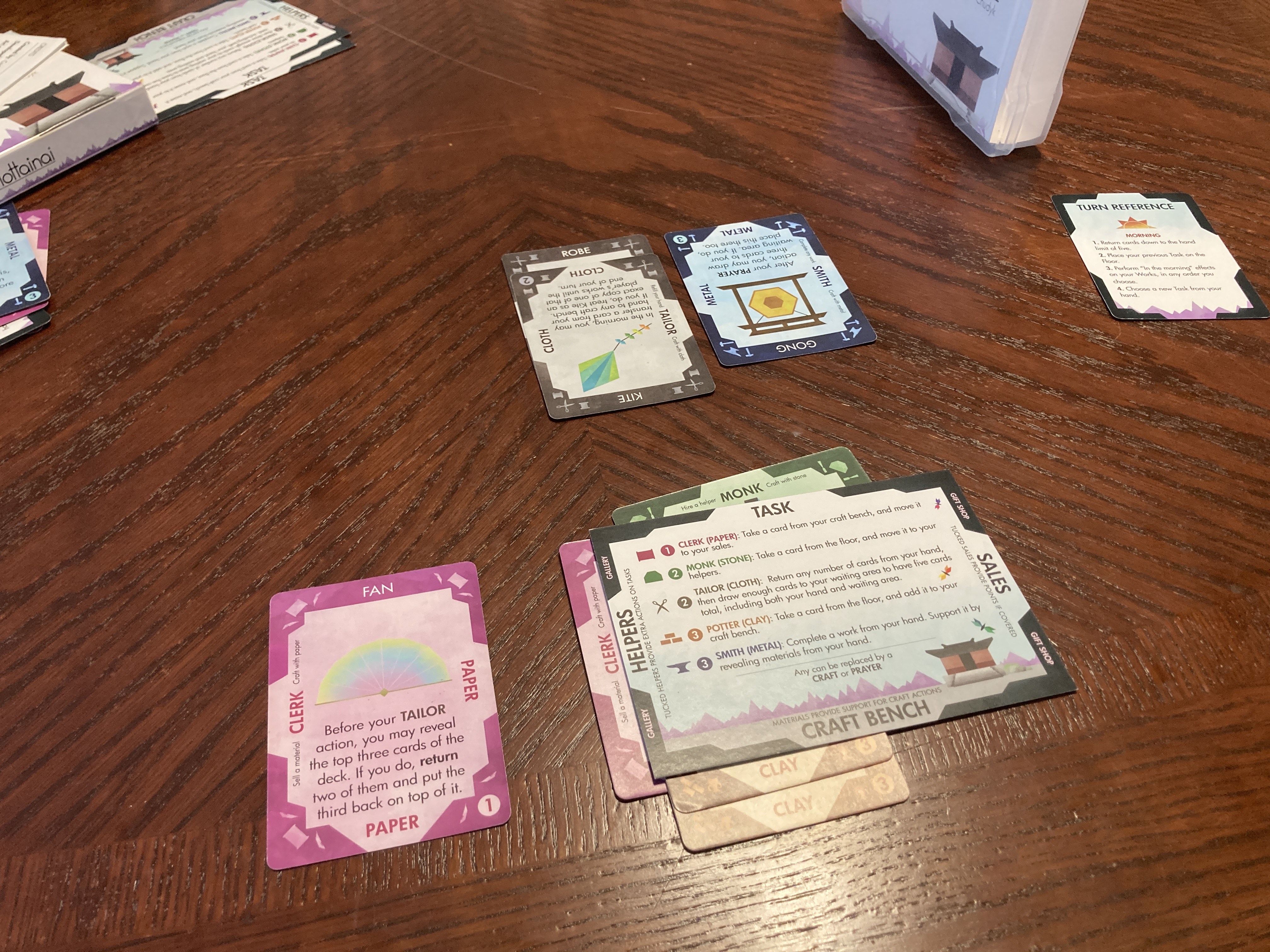
    While this might look completely unparsable at first, after just a game or two, it’s easy to see that I have two clay in craft, a Clerk helper, a completed Fan, and I’m about to take a Monk action. Also there are some resources in the middle of the table.

    I’m not sure there’s much value in trying to summarize Mottainai mechanically. It’s not quite an action selection game, but there is some action selection and follow-the-leader sorts of elements. It’s not entirely a tableau builder, but the items you build are both your main source of victory points, while offering additional capabilities.

    In that sense, it’s like Glory to Rome. Let’s talk about the ways in which it isn’t.

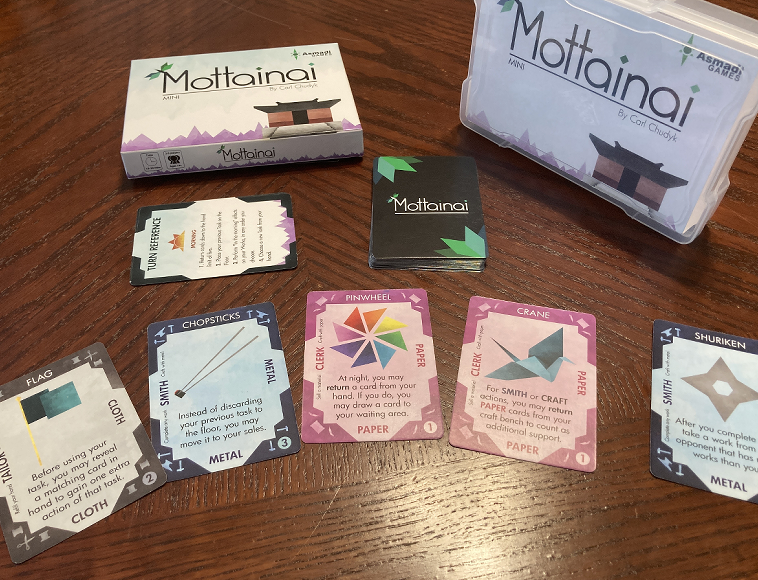
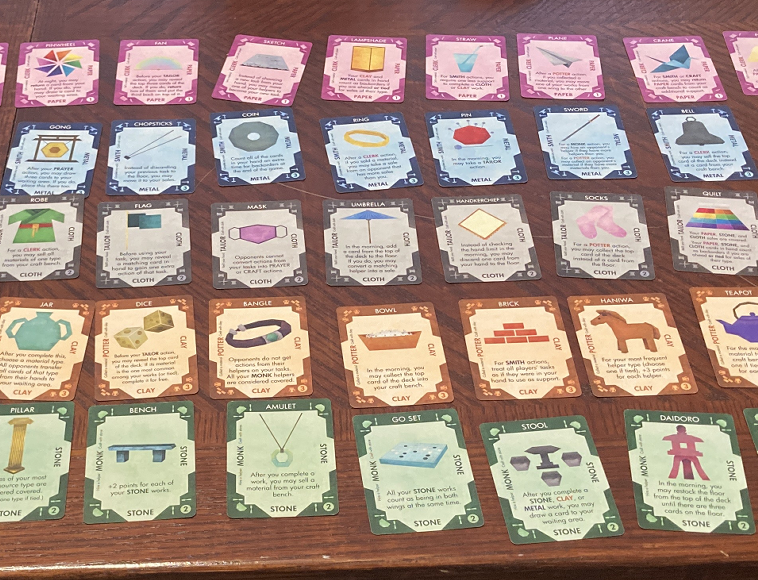
    Just like Aegean Sea, every card is unique. Unlike Aegean Sea, I’m actually happy to see all the unique cards. Here’s a small smattering.

    Probably the biggest difference is that Mottainai takes 20-30 minutes to play, instead of the slog that Glory to Rome can turn into. It’s a much faster game, and while it uses similar structures, it can have a very different mindset to it. Glory to Rome has always felt like building an engine, whereas Mottainai feels much more like looking for lethal in a game of Magic.

    Another thing that I find interesting about Mottainai is that as I’ve played more and more with the same few folks, the game has distinctly shifted. Early on, we played like it was necessary to take every action, but as we’ve played more, the pace of the game has slowed down.

    Not enough to slow down play, of course. We’ve now played enough that we can resolve turns and actions quickly. But the tempo has shifted down as we’ve recognized that it’s not necessarily to always be firing on full cylinders. Especially because if you take a strong action, your opponents get to take it to… but if you choose to skip an action and just draw a card, your opponents get nothing.

    If you liked (or wanted to like Glory To Rome) I highly recommend Mottainai. Or if you’re just curious. It has a bit of grit to it, but once you learn, it’s a fantastic quick game.

  • Should Paradox Engine be banned in Historic Brawl?

    It seems like every few months, I see an argument about Paradox Engine in Brawl and Historic Brawl formats. Someone comes in, complains about the card, other people agree or push back, and then everything returns to normal.

    Rinse, repeat.

    Given how often this happens, I thought I’d take some time to lay out my view, so I stop typing it out every time this happens.

    Paradox Engine art by Vincent Proce

    As always, my sources for this are in the spreadsheet.

    What gets a card banned in Historic Brawl?

    There are several things that can get a card banned from Historic Brawl by WoTC. Some are very clear and easy to understand, while others are much more subjective.

    Ban Gang 2024

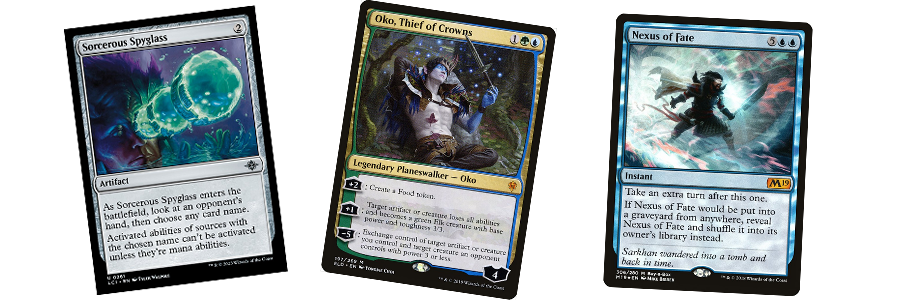
    The easiest category of bans to understand are cards that shutdown wide classes commanders. Examples include Sorcerous Spyglass and Chalice of the Void.

    The second more subjective category are cards that are “too powerful.” This includes Channel, Demonic Tutor, Natural Order, Tainted Pact, and Oko, Thief of Crowns.

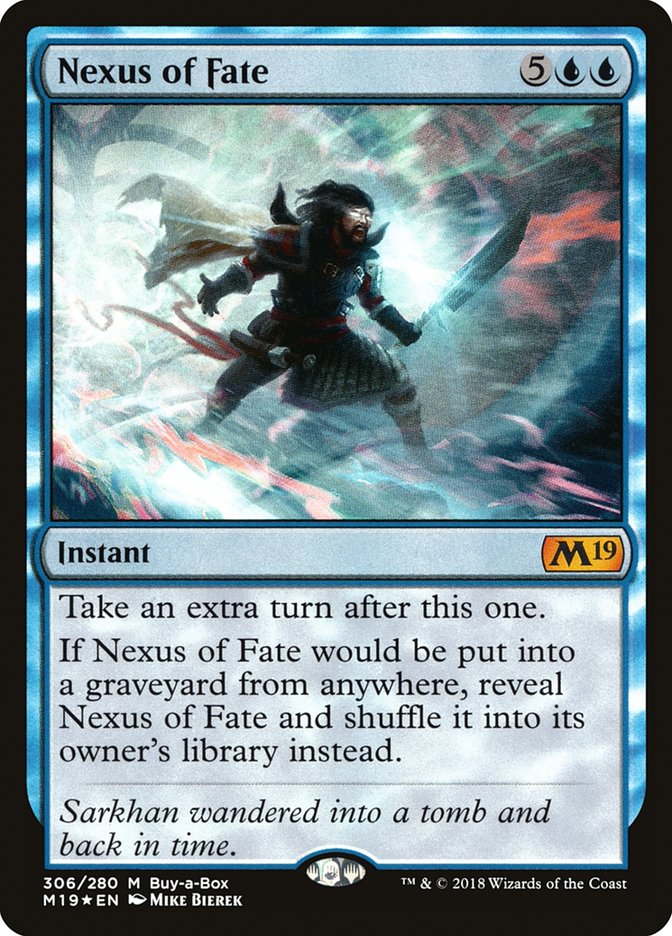
    And then we have the the rest of them. Cards that are banned for reasons specific to the card themselves. Lutri, Agent of Treachery, Field of the Dead, Ugin the Spirit Dragon, and Nexus of Fate. We’ll call this group the “Weird Ones.”

    So here’s my take: if you want to argue that a card should be banned from Historic Brawl, you need to argue that the card falls into one of these categories.

    Does Paradox Engine do that?

    Let’s go through the categories.

    Category One: Shuts off a wide class of commanders
    Paradox Engine doesn’t do this. Easy!

    Category Two: Too powerful
    This one’s a bit harder to quantify, but we can look at the results from the cHB Season 12 tourney for some info. While this event as a whole only had 33 players, across the top 8, there were zero copies of Paradox Engine played.

    Maybe you’re not convinced. Lets go back a bit further.

    SeasonCopies of Paradox Engine in Top 8
    110
    100
    9(Couldn’t find data)
    80
    70, but one decklist was missing

    Many of these decks do play The One Ring. Some play up to seven mana rocks. As far as I can tell, none of them play Paradox Engine, and Paradox Engine isn’t banned from the event. So, no. There doesn’t seem to be any evidence the card is “Too Powerful.”

    Quick Note: The data only goes back so far, and notably, doesn’t include a point in time I mentally refer to as “Rusko Hell.” I’m open to the idea that maybe Paradox Engine was a bit much then, but the current state of things doesn’t indicate Paradox Engine needs a ban.

    Category Three: The Weird Ones
    And this is where things gets difficult, since we can no longer look at general usage, or card abilities to easily determine if something belongs here. Instead, we have to go through cards one by one. Do any of these cards offer parallels to Paradox Engine?

    Lutri: Nope! Lutri is banned as a result of companion making him into an auto-include.
    Field of the Dead: Field of the Dead was banned in multiple formats, mostly for power level. In Brawl, it was an auto-include that was a strong payoff for any deck running more then 6 different lands, with very little downside. As we’ve already noted, Paradox Engine doesn’t have a high play rate, so this doesn’t count either.
    Ugin, the Spirit Dragon: Ugin was a strong colorless board-wipe that could be slotted into any deck, and there was very little reason to not do so. It was also called out for being overly prevalent in main decks. Again, no overlap in function.
    Agent of Treachery: Agent of Treachery could go in either category two or three. I include it three because I think it’s less a direct factor of power-level, and more an issue of breaking color-identity and being overplayed. It was effectively permanent removal that could be used recursively. But again, no clear relationship with Paradox Engine.

    This leaves just a single card left to try to use to justify a Paradox Engine ban in Brawl.

    Nexus of Fate: The Most Complicated Ban in Arena History

    Most bans get a line or two, or maybe a few sentences. Nexus of Fate gets six paragraphs.

    The short version is that it’s banned for play disruption. Arena doesn’t allow easy combos/loops. WoTC decided that 30 minutes to have a game non-interactively resolve was a bit much. So it got banned.

    This is the closest we get to a comparable card for Paradox Engine: a card that was banned for causing non-interactive, slow loops.

    So now things can go either way.

    Like Nexus of Fate, Paradox Engine can slow down games. It requires manually tapping all your non-land mana sources in the Arena client to use it optimally and try to go infinite, and it’s non-interactive. It can often end the game outright once it comes down, if you get lucky and have the right tools. And it’s very, very boring to play against.

    But it’s also not a perfect match. Paradox Engine doesn’t perform an infinite loop based off luck to anywhere near the extent that Nexus of Fate does. Once Paradox Engine comes out, it either gets removed and the combo ends, or it sits there and continually provides resources for whoever played it until they win, or run out of actions to take.

    My Take

    Personally, I lean against banning Paradox Engine at the moment. It’s nowhere near widespread enough to make it a “necessary” ban, and its existence is a win-con for several decks. That doesn’t mean that it should never be banned, but the mild frustration it produces is outweighed by the neat decks it allows to exist.

    Still, there are strong arguments both ways and (in theory) as more and more cards, and more and more mana rocks are added to Brawl, the scales (in theory) start to tip toward a ban.

    But right now?

    Paradox Engine doesn’t need to be banned.