Category: Card Games

  • PAX East – The Card Game Post

    Card games? Card games! One of the great things about PAX East is that there are an incredible variety of new card games and weird TCG’s to play. In this post, I’ll be quickly going over what I saw, and what I enjoyed, and also what I didn’t.

    The Good

    These are all the games I recommend at least trying if you get a chance. Am I going to collect them myself? Not necessarily, but I do enjoy playing them, and would play them again.

    Here Be Monsters

    Here There Be Monsters is a placement and ability-driven head-to-head battler with a sort of wacky pirate theme. It was in Unpub, and unfinished, but was fun enough for me to play 3 games of it—which is rare for something in Unpub. The core mechanics felt like they were almost where they needed to be, but the cards themselves did have some balance issues.

    I’m hopeful that I’ll get to see more of this game, though I’m not sure when. There’s a lot of promise here, and the core mechanics are fun.

    Altered

    It feels like we’re in a bit of a TCG gold rush at the moment. Altered raised over $7 million kickstarter. I didn’t back it for various reasons, but mostly a distaste of said gold rush.

    That said, I will absolutely not turn down a chance to try to play new card games, so I did play it. It’s neat, and doing some fairly different stuff. There’s no direct combat; instead it’s effectively a series of cost checks, where you and your opponent try to have the most of a given value present at one of two locations. While what I played didn’t sell me on buying a case, it did convince me that it might not just be an attempt to cash in.

    Star Wars: Unlimited

    I actually rather like Star Wars: Unlimited. It’s just unfortunate that I’m not a Star Wars person; I actually find the Star Wars theming a bit of a turn off. But I’ve found the gameplay of all the demos I’ve played quite enjoyable. They’ve got a nice tension to them, and that’s enough to put it into the good category.

    PAX is also a great opportunity to grab all the promos.

    The Bad

    Despite the title of this section, these aren’t necessarily bad games. They are, however, (based on what I played) games I will never demo or touch again unless I am paid cash to do so.

    Flesh and Blood

    I’d heard a lot of good things about Flesh and Blood over the years, and it’s one of the mid-level TCG’s that seems to have clawed itself a spot at various local game stores. So I’ve been curious about it for a while, and at one point even thought about picking up a starter set.

    Holy crap, am I glad I didn’t. I hate this game. I pretty much just quit halfway through, and didn’t even grab the simple starter deck.

    The short version is that I just found Flesh and Blood both boring and frustrating, and it felt more akin to playing a fighting game than a card game.

    UniVersus

    The best thing I can say about playing UniVersus is: UniVersus made it clear that I just don’t like the alternating turns of attack and defense pattern that both it and Flesh and Blood seem to be using.

    It just never clicked, and I never had fun. I’m sure I’ll get plastered for this, but both of these demos felt random. They felt like I was missing much of the critical information I needed to make meaningful strategic choices. And the remaining choices—the tactical ones—were boring to me.

    The Ugly

    Welcome to the bad vibes section. It’s not even the mechanics for this one.

    Gem Blenders

    I wrote a bit about Gem Blenders a while back, and I was pleased to see they were still around, and had a booth. But I was somewhat dismayed to learn that with their switch to a full TCG model, they also switched their card backs. Meaning that if you purchased their earlier base set, the game is no longer compatible.

    It just doesn’t feel great, y’know? Anyway, that lands them in ugly.

    Final Fantasy TCG

    Not good, not bad, just sorta there. Maybe this would have landed better another year, but I just didn’t get anything out of this one. Honestly, I felt a bit bad for the enforcer and 3 other folks total I saw playing the game over the con. It follows a weird version of MTG’s resource system that I found both very slow, and not too fun.
  • Skulls of Sedlec

    Work has been incredibly busy lately. As such, this review, much like Skulls of Sedlec, is going to be incredibly compact.

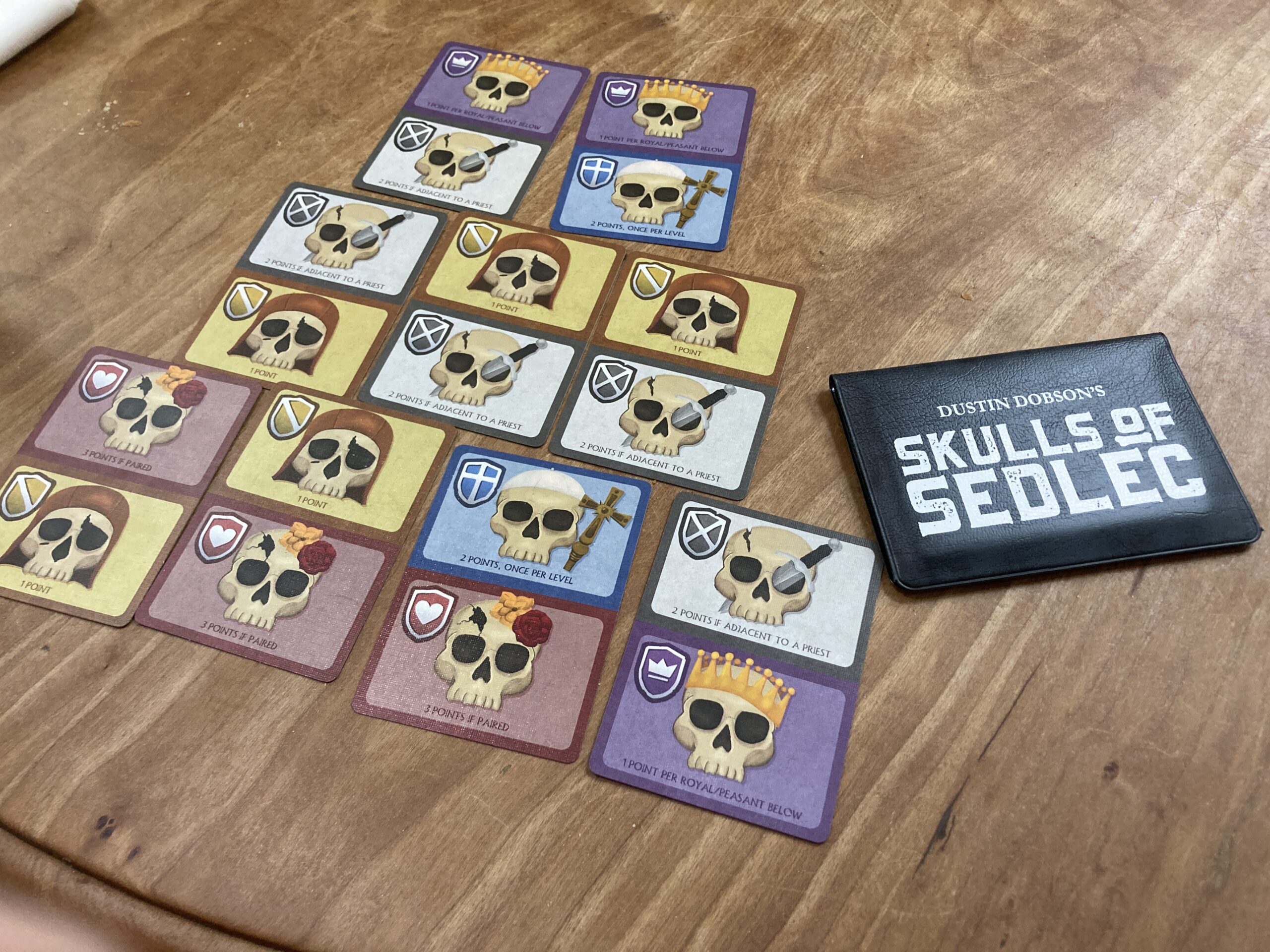
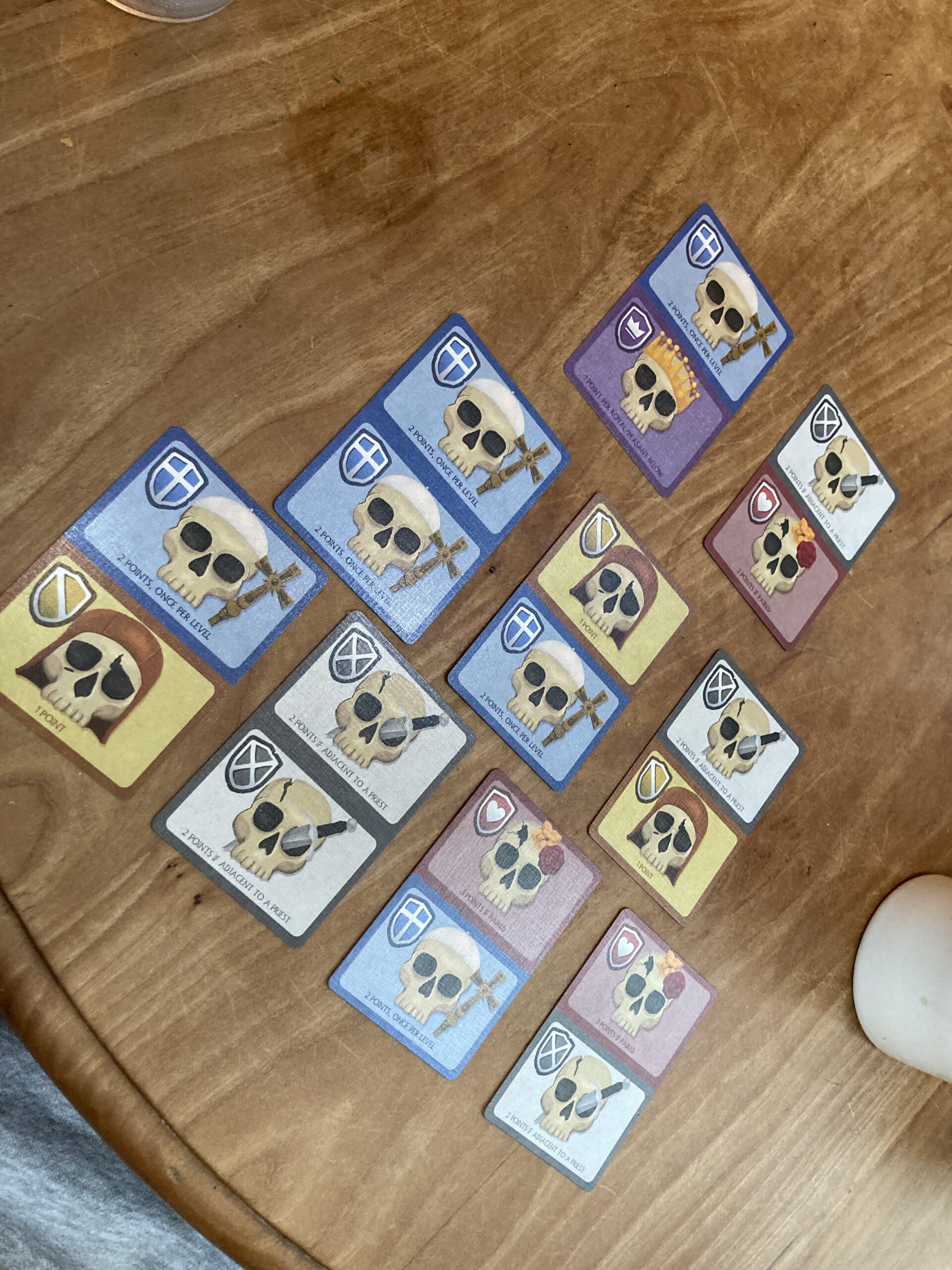
    Skulls of Sedlec is an 18-card pattern building, open drafting, and set collection game. Two of those three phrases I didn’t know until I went and looked them up on Board Game Geek, and I somewhat disagree with the third. It also has 12 expansions of which I will be reviewing zero. After all, the point of a Button Shy game is to make a micro-game that fits into a wallet, not one that you can go band for band with.

    The full rules for Skulls of Sedlec are less than a page long, so I’m not going to spend too much time on the rules. The short version is that cards are divided up into piles, and on each player’s turn, that player takes one of three actions. You can:

    1. Flip two cards in piles face up, then take one of them into your hand
    2. Take a single face-up card from a pile into your hand
    3. Put a single card from your hand into a stack/tableau.

    Board Game Geek calls this game a set collection game, but I disagree. After all, most cards don’t score based on being part of a set. Instead, they score based on their relation to other cards in the pyramid. Some, like the lovers do need to be in a set to score, but many like royals or clergy have their own unique scoring rules.

    Overall, I quite enjoyed Skulls of Sedlec. It’s a very compact game, and I’m not sure I’d get more than 2-3 more plays out of it. But it’s quick enough that I feel I could teach it pretty easily, even to non-board gamers. I’ve seen a fair number of people note that they didn’t consider it worth playing without the expansions, but I found it quite enjoyable, even as a standalone.

  • PAX Unplugged 2023 – The Trading Card Games

    Ah, Trading Card Games, or if you’re me, “The Money Hole.” PAX Unplugged is almost always awash in TCG’s of some sort or another, and this year was no exception.

    Alpha Clash

    Alpha Clash was the indie TCG of the show for me. Were there other small TCG’s at the show? Yes, but if you can afford a Disney license for your product, you’re not small enough.

    It’s also the one I’m probably going to write the least about here. It’s actually interesting, so I’m going to play a bunch more and do a full writeup later. But as a teaser, here are some of the game’s mechanics:

    • Every creature effectively has haste. (Okay.)
    • All cards are lands. (We’ve seen this before, but still neat.)
    • The entire system for resolving combat has been blown up. There’s a secondary system to prevent the game from stalling out in a game of chicken with combat tricks. (Actually very new and interesting.)

    As with almost all games, I do have problems with it. I dislike the the rarity system, and I don’t love the American comic book aesthetic. But the game’s actual mechanics are far more solid than pretty much every other indie TCG I’ve run into over the last few years. So this could be one to watch.

    If this sounds interesting, here’s a link to the game’s webpage, and the game has a fully functional TTS implementation as well.

    Star Wars: Unlimited

    I’ve done some thinking about other Disney properties in Lorcana, but I never put my thoughts into writing in my “Future of Lorcana” writeup a while back. I was curious if Lorcana could potentially see Marvel or Star Wars cards, and the answer right now appears to be “No.” Otherwise I suspect Fantasy Flight wouldn’t have shelled out for a license for Star Wars: Unlimited.

    I never actually asked anyone what the Unlimited in the name meant. Presumably the amount of money Fantasy Flight hopes to make with the game? Regardless, I did play a demo of Star Wars: Unlimited.

    I don’t have much to say on the game itself. It’s not uninteresting, but the starter decks and demos often don’t translate into thrilling gameplay. Meanwhile, Star Wars: Unlimited doesn’t have any incredibly unique inherent systems if you’ve already played a ton of games.

    The most interesting part of the game for me is how it handles the ever present “actions on opponent’s turn” problem. Star Wars: Unlimited makes it so that players don’t really have turns, they just have actions. Doing anything: attacking, playing a unit card, using a commander ability, or playing an action card all use up your action, resolve the effect, and then pass priority to your opponent. In addition, one of the actions that can be taken is to pass all futures for the round, and in exchange, get to act first next round, called seizing the initiative.

    If I remember correctly, I think this sort of mechanic might have been in Star Wars: Destiny, another collectible game by Fantasy Flight.

    My overall thoughts on Unlimited are kind of just “Okay.” Star Wars has negative brand loyalty from me, mostly because I just don’t care about the franchise. Also because I’m petty and billion years ago dated someone who cared too much. There were some elements in Star Wars: Unlimited that felt like fun flavor touches with how certain mechanics functioned, or characters worked together. But while I’d play more of the game, I’m not in any rush to acquire a copy. It launches March 8th, and I suppose I’ll see what state it’s in at PAX East.

    Lorcana

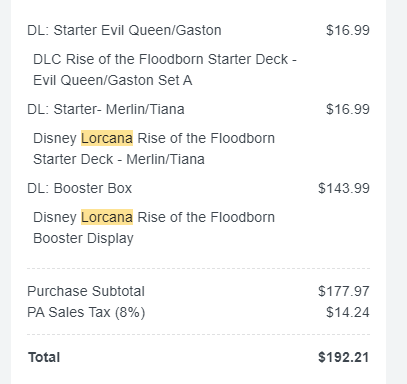
    The most notable thing about Lorcana for me at PAX Unplugged was that the prices were “within expectations” as opposed to an “arm and leg.” Usually things are not notably cheaper at Conventions. Usually it’s the other way around. But booster boxes and decks were at MSRP. For comparison, single booster boxes are currently $207 dollars.

    Not cheap, but yknow. Normal prices. Also 8% sales tax. The hell is that Pennsylvania?

    I was going to say that I didn’t actually play any Lorcana at the show, but that’s not true! While I didn’t play any during the show, I did run into a very friendly group of folks in the hotel lobby Wednesday night, and spent a few hours chatting with them. And also beating them with their own starter decks that they’d just picked up. Because y’know, I’ve played the game before. A lot.

    There wasn’t anything in the new set that immediately stood out to me. Looking back at it now, it does have at least one new keyword, and some new typal references. It also had a fair amount of space on the show floor.

    Magic: The Gathering

    Magic earns a slot on this just barely above Pokémon by virtue of the fact that I actually did play some Magic at Unplugged. It was a grand total of 3 games, they were all two-headed giant Ixalan drafts. Me and the friend I was playing with won every single one, admittedly some by the skin of our teeth. But win we did, and I was able to get a copy of one of the Dr. Who commander decks with our prize tickets.

    There’s not too much to say on Magic, really. Ixalan is a fun set. Pasttimes is still running events in a way that makes no sense. You still have to use the terrible MTG Companion app whose one saving grace is that I can log in with my MTG Arena Account.

    Pokémon

    I didn’t play much Pokémon this year outside of looping by the Pokémon booth to get some pins. At this point, I’ve played those demos enough that I could probably run them. They did add a small raid battle mode which was almost cool, but unfortunately, doesn’t actually have any meaningful strategy.

    As such, it’s hard to tell if Pokémon was mostly at Unplugged as a collector’s game, as opposed to a TCG.

    Everyone else.

    It was an interesting year for PAX TCG’s. There was a lot more support for mid-level entries than I was expecting. The show had at least semi-dedicated areas for Flesh & Blood, and One Piece. I think I saw SolForge fusion over somewhere as well. That said, I didn’t play any of these, and didn’t feel very compelled to.

    Unlike last year, with Gem Blenders & Genesis, and last year’s PAX East with Nostalgix, it felt like a very light year for the true indies, with Alpha Clash really being the only one.

    Still though. Lotta card games.

  • Magic’s New Play Boosters

    Content Warning: Maximum Amounts of Inside Baseball on TCG’s

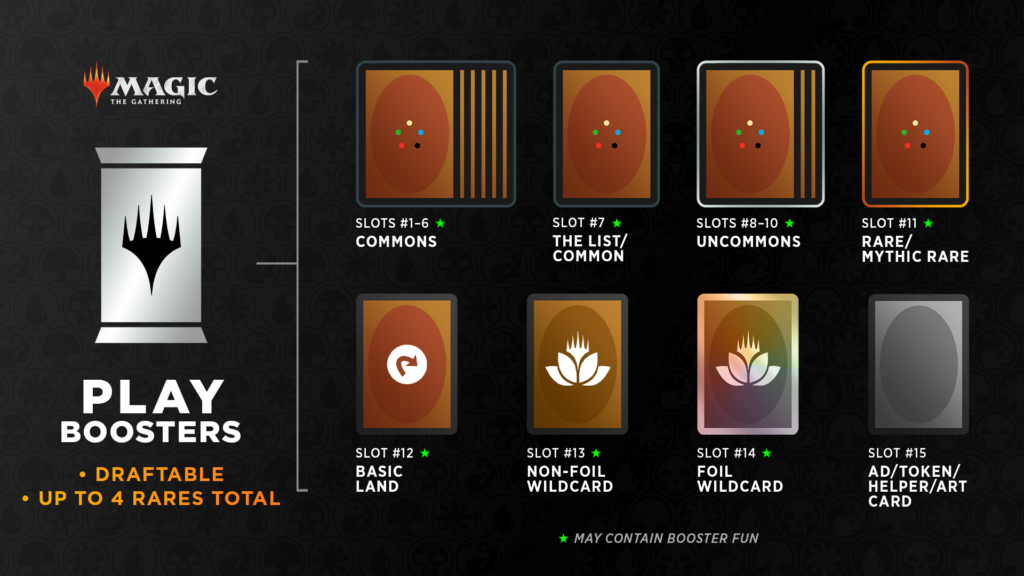
    Magic just announced a new type of Booster Pack, and it’s something I find fascinating for a variety of reasons. One of those reasons is that it has the potential to break some things horribly. Before I get into those things, I’m going to lay out a few assumptions. If you disagree with these assumptions, you’ll still enjoy the article, but it may sound like rambling from a madman.

    Assumptions

    1. Magic cards are artificially scarce. It costs just as much to manufacture a rare or a mythic rare as a common or uncommon.
    2. Past a certain point, when opening booster packs to collect cards, the only card that matters is the rare or mythic. (Yes, there are uncommon cards with value like Pitiless Plunderer, but they’re few and far between.)
    3. Rare cards are more powerful. If two cards in the same set have a similar effect, and one is rare/mythic, and the other is common/uncommon, the rarer one will be better.
    4. Magic’s limited formats are reliant on uncommon and commons cards making up the bulk of the strategies and play.

    Why New Boosters?

    There are several reasons for play boosters. Most are in the Mark Rosewater writeup, but one is conspicuously absent: manufacturing cost. Back in December of 2022, the Pokemon TCG updated its boosters pricing, but also added additional rare cards. For Pokémon, adding more rares doesn’t have much of a trade off, because Pokémon doesn’t have a limited format.

    But Magic does have a limited format, and that format is popular enough to cause a problem. Some Magic players use booster packs as game components to play one type of game, and some buy boosters to get components to play a different game.

    Wizards’ first attempt to fix this problem was to split things out into Draft Boosters and Set Boosters, separating the two types of players. The aforementioned Mark Rosewater writeup is a 4 point memorandum on why that design failed for business reasons.

    So now Wizards has done the opposite. They’re attempting to combine both products into a single product to be used by both audiences, solving the above issue of product availability and stocking.

    A New Set of Problems

    However, in moving the problem from a business problem into a design problem, they’ve opened the potential for a variety of incredible things to wrong, and that’s what I’m excited about.

    See, Wizards is trying to make this product serve two masters. If the contents are a downgrade from Set Boosters, it’s going to piss off everyone not playing limited formats. The whole thing that made set boosters desirable (more variety of cards, more rares) could go completely out the window. Given that Set Boosters are the product that everyone is buying, according to Wizards themselves, I’m hopeful they won’t destroy the fun of Set Boosters.

    Instead, I’m hoping they keep the rare rates up, and run Limited formats into the ground adding 50% more rares to a format with traditionally limited bombs.

    Even if they don’t do that, though, having draftable cards from “The List” should be a real hoot. I’m looking forward to seeing Wrath of God and Skullclamp in low power limited games.

    Ultimately, they’re going to have to make the experience different for someone: either drafters, or collectors. I’m hoping it’s the first, because watching Wizards warp a format for money is much funnier than watching people open trash rares.

  • Lorcana’s Future

    So far this week we’ve looked at Lorcana’s strengths (game design) and weaknesses (product allocation, rarity distribution). So now it’s time to get into the armchair, and pundit like no one has pundited before. What does the future of Lorcana actually look like? Will this game be around in 2 years? What factors will determine its future?

    The House of Mouse and the Burg of Ravens

    Lorcana’s wide ranging appeal is likely going to be seen as the result of the use of Disney property. Ignoring whether or not this is completely true, this puts Disney in the driver’s seat here for the continued production of Lorcana as it exists, with the use of the Disney intellectual property.

    And there are sooooo many things that have the potential to go wrong.

    It’s worth noting that for the other large card games with sticking power, they almost always completely own the art and IP they’re working with. Pokémon is owned by the Pokémon Company, Yu-Gi-Oh is owned by Konami, and Magic is owned by Wizards of the Coast.

    Sure, other card games that have IP from other franchises exist. There’s things like Weis Schwarz and MTG’s Universes Beyond. But these are side products, augmenting an existing game.

    Here’s just a short list of problems I could see happening:

    1. Disney refuses to license any additional characters to Ravensburger for use, limiting space for growth.
    2. Disney ups the price of the license to the point that production of the game isn’t worth it.
    3. Disney approval and checks of licensed designs require a large amount of sign off, extending the production schedule of sets, and causing Lorcana to product sets at a much slower pace than its competitors.

    And I’m sure more exist. The short version is that any breakdown of corporate goodwill or licensing agreements could kill Lorcana real quick.

    Community Building

    Disney can’t kill Lorcana faster than the fanbase could, though. Trading card games need an active community of players to survive and thrive. Do you know what doesn’t contribute to an active and healthy community? Booster packs costing the same amount as another game’s starter deck.

    Some dude once said something about people being unable to survive off just bread. You can quote me on this one: card games can’t survive off whales alone. Right now, I suspect a majority of would-be players are priced out of the market for playing this game. Lorcana needs a casual player base.

    Right now, Lorcana is not in the position to have that player base. That’s not to say you can’t buy singles and play the game cheaply. But the players Lorcana needs are the players who haven’t heard of something like TCG Player, and maybe don’t even known what TCG stands for.

    If Lorcana isn’t able to actually meet demand and start selling to players who aren’t hyper invested, and who aren’t whales, they’re very unlikely to actually build the casual player base that is the fundamental foundation of a community. Without a community large enough to sustain prolonged interest, attract new players, and weather down time and bad sets/designs (because it will happen!), I predict Lorcana will shrivel and die.

    This clause in particular seems incredibly… hmm. Look, friendly local game stores are not a big money business, and requiring a store to purchase new product every 90 days for an unproven game just to be in your program feels like it could go badly.

    Oh, and also because I’m that sort of person, I read through the entire set of terms and conditions for becoming part of their organized play program, and while I’m not a lawyer, I’m gonna be honest. Their whole thing seems smotheringly draconian compared to other programs I’ve seen of this sort.

    Author Note: Just based off theming and demographics, I suspect the group that needs to worry about Lorcana coming for its lunch money isn’t MTG, but Pokémon. Lorcana has the potential for cross generational appeal in a non-threatening manner, which is much more Pokémon vibe than Magic’s. Y’know, given that the upcoming Magic set features people being eaten by a murderous village of candy, in a world suffering from the aftereffects of invasion by a group of sentient flesh robot hivemind. Other sets this year include the giant living horror murder hotel.

    Expansive Design

    But not every prediction for Lorcana’s future is a bummer.

    The last thing Lorcana needs is design space to continue to release expansions and sets. And I actually think it has that in spades. First Chapter is a very restrained product, and if playing a game makes me think of 5-6 new mechanics, I guarantee the actual designer has a list including all of those, and an additional fifty in a text document somewhere.

    There’s a lot of obvious space. Cards that care about color. Cards that are multicolor. More typal support, modal typal punish. Just going and borrowing twenty years worth of what Magic already did.

    Now, because the people who make this game are likely smart, they also need to do this in a way that isn’t overwhelming, but I have confidence they can pull that off.

    Conclusion

    Lorcana has the potential to turn the big 3 of cards games into the big 4. However, it needs to surpass a significant number of challenges and risk to do so. Even ignoring their fans, Disney and Ravensburger need to maintain a good working relationship. But the biggest challenge is going to be Ravensburger’s ability to supply product to LGS’s and other stores where people can buy it at sane prices.

    Funnily enough, the one area I don’t have any worries about is the game’s design and playability. It’s fun. It’s interesting. It’s relatively unique.

    But it needs to be easier to get ahold of than, for example, illegal street drugs. And also have a lower price point.

    If Lorcana can do all of the above, and survive the next two years, then Ravensburger might actually have made a popular, mainstream TCG.