Category: Card Games

  • Lorcana Enchanted Rarity

    Enchanted is Lorcana’s sixth rarity, and its rarest rarity. Enchanted cards alternate art cards with a special finish and design, but the same mechanics as a lower-rarity card.

    Left: Belle, Strange but Special. Right: The exact same card, but 10x more expensive.

    In Lorcana, First Chapter boosters, enchanted cards can only show up in the foil slot of the booster. This means you have at most one chance to pull an enchanted card per pack.

    So what are the approximate odds? There’s no official source for these odds. Instead we’re going to look at two separate sources of experimental data.

    The first is from Digital TQ, who posted their breakdown here. I don’t trust this breakdown very much for several reasons, but I’m still going to use it, and I’ll talk about why in a bit.

    This data set has 216 booster packs opened (9 boxes worth) and 5 enchanted cards pulled. This puts them at an experimental probability of 2.3148% odds of a booster pack containing an enchanted card.

    The second data set is from a game store in Halifax, Nova Scotia called The Deck Box. They posted their own data from opening 18 booster boxes online, and had an experimental probability of 0.9259%.
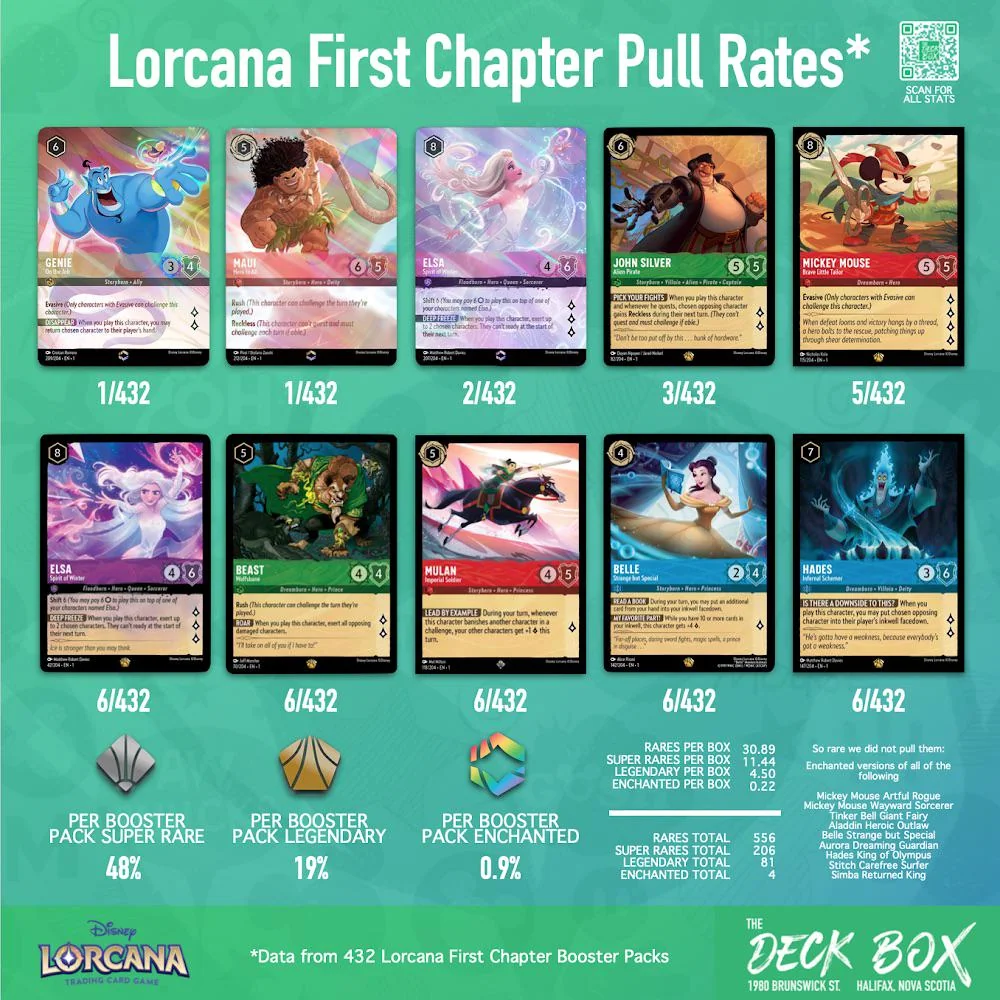
    Wonderful graph made by The Deck Box, with the experimental probabilities of various cards. Like, seriously. This is a really nice infographic.

    So, we have two different sets of numbers. You might have noticed that what I didn’t do is just average these two numbers together, because that would violate principal one of the Fundamental Constraints of Math.
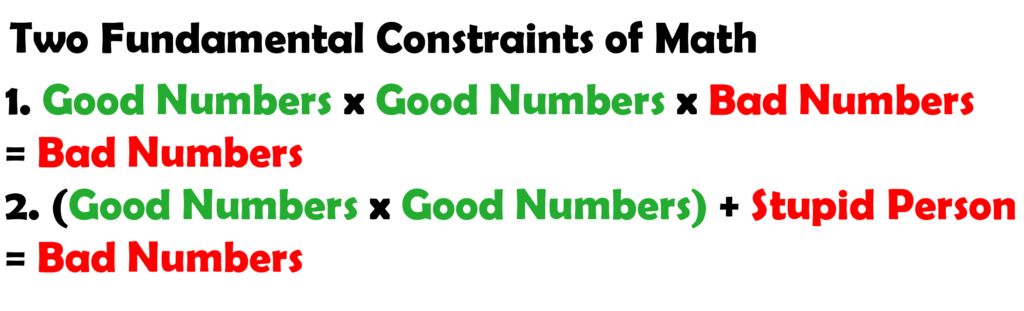
    This might be better worded as “The Two Fundamental Constraints of Mathematical Analysis”. Also, in this diagram, the stupid person is me. I’m the stupid.

    As such, experimental data indicates that the experimental probability of opening an Enchanted card is likely around 1%.

    Math Time

    Disclaimer: Any of the below writing and statement of the problem is the result of my requesting that some friends help me out. As a result, any mistakes for dumb shit, misinterptation of math, or misuse of statistics should fall to me, chief idiot of Gametrodon. Any praise for analysis or clever thought should go to them.

    However, just because I’m stupid doesn’t mean my friends are. In fact, some of them are quite smart, and actually do statistics based things.

    So I reached out to one of these friends, and asked him to help me calculate a range of probabilities for what the true rarity of enchanted cards is likely to be, and here’s what he came up with.

    VanillaWald HighWilsonWilson LowWilson High
    Estimated Probability of Rare0.0090.0180.01360.00360.0236

    So based off these numbers, here’s what we can say.

    Based on the assumption that the 432 packs were opened were a representative sample of Lorcana booster packs, we believe that the true probability of opening an Enchanted rarity Lorcana card in any given random pack is between 0.3%, and 2.3%.

    So, assuming that’s the case, how many boosters would you need to open to probably get an enchanted card, for each of these probabilities?

    Packs OpenedOdds of Getting At least 1 Enchanted Card at 0.3%
    51.49%
    102.96%
    246.96%
    9625.06%
    Packs OpenedOdds of Getting At least 1 Enchanted Card at 1%
    54.90%
    109.56%
    2421.43%
    9661.90%
    Packs OpenedOdds of Getting At least 1 Enchanted Card at 2.3%
    510.98%
    1020.76%
    2442.79%
    9689.29%

    There are a lot of assumptions here, and I’m sure real statisticians are looking at this and wincing, but the point I mostly want to make with these charts is the following:

    If something has a 1/100 chance of occurring, and you do it 100 times, there’s no guarantee of getting that 1/100 chance odds. Actual odds are around 60%.

    Author’s Note: I don’t care about enchanted cards, because when all is said and done, they’re alt-arts, and that’s it. That said, leaving them out entirely seemed rude to people who might care. So I’ve compromised by giving them their own post.
  • Lorcana’s Rough Launch

    So, you’ve decided you’d like to buy some Lorcana cards. Good luck finding any.

    It feels wrong to describe Lorcana’s launch as “Ugly” since we’re still technically in the middle of the launch… But I think it’s pretty clear at this point that Ravensburger massively underestimated initial demand for the product.

    I could just link to the subreddit here, but I decided I’d grab a few choice examples:

    1. Players complaining about LGS’s selling Booster Boxes for $300
    2. Players being told their LGS won’t get more product till October
    3. Boxes selling for $400 in the land of Canada

    Oh, and Penny Arcade made this.

    In short, nobody can actually buy what they want, every item for sale in big box stores already got bought out by bots, and the general tone is “People like the game, but are pretty upset they can’t get cards to play it.”

    And booster packs are $19 a pop.
    Edit: In the time between me writing this, and the post going live, they’ve gone down to $15. Which is still too high.

    So, ugly launch. But I’d be lying if I said that this was particularly surprising. A lot of TCG’s have these super hype launches, that then fizzle out several months later. MetaZoo might be the best example of this.

    Right now though, we’re firmly in the middle of the hype train, and it shows no sign of stopping. As such, as much as I like the game, there’s no way I would ever buy it at current prices.

    A Tale As Old As Time

    Part of that is because I’ve been here before. I’ve bought into plenty of TCG’s that ended up dying early on (Looking at you, Force of Will). Prices for a base set are a pretty bad way of estimating how much staying power a game will have. For example, a few years ago the new hotness was MetaZoo. Then it became Flesh & Blood.

    There will always be a brand new card game, and there will always be content creators hyping it up as the next member/killer of the Big Three: Magic, Pokemon, and Yu-Gi-Oh.

    Here’s the thing: in over 15 years in this hobby, I haven’t seen any new TCG’s that have really stuck around. Some end up niche, like Buddyfight Vanguard, or Flesh and Blood.

    But most just fade and die.

    Why does this matter for Lorcana?

    I’ll write more on this in the conclusion to this series, but as I’ve already noted, Lorcana is currently at a state of very low complexity, and perhaps more importantly, it can’t actually get less complex over time.

    Unless Lorcana wants to be yet another failed attempt to bottle lightning, right now could be the largest period of hype that it experiences. And it probably wants to convert that hype into an actual community of long term players.

    From a gameplay perspective, this is currently the easiest period for onboarding players who have never played a card game before. From a physical product acquisition perspective, it’s the worst time for onboarding new players. If there’s not enough product for people who are actively aware and hyped about the game to get their hands on it, there sure isn’t enough for casual players to try it, or buy it.

    That’s not to say Lorcana is dead in the water. But frankly, I would consider this to be a badly managed launch for what feels like a family oriented introductory card game.

    So that said, let’s say you do get ahold of those booster packs, and don’t have to sell a kidney for them. Then what? How do the odds for various rarities stack up? How much of the set are you likely to see?

    That’s what we’ll be covering tomorrow.

  • Lorcana – The Actual Game

    Ignoring everything else about Lorcana, there’s one critical question that needs to be asked. Is the game any good?

    Yes. It’s a perfectly solid game.

    Is it the most innovative thing in the world? Not particularly.

    For anyone whose played a fair amount of TCG’s over the last 10 years, there’s nothing here that’s immediately shocking. Lorcana’s gameplay is a mash-up of a variety of different systems that most experienced players will have seen before.

    Lorcana has players make a 60 card deck, with up to four copies of the same card. Deck construction is limited by the fact that decks can only contain cards from 2 of the game’s six colors.

    The first small twist on the standard TCG is that instead of being a rush to bleed your opponent out, it’s a race to the top. There are no life points. Instead players are competing to be the first to collect 20 lore, in something more akin to KeyForge, than Magic or YuGiOh.

    For the rest of this to make sense, we’re going to go over the general structure of the game. If you don’t care too much about that, you can skip ahead for our actual opinions on the gameplay.

    Types of Cards, and General Structure

    Lorcana currently has three types of cards. These are characters, actions, and items. Items and actions are somewhat self-explanatory, so we’ll cover them later.

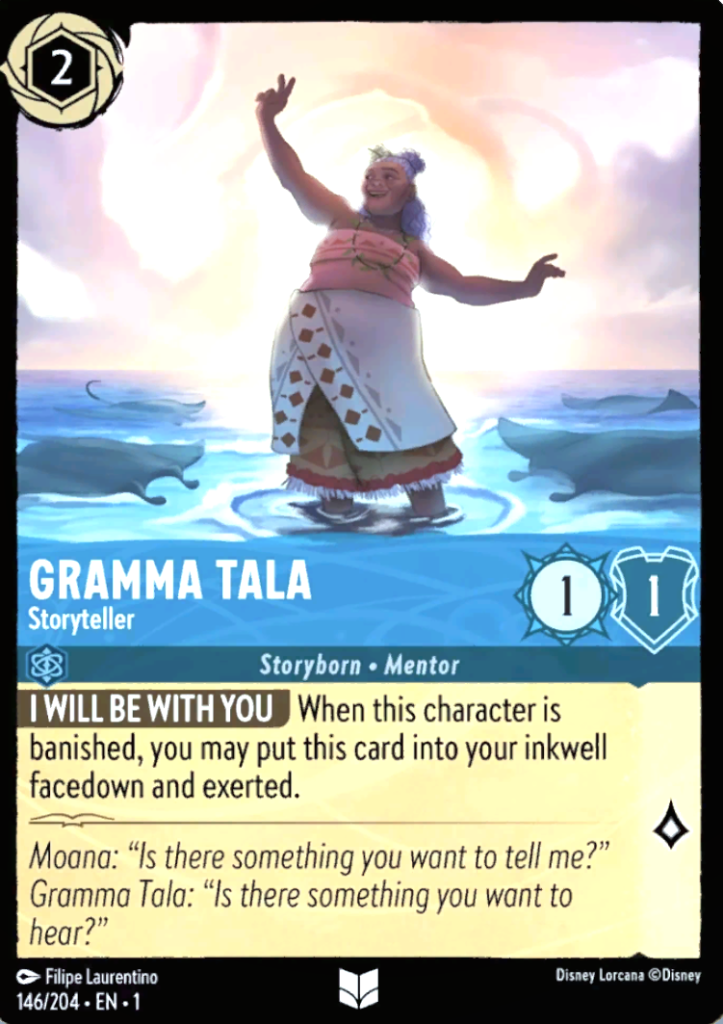
    Example Card: Gramma Tala

    Characters are more complicated, and explaining them gives a good opportunity to go over the core of the game, so we’ll start with them. First, characters (and all other cards) have a cost. For Gramma Tala, this cost is two. But it’s not the only thing communicated by the top left corner. Gramma Tala also has swirly border around her cost.

    This means she can be placed into your inkwell, Lorcana’s version of a mana/resource ramp system. Each turn, you can play one card facedown into your inkwell. Once in the inkwell, cards have no other types or information, can’t be looked at, and are just considered Ink for the rest of the game. Cards in the inkwell start facedown, and pointed up. To get resources, you rotate them 90 degrees, “exerting” them. (Yes, this is just tapping from Magic. But since they patented tapping, each time someone wants to make a new game, they have to invent a new word for it.)

    There are three other numbers on Gramma Tala besides her cost. The first is the 1 in the spiky circle. This is Gramma Tala’s attack/power/what have you. It’s how much damage Gramma Tala does when attacked, or when she attacks. The second is the number in the shield. This is her health/toughness. Each time characters take damage, they receive damage counters.

    Finally, there’s a small diamond shaped symbol under her health. This is Gramma Tala’s lore value. And it’s a great segue into the next part of this writeup: character actions.

    Characters in Lorcana can be used to do three things. First, they can quest. Questing means turning a character sideways, and getting lore equal that character’s lore value. Collecting 20 lore is how you win the game.

    Next, characters can challenge opposing exerted characters. Note the emphasis on exerted. If a character isn’t exerted (turned sideways), they’re safe from being attacked by the enemy. When characters challenge, the challenger is exerted down, and then both the challenging character, and the challenged character take damage equal to the other character’s power.

    If either of them have more damage than they have health afterward, they’re put into the discard. Lorcana damage, like Hearthstone or Pokémon, doesn’t heal between turns.

    Finally, characters can sing. Which brings us to our second card type: Actions!

    Actions take the role of Hearthstones spells, or Magic: The Gatherings sorceries. They’re single use cards with a one-time effect. After paying the cost, the player performs the effect, and the card is discarded.

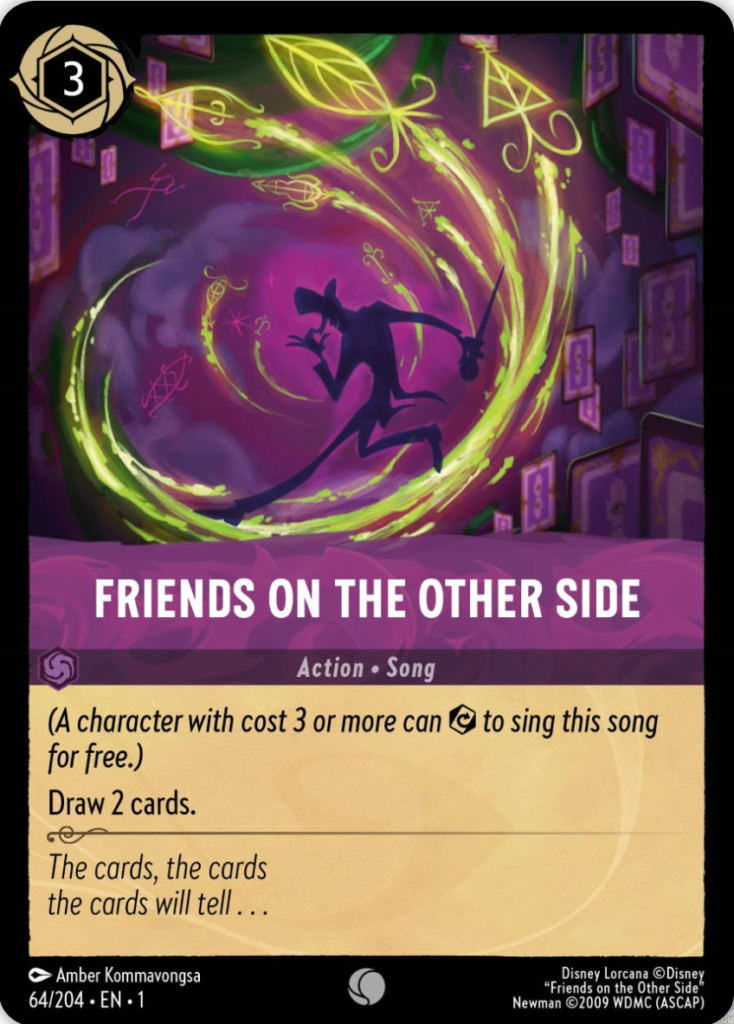
    Some actions though, are songs. For songs, you can pay their cost with Ink, or by exerting (tapping) a character with a cost equal or greater then the cost of the song.

    Finally, this brings up the last card type: Items.

    Items, like all other card types, have a cost. Once put into play, they can be used immediately, unlike characters which have to wait a turn. They have a variety of effects, ranging from purely passive, to activated abilities that can be used on a player’s turn.

    Back to Opinions

    So, now we’ve at least covered the general structure of Lorcana, which means I can talk about how I feel about the game, and the cards in it.

    The first thing that stood out to me after playing my first few games and looking through the card list is that Lorcana’s base set is incredibly restrained. There’s a very large amount of unexplored design space here.

    I use the word restrained because “Basic” or “Simple” feels unfair. Lorcana only has 3 or 4 named mechanics, what other card game players might think of as keywords. But I don’t think it’s because Lorcana couldn’t have more. I suspect the designers made a deliberate choice to limit the number of mechanics and complexity present in the base set.

    For example, while many Lorcana cards have tags for type, many of those types aren’t used by any cards. Only princesses, villains, and brooms have cards that interact with their type.

    In addition, there are zero cards that care about other cards’ colors, or are multicolor. There aren’t any cards that allow you to recover cards from your Inkwell. There are very few pieces of hard removal, and they cost a large amount of ink, and there’s only one board wipe card.

    All of which strikes me as a deliberate choice to prevent the game from becoming overcomplicated, or overwhelming. Because I suspect a large part of the game’s intended target audience are Disney fans who are first time TCG players.

    So does that make it boring? No, but given that there are currently only 204 cards, the deckbuilding pool is very small. And even with small pool, the game feels pretty good!

    So perhaps you’ve read all of this, and decided to buy in.

    Well, it’s not gonna be that easy. Read on to find out why.

  • Welcome to Lorcana Week!

    The last time I devoted an entire week to talking about a single game or series, it was Disgaea, in a blatant pandering attempt to get a review copy of their newest release.

    This is not going to be one of those weeks. For starters, I don’t think Ravensburger has any more Lorcana to send out at this point. If anyone from Ravensburger reads my set of writeups, here are a list of items I think it’s more likely they would send me:

    1. A cease and desist letter.
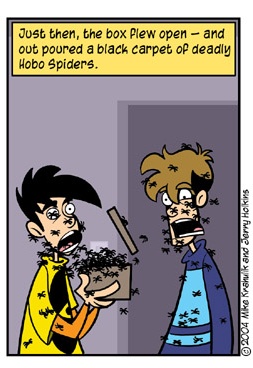
    2. A box of spiders.
    3. A mailbomb.

    A Brief History Lesson

    For an omnipresent entertainment juggernaut, Disney has always kind of fallen flat on its face when it comes to making games. Pretty much every first party attempt they’ve made to create games has, while not failed, apparently never made enough money to justify its existence.

    Propaganda Games, Avalanche Software, Wideload Games. Those are just a few names in the pile of corporate corpses the House of Mouse has produced.

    As such, in 2016, they finally threw in the towel, and just licensed out their properties for other developers to make games with. And that’s how we get Lorcana.

    Lorcana is a new TCG published by Ravensburger, by Steve Warner and Ryan Miller, and using licensed Disney IP. If you’re not familiar with TCG’s (trading card games), I suggest you take a minute to read our Guide to Card Game Terms.

    This week we’ll be covering the game itself, the somewhat interesting launch it’s had so far, the game’s rarity system, and what the future could hold for Lorcana.

    Is the game any good? Will it supplant the big 3 of TCG’s, or turn it into the big 4? How does Lorcana’s base set match up with other card games?

    All these questions will be answered this week.

    Schedule

    Part 1. The Game Itself
    Part 2. Lorcana’s Rough Launch
    Part 3. Rarity, Distribution, and set Design (8/24 – Delayed While Math Occurs)
    Part 4. Lorcana’s Future
    Part 5. ???? (???)
    Bonus Post 1. Enchanted Rarity Cards and Odds

  • Avant Carde

    A few months ago I mentioned in my Granite Games Summit writeup that one of my favorite prototypes at the event was a deck builder with a working title of “Cubism.” I also noted that I didn’t really want to write about it while it was still in the prototype stage.

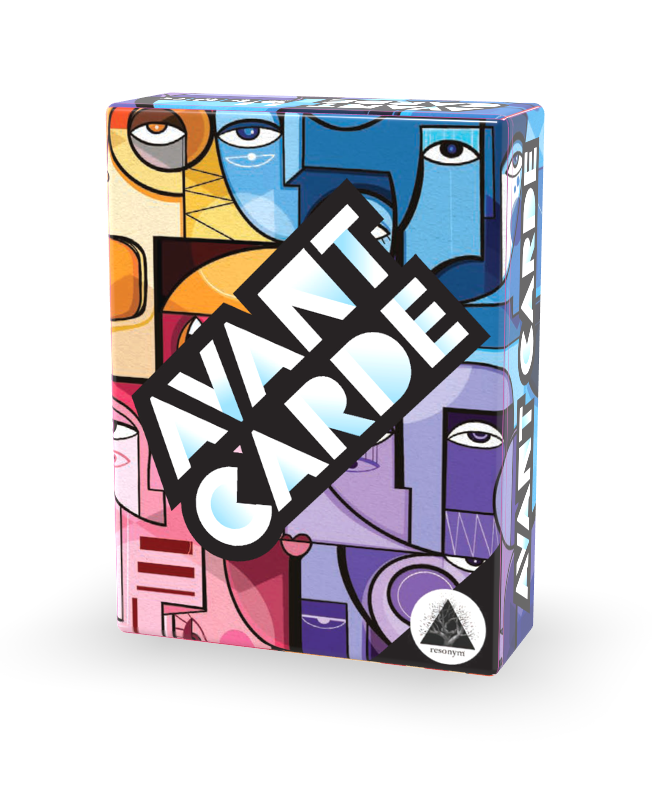
    It’s been a while since then, but I’m happy to note that this week I can finally talk about that prototype. Mostly because it’s no longer a prototype, and it has a new final name: Avant Carde.

    Avant Carde is a deck builder where players take on the role of collectors organizing shows of their artwork to score awards.

    If you’ve played a traditional deck builder, you’re likely familiar with a lot of the base components of the genre. Players are given a (weak) starting deck that they make more powerful over time by using it to generate resources, and purchase additional cards to be added to the deck.

    Where Avant Carde innovates, though, is in how it handles playing cards during a players turn, and also its scoring and buying system.

    In something like Dominion or Clank, any card can be played in any order, though there might be advantages to doing things a certain way. Avant Carde is different.

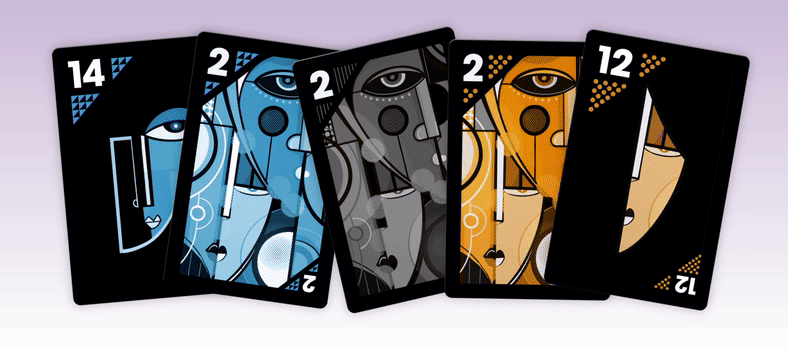
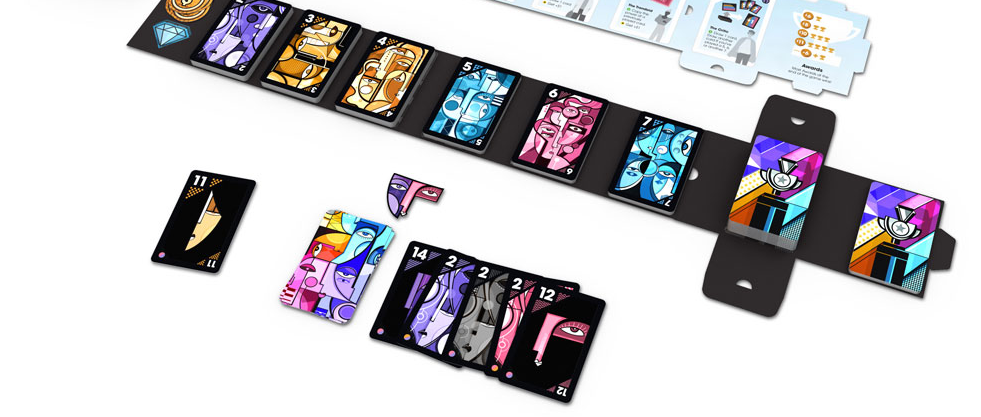
    Avant Carde has a something more akin to an Uno style chaining system. Once a player plays a card for their turn, the next card they play has to match the previous card in either color or number to continue the chain. At the end, they count up the number of cards in the chain, and any other abilities those cards might have, and that number is the amount of money they have to buy with.

    This chain, for example, would generate 5 money for the player.

    This leads to a really interesting balance where the more expensive and powerful cards can end up being a bit riskier to play if they aren’t in a color that you’re collecting.

    Avant Card also has some interesting changes in how it handles the buying area. Unlike Ascension, where a limited pool of cards are available at any point in time, or Dominion, where everything is always available, Avant Carde splits the difference in a pretty fascinating way.

    Another neat thing: The abilities in Avant Carde aren’t on the cards in your deck. Instead they’re on the cards you lay out above the buy row! This means you can change all of the cards’ abilities by just swapping out 6 cards.

    You’re collecting cards numbered 2-7. Every number is always available, but the stack of cards for each number only ever has the top card flipped up and visible. And since the numbers come in different colors, even if you have the money to buy a high-cost card, it may not make sense to actually buy it if it’s completely off color, and would be hard to include in your future chain.

    As tempting as that 5 might be, splashing into blue to play it could be difficult.

    I’ve really enjoyed Avant Carde. It’s one of the few prototypes that I wanted to play every time I saw it over the last few months. I’m even more excited to see the final game. It’s a fascinating deck builder with some really neat mechanical innovations in the genre.

    If any of this sounds cool, Resonym is currently running a Kickstarter for the game that you can check out.

    Disclaimer: I am friends with the designers at Resonym, which is how I ended up playtesting it, but it’s honestly the best Resonym game I’ve played