Category: Console Game

  • Disgaea 5 Complete

    I like Disgaea 5. While I didn’t enjoy the story as much as Disgaea 4, there are a variety of improved mechanics, UI, and massive quality of life features that make it a massive upgrade over its predecessor.

    Also, just for clarity here, I’m mostly going to be discussing my experience with the game pre-endgame. I’ve played about 40-45 hours, and while I plan on playing more, that may not happen for a little bit for secret reasons.

    So, let’s start with the story, and some of the related mechanics. Across the Netherworlds, now rendered as planets, Demon Emperor Void Dark is trying to take over everything. You’re introduced to some of the main characters, Seraphina, and Killia, both who have a bone to pick with Void Dark. In Killia’s case, he’s a brooding loner. In Seraphina’s case, it’s an arranged marriage to Void Dark that she has no interest in. She’s decided the best way to deal with the problem is to kill Void Dark so she doesn’t have to marry him.

    Adventure intensifies, and as the duo go on their merry way, we meet an increasing cast of other indivuals, including Red Magnus, Christo, Zeroken, and Usalia, who all also have their reasons for wanting to see Void Dark six feet under.

    There’s not too much else to say. Our band of misfits proceeds from Netherworld to Netherworld, trying to push back Void Dark’s advance while not getting slaughtered. Each of them gets a mini-arc/story around their background and flaws, usually followed by a redemption or adjustment.

    While I appreciate that these moments existed, most of them feel standard anime trope-esque. There are a few that are more interesting, but most end up feeling predictable. This annoyed me because 4 did (at least by my standards) a much better job of handling these sorts of changes. Here’s an entire mini-writeup on what I mean, but be warned, here there be story spoilers!

    Oh, yeah, this whole thing was supposed to be about new game mechanics, wasn’t it?

    Well, one of those new game mechanics is Revenge. Each character has a Revenge Bar that fills as they or their allies take damage. Once a character’s bar is filled, they enter Revenge Mode, where all of their attacks are critical hits, and all of their spells and specials have their costs reduced down to 1.

    In addition, characters that are Overlords of a Netherworld, like our MC’s mentioned above, also get access to their Overload. Some bosses get them as well!

    Overloads are one-time use per battle skills that have a variety of effects, many of which either play with tactic game tropes, or just utterly break them, and all of which are fun. While some are simple (Deal damage to everyone on the map, stat boost, heal all friendlies) there are also a few really neat ones. My personal favorite would have to be Zeroken’s “Superluminal Wolf” which creates 4 temporary copies of the character. And when I say copies, I mean full copies. Each copy can take any action the original can, up to and including casting all of his specials, throwing units, and lifting enemies. Another character has an ability that allows them to temporarily take full control of a few enemy units.

    Overloads can turn fights that are going badly, and at the same time add an interesting element to some of the boss fights. You know your enemy has an Overload, and you have to try to manage their access to it. You can do this by chipping them slowly, trying to take them out in one hit, or just finding ways to avoid the Overload’s effect. Dealing with bosses’ Overloads is a fun and interesting change from how static boss fights were previously.

    Pretty much every side system has also been improved, but going into detail on each them would be both a waste of time, and not something I’d be capable of doing. So instead, let’s take one system as an example: innocents.

    If you haven’t played a Disgaea game before, it might be easiest to think of innocents as a sort of sub-item that can be socketed into other items. They have a type, and a value. The type determines their behavior, and the value determines the impact. For example, socketing a Gladiator gives the item it’s located in additional ATK, and the Dietician gives additional HP.

    These are both fairly straightforward examples, but there are also innocents that give extra EXP, extra Mana, innocents that change the damage type of basic attacks, and innocents that give you chance to steal items from defeated enemies. There’s a lot of variety.

    Acquiring innocents is a little more complex, though. One of Disgaea’s primary features is the Item World, a series of semi-random procedurally generated levels that exist inside an item. And inside items is where you get innocents. When you get an item, it will usually have a few innocents inside of it, but they’ll be in the hostile state. When you go into that item’s Item World levels, those innocents can show up as enemies, and if you defeat them, they go to the subdued state.

    So how do Disgaea 4 and 5 handle innocents differently?

    In Disgaea 4, innocents couldn’t be moved until after they were subdued. This meant that collecting an innocent you wanted required going into an item, clearing levels until it appeared, defeating it, and then repeating this process for each new copy of the innocent. Because of how innocents level up, getting an innocent to its level cap could be even more painful, requiring gathering lots of copies of a single innocent, and fusing them into each other.

    In Disgaea 5, non-subdued innocents can be moved between items. So instead of going into 5-10 different items you might not be interested in leveling up to get a bunch of innocents you want, you can now move the innocents you’re farming into a single item, and do one run to gather them in a single fell swoop.

    But these changes on their own wouldn’t solve the problem of needing to grind a silly amount of innocents. And that’s where the Innocent Farm comes in.

    The Innocent Farm is a daycare center zone where you can leave innocents, and they passively gain levels as you do other things. In addition, if you leave two or more innocents in the Innocent Farm, they can breed, giving you even more innocents.

    And these sorts of improvements are present across the rest of the game’s systems as well. Better capture mechanics and prisoner management. The Chara World is now its own unique Mario Party style world… thing, instead of being a sort of rip-off of the Item World.

    Okay, so looking back at this whole writeup, I think I might have rambled enough. Here’s the five second version of my thoughts:

    Disgaea 5 is a mechanical improvement over 4, both for its subsystems (and tweaks to make them more friendly), and also its improvements to the combat structure. While the story didn’t grab me the same way 4’s story did, it’s still solid. It just doesn’t surpass the usual JRPG tropes the same way some of it’s predecessors do. The end result is an incredibly solid game that I’d probably recommend over earlier games in the series, because as much as I like the story, this isn’t a series that I personally play for the writing.

    Disgaea 5 Complete is available for Switch, PC, and Playstation 4. I played on PC with a controller, because, well, mouse and keyboard just doesn’t cut it for grid based tactics games.
  • Prinny: Can I Really Be The Hero?

    Ed Note: Images are from theSwitch re-release press kit.

    “Prinny: Can I Really Be the Hero?” was re-released for Switch back in 2020, after originally being released on PSP. It’s a game that I first played on a whim, but grew to love and play religiously. And what with this being Disgaea Week, I figured now is as good a time as any to talk about it.

    I was still in high school when I heard about its release, and while I thought the animation looked good, and the gameplay seemed cool, I knew nothing about the Disgaea series. Still, I grabbed it anyway, and on a cold day after class while waiting for the bus, a friend passed me his PSP and I was off on a journey where I learned the most important lesson in life: “Gotta be smart, dood!” 

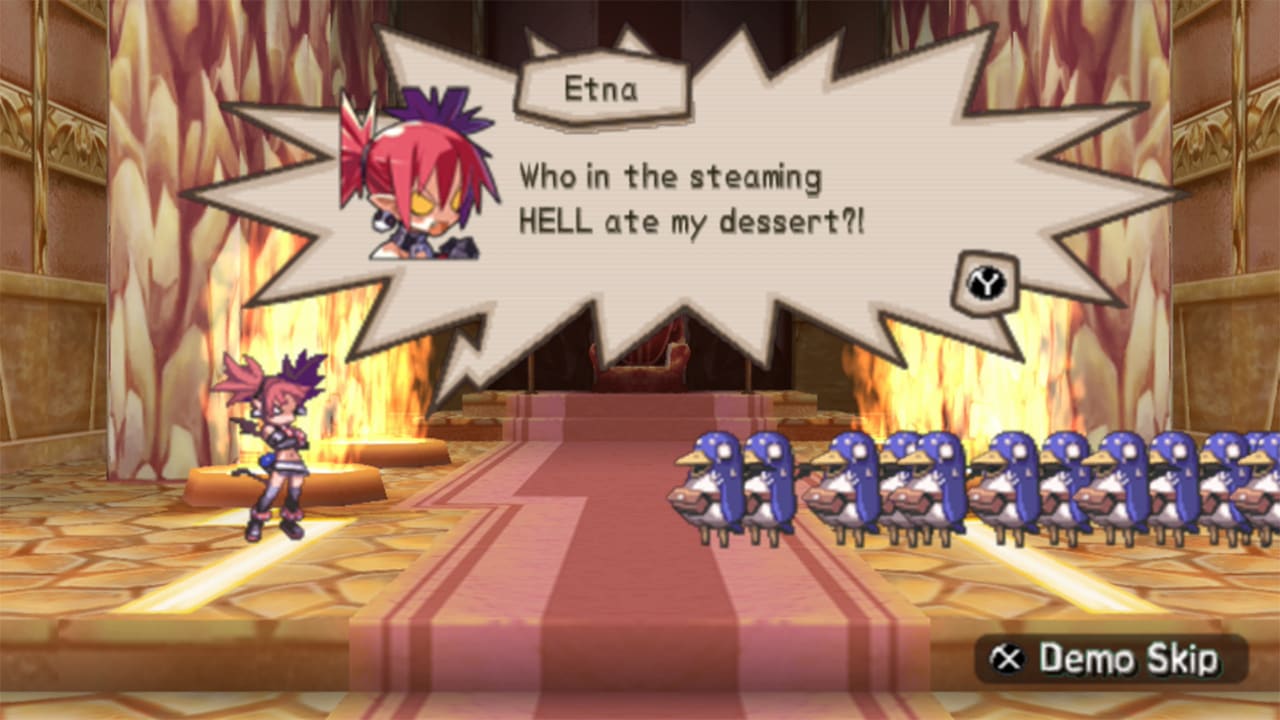
    Starting the game, you’re introduced to our expandable super cool hero, the Prinny, a penguin-shaped husk that houses the spirit of a criminal sentenced to hell. After a quick meeting with your master, Demon Lord Eta, you’re told someone ate her Ultra Dessert and that unless you and your fellow Prinnies get her a new one, you’re all dead. With this promise of an asskicking should you fail, Etna gives you a magical scarf, and it’s off to the races.

    Take three hits, and it’s the end of the line dood!

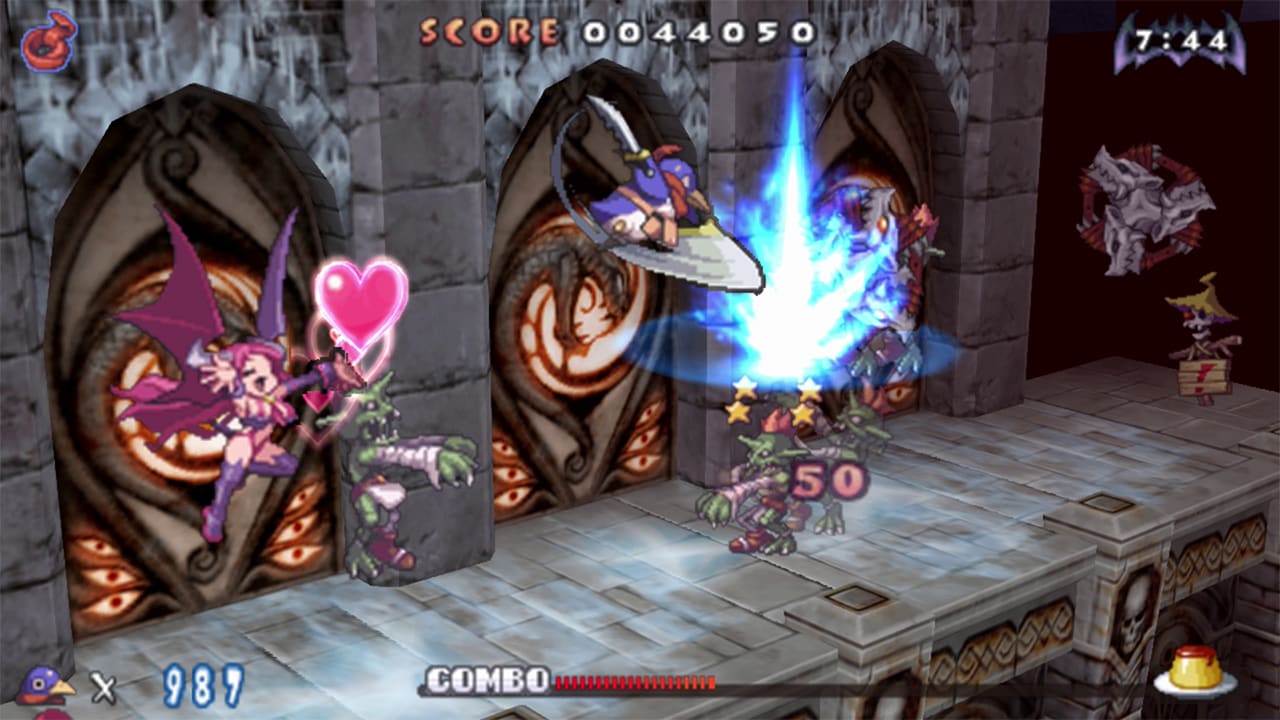
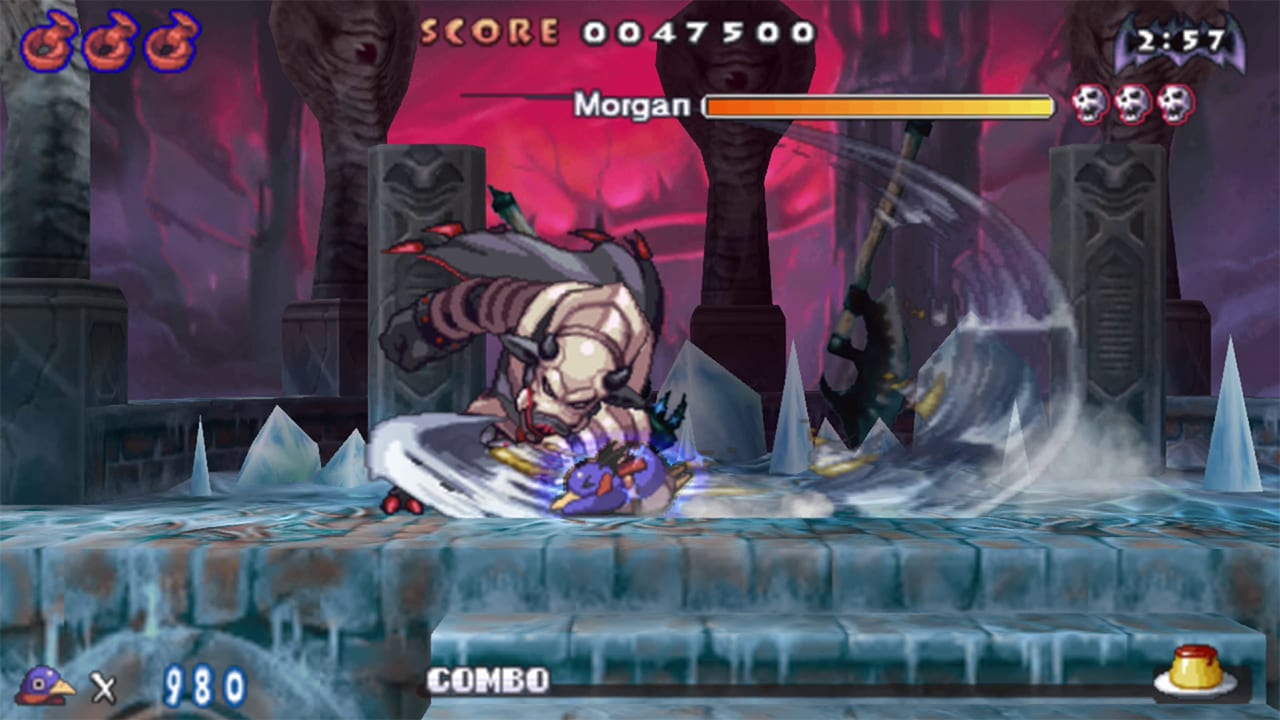
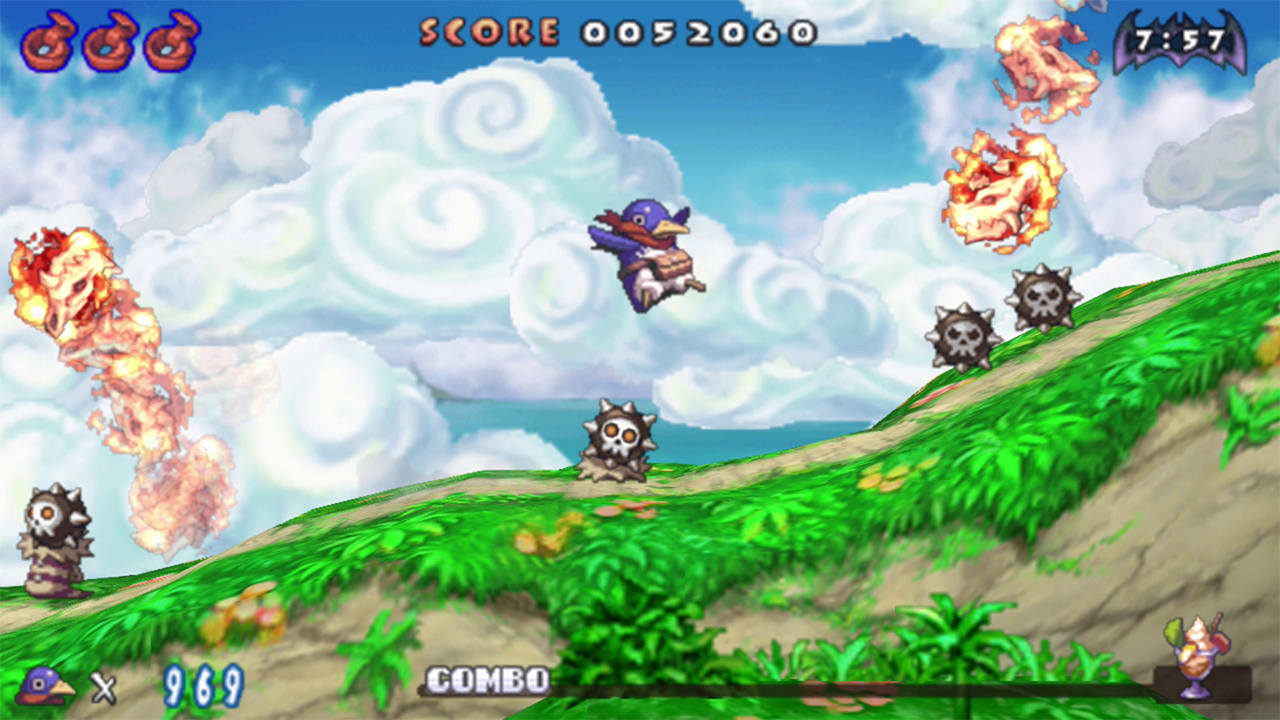
     Once the story begins your UI shows you the main helpful info: your scarves, combo bar, points, a timer, and the total number of Prinnies left. The UI’s not overwhelming when playing and all of the elements are spaced out nicely, so you never have a moment where the action is covered or blocked. The game has a very roguelike feel considering how your Prinny can take three hits, and then they’re gone.

    1000 Prinnies might seem like a lot, but they disappear quickly and watching the life counter in the bottom left adds a very fun sense of impending doom. I’ve always been a fan of watching the counter go down as I struggle, getting closer and closer towards the end but also getting better and better, learning boss and enemy mechanics.

    Overall, the game is a very snappy side scrolling platformer, and it feels great; there are only rare moments where I felt like a death was due to confusing level design or weird controls. One thing to note is that the game changes perspective when you do an air attack from 2d to a pseudo-3d. This can be awkward at first, but once you get used to the perspective shift it can be helpful for platforming or trying to find hidden areas. 

    For combat, your character has a ground slam attack and a sword slice that can be used at short range. The slash attack can be used on the ground or in the air which will cause your Prinny to float while the attack is active. 

    Combat is simple and honestly that’s what I loved about the game. Prinnies are supposed to be a weak throw-away characters, and while they are (sorta) the hero of this story, you can tell they’re not traditional overpowered protagonists. 

    Enemies and boss fights feel challenging but absolutely beatable. The level design is streamlined and makes it hard to get lost. Additionally, if there was ever a moment where I entered a boss room and didn’t immediately know how to complete the fight, a quick look around the room always guaranteed I knew what was needed to beat them. 

    The music and voice acting is also a huge part of what makes the game great. The soundtrack has a very Nightmare Before Christmas/Disgaea vibe. It’s always very fitting for the level and really gets you bobbing with music. As for voice acting, the Prinnies have their go-to catchphrases that after 4 hours I found myself yelling as I beat enemies or made lots of progress: “Gotta be fast dood!” They all have an attitude and speech type that makes you want to help these doods.

    Additionally, the supporting cast of demons and lords are hilarious and as an unassuming Prinny walking up to these powerhouses, you get amazing dialog as they ridicule you or even pay no attention. And when you end up interrupting, rest assured, it may end with you running for your un-life.

    In short, the game is a great time. If you’re looking for something to pick up and play mindlessly for a few hours, or just laugh at all the crap the hero endures, only to see him finally succeed, it’s still worth it. It’s a simple joy to play and one that shouldn’t be overlooked. As I noted above, the game was released on PSP before, but your best bet at this point if you’re interested is to grab the Nintendo Switch re-release.

  • Disgaea 4 Complete+

    Ed Note: Images for this writeup are from a combo of the Disgaea 4 Complete press kit, and my own save file.

    Disgaea 4 is, somewhat strangely enough, the first Disgaea game I played. Specifically, Disgaea 4 Complete+ for the Switch. As far as I can tell, the “Complete” part just means that they opted to include all of the additional DLC and scenarios that were added to the game after its initial release in… 2011.

    10 years ago.

    Okay, so we might be a teensy bit late on this one.

    One of the best things about Disgaea is the ability to customize your hub world and move all the NPC’s you actually care about next to each other.

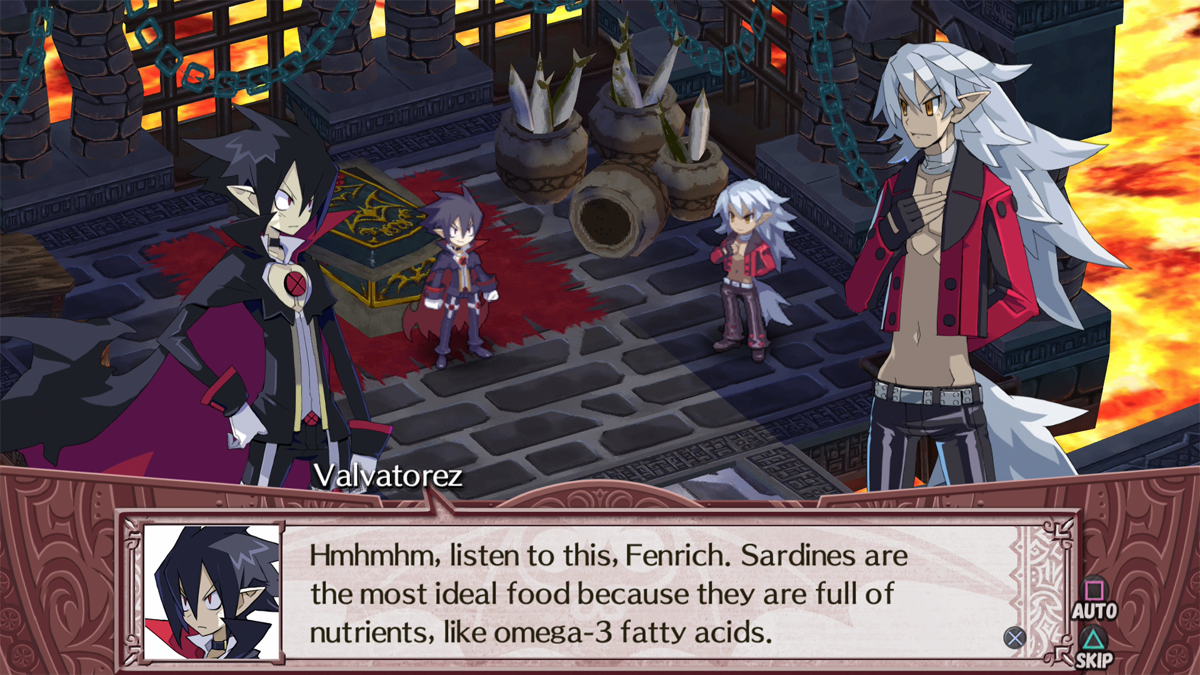
    In any case, like the other games, Disgaea 4 primarily takes place in the Netherworld. The main focus of the story is Valvatorez, a previously incredibly powerful vampire and also arguably total idiot, who never breaks promises he makes. One of these promises involved an agreement to not consume human blood ever. Pretty much all the other side characters are great as well, including Fenrich, Valvatorez’s second in command, who feels like an inverse version of the traitorous vizier trope, and Fuka, a elementary school child who dies, goes to hell, and then proceeds to determinator her way through the Netherworld by refusing to accept her death.

    Valvatorez, the vampire who doesn’t drink blood, and Fenrich, his loyal servant who would really like it if maybe he would again.

    These games can be kinda weird.

    The general arc of the game is Valvatorez’s staging of a coup against the current President of Hell, in an attempt to fix the problems the Netherworld is having, including lack of energy, an inability to handle the influx of guilty souls, and just general failure to… well, be hell.

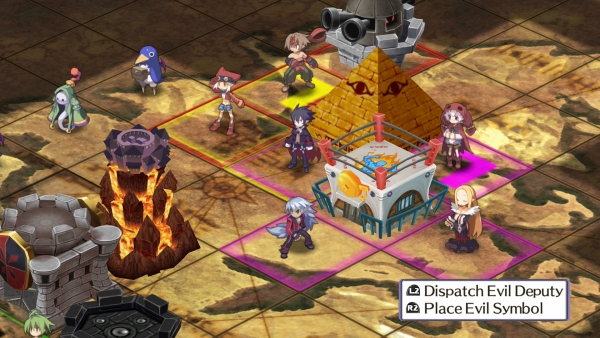
    Behold, the… grid that I don’t remember the name of.

    Mechanically, this comes in with the Corrupternment and building placement map. As you advance through the game, you’ll unlock political titles, buildings, and other elements that give benefits to units placed within their area of effects on this grid. You can also pass bills and policies to boost yourself, your rate of EXP gain, unlock new units, make friends, and also just shake down senators for cash.

    The general structure of the rest of the game is fairly straightforward, with both the Item World and Chara World in Disgaea 4 following a similar structure of being procedurally generated combat levels where you need to clear all enemies, with a few additional minor changes between them. The game also has Magichange, the ability to turn monster characters into weapons temporarily for your other characters to use (don’t worry, they get better), and monster fusion, which lets you fuse monsters into larger versions of themselves with better range and damage.

    Is it really a Disgaea game if the stats aren’t measured in hundred thousands?

    Overall, Disgaea 4 is currently my favorite of the games story-wise, if not mechanically. While the game’s art style and mechanics haven’t aged terribly, many of the UI elements and menus do feel a bit outdated at this point, and some of the connectivity features, like fights and pirate ship leaderboards, feel a bit dead. Despite all of this, though, the fights are still interesting, the grind is nice and grindy, and story and characters are still funny.

    Okay, so maybe I’ve played a bit too much of this.

    You can get Disgaea 4 Complete+ here for Switch, and here for PC if you’re interested.

  • Disgaea Franchise Week – Kickoff

    This post inaugurates what I’m calling Disgaea week. Some of you may be wondering why we’re doing this. Is it blatant pandering? Is it because America NIS approved my press credentials? Is it because I love Disgaea and really want them to send me a review copy of Disgaea 6?

    The answer has two parts. 1. How dare you question my journalistic integrity, and 2. Yes.

    Yes to all of the above.

    On the flip side, it also gives a good opportunity to talk about some of the things that are similar between the games, without having to rehash them each time I write about the series.

    So lets talk about Disgaea. If I had to summarize the game series in one sentence, I would say: “Disgaea is a tactics game about unleashing your inner mechanics munchkin.” Of course, this ignore the great art, the really solid writing, and skips over all the actual mechanics. But I only had one sentence, so we’ll get to that in a bit.

    If you’re not familiar with the series, the Disgaea games don’t necessarily have any continuity between them. Instead, it’s a franchise more in the form of something like Final Fantasy, where each game is a separate cast of characters and goals, but certain elements remain the same, such as the primary combat mechanics, character classes, and Prinnies. Prinnies are the souls of the damned, doomed to pay for their sins in the afterlife by being sewn into a penguin shaped costume and used as the servants/cannon fodder/meat shields/target practice dummies for everyone else in the netherworld.

    I’m expandable, dood!

    The mechanics of the games often consist of a few fairly nested systems, but the general core gameplay is pretty simple. You’re given a gridded map, a deploy point to move units out onto the map from, and a bunch of enemies you need to defeat to clear the map. The complexity of these maps ranges based on the game, and how you’re expected to beat the map. Some maps are effectively puzzles, requiring moving boxes/blocks around, or destroying various patterns. Some are just standard “Brawl your way across” fights. And some are a combination of the two, or exist to teach you to understand specific mechanics.

    Of course, this is just for the standard levels included throughout the campaign. You can also go to the “item world,” which is a series of randomly generated challenge floors. Clearing each floor levels up the item that you’re currently inside, and you can also collect “Innocents” which are people that can be moved between your items, and equipped to your items. So, you can level up your items that you equip to your characters and also equip characters to your items that you equip and where are you going please come back.

    And it’s this sort of systemic and mechanical orgy that defines what a Disgaea game is for me. Disgaea games are games where you can level up everything, and once you hit the level cap, you can reincarnate and do it again. They’re games that let you graft and move skills and Evilities (think passive Pokemon-style abilities) from character to character. They’re games where your skills gain experience separate from your character, where you can tweak every inch, and relevel a character over and over until the number on their stat bar is larger than the GDP of the entire planet.

    Oh, and you can also go to the chara world, which is different depending on the game, but lets you adjust additional bonuses, and okay, I promise, I’ll stop talking about the systems for now.

    Outside of this smorgasbord of interesting interactions, the other biggest thing I’d say the games have going for them are that they’re actually well-written and have voice acting that doesn’t make me cut the cables going to my headphones.

    Most of the characters involved, especially the protagonists, are deeply flawed individuals in a variety of interesting ways. My personal favorite would have to be Valvatorez, the main character of Disgaea 4, who is a powerless vampire who could instantly become extremely powerful if he wished, except for the fact that he absolutely refuses to break his promises.

    In either case, the key take away from this article is as follows:

    1. I really like Disgaea
    2. Disgaea is a tactics game about being a complete munchkin.
    3. NIS America please send me a review copy of Disgaea 6.
    4. This entire week is going to be me pandering to try to get that to happen.

    So buckle up mother fuckers, because this entire week is about to a roller coaster ride of exploding penguins, exceedingly strange mechanics, vampires that don’t suck blood, and the other weirdness that makes up the Netherworld(s)!

    Lets go Dood!

  • Micro Mages

    There are a lot of interesting things that can be said about Micro Mages. For example, it came out for the NES… in 2018, which is at least a little bit after that particular console stopped being manufactured. There’s some cool stuff about the game being able to support four players via some trickery and other stuff. It also got physical cartridges manufactured, again, years after the discontinuation of said cartridges.

    Of course, having zero appreciation for impressive technical achievements as I do, I don’t really care about any of those things. I’m here to answer a different question: “Is Micro Mages fun?” My answer is “Yes, now, can I go back to bed?” I’m told this is apparently not a sufficient enough answer to count as an entire article.

    Okay, so what is Micro Mages? Well, it’s a fairly small vertical platformer. The game has four areas, with three levels each, and a boss at the end. (And two bosses, sorta, at the end of fourth area.) You control one of the titular miniature magi in their quest to get through all the levels, via wall jumping, shooting projectiles, and trying not to die. You die in one hit (if you haven’t picked up any powerups), making avoiding death a bit more difficult than you would think. Once you beat the game the first time around, there is also a hard mode, in which you replay the same worlds, but the enemies get additional behaviors/attacks, and the rate at which the game auto-scrolls up gets faster.

    Why yes, I did just take all of my images from their press kit. Except the last one of course.

    This is all just so much fluff in describing the game, and the reality is that while Micro Mages is really simple, it’s also quite fun. Everything about how it controls and plays feels well thought-out. A few things of note for me were how fluid and accurate the wall jumping felt, along with the fact that projectiles could be fired in all of the compass directions, and almost always went where I wanted them to go. In addition, the range on said projectiles was generous, avoiding the classic “The projectile despawned right before hitting the enemy and now you’re dead” moment.

    The powerups are fairly plain, but they do what was intended. The game only really had one instance of mechanics screw/death is the best teacher. (Looking at you, giant floating skull that speeds up if you hit it with a projectile and can’t be killed.)

    I remember there being a really cool article about how the game saved space by using mirrored images to construct the mages and the bosses, but I can’t find. If I track it down, I’ll link it here.

    Outside of the final world and final world’s final boss, I would say the game isn’t too difficult, and it’s also short enough to be worth playing. And, like many other things I write about, if you purchased the itch.io racial justice bundle, you already own it!

    Did I beat it from world 1 to 4? No. But did I clear the whole game? Technically still also no; I didn’t beat hard mode. But I did beat it in normal, and that’s what really matters.

    If you didn’t, it’s $10 on Steam, the same on itch.io, and 45 European Monetary Units for the physical cartridge, complete with game manual, and all that other good stuff. I have no idea if they ship worldwide or anything though.

    Ed Note: I was planning on having this article be very short, as part of a meta joke about how small Micro Mages is. Except then the final level absolutely kicked my ass for quite a bit, and I had to abandon that plan.

    Ed Note 2: You have no idea how incredibly pleased I am with the phrase “Miniature Magi,” and even though it’s not as clever as I think it is, it fucking kills me that no one will see it.