Friend Vs Friends

I enjoy playing Friends Vs Friends. I don’t enjoy its progression structure for unlocks, and I will complain about that in a bit. One person I played with called it “Play-To-Win” which is very funny way of putting it, and also felt kind of accurate. But let’s start with the good stuff.

Genre1v1/2v2 FPS
Recommend? Y/NYes.
Price$10. Deluxe Ed $18. No IAP.
PlatformPC
Short VersionBest as a party game with friends. Progression systems are a bit annoying, but not a deal breaker.

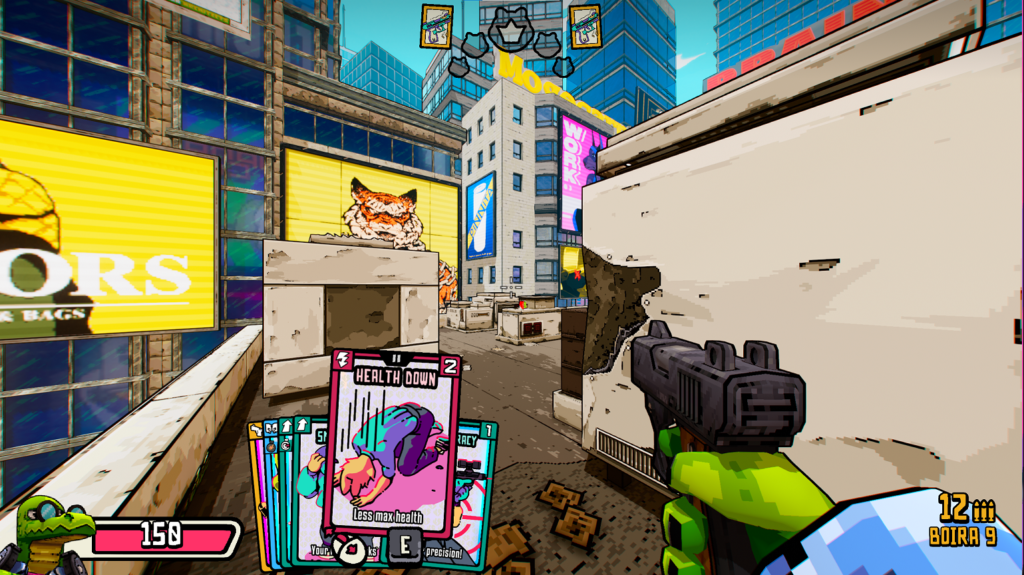
Friends Vs Friends is a 1v1 and 2v2 first person shooter with a pleasant low-poly vibe. The goal is simple: kill the other player before they kill you to win a round. Win 3 rounds before they do to win the match.

So now it’s time for the twist.

Before a game, you build a deck of cards. Using a card can give you a weapon or other equipment, buff you, debuff an opponent, or other wild and weird things.

Perhaps most importantly for the purpose of strategy, unused cards carry over between rounds, and it’s possible to see which cards the opponent uses. So if they pop a powerful weapon, give me a big head, and slow on me on me at the start of the round, I might decide it’s not even worth committing resources to try to win that round. Instead I might pool up cards, then try to push through on a future one.

The end result is a really fun blend of moment to moment resource management, and FPS skill. Time to kill is fairly high overall, with most weapons requiring a large number of hits. This is important because it gives you the time you need to decide what cards to use.

The most fun I’ve had with Friends Vs Friends is playing it as a sort of party game with 3-4 friends who I talked into getting it. It’s relatively easy to set up a private game, invite folks, and then just jump into it. Running around, yelling at each other, trash talking, and calling every single round winning clutch is great.

But some parts are not as great. So let’s talk about them.

Progression and other complaints

Deckbuilding in Friends Vs Friends is reliant on collecting cards. You buy card packs with a in-game earned currency. There are two types of card packs: basic and rare. Rare packs cost twice as much as the basic ones, and it feels like you earn currency pretty slowly.

The frustrating thing about the cards is that they use what I’ve come to think of as the “Clash of Clans” model. That’s the one where duplicates don’t give you more copies of the card to work with, they just upgrade the existing card’s power level. Which is not very fun, because it means duplicates of a rare card (instead of feeling special and improving your deck a lot) just give you a like 3% boost.

But that’s not the real problem. The real problem is quests.

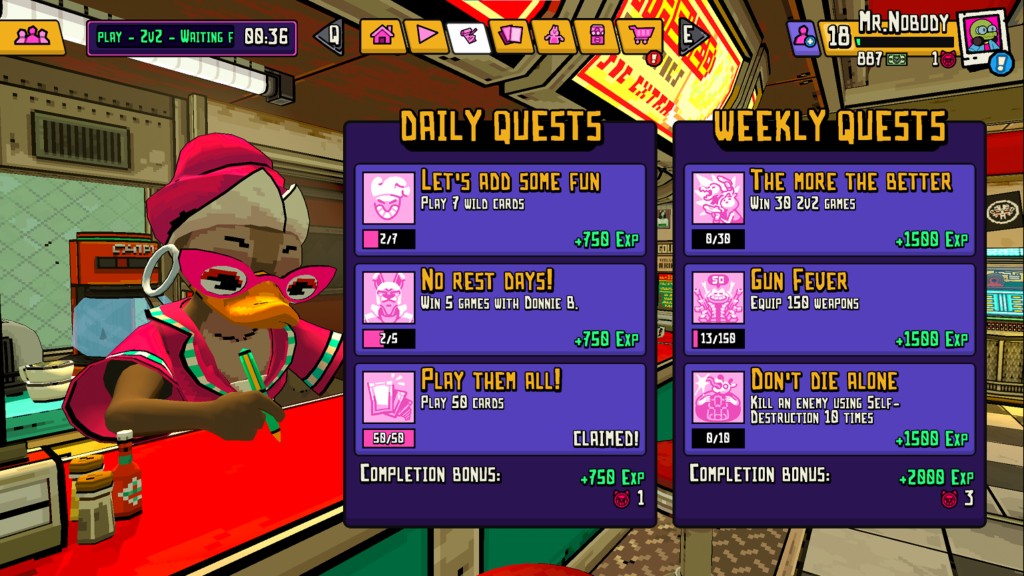
There are daily and weekly quests, because of course there are, and they give much larger amounts of EXP than just playing games. This would be fine, except for one thing.

You can’t complete these quests in games withfriends, or anything that isn’t random online matchmaking.

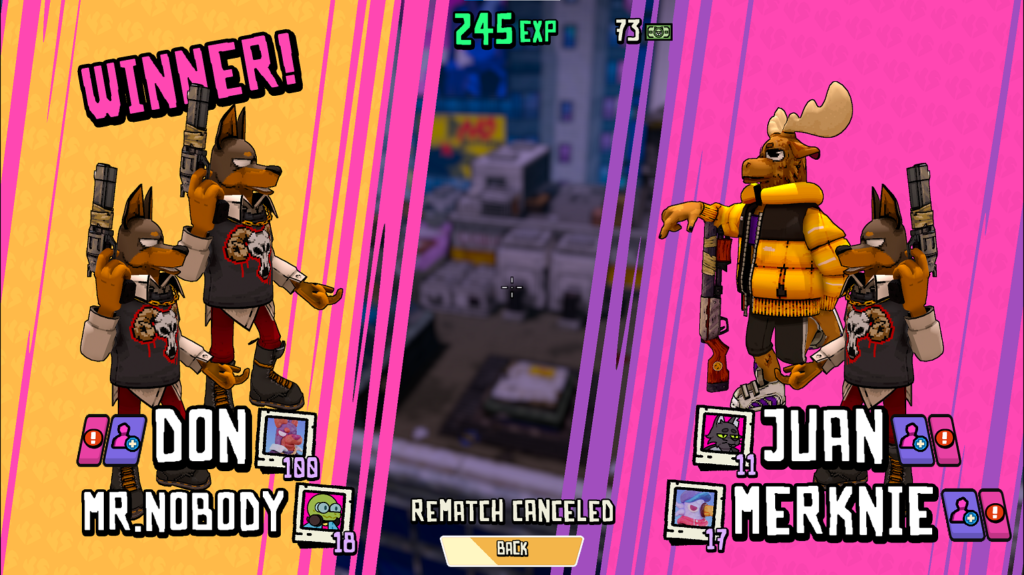
And the random online matchmaking, suffers from two really big issues. First of all, it’s very easy to just drop out of a match after a loss. So you can expect to see a lot of canceled rematches. This in turn means a fair amount of time spent waiting for the next match.

To be fair, I would also probably quit after losing a match to someone at progression level 100.

Secondly, it just isn’t quite as fun. The game is a lot more enjoyable with a group of friends shouting at each other over voice chat, and with the ability to make a fair set of 2v2’s by balancing teams.

But grinding online is the best way to unlock more cards and money to play with, and also the only way to unlock the in-game cosmetics.

So the weird end result is that the best way to play a game called Friends Vs Friends is, in fact, to not play it against your friends.

Overall

I like Friends Vs Friends. The gunplay is fun, and it feels fantastic as a group game. Unfortunately for my group of folks, it sort of got its lunch eaten by BattleBit in the FPS department. But we were having a good time with it before that.

It probably would have been better if the quests/progressions/unlocks didn’t work the way they did, or there was more capacity to really deckbuild. As it is, it’s fun, but the deckbuilding is never about building cool combos. Ultimately deckbuilding is just a “Stuff as much good stuff as you can” sort of vibe.

Overall thought, it’s good! I just wish there was a bit more to it, and some tweaks to a few systems because it could have been great.

Deceive Inc

Deceive Inc is out. This game’s been on my watch list for a while, mostly based off playing the demo a while back. I’ve managed to rack up 30 hours so far, and I’m ready to give my thoughts. I do like Deceive Inc, and I recommend it. BUT.

In what feels very appropriate, I don’t think Deceive Inc is actually the stealth game it might first appear to be. Or, at least, it’s not quite a stealth game at its core. So let’s talk about that.

Deceive Inc’s Deception

Deceive Inc falls into a lot of genres. It’s a multiplayer stealth action game with battle royale and hero shooter elements.

However, it’s the shooter part that I really want to focus on. The shooting is the most important game mechanic underpinning everything else in Deceive Inc. It’s not what you’ll be spending most of your time doing, necessarily, but it is required for victory. Which brings me to my one big point: if you do not like first person shooters, you will not like Deceive Inc.

If you do enjoy first person shooters, though, you will find this one of the most interesting and unique takes on the battle royale genre that’s been done so far.

More on that later. For now, let’s talk about the general flow of a game of Deceive Inc. Players take the role of spies infiltrating one of several expansive maps, attempting to escape with a briefcase, while avoiding being killed by NPC guards and other players.

I won’t be talking about the AI guards much from here on out. They serve the same purpose as AI in Hunt: Showdown. They’re not actually much of a threat except that drawing their attention them will alert other players to your presence.

Note: Between when I started writing this, and it getting put up on the blog, Deceive Inc has added a new class of NPC called the Elite Guard who are noticeably more lethal. Still not a threat on their own, but absolutely can become a problem in larger firefights.

Fortunately, avoiding the NPC guards is incredibly easy. Deceive Inc has a disguise system called cover. Cover lets a player copy the appearance of any character they can see and stand next to. As long as you have cover that matches the appropriate area, guards will never shoot you.

Author Note: The actual functionality for cover is incredibly interesting. The character other players see doesn’t actually mimic your movement 100%. Instead, it just faces the direction you last moved. This means that you can look around wildly without giving yourself away as a human player. You can also walk backwards to watch behind you, while giving the impression you’re looking in the direction you’re moving.

Cover is broken when you shoot or get shot enough, or if you’re seen for too long in a forbidden area. For example, a staff member cover won’t last long in a guard area.

The primary threat to success is other players, and the actions they take. I have a whole side writeup about the meta strategies currently in vogue.

What Deceive Inc Does Well

Deceive Inc absolutely nails the 70’s spy aesthetic. Every map and character feels like they just stepped out of a portal from the James Bond or Austin Powers movies. There’s a fun but not overwhelming retro-tech theme, and the sound effects and music fit incredibly well. (Casino map when Sweat Bandits?)

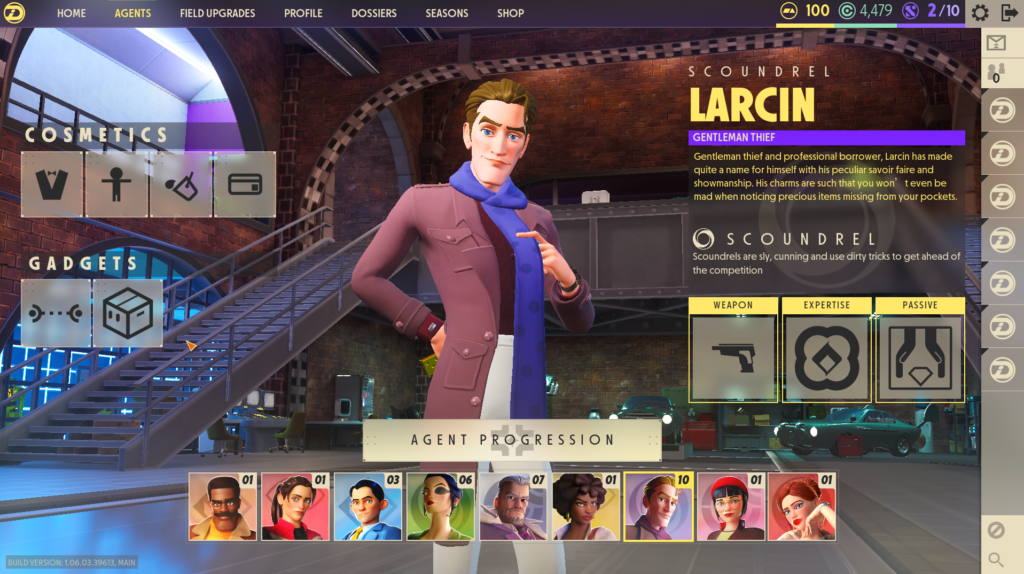
My personal favorite, Larcin.

The gunplay is solid, if a bit unusual compared to many other shooters. Time to kill is fairly high, and takes some getting used to. So do some of the behaviors around aiming. Each character also only has a single gun. But in the long run, the biggest difference from most shooters are the activated abilities.

Deceive Inc also has one of the best respawn mechanics that I’ve ever seen in a battle royale. There’s no respawn or bleed out. Instead, downed teammates can always be revived as long as they don’t leave the game. The catch is that each respawn brings them back with lower and lower max health. This rewards quick pickoffs and disengaging, but it’s still always possible to stage a comeback.

The spy and sneaking mechanics are fun and flavorful. Unfortunately, for reasons I wrote about in another post, really trying to blend in and be stealthy isn’t quite the best way to play the game. Even so, the sneaking absolutely sell the fantasy of being the high tech secret agent. The devs have indicated that they’re trying to make the game be a bit more punishing of run and gun, and have released patches to encourage that, so we’ll see how it goes in the long run.

Friction Points and Annoyances

In-game, I have very few annoyances with Deceive Inc. That said, I would really like to be able to see kill replays, and would love to see damage breakdowns upon death. Even after playing for 25 hours, I still often don’t understand how I was spotted out and killed. This makes learning really hard.

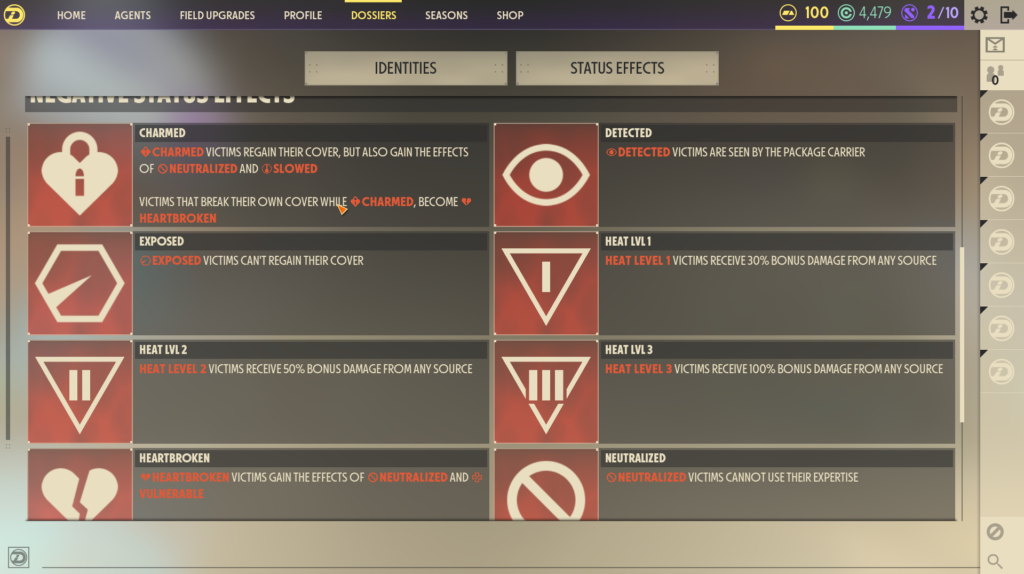
In addition, there are a bunch of small things in Deceive Inc that aren’t explained super well. These include various status effects, debuffs, and how specific weapons work. The information is present in the game, but it’s just not super easily exposed. The most recent update added a glossary which I like, but it could still do a bit more.

Out of the actual gameplay, I have one big complaint, and a few minor ones. The biggest complaint is the matchmaking.

The matchmaking is bad.

I recognize that a small player base leads to tradeoffs in order to keep queue time down. That said, getting matched into someone who has played 15 times as much as me feels bad. Getting matched into a whole team of players with that much time played felt even worse. The lack of death breakdowns and kill replays means it’s not possible to even learn from this kind of absolute butchery.

Also, I don’t love that in a game I already paid $20 for, there’s a battle pass on release. Blah blah, server expenses, blah blah, live service. But look. I already gave you $20. C’mon.

Conclusions

Do I recommend Deceive Inc? As long as you enjoy first person shooting mechanics, yes.

Everyone I’ve played this game with so far has enjoyed it, and played more with me, which is ridiculously high bar all things considered. It definitely has pain points, and bunch of unique mechanics that can make it a bit difficult to learn, but I’ve never played anything quite like it.

Guns in Deceive Inc

Author’s Note: This was part of my writeup on Deceive Inc. Partway through, I realized that a 7 paragraph diatribe about gun balance and the current meta might not be the most relevant for deciding if you want to buy Deceive Inc. That said, I still think this post does make an accurate observation about why Deceive Inc plays the way it does.

Deceive Inc sells itself as a stealth game, but after playing a few rounds, it becomes clear that isn’t entirely true. The dominant strategy used by very high level (300, the level cap) players is much more based around fast movement, while ignoring the stealth aspects of the game to a certain extent.

I think this happens because the guns fairly high time-to-kill. Across the characters I’ve played, and had my friends play, here’s a short list with some approximate damage values:

WeaponBody ShotHeadshot
Sniper Rifle3575 (Charged)
Shotgun4550 (ADS)
Pistol10-1520

For reference, a player starts out at 100 health, and some in game upgrades can push them up to 115 health at max.

But the important part here is that there is no way to one-shot kill a full health player. Which I think I think makes sense when you game out a bunch of other factors:

Since Deceive Inc is a battle royale, there is no respawning. You have to play carefully offensively, and defensively. Players want to blend in, and they want to be paranoid of anyone who sticks out. In addition, it’s a fairly small player count battle royale, withonly up to 12-16 players in a match.

So if weapons could one-shot, be it a shotgun at close range, or a sniper headshot, the dominant strategy I think becomes something like “Engage anyone suspicious, and try to one tap them.” If the player is correct, and did spot a disguised human, they instantly win the combat, can disengage, and have permanently removed a threat from the game with very little risk to themself.

If they’re wrong, they’ve made themself a target for anyone else nearby to get one-tapped, and also wasted ammo. But because of the risk of being spotted, I still think the right choice is to blast first, ask questions later. And this encourages a super passive playstyle of taking the minimal number of risks at all points in time, to avoid being found and nuked down.

But weapons don’t one shot. So even if you spot someone else out first, and engage them first with a surprise shot, it’s still very possible for the player who is stronger with the gunplay mechanics to turn and kill you.

This is why I can only recommend Deceive Inc to people who like first person shooters. Playing well against other humans requires winning gunfights. And winning gunfights requires strong FPS skill mechanics. Even though most of the game is spent engaging with the stealth mechanics and trying to avoid trouble, without gunplay skills, you just can’t win.

Redfall

Redfall is the newest game from Arkane Studios, best known for Prey and Dishonored. It’s their attempt at making a horde shooter/looter shooter, and I have thoughts about it.

Lmao got em.

They are “This is terrible,” and, “Why does this exist?” If you told me Redfall came out 10 years ago, I would have believed you.

The first bad sign is the gunplay. It is not great. The aiming is tight, but the feedback from shooting and recoil is awful. Every enemy feels like a bullet sponge. Only two weapons feel right: the shotgun and sniper rifle. And both of those require headshots. While sloppy guns might be okay in other types of games, this is a horde shooter… it relies on its gunplay.

In addition, there’s apparently no party scaling. So regardless of if you want to play in “single player” where you can’t pause, or with an actual team, it’s the same experience. In fact, you can never pause the game, so I hope nothing ever happens while you’re playing that might interrupt you, or you’ll die.

The graphics are okay, and have a cartoony aesthetic, but the movement animations are all the same. Each special type of vampire feels pretty much the same.

For example there’s one called Angler. Much like L4D’s Smoker, they have a grapple to reel you in with. But as far as I can tell, you they don’t have an obvious tell or signal. The ability is on a 20 second cooldown, and you need to just dodge it based on the timing, and circle strafe.

Redfall could be redeemed by its story, but even after just seeing the opening, I have low hopes. The opening is incredibly stupid. The game opens with two vampires alive in front of the player character. The player has no guns or anything, and can only watch as the vampires turn another unlucky human into a buffet. Suddenly, one of the vampires notices you’re alive, and turns to deal with you.

Then the most predictable thing to happen in the history the earth, happens. The thing that happens every day, and will happen every day for 7 million years after I die occurs: the sun the comes up.

Which makes the vampires run away. Not die or anything. Just… run away. Because I guess they didn’t have sunscreen on. On the boat that we’re on. Because the game starts on a boat.

Once you get off the boat, and go out to face your first enemy, things don’t get better. I chose to go full sneaky commando, because I selected the hardest difficultly I have available. I was prepped to deal with these bloodsuckin motherfuckin vampires, but the first enemy I ran into was actually a cultist.

Here’s the thing though: apparently the children of the children of the night are deaf, because they can’t tell if someone straight ass sprints at them at full speed from behind. For some reason the game doesn’t have an assassination animation or anything; you just thwack them in the back of the head and they fall down dead.

There are some signs that this was made by Arkane, of course. There are a bunch of interactable objects, common in the immersive sim genre, but unlike actual immersive sims (and any game from last 10 years) you can’t actually do interesting things with them. For example, there are more oil spills in the environments than the gulf of Mexico, but you can’t throw gas canisters at enemies, you can only shoot the canisters when enemies walk by.

Some other things that suck:
1. The quippy dialogue. It made me want to root for the vampires.
2. The enemy AI. Maybe it got copied from Fallout 76, and then made worse, somehow. A non-zero portion of the time enemies don’t do anything, and just stand still. The rest of the time enemies wander toward you like geriatric hobos.
3.The questing loop. There seem to be 2-3 options for each mission: i.e. go in guns blazing, sneak in, or sneak in with lockpicks or electric lockpicks via hacking. These are your only options.
4. An open world made out of absolutely nothing between the points of interest. Every other mile has one to two enemies. Apparently everyone thinks you’re a Mormon missionary, because no one will come within six miles of you.

Why make an open world game if it’s all empty? Just give us a mission select. It was good enough for Doom, it can be good enough for you.

Maybe the game would get better if I played another 7 hours. Here’s the thing: I played 7 hours. That’s enough time to watch the entire Lord Rings Trilogy. There are other games that are better, sooner. I’m not continuing to smack myself in the nuts for another full workday to see if it gets fun.

If you want a better horde shooter, go play Back 4 Blood. And I’ll see you on the servers, because I’m the only other person that likes it. But I can’t stomach another minute of Redfall.

If, for some reason, you want to play Redfall, you could buy it with money. Or you could get a game pass subscription, so that after you uninstall, you can go play something good instead.

Pokémon Scarlet

When I was in highschool, I had to write essays. These essays were graded on a rubric with a certain percentage of points for various categories. One of these categories was what could be considered writing “technical skills.” Things like grammar, sentence construction, and spelling mistakes as a whole contributed to about 20% of the essay’s grade.

As a result, I would never get higher than 80%, because regardless of how good any of my points, ideas, or concepts were, my writing was a complete technical failure.

In that respect, my high school essays have a lot in common with Pokémon Scarlet and Violet.

The Worst Performing Switch Game I’ve Ever Seen

Pokémon Violet’s miserable technical performance is omnipresent across the entire game. Miserable pop-in, levels of detail so low that you can see polygons getting added onto character models, poor framerates, and slowdown are present in virtual every area of the game. Almost every object is also subject to animation-frame culling as well.

My personal breaking point for this was the game’s credit sequence. This game is so unbelievably scuffed from a technical level that it fails to smoothly display scrolling text on a screen.

I’m not going to harp on the technical problems of Violet after this paragraph, except for when they become relevant to other portions of the game. Games are made up of multiple components, and worked on by multiple teams.

Some teams did their job very well. Some of these teams may have done the best they could under extreme time pressure. Or maybe they’re just incompetent! I don’t know which one it was. My conclusion is the same.

Despite liking and enjoying Pokémon Violet, the game’s technical issues are so widely spread that I just can’t recommend the game.

Core Mechanics

I did a large writeup on Pokémon as a series a while back. If you’re not familiar with Pokémon games at all, I suggest you read that writeup before the next bit. It included a overview of structure the games follow, along with general coverage of the series’ mechanics, and some suggestions for where a new player could start.

Scarlet and Violet mark the series transition to a full open world from the previous linear routes and narrative path. Instead, the world is shaped like a large donut. Difficulty scales as you travel up either side of the donut, with the game’s finale taking place in the center.

In Legends: Arceus, the battle and catching system was very simple. In Scarlet and Violet, those systems have been rolled back to their more complex previous forms, and are still very good and very compelling. There’s no more tall grass. Instead Pokémon spawn into the world in packs, and running into them will start a battle.

Node-Based Story Structure

The story structure is also fairly different. Because of the game’s open world nature, there’s no single series of events, or path that’s really required. Instead, each story event is sort of a self-contained mini-event. There are three main routes for these events. Two routes have 5 events, and the gym route has 8.

I think these story nodes can be completed in pretty much any order. I’m not sure that’s the case, though, because I did all the ones that gave me travel upgrades first. It certainly didn’t feel like there was a required order to me.

That said, these events don’t dynamically scale. I left what could be considered the 2nd or 3rd gym fight to do last one. There’s something amusing about showing up with a team of level 60 Pokémon for a gym battle against level 25s. But it’s also a little disappointing that the game doesn’t utilize the nonlinear story structure to give different players a different experience based on the order they complete story battles.

Also, before I switch topics, the games story arcs are surprisingly good. From a purely story standpoint, Scarlet might be my favorite Pokémon game. Is it the greatest story ever? No, but it’s memorable and unique.

Thematically Vast, Visually Bland

The Paldea region is one of the areas where the game feels like it’s been held back by the technology. There’s an early moment where a character is supposed to be introducing the stunning majesty of the Paldea region, and we get treated to a set of panning views of… various green-grey plains.

It’s sort of sad-funny that sets the tone for what we’ll see in the rest of the game.

The game has a variety of areas, but outside of Pokémon variety, the areas never felt different. Looking back, I remember dry desserts, a large cave, some icy mountains, ocean-side towns, and a coal mine, but they all felt identical. The only area that left any sort of impact was a large cave that I wandered into under leveled, swiftly got pulped, and then booked it out of.

The Pokémon Cave Experience

I think the biggest issue is that Pokémon games have often been light on visuals. Instead, the tone of the zones was sold by the Pokémon themselves. Caves full of Zubats spring to mind. Lunatone and Solrock in Meteor Falls, or Skarmory in the ash covered zones.

However, because of how Pokémon spawning works, and the fact that it’s possible to ignore pretty much every encounter I didn’t want to fight, most areas ended up feeling empty. I could rush through them, and interact with nothing but story events if I so chose.

Some thoughts that don’t fit anywhere else

Pokémon is a broad franchise, and has its own subtypes of players just like other complicated and broad games. As such, there are some things I can’t comment on. I don’t know how well the game is balanced and plays for multiplayer activities, such as competitive tourneys, or the end-game raids. I also didn’t do much with the breeding post-game/shiny hunting.

Many of the gyms in this game have their own mini-game or side mode associated with them. One of the more standout moments for me was a game mode where you’re supposed to collect Sunflora, and bring them back to a central area. This puzzle was very clearly designed before being tested, because it required collecting such a large number of Sunflora, that they would lag the game, and pop-in if you ran too far ahead of them. The town with this gym challenge also had a windmill that had ridiculous animation culling. Both of these combined to make the whole area incredibly immersion-breaking.

The new Pokémon designs generally felt quite good, as did much of the general world design and writing. The Jiggypuff with sharp teeth that screams and bites you is one of my favorites.

Again, though, it’s things like the carefully crafted in-world advertisements and logos that end up feeling like they’re in sharp contrast to the generally poor technical quality of the rest of the game.

Friendly reminder that the Fairy Pokémon type is based off old-english fairies, and those things were public menaces.

The vengeful fairy with a giant hammer that just beats the shit out of you is also great.

In Conclusion

Pokémon Scarlet is a 7/10, but it gets that score, much like my high school English papers, for a sheer lack of technical polish.

If this was an indie game, I’d excuse a lot of these issues. But this is the largest media franchise in the world. Yes, Scarlet makes makes changes in story, structure, and world, but they’re all hindered by those technical issues.

There have been some rumors that Nintendo/Gamefreak are working on patches to improve performance, but I’m not holding my breath. And I’m not betting on these issues being fixed for the next game either.

Did I have fun? Yes! Would I play it again? Probably. Will I buy the next entry in the franchise? In the immortal words of Penny Arcade’s Tycho Brahe, “I am a consumer whore.”

Of course I will.

But I don’t recommend you buy it.