Become a Fish Wizard. Fight. Kill. Collect silly hats.
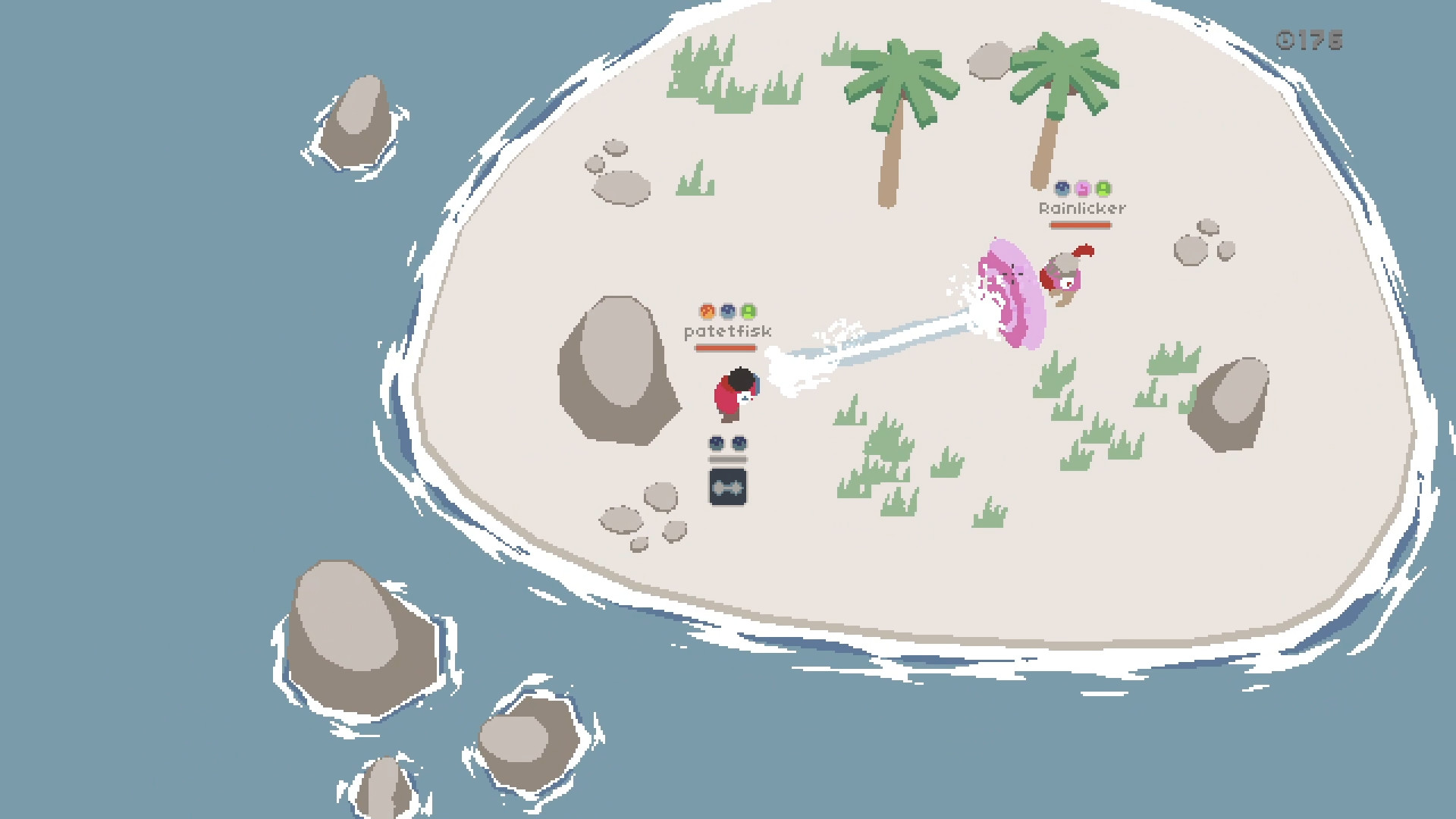
Ed Note: We requested and received a few free keys of Fishards after watching the trailer, and being interested. This review is based on the experience with those pre-release game keys. Images are from the Steam Page.
When I saw the trailer for Fishards, I thought it looked neat, and convinced 3 other friends to play it with me. Of that group, I’m the only person who was kinda “Eh” on Fishards, with everyone else generally liking the game, even if they had some criticism. But they’re not writing this article, so lets talk about what I thought about it, and what the game generally is first.
In Fishards, you are a Fish Wizard. By combing the 5 elements, fire, water, earth, slime, and goo, you will cast spells, and defeat your enemies. Each combination of elements produces a specific spell.
While its tempting to compare Fishards to Magikca, I think this is a fairly inaccurate comparison. After going back and playing some Magicka for this writeup, while both games have a concept of “Combine elements for spells”, they both do it very differently. In Magicka, the elements you combine have various properties and rules. While there are specific spells that require you to enter a given combo of elements, just randomly pressing buttons will give you something. For example, if you combine lightning and beam, you get a beam that does lightning damage.
That’s not the case in Fishards. In Fishards, any two elements correlate to a specific spell, with it’s own specific cooldown. It reminds me a lot of playing the character Invoker in Dota 2. Because each spell instance has it’s own cooldown, you can’t really spam the same thing over and over again. There are a few exceptions to this rule, with the fireball and goo-spread spells that let you cast them multiple times. But a vast majority of them cannot be multicast, so you’re forced to switch up spells fairly rapidly.
Another way it’s unlike Magikca is that Fishards is technically stable and runs fairly well. While this is to it’s credit, I also never really found myself super engrossed in the game. If this article sounds kind of…. “Eh” on Fishards, that’s because it is. I don’t really feel strongly about Fishards. It’s neat, but right now, I didn’t really have a huge amount of fun with it.
Here’s the thing though: That’s just my thoughts. Of the group of folks I played with, other folks had some more positive thoughts. One friend generally liked the combo system, even if they thought the spells and other factors needed some tuning. The other two had issues seeing the cursor, but after the Dev’s were told about this, there was a patch that resolved this issue fairly quickly.
You can get Fishards here on Steam for $7. And y’know, that’s probably the right price for it. If the idea of a weird indie top down arena brawler interests you, I’d encourage you to give it a look, and see if you think you’d have fun with it.
A mobile tower defense game where you run a PMC of anime furies. No wait, it’s cool, please come back.
Arknights is a mobile tower defense game. It commits some of the sins of mobile games in general, such as a gacha system for acquiring your “towers,” and an upgrade system that requires you to loot an entire RadioShack worth of gear to do anything. That said, it does enough unique and interesting things as a tower defense that I want to write about it, and I recommend it.
There’s a funny story about how this article wasn’t actually going to be an article about Arknights. It was going to be a list of some of some phone games that I’ve been playing. Part way through writing that list, I realized that I had written two paragraphs on Arknights, and nothing for the others. Then, when I tried to write about those other games, I realized that my reasons for playing them were, in no particular order:
To collect fox girls.
Because I’m desperately starved for anything pinball related.
Sunk cost fallacy.
Arknights was the only one that I was actually playing because it was fun.
That’s not to say the game itself is perfect, by any means. As I mentioned above, I have problems with it. First, you have to roll what amounts to a slot machine in order to permanently unlock your units. Second, powering and leveling said units requires a shit ton of time. And the third, the game’s general story and lore is on par with Dota: Dragons Blood (which is to say, a mess).
But it does a bunch of other stuff right. For one, I really its “Stamina” system. Like many mobile games, Arknights has a Stamina system where you have to spend Stamina to enter and play a given stage. Unlike most mobile games I’ve played, if you wipe on stage, or choose to quit, it refunds a portion of that stamina. While this would be fine by itself, the bigger portion of this is the “Plan” system.
Plans are a parallel resource that refills to 30 at the start of each day. Plans can be used to enter a stage without spending any stamina, but you won’t get rewards for beating the stage, nor will beating it actually count as clearing the stage. In essence, they function as free “test” runs. If you haven’t played many games with a stamina system, their purpose might not be apparent. Plans allow you to constantly make attempts on content you’re stuck on, but without any risk of “wasting” your precious Stamina until you’re sure you can beat the level.
I really like this because it makes it into much more of game. You’re encouraged and enabled to try multiple strategies and ideas against levels you can’t clear. Instead of being punished for failure, you can practice and end up feeling 100% sure you’ll clear a level. You can safely try cheese and other weirdness to pass a level with no risk other than your time.
Actual Arknights levels tend to be structured similarly to normal tower defense levels. There are entry points where enemies spawn, and will follow a path to get to an exit point. If an enemy makes it all the way there, you lose a life. Run out of lives, and you fail the level.
That’s where a lot of the common genre tropes go out the window. You can’t just put down as many towers as you can afford. Instead, you can only have up to a given number of your operators on the field at any one time. Most operators can also only either be placed on ranged or melee tiles, based on their type. Once you place an operator down, you can’t move or reorient them without retreating them, waiting out their redeploy period, and then paying an increased cost to place them down again.
Almost all operators have a skill or talent of some kind. These range from stat buffs, to summoning a shadow clone copy of themselves, or just nuking the area around them.
And you will want to move them. The cost to deploy an operator is different from character to character, so you’ll often want to start by putting some of your cheaper units that generate additional deployment points into play, only to remove them later to free up space in your unit cap. And even if an operator is knocked out, after waiting out their redeployment, you can use them again on the same map. Did an enemy get past your defenses? You might find yourself having to toss someone down to block them from getting to the exit. Figuring out when to retreat unit, and when to play them is a big part of managing enemy aggro. Because of this system, Arknights is the only single player tower defense game I’ve ever played where I’ve straight up put units into play knowing they’ll die just to stall for time.
The enemies are also a bit more unique. While many of the starter enemies are standard, the game pretty quickly introduces some really neat types. Here are a few in no particular order: Sentinels – A weak flag waving enemy who isn’t that big of a problem… except the second you shoot him, he goes into alert, buffing the rest of the units on the maps. Perhaps more interestingly, they tend to travel in routes where they ignore going toward the exit, and instead go on a grand tour of the rest of the map. Grudgebearer – Grudgebearers start in Standby mode, which means unlike most enemies in tower defense games, they won’t attack. Even once they start moving, they won’t hit you. Unless you hit them or one of the aforementioned Sentinels, at which point Grudgebearers turn into giant tanky balls of pain. Figuring out how to aggro them in manageable ways before they all wake up is a neat challenge. Maintenance Drones – Just because something shows up in the enemy list doesn’t mean it’s actually a threat to you. Take these very helpful little fellows. Of course, just because they’re helpful doesn’t stop your units from opening fire, which will be a problem, because you really want these guys to activate sanity restoring beacons. Why? Well… The Entire Sea Terror Family – Have you ever wondered what what trying to fight the deep ones would look like in a tower defense? Well, worry no more, because now you can! And by “Can,” I mean you can watch your units go insane, and get stunned from trying to deal with any of the enemies from this archetype. Hooray!
There are civilians you’ll have to try to stop from getting butchered, leader enemies that will blast half your operators with a grenade launcher, and then cheerfully pull out a shiv when they get into melee range, and cloaked little shits who don’t care if you block them. They’ll just wander on past your entire defensive line if you can’t damage them down quick enough.
And that’s just a little taste of the enemies. There’s an equally large set of interesting map mechanics and setups. My personal favorite are maps where you can set up your units to just straight up shove the enemy into pits or off rooftops. But there are also maps with air vents that can boost or weaken stats based on if you’re facing into the wind or away from it, maps that let you maze like a more traditional tower defense with massive bricks, and even maps where your units are constantly being fired on by ballistas.
I will finish this Under-Tide furniture set someday. Ed Note: He never finished it.
There are some other subsystems, including an upgradable base, daily challenges, and some semi-survival raid-like sort of things, but they’re all additional modes and features, so I’m not going to talk about them here.
So yeah, that’s Arknights. A neat mobile tower defense game with a bunch of cool mechanics and enemies, and some less cool decisions around getting new operators. But overall, some really nice twists on the format.
Usually this would be good, bad, and ugly, but today we have weird, weirder, and still pretty weird.
Last week was the Steam Next Fest, a great chance to check out a whole bunch of demos of new games! Of course, I did not do that until yesterday when it turned out the entire event was over.
So instead of information about games promoted via Steam Next Fest, I went, downloaded a bunch of demos in the first three pages, and played them. So here we go.
Thoughts – In theory, Cthulhu Pub is a game about building a restaurant for Elder Gods, and keeping it from being assaulted by things that want to destroy it. Of all the games on this list, I would say this one is in the roughest shape. I had to restart quite a few times before I figured out how to just… start the game without running out of money before finishing the tutorial. There are mechanics that aren’t explained, and it’s just generally kind of buggy and starts to slow down when you get a fair amount of monsters on the screen. But, it was weirdly compelling enough for me to keep trying until I figured stuff out, so it’s got that going for it.
Thoughts – Magical Girl D is an RPG where you play as a magical girl with a dick. The demo had three visual novel style sex scenes, and the PC had one non-basic special attack. I feel like those two sentences really capture everything you need to know about this game demo to decide if you want to play it.
Thoughts – This might be a good time to mention I can’t speak Chinese, because this entire demo was in what I assume was Chinese. It could be something else. It’s some sort of RTS, but again, the whole “I can’t speak Chinese” thing meant I didn’t get through the tutorial.” But, I mean, it seemed kind of cool.
Thoughts – Fishards is a neat little arena brawler, and I’ll most likely write more about it than just this little blurb. You are a fish wizard, and you try to kill other fish wizards in multiplayer battles. I’d say it feels like it has the most in common with Magicka, as you summon spells by combining various elements. Unlike Magicka, it actually runs on my computer.
Thoughts – I didn’t play a huge amount of this demo. The combat itself is much better than the other RPG on the list. The combat is a sort of real time charge bar system. Each character in your demo party has multiple meaningful attacks. I got to the first mini-dungeon, then went to do something else. With that said, the writing was… present. It was there. I did not really care for it.
Thoughts – I didn’t play a huge amount of this one. Treasure Tile feels like someone took an old roguelike, removed the permadeath portion, and strapped in Diablo/ARPG mechanics instead. While the game has some beautiful graphics, the combat itself just felt kind of off to me, and aiming skills felt difficult.
As always, thanks for reading, and if any of these seem interesting, I encourage you to play the demos yourself. Also, if anyone can tell me what that RTS game is called or how it works, that would also be cool.
I’ve been trying to figure out what to write about Crowfall for the last few days. Let’s start with my opinion on the game: Crowfall is too fucking expensive to be worth playing. And when I say expensive, I mean both in terms of money and time.
If you want, you can close this article now, because the rest of it is going to be an extensive exercise in dead horse beating. If you’re still here, please grab your stick and join me.
I’d tolerate the mediocre graphics if the gameplay had any redeeming features. It doesn’t.
I want to start by talking about the easiest part of Crowfall to quantify: the simple monetary cost. Crowfall is $40, and it also has a monthly VIP system that costs about $15 a month. This puts it about on par in terms of pure cost with its competitors. Final Fantasy 14 is $60 for the full game with 4 expansions, and a required monthly subscription of about $15. World of Warcraft is $40, and also $15 a month plus the incalculable cost of knowing you’re supporting Activision-Blizzard, making it cost effectively infinite money. New World is $40 and the knowledge that you’re adding Jeff Bezos’s draconic horde of wealth.
This is a problem, because on a scale of “Virtual Disneyland” to “Digital Version of Detroit,” Crowfall is the latter. It wants to be a hardcore PVP game, with fights for territory, resources, and areas going on constantly. It has castles and landmarks that you can build up and guilds to join. As soon as you’re out of the pure tutorial world, when you die you drop 50% of your gold.
In the normal world, when you die, you drop half your inventory.
I have a bunch of small problems with Crowfall, but I have small problems with almost every game, so I’m going to talk about the big problem I have with Crowfall: the game expects you to do everything with other people. And not just a few other people, a lot of other people.
Let me give an example: One of Crowfall’s big ideas is that you are a “Crow,” a semi-immortal soul repeatedly brought back to life by the gods in order to fight for them. In terms of in-game mechanics, this means that to level up past a given point, you need to get and fuse with a new body.
Getting these bodies requires that you start by digging up body parts. In order to do this and get anything that’s not garbage, you’ll need the grave digger discipline. I believe it counts as an exploration discipline (more on that later). However, in addition to that discipline, which is a socketable rune, you’ll actually want an upgraded version of the grave digger, which you get by… farming random rune drops from digging up corpses. This requires you to have an intermediate shovel at a minimum, which means you’ll need to craft yourself a shovel, then upgrade it, which means you’ll need to mine and quarry stone, because those two are different. Once you have your upgraded rune that you got from RNG and upgrading (and you’ll need to socket Runecraft to actually upgrade it, I believe) you can actually start grinding again. Now, when you’ve finished grinding, you’ll have the body parts. You can’t use them yet, of course, you need to remake them. This means combining them with some other body parts, and also Ambrosia, which you’ll need an alchemist to make. Now that you’ve got all your body parts collected, you can finally combine them into a new vessel.
Hooray! Did I mention that doing this requires that you collect the right type of each body part for the right race of character that you want to create?
So why are we doing all of this? Well, because without doing it, you can’t actually play in a Shadows World, which is to say the big boy world. Up until then, you’ll play in what is basically a tutorial world. That’s right, this multi-step process just to create a character is more or less before you can actually start playing the full game.
Remember how I said we’d come back to that bit about minor disciplines? Well, you can only actually have two equipped at once, and you can only change them out in a temple. Long story short, there’s no reasonable way to do all of what I described above as a single person, or even a pair. You’ll need a guild or another group to work with. Without one, you’ll most likely have to stay in the beginner world, where drop rates are lower, and buildings seem to reset daily.
Now, it’s entirely possible you read all of this, and go “Wow, that seems like the game for me!” And maybe it is. Maybe you’re all excited about PvP, farming for random items for hours, and ganking other players.
One tiny problem: remember how I mentioned the devs hiding the player count up above? Well, that might be because the servers are incredibly fucking dead. In my time spent during the trial, I feel like I saw less than 30 players total outside of the spawn area.
Yeah, the game is not highly populated.
I have some other problems as well. The auto-attacks put all of your other abilities on cooldown, making combat super frustrating. The number of enemy types in PVE are really low. There’s no form of inventory sorting, meaning that your inventory more or less ends up looking like Minecraft. Speaking of mining, your auto attack and your harvesting abilities are bound to same key, so if you don’t click on that boulder correctly, you’re now in combat until that cooldown wears off in a few seconds. Oh, and if you try to put items of a type you already have into your bank, but don’t have an empty bank slot, you can’t. Even though you already have those items in your bank.
So yeah. Crowfall is an attempt at a sandbox, heavy player interaction MMO, but because there’s nobody playing it, and it takes forever to do anything. It’s filled with small annoyances, and systems that don’t feel fun (I’m looking at you, obscenely fast gear decay). Some of its ideas are decent, but on those bones sits nothing of interest.
It’s been over a month since D6 came out in North America. We had a spoiler-free writeup on the series earlier, and I’m gonna write this post assuming that you already read that one. Is that entirely fair? No, it’s not, but otherwise I’d be retreading a lot of already-visited ground.
Just in case you still choose not to read it, here’s the five second version. D6 has a new art style, performance problems, and gives you meaningful access to the unique mechanics essential to the game faster than its predecessors. Good?
Few more things to get out of the way before we get into this:
I cleared all content except Raksha Ba’al, the last endgame secret boss.
I played without any DLC except the free Hololive DLC.
My save file has about 300 or so hours on it. I’d say that translates to about 80-100 hours of gameplay, maybe a bit more. The reason those numbers don’t add up is because I spent a lot of time auto-grinding.
ART
Disgaea 6 has a very different look than its predecessors. Instead of using 2D sprites like the previous games, D6 uses 3D models. I don’t like them as much as the old sprites. In addition, the super over-the-top skills feel a bit more toned down than usual in terms of visual flashiness. I didn’t see anything that was super memorable, and many of the skill animations feel shorter, as compared to things like D5’s Super Olympia which crushes an entire solar system as part of the attack.
STORY
If I’m rushing through these elements, it’s mostly because I want to just address them and get them out of the way. Compared to the other games, I’d say D6 has a stronger finish and conclusion than 5, albeit with somewhat weaker middle. The characters are solid. There are some fairly funny moments, and a few more brutal ones. All in all, it’s fine. It does follow the same pattern as D5: many characters get a power up at various points in the story arc that correspond to their growth as a character, making that growth feel a bit forced, but it’s an overall improvement.
GAMEPLAY
And here we are: the big one. The chonky boy. The factor that the rest of this post is going to be devoted to: D6’s gameplay loop. So how is it?
Well… it’s a bit different than other entries in the series, actually. Let me explain what I mean.
Disgaea has a reputation for being a grindy game, but despite that fact, grinding usually isn’t necessary to beat the “Main Game” and see the credits roll. It’s more or less required to beat endgame content, but even then, grinding in Disgaea tends to be a bit different than traditional grinding. Instead of the classic “Walk around, find encounter, spam attacks, rinse repeat,” Disgaea tends to take more of a puzzle route. End game grinding in Disgaea is less about how much you grind and more about making your grind as efficiently as possible.
Let’s take D4 as an example. D4 has a set of end game maps that culminate in a map that is incredibly simple. It’s just a large square of enemies, arranged in a specific pattern. And it’s possible, with the right set of skills, abilities, and setup, to hit and clear this entire map in one hit, and hit the level cap after a single fight in this map. This isn’t an oversight. The map is designed in such a way to be beaten like this, and cleared incredibly quickly.
D6 is different. Unlike other games in the series, you will have to grind to beat the main story, because the level cap has been extended twice, all the way up to something like 9,999,999,999, along with the stat cap. The leveling process itself is much faster, and but there are still a few points where if you’re playing each map once, you won’t be high enough level to clear the next one.
And this is where some of the game’s new systems, Demonic Intelligence (D.I. for short), auto-play, and auto-repeat come into play. DI is effectively a visual programming language. Each unit can store up to five of these, and have a single one active. When you toggle on the auto-play feature, the game will have your units execute commands based off their active DI. If you toggle on auto-repeat, when you clear the map, you’ll just start it over again. Which means this is the point where D6 switches from being a tactics game, to being an incremental game.
DI is a really cool idea. I really would like to say I love it. Unfortunately, I can’t because in its current incarnation, it has some massive flaws. Disgaea 6 doesn’t have any form of documentation/information about exactly how DI works. When I say documentation, I mean explaining how the various functions work. For example, it would be great if the game explained that “The Target an Enemy Function will target the closest enemy starting by checking clockwise…” but it doesn’t. And while normally this wouldn’t be too bad, it brings me to the second point. There’s no real way to debug or step by step execute DI Instead, you can either have it turned on or off. There are also several commands that are effectively useless such as option that lets you target a specific square on a grid, without any way to figure out how gridding for maps works.
The end result is a system that is very hard to get it to dowhat you want. Instead, I found myself just sort of brute-forcing it. I would run DI setups that I thought would fail, and they would end up working. More often than not, though, the DI setups I thought would work instead failed. Instead of using DI as a solution to automate grinding to high levels, I tended to make simple patterns, and just have units leveled up high enough that I could face roll through content.
And generally speaking, this would be mostly fine if it wasn’t for another new system: Karma.
Karma functions as a replacement for the Chara World systems from previous games. These are areas that you would use to permanently boost your characters’ growth and stats.
In D6, instead of having an item world equivalent like D4, or a Mario Party board game like D5, each time you reincarnate a character, you get a certain amount of Karma. You’re then given a menu where you can spend this Karma on a variety of things, including extra evilities, stat boosts, and…. max level and stat caps.
And here’s the problem: because of the ridiculous scaling in D6, scaling your stats with Karma feels like the most effective way to boost scaling. But because the level cap is so high, it takes several hours of grinding with DI to have your party hit the level cap. Or you can do this bullshit and have a single member of your party hit max level in about 5 minutes, but there’s no way to use DI to farm it.
Regardless of how you choose to do it, once you do, you hit one final wall: The amount of Karma you get per reincarnation is “relatively” small. And because this is Disgaea, let me give some exact numbers. Each reincarnation from max level gives about 120,000,000 Karma. Each stat point past 2,000 costs 5,000,000 Karma to buy. Stats cap at 4,000. There are like 6 stats. I was gonna say “I’ll let you do the math”, but that’s a cop out, so instead, here it is.
Getting a single character to max stats would require you to run this 3-5 minute setup about 500 times. So, assuming maximum generosity, just about 25 hours, if each loop took 3 minutes. There is no way to speed it up or make it faster.
I wouldn’t say this is the defining factor of D6 for me, but it does highlight what feels like the weirdness of the game. It’s a game based around massive numbers, but makes getting to them a chore. It adds autogrinding and looping, but it does so in a way that makes the system hard to utilize, and debug, and means that you end up skipping more content than you play. And even when you use those systems, in the hyper late game, they’re less efficient than actually playing the game by such a massive amount that you may as well just ignore them.
While it might seem like I don’t like D6 given how much time I just spent tearing parts of the game apart, those things only came to annoy me because I spent so much time playing the game. I do want to call out D6 for what it does well: making an attempt at innovating with some of its mechanics and systems, and trying to make them more core to the main game.
The attempt at switching to 3D, and the new combat animations aren’t great, but hopefully that’s the result of unfamiliarity with new tools and systems. DI is a very interesting system, but it’s heavily busted because of the lack of ability to debug and step through behavior. The frame rate is garbage for no reason, so hopefully that gets fixed.
As an entry in the Disgaea franchise, D6 simply wasn’t as fun from a purely tactical gameplay standpoint as D5. The lack of exciting combat mechanics like Overloads, somewhat reduced skills, and lower character class pool didn’t feel as interesting.
So here’s my verdict:
If you already like the Disgaea series for the story and humor, D6 is worth playing through for those.
If you already liked the series for munchkining tactics and extensive vidya bullshit, and don’t give a shit about the story, D6 is probably not going to be your cup of tea.
And if you’ve never played a Disgaea game before, well, it depends. D6 is in many ways a good introduction to the series, with some of the simplified systems, and auto-grinding. But those same elements also make the meta-flow of progression less interesting, so if you want to see what the franchise’s mechanics are all about, I’d suggest D5 instead.