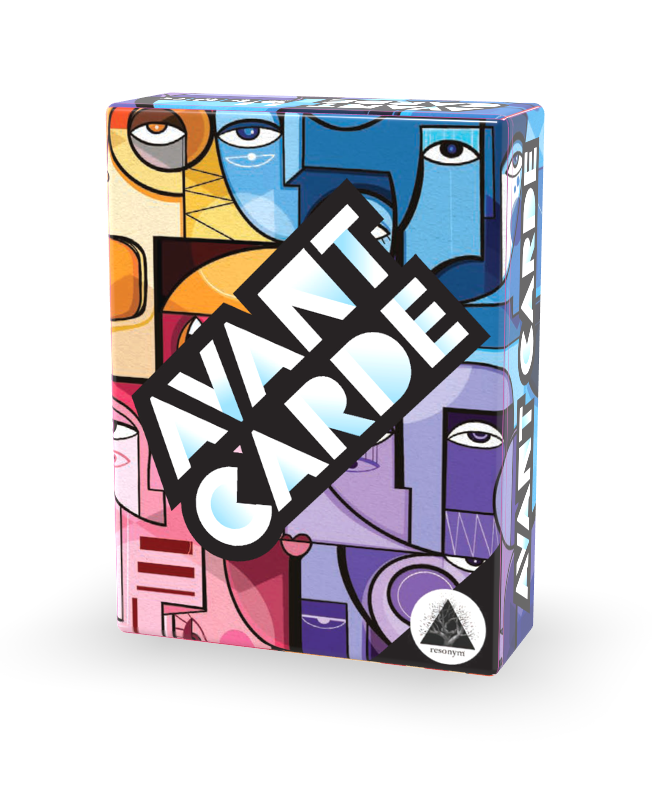
A few months ago I mentioned in my Granite Games Summit writeup that one of my favorite prototypes at the event was a deck builder with a working title of “Cubism.” I also noted that I didn’t really want to write about it while it was still in the prototype stage.
It’s been a while since then, but I’m happy to note that this week I can finally talk about that prototype. Mostly because it’s no longer a prototype, and it has a new final name: Avant Carde.
Avant Carde is a deck builder where players take on the role of collectors organizing shows of their artwork to score awards.
If you’ve played a traditional deck builder, you’re likely familiar with a lot of the base components of the genre. Players are given a (weak) starting deck that they make more powerful over time by using it to generate resources, and purchase additional cards to be added to the deck.
Where Avant Carde innovates, though, is in how it handles playing cards during a players turn, and also its scoring and buying system.
In something like Dominion or Clank, any card can be played in any order, though there might be advantages to doing things a certain way. Avant Carde is different.
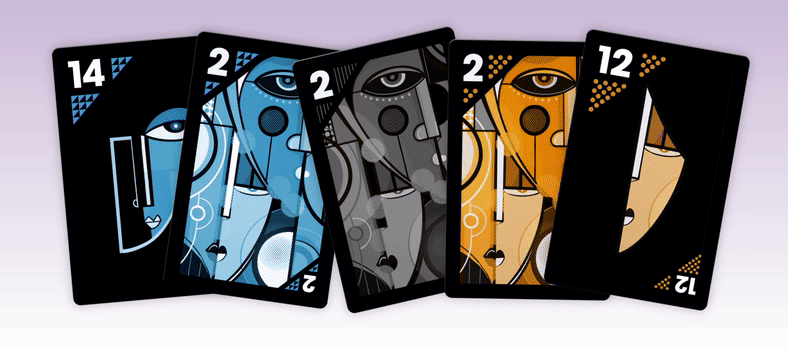
Avant Carde has a something more akin to an Uno style chaining system. Once a player plays a card for their turn, the next card they play has to match the previous card in either color or number to continue the chain. At the end, they count up the number of cards in the chain, and any other abilities those cards might have, and that number is the amount of money they have to buy with.
This chain, for example, would generate 5 money for the player.
This leads to a really interesting balance where the more expensive and powerful cards can end up being a bit riskier to play if they aren’t in a color that you’re collecting.
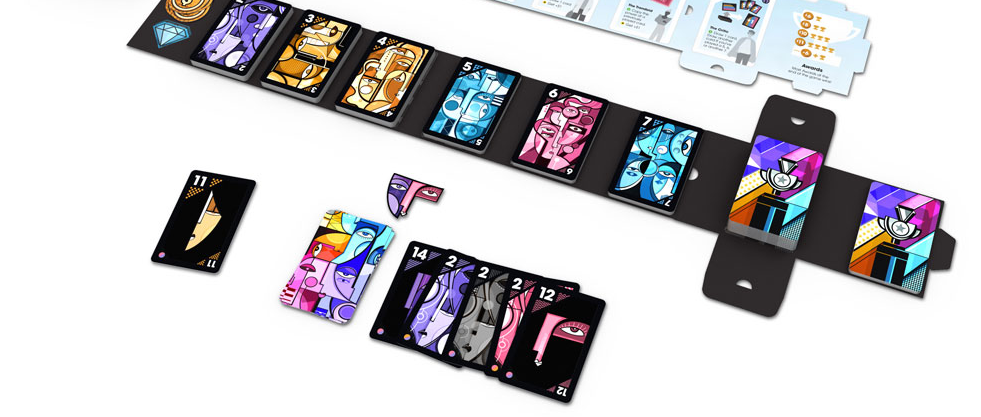
Avant Card also has some interesting changes in how it handles the buying area. Unlike Ascension, where a limited pool of cards are available at any point in time, or Dominion, where everything is always available, Avant Carde splits the difference in a pretty fascinating way.
Another neat thing: The abilities in Avant Carde aren’t on the cards in your deck. Instead they’re on the cards you lay out above the buy row! This means you can change all of the cards’ abilities by just swapping out 6 cards.
You’re collecting cards numbered 2-7. Every number is always available, but the stack of cards for each number only ever has the top card flipped up and visible. And since the numbers come in different colors, even if you have the money to buy a high-cost card, it may not make sense to actually buy it if it’s completely off color, and would be hard to include in your future chain.
As tempting as that 5 might be, splashing into blue to play it could be difficult.
I’ve really enjoyed Avant Carde. It’s one of the few prototypes that I wanted to play every time I saw it over the last few months. I’m even more excited to see the final game. It’s a fascinating deck builder with some really neat mechanical innovations in the genre.
If any of this sounds cool, Resonym is currently running a Kickstarter for the game that you can check out.
Disclaimer: I am friends with the designers at Resonym, which is how I ended up playtesting it, but it’s honestly the best Resonym game I’ve played
Grim Dawn is an ARPG that is probably intended to be in the vein of Diablo 2. I honestly don’t know. I never played Diablo 2.
What I do know is that after 11 hours, 17 deaths, and one kill on the final boss, I do not recommend it. In fact, I actively loathe Grim Dawn. I have a lot of problems with the game, but upon reflection, I think they break down to two large gripes.
The Good Bits
Before I devote a large amount of time to eviscerating every other aspect of this game, I’d like to take a moment to say some nice things about Grim Dawn. Don’t worry, it won’t be long, because there aren’t very many.
I like how the game can run without an internet connection. If the apocalypse happens and I happen to have Grim Dawn installed, I’d have a reason to kidnap people to run in a giant hamster wheel and charge my computer.
I like that the game has auto-pickup for certain types of loot, like currency and certain crafting items. Not having to click every time I want to grab something is nice.
Fundamental Problems
Grim Dawn has two fundamental problems as an ARPG. Every other issue I have with the game is either the result of these problems, or caused by them, and they are as follows:
Movement is slow.
Skills are fundamentally uninteresting.
Movement speed in Grim Dawn is really slow. Like, incredibly slow. One of the few really interesting items I found in my 11 hours was a pair of boots that gave 17% movement speed. They also had the downside that if you got hit, you lost 20% movement speed. I ended the game with a pair of drawback free 11% movement speed boots, and 6% buff. The end result is that the game feels incredibly slow.
This matters because of all the problems that spiral out of it. Every quest is a fetch or kill quest that requires you to go out, find something, and then teleport back home to turn it in, so you’re going to spend a lot of time walking around.
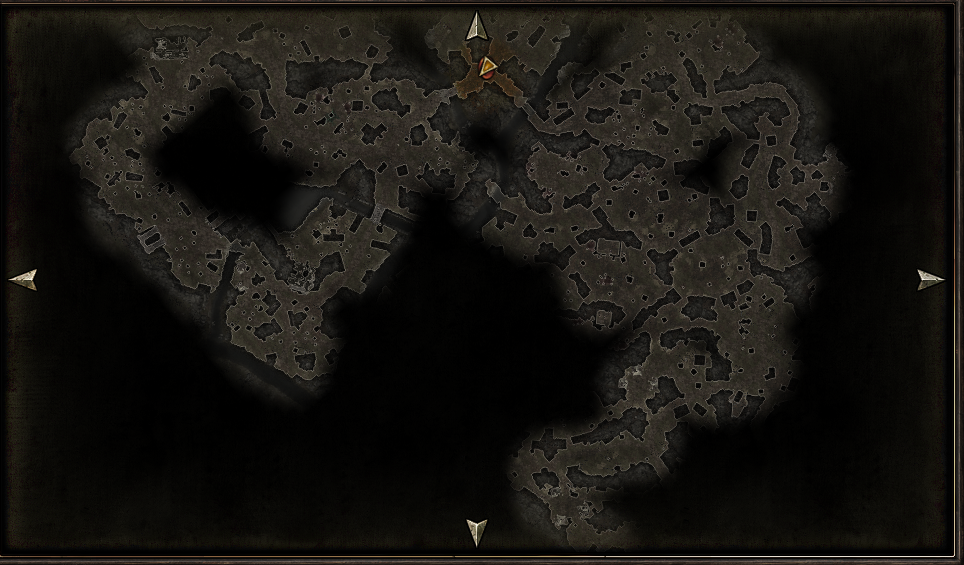
Also, in terms of finding things, the maps are large, confusing, and generally janky messes. Sometimes if you click somewhere, you will be autopathed to where you need to go! Sometimes, you will not.
A fully zoomed out view of Blood Groves.
Maps cannot be overlaid on top of the game screen unlike in many other ARPG’s, adding to the difficultly of exploration. Instead, you’ll have to constantly open the map and check your location, or leave it open the middle of screen.
Finally, the GUI isn’t modifiable. Meaning that if you play on an Ultrawide, some HUD elements like pet health will be the in VERY far corner of the screen, but the map can’t be moved around and will always sit dead center.
None of this would be as big a problem, though, if you could move faster than molasses.
There’s also one other thing that prevents fast movement. Unlike Path of Exile or Diablo 3, there are no skills that offer mobility or movement in the base game.
This brings us to the other big thing that Grim Dawn doesn’t have: fun skills.
I wanted to try to make a summoner build, as I usually play Necromancers in ARPG’s. I do this so I can live out my deepest, darkest fantasy: being in upper management. I come up with high level strategic objectives (murder people for loot) and delegate responsibilities to my HMZ (highly mobile zombies) to fulfill them.
So how did that work in Grim Dawn? Pretty unimpressively.
I got through Grim Dawn on Veteran Normal difficulty using a total of 7 skills. Skills 1-3 summoned pets, but only one pet each, so I would just cast them each time my other pets died. Skill 4 was an aura, so I would toggle it on and forget about it. Skill 5 was a temporary buff, that I would just activate every 30 seconds or so, and skill 6 was a small orb that did poison in an AOE. Skill 7 was a swarming dot/right click skill.
But for those who are counting, there are only 2 skills I would use actively: the poison orb, and the buff. And only one of those had to be aimed.
By the end of the game, my character was less entertaining and satisfying to play than pretty much any Dota 2 hero or any build I’ve done in PoE. The skills just felt bad.
This led to a bunch of my other problems. Trying to find specific key locations or waypoints when you have to slog through tons of bad combat is annoying. Every boss fight being the same “poke, walk away, poke” for 3 minutes is annoying and boring. Speaking of which: what’s up with every boss fight (except 2) just being a dude in armor?
Also, this is the first ARPG I’ve ever played where I was enviously looking at the NPC’s and going “Wow, that skill seems fun, or at least more useful. Wish I could use that!”
Some Other Nitpicks
These are all minor, and frankly, they’re all the sorts of things that I would overlook if I had fun with the game. But I didn’t, so let’s complain!
Nobody has ever enjoyed back tracking to turn in quests. Lost Ark solved this for ARPG’s, and the solution very simple. I pickup the quest in Area A, Go to Area B, and when I finish, I turn in at Area C, the area I’m going to next. Stop making me backtrack.
Also, the quests!
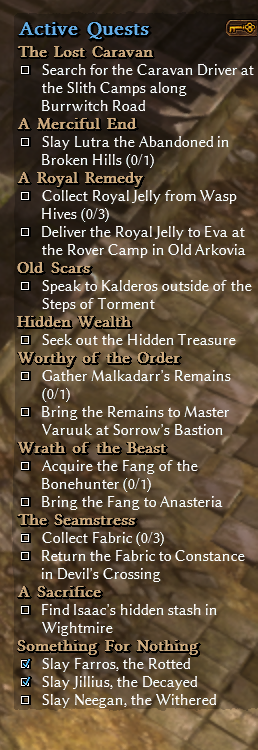
These were all the quests I had unfinished by the end of the game.
I think that Grim Dawn is trying to do a thing where you have to really read the dialogue of each quest, and then carefully do it. This would be interesting if quests were ever anything more than “Kill the Dude” or “Find The Obtusely Hidden Thing.” But it means that if you don’t remember exactly what that quest giver said, good luck. Also the rewards are pretty shit, and you can’t hide individual quests on the UI.
By the final 75% of the game, I just stopped picking them up all together, mostly because I didn’t care about these people or the story.
Which brings us to the story. I think the story of Grim Dawn is trying to be all spooky and grimdark. It mostly fails. There’s only so many times a poor survivor can be all “Please, find my family/pet/Jays” and then you get there and they’re killed/eaten/creased before I stop caring.
Also, there’s some sort of “Actions have consequences” system, but I want to stress something: I don’t know who gives a shit about actions/morality in an ARPG. Presumably the same person who thought I’d read all that quest text. Most ARPG players I know would kill every NPC in the starting zone for a 5% item quantity boost. 5% exp boost? You bet your ass I’m decking Deckard Cain.
The story is also unsatisfying! You start out fighting monster group A, and then it turns out that monster group B is also here, and you have to stop their evil plans. And then you fail, and have to kill their resurrected god instead. So you do, but then the world is still shit. PoE didn’t have the greatest story in the world, but at least after you completed the story mode, there was a single map where everyone throws a great big party. (Also, Kitava’s head goes in the middle of table like a gorey centerpiece, which I’ve always enjoyed.)
Also, the enemies are boring. There are like 5 of them, and most of the bosses are just dude in armor, or a tentacle thing. There’s a whole section near the end of the game where you find a bunch of ruined pre-industrial tank things that have been tipped over and destroyed. For a moment you’ll be like “Oh, are we gonna have to fight one of those? Are we gonna ride one of those?” No, no we’re not. They’re just there to build ambiance.
In Conclusion
Back when I played PoE, sometimes after grinding for several hours, or trying to power through the game’s campaign to get to the rest of the game, I would reach a sort of fugue state. I would get tired, drained, lose interest, and feel like my brain was melting out of my ears.
Grim Dawn managed to make feel like this before the first boss.
There were moments of amusement, or interest, but they were few and far between. And they were massively outweighed by the thoughts of “I could be playing PoE/D3/Don’t Die, Collect Loot instead of this.”
I am $12 poorer, and have 12 hours less life, but you dear reader need not make my mistake.
Grim Dawn is 50% off on Steam at time of writing, but you can save even more money by not buying it.
PS: It’s possible that some of the DLC solves the issues I have with this game. To which I say, if it makes the game not garbage, maybe just include it in the actual game.
I enjoy playing Friends Vs Friends. I don’t enjoy its progression structure for unlocks, and I will complain about that in a bit. One person I played with called it “Play-To-Win” which is very funny way of putting it, and also felt kind of accurate. But let’s start with the good stuff.
Genre
1v1/2v2 FPS
Recommend? Y/N
Yes.
Price
$10. Deluxe Ed $18. No IAP.
Platform
PC
Short Version
Best as a party game with friends. Progression systems are a bit annoying, but not a deal breaker.
Friends Vs Friends is a 1v1 and 2v2 first person shooter with a pleasant low-poly vibe. The goal is simple: kill the other player before they kill you to win a round. Win 3 rounds before they do to win the match.
So now it’s time for the twist.
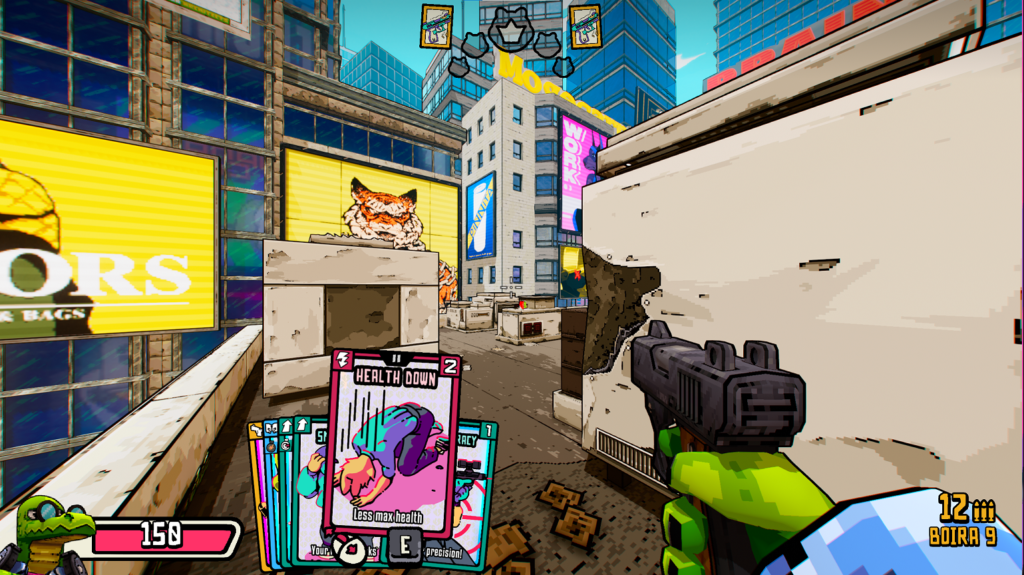
Before a game, you build a deck of cards. Using a card can give you a weapon or other equipment, buff you, debuff an opponent, or other wild and weird things.
Perhaps most importantly for the purpose of strategy, unused cards carry over between rounds, and it’s possible to see which cards the opponent uses. So if they pop a powerful weapon, give me a big head, and slow on me on me at the start of the round, I might decide it’s not even worth committing resources to try to win that round. Instead I might pool up cards, then try to push through on a future one.
The end result is a really fun blend of moment to moment resource management, and FPS skill. Time to kill is fairly high overall, with most weapons requiring a large number of hits. This is important because it gives you the time you need to decide what cards to use.
The most fun I’ve had with Friends Vs Friends is playing it as a sort of party game with 3-4 friends who I talked into getting it. It’s relatively easy to set up a private game, invite folks, and then just jump into it. Running around, yelling at each other, trash talking, and calling every single round winning clutch is great.
But some parts are not as great. So let’s talk about them.
Progression and other complaints
Deckbuilding in Friends Vs Friends is reliant on collecting cards. You buy card packs with a in-game earned currency. There are two types of card packs: basic and rare. Rare packs cost twice as much as the basic ones, and it feels like you earn currency pretty slowly.
The frustrating thing about the cards is that they use what I’ve come to think of as the “Clash of Clans” model. That’s the one where duplicates don’t give you more copies of the card to work with, they just upgrade the existing card’s power level. Which is not very fun, because it means duplicates of a rare card (instead of feeling special and improving your deck a lot) just give you a like 3% boost.
But that’s not the real problem. The real problem is quests.
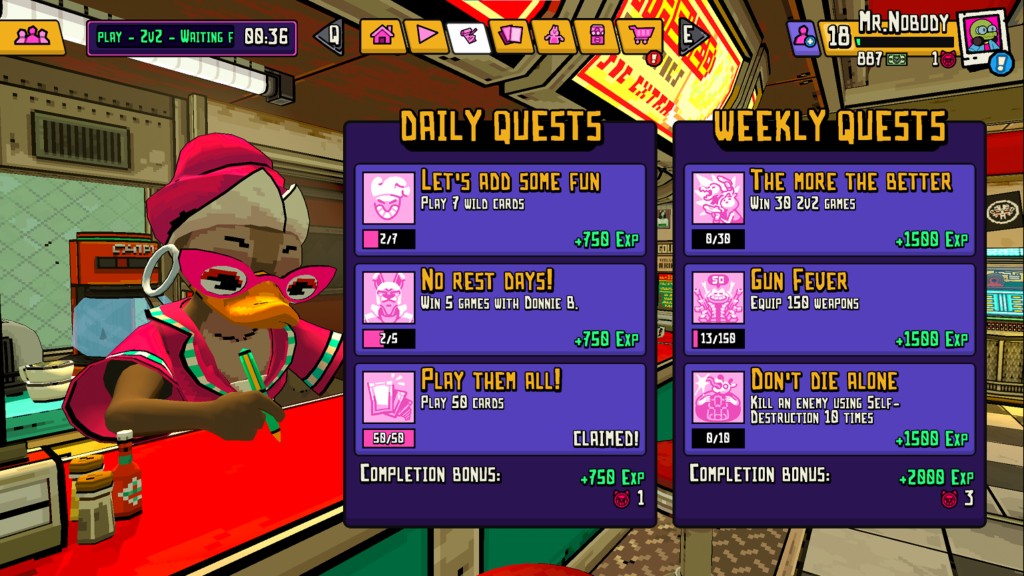
There are daily and weekly quests, because of course there are, and they give much larger amounts of EXP than just playing games. This would be fine, except for one thing.
You can’t complete these quests in games withfriends, or anything that isn’t random online matchmaking.
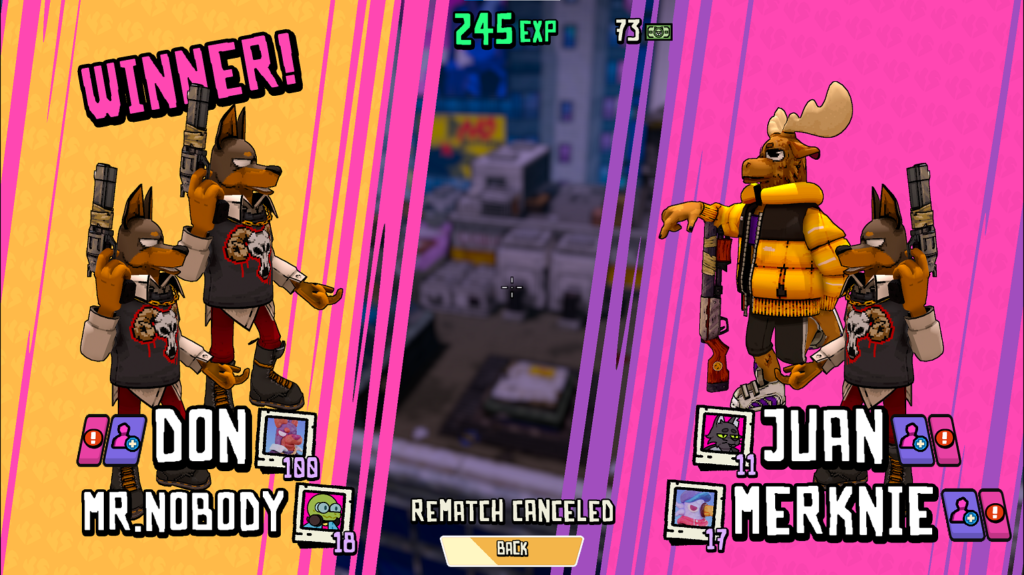
And the random online matchmaking, suffers from two really big issues. First of all, it’s very easy to just drop out of a match after a loss. So you can expect to see a lot of canceled rematches. This in turn means a fair amount of time spent waiting for the next match.
To be fair, I would also probably quit after losing a match to someone at progression level 100.
Secondly, it just isn’t quite as fun. The game is a lot more enjoyable with a group of friends shouting at each other over voice chat, and with the ability to make a fair set of 2v2’s by balancing teams.
But grinding online is the best way to unlock more cards and money to play with, and also the only way to unlock the in-game cosmetics.
So the weird end result is that the best way to play a game called Friends Vs Friends is, in fact, to not play it against your friends.
Overall
I like Friends Vs Friends. The gunplay is fun, and it feels fantastic as a group game. Unfortunately for my group of folks, it sort of got its lunch eaten by BattleBit in the FPS department. But we were having a good time with it before that.
It probably would have been better if the quests/progressions/unlocks didn’t work the way they did, or there was more capacity to really deckbuild. As it is, it’s fun, but the deckbuilding is never about building cool combos. Ultimately deckbuilding is just a “Stuff as much good stuff as you can” sort of vibe.
Overall thought, it’s good! I just wish there was a bit more to it, and some tweaks to a few systems because it could have been great.
I moved recently, and work has been incredibly busy. So instead of a full review, I want to talk a bit about something that’s been on my mind recently: myself!
I’ll be honest, this was a post about why I have difficultly recommending live service games, but after getting 8 paragraphs in, I realized it had turned into something else. First though, a story.
I was at a board game playtesting event recently where I had just played a large game in an early prototype stage. We were discussing the game’s strategies and elements. Mentioning that I felt the strategies were fair because we all ended with around the same number of points, another person at the table stated that was a bad way of looking at things.
Then that person stated that perhaps I couldn’t understand this because I wasn’t a game designer. I’ll be honest, that made me more than a bit angry. But this wasn’t my space, and also even if I think they could have been a bit less antagonistic with that statement, they were correct.
But it does raise an interesting question. What exactly is my relationship to games?
If I had to choose, I think I’d use the word “Hyper-Enthusiast.” I’m not designer. A few mods, small projects, and an internship do not a designer make. I’m not really a journalist. Yes, I run this blog, but I have no training in it, and I do very few interviews or investigative content. And the term “Aspiring Influencer” makes it sound like I sell protein shakes for $50 a bottle on TikTok.
I would certainly like to have a large audience! But my experiments with modifying the sorts of things I make and how I write are mostly constrained to my YouTube channel. I’m not interested in changing this blog to appeal to more people.
So, going back to how I’d label myself. “Hyper-Enthusiast.” Why don’t I just say gamer?
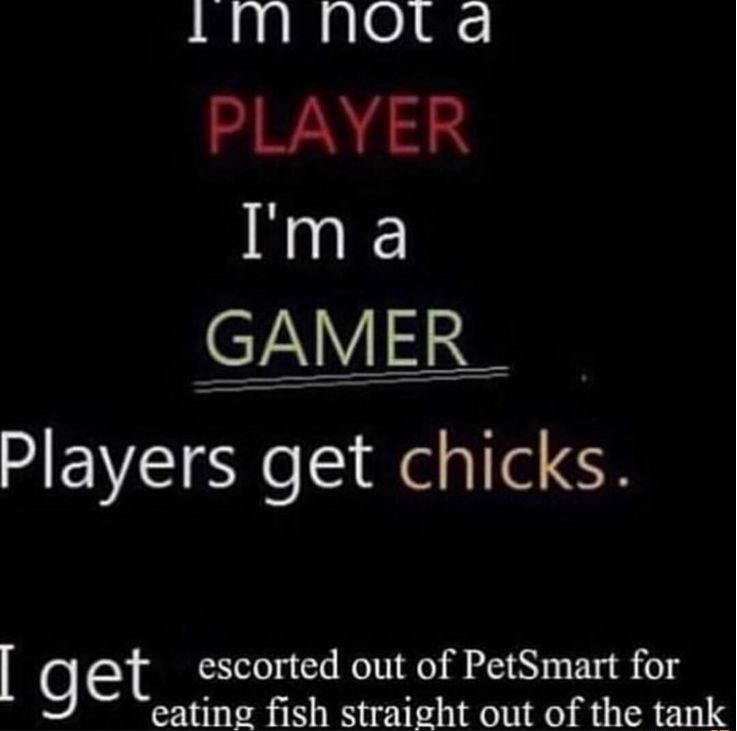
Partly because of shit like this. Partly because Gamer Gate changed the word gamer at least a bit to mean “someone who hates women and minorities” instead of “person who likes games.” It also changed “ethics in games journalism” into “someone who hates women and minorities.” Which is unfortunate, because it is something I care about in the non-dogwhistle sense, but I’m about 8 years late on all of that, so whatever.
But mostly because I view myself as a hyper-enthusiast because I will do a lot of things, and put up with a lot of shit that I don’t think most people will. Even game designers.
I will put up with a lot of garbage in search of novelty.
I don’t actually know anyone else like this.
Okay, so you’ve talked about yourself for too much time. Why does this matter?
So this post was going to be a writeup on the difficulty of recommending live service games. There are bunch of parts to my dislike of those games. For one, a live service game changes over time, and by the time you, dear reader, get around to it, it might be completely different than what I played. Or it might just have died!
But there’s a second somewhat more insidious reason, and it’s the real reason that this writeup was just me talking about myself.
A lot of people I know have maybe one or two games that they play at any point in time. They might have a permanent lifestyle game, something like Rocket League, Dead by Daylight, Team Fight Tactics, Apex Legends, PoE, Magic: The Gathering or Dota 2.
Then they might have a second game that they are actively playing through, usually something single player, or maybe a single indie game.
I consume games differently. I also consume games at a somewhat higher pace. And when it comes to live service games, or games with an “infinite” endgame, I generally move on from them fairly quickly when I get bored, or find something more interesting.
And I think this makes be a bad source of information on some lifestyle and live service games. Because I don’t play them in a way that much of their player base is going to interact with them. I will not play them for 100, or 1000 hours. I will play 40 hours, and then I will move onto next week’s game.
Instead of playing one lifestyle game and one other game at a time, I consume games 3-4 at a time. It looks like this.
Type 1 – Space Fillers/Social Games – These are the games I always come back to when I don’t have anything else, or I don’t have effort to engage with more interesting things, or they’re games I play almost exclusively in their base form with other people. Mostly just Magic and Dota 2.
Type 2 – Active Games – These are whatever games I’ve currently picked up and roped people into playing with me. They’ll get played above type 1 games. Right now, they include InkBound, Battle Bit, and Deceive Inc. And it sort of was Friends vs Friends for a bit. More on that in a writeup shortly.
Type 3 – Good One Time Experiences – Any game that I’m enjoying/excited about goes here. If I don’t have anyone to play with, I’m likely to play these. But eventually I finish them, and I don’t usually go back. I actually don’t have anything in this category at the moment, because….
Type 4 – Forced Engagement – These are all the games I’m playing out of some form of either obligation or investigation. Critically, these are not necessarily games I’m actually having fun playing. Some of these I have played out of semi-contractual obligation. coughCatchTheFoxcough. Right now this category includes GrimGrimoire (I want to love it, but RTS + controllers is not a great match) and Rain World. (I promised a friend I finished it, but holy shit, Alien Isolation was less terrifying.)
So, now that we have all this garbage, lets go make an actual point.
Okay, so back to the live service thing. Again.
Ultimately, I prize novelty and interesting interactions very highly. I am willing overlook frustrations or flaws that might annoy other people. And because I go through such a high number of games, perhaps never achieving some deep mastery or skill, I don’t really get worn down by small tedious things, or issues that only become apparent at high level play.
And for single player games, that’s fine! But it gives a very specific perspective for games that are in some ways intended to played on and off forever. And it also means that I annoy my friends when I nag them to buy a game for $20, play it every day for a week with them, and then never touch it again.
Anyway, this whole thing ended up being a bit disconnected and rambly, but hey, I’m a bit tired, and I wanted to write something this week. So hopefully you got some value out of it, and if you didn’t, more to come on a Friends vs Friends writeup shortly.
Deceive Inc is out. This game’s been on my watch list for a while, mostly based off playing the demo a while back. I’ve managed to rack up 30 hours so far, and I’m ready to give my thoughts. I do like Deceive Inc, and I recommend it. BUT.
In what feels very appropriate, I don’t think Deceive Inc is actually the stealth game it might first appear to be. Or, at least, it’s not quite a stealth game at its core. So let’s talk about that.
Deceive Inc’s Deception
Deceive Inc falls into a lot of genres. It’s a multiplayer stealth action game with battle royale and hero shooter elements.
However, it’s the shooter part that I really want to focus on. The shooting is the most important game mechanic underpinning everything else in Deceive Inc. It’s not what you’ll be spending most of your time doing, necessarily, but it is required for victory. Which brings me to my one big point: if you do not like first person shooters, you will not like Deceive Inc.
If you do enjoy first person shooters, though, you will find this one of the most interesting and unique takes on the battle royale genre that’s been done so far.
More on that later. For now, let’s talk about the general flow of a game of Deceive Inc. Players take the role of spies infiltrating one of several expansive maps, attempting to escape with a briefcase, while avoiding being killed by NPC guards and other players.
I won’t be talking about the AI guards much from here on out. They serve the same purpose as AI in Hunt: Showdown. They’re not actually much of a threat except that drawing their attention them will alert other players to your presence.
Note: Between when I started writing this, and it getting put up on the blog, Deceive Inc has added a new class of NPC called the Elite Guard who are noticeably more lethal. Still not a threat on their own, but absolutely can become a problem in larger firefights.
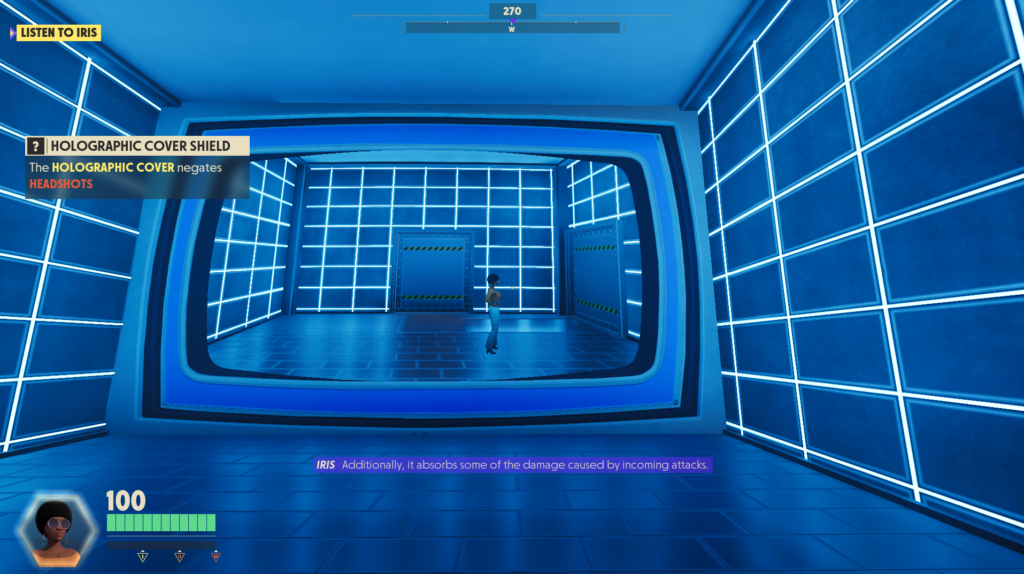
Fortunately, avoiding the NPC guards is incredibly easy. Deceive Inc has a disguise system called cover. Cover lets a player copy the appearance of any character they can see and stand next to. As long as you have cover that matches the appropriate area, guards will never shoot you.
Author Note: The actual functionality for cover is incredibly interesting. The character other players see doesn’t actually mimic your movement 100%. Instead, it just faces the direction you last moved. This means that you can look around wildly without giving yourself away as a human player. You can also walk backwards to watch behind you, while giving the impression you’re looking in the direction you’re moving.
Cover is broken when you shoot or get shot enough, or if you’re seen for too long in a forbidden area. For example, a staff member cover won’t last long in a guard area.
Deceive Inc absolutely nails the 70’s spy aesthetic. Every map and character feels like they just stepped out of a portal from the James Bond or Austin Powers movies. There’s a fun but not overwhelming retro-tech theme, and the sound effects and music fit incredibly well. (Casino map when Sweat Bandits?)
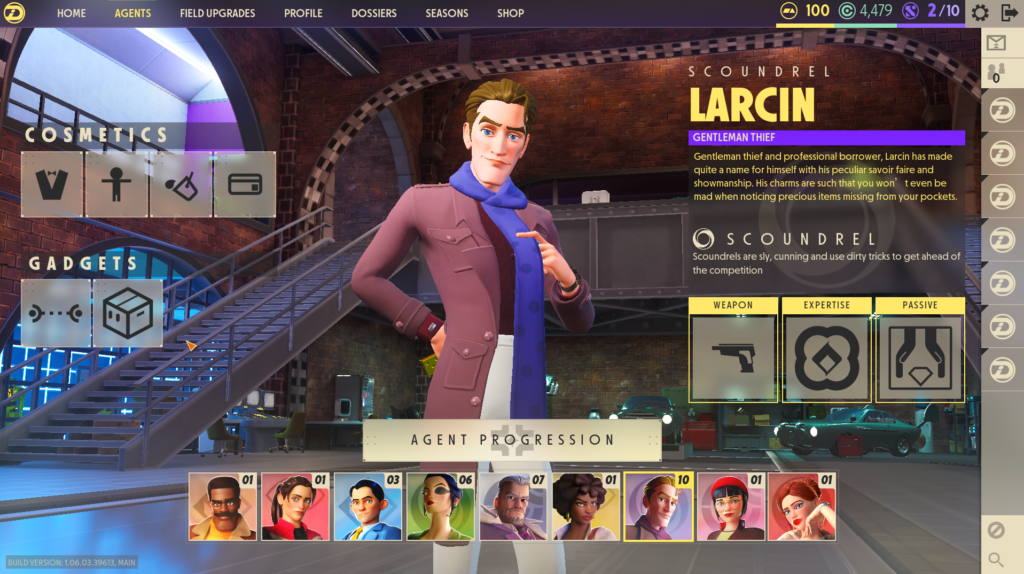
My personal favorite, Larcin.
The gunplay is solid, if a bit unusual compared to many other shooters. Time to kill is fairly high, and takes some getting used to. So do some of the behaviors around aiming. Each character also only has a single gun. But in the long run, the biggest difference from most shooters are the activated abilities.
Deceive Inc also has one of the best respawn mechanics that I’ve ever seen in a battle royale. There’s no respawn or bleed out. Instead, downed teammates can always be revived as long as they don’t leave the game. The catch is that each respawn brings them back with lower and lower max health. This rewards quick pickoffs and disengaging, but it’s still always possible to stage a comeback.
The spy and sneaking mechanics are fun and flavorful. Unfortunately, for reasons I wrote about in another post, really trying to blend in and be stealthy isn’t quite the best way to play the game. Even so, the sneaking absolutely sell the fantasy of being the high tech secret agent. The devs have indicated that they’re trying to make the game be a bit more punishing of run and gun, and have released patches to encourage that, so we’ll see how it goes in the long run.
Friction Points and Annoyances
In-game, I have very few annoyances with Deceive Inc. That said, I would really like to be able to see kill replays, and would love to see damage breakdowns upon death. Even after playing for 25 hours, I still often don’t understand how I was spotted out and killed. This makes learning really hard.
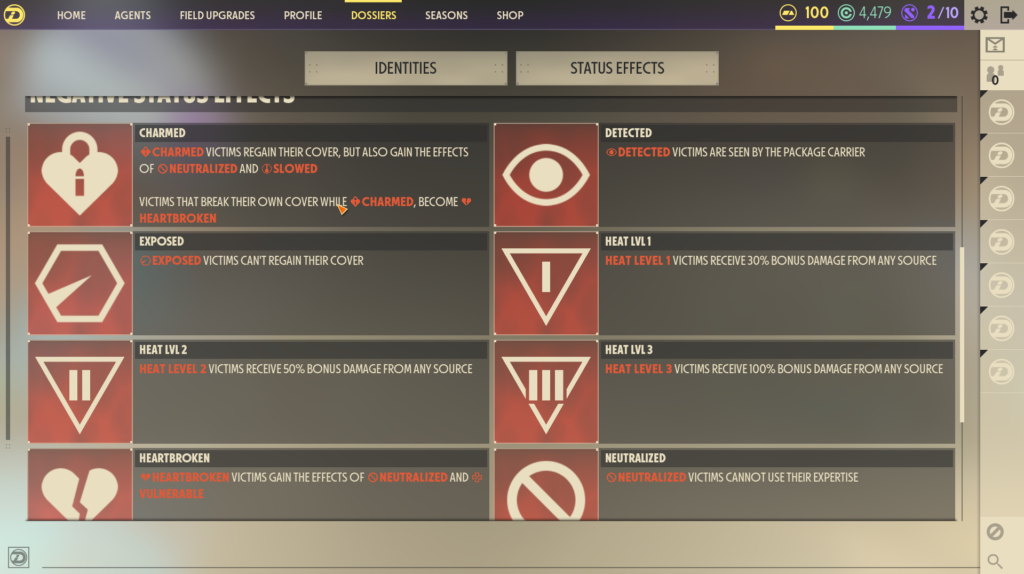
In addition, there are a bunch of small things in Deceive Inc that aren’t explained super well. These include various status effects, debuffs, and how specific weapons work. The information is present in the game, but it’s just not super easily exposed. The most recent update added a glossary which I like, but it could still do a bit more.
Out of the actual gameplay, I have one big complaint, and a few minor ones. The biggest complaint is the matchmaking.
The matchmaking is bad.
I recognize that a small player base leads to tradeoffs in order to keep queue time down. That said, getting matched into someone who has played 15 times as much as me feels bad. Getting matched into a whole team of players with that much time played felt even worse. The lack of death breakdowns and kill replays means it’s not possible to even learn from this kind of absolute butchery.
Also, I don’t love that in a game I already paid $20 for, there’s a battle pass on release. Blah blah, server expenses, blah blah, live service. But look. I already gave you $20. C’mon.
Conclusions
Do I recommend Deceive Inc? As long as you enjoy first person shooting mechanics, yes.
Everyone I’ve played this game with so far has enjoyed it, and played more with me, which is ridiculously high bar all things considered. It definitely has pain points, and bunch of unique mechanics that can make it a bit difficult to learn, but I’ve never played anything quite like it.