A few months ago I mentioned in my Granite Games Summit writeup that one of my favorite prototypes at the event was a deck builder with a working title of “Cubism.” I also noted that I didn’t really want to write about it while it was still in the prototype stage.
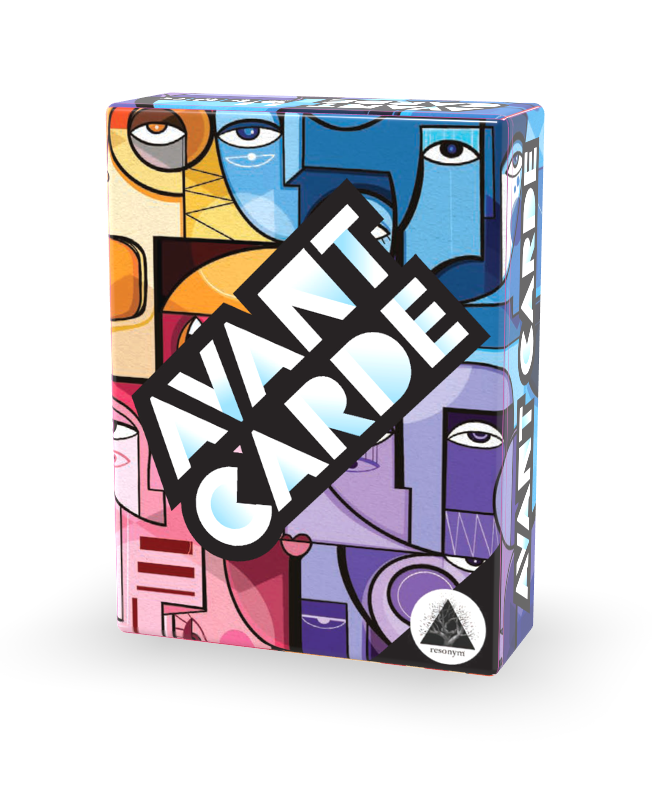
It’s been a while since then, but I’m happy to note that this week I can finally talk about that prototype. Mostly because it’s no longer a prototype, and it has a new final name: Avant Carde.
Avant Carde is a deck builder where players take on the role of collectors organizing shows of their artwork to score awards.
If you’ve played a traditional deck builder, you’re likely familiar with a lot of the base components of the genre. Players are given a (weak) starting deck that they make more powerful over time by using it to generate resources, and purchase additional cards to be added to the deck.
Where Avant Carde innovates, though, is in how it handles playing cards during a players turn, and also its scoring and buying system.
In something like Dominion or Clank, any card can be played in any order, though there might be advantages to doing things a certain way. Avant Carde is different.
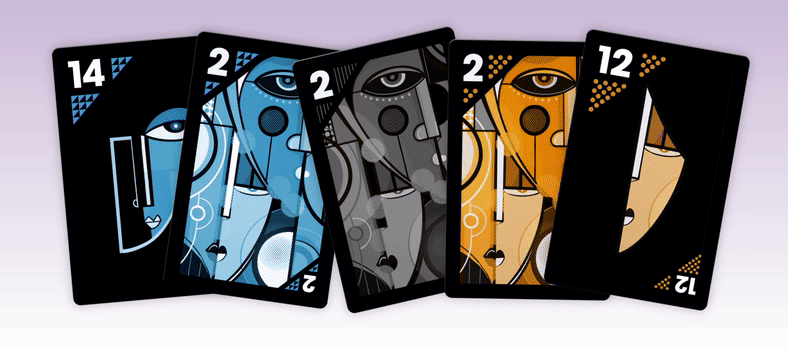
Avant Carde has a something more akin to an Uno style chaining system. Once a player plays a card for their turn, the next card they play has to match the previous card in either color or number to continue the chain. At the end, they count up the number of cards in the chain, and any other abilities those cards might have, and that number is the amount of money they have to buy with.
This chain, for example, would generate 5 money for the player.
This leads to a really interesting balance where the more expensive and powerful cards can end up being a bit riskier to play if they aren’t in a color that you’re collecting.
Avant Card also has some interesting changes in how it handles the buying area. Unlike Ascension, where a limited pool of cards are available at any point in time, or Dominion, where everything is always available, Avant Carde splits the difference in a pretty fascinating way.
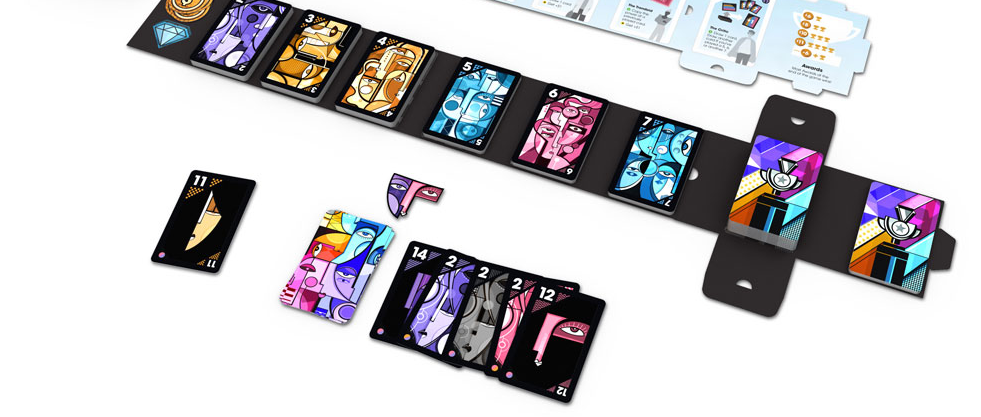
Another neat thing: The abilities in Avant Carde aren’t on the cards in your deck. Instead they’re on the cards you lay out above the buy row! This means you can change all of the cards’ abilities by just swapping out 6 cards.
You’re collecting cards numbered 2-7. Every number is always available, but the stack of cards for each number only ever has the top card flipped up and visible. And since the numbers come in different colors, even if you have the money to buy a high-cost card, it may not make sense to actually buy it if it’s completely off color, and would be hard to include in your future chain.
As tempting as that 5 might be, splashing into blue to play it could be difficult.
I’ve really enjoyed Avant Carde. It’s one of the few prototypes that I wanted to play every time I saw it over the last few months. I’m even more excited to see the final game. It’s a fascinating deck builder with some really neat mechanical innovations in the genre.
If any of this sounds cool, Resonym is currently running a Kickstarter for the game that you can check out.
Disclaimer: I am friends with the designers at Resonym, which is how I ended up playtesting it, but it’s honestly the best Resonym game I’ve played
I enjoy playing Friends Vs Friends. I don’t enjoy its progression structure for unlocks, and I will complain about that in a bit. One person I played with called it “Play-To-Win” which is very funny way of putting it, and also felt kind of accurate. But let’s start with the good stuff.
Genre
1v1/2v2 FPS
Recommend? Y/N
Yes.
Price
$10. Deluxe Ed $18. No IAP.
Platform
PC
Short Version
Best as a party game with friends. Progression systems are a bit annoying, but not a deal breaker.
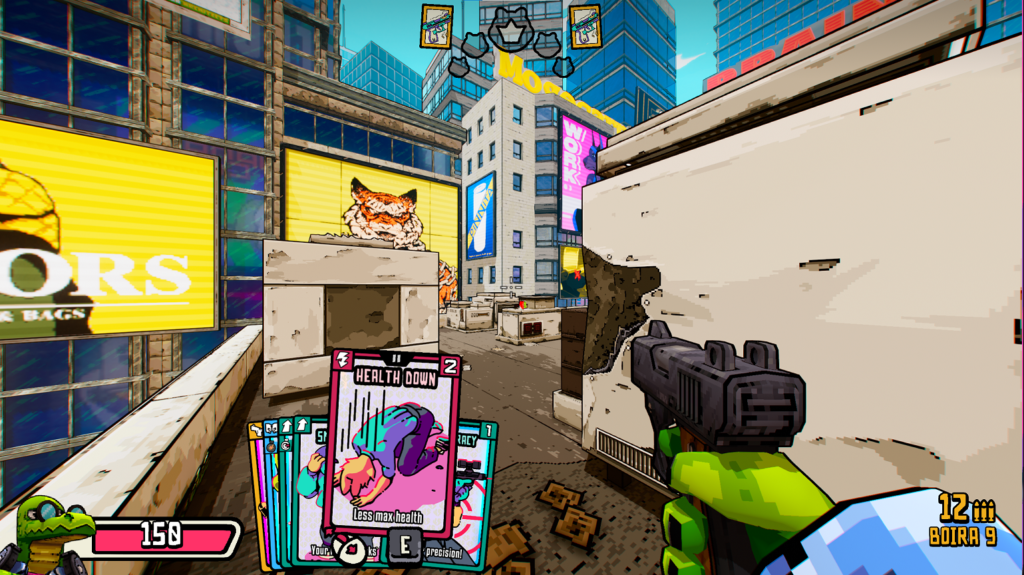
Friends Vs Friends is a 1v1 and 2v2 first person shooter with a pleasant low-poly vibe. The goal is simple: kill the other player before they kill you to win a round. Win 3 rounds before they do to win the match.
So now it’s time for the twist.
Before a game, you build a deck of cards. Using a card can give you a weapon or other equipment, buff you, debuff an opponent, or other wild and weird things.
Perhaps most importantly for the purpose of strategy, unused cards carry over between rounds, and it’s possible to see which cards the opponent uses. So if they pop a powerful weapon, give me a big head, and slow on me on me at the start of the round, I might decide it’s not even worth committing resources to try to win that round. Instead I might pool up cards, then try to push through on a future one.
The end result is a really fun blend of moment to moment resource management, and FPS skill. Time to kill is fairly high overall, with most weapons requiring a large number of hits. This is important because it gives you the time you need to decide what cards to use.
The most fun I’ve had with Friends Vs Friends is playing it as a sort of party game with 3-4 friends who I talked into getting it. It’s relatively easy to set up a private game, invite folks, and then just jump into it. Running around, yelling at each other, trash talking, and calling every single round winning clutch is great.
But some parts are not as great. So let’s talk about them.
Progression and other complaints
Deckbuilding in Friends Vs Friends is reliant on collecting cards. You buy card packs with a in-game earned currency. There are two types of card packs: basic and rare. Rare packs cost twice as much as the basic ones, and it feels like you earn currency pretty slowly.
The frustrating thing about the cards is that they use what I’ve come to think of as the “Clash of Clans” model. That’s the one where duplicates don’t give you more copies of the card to work with, they just upgrade the existing card’s power level. Which is not very fun, because it means duplicates of a rare card (instead of feeling special and improving your deck a lot) just give you a like 3% boost.
But that’s not the real problem. The real problem is quests.
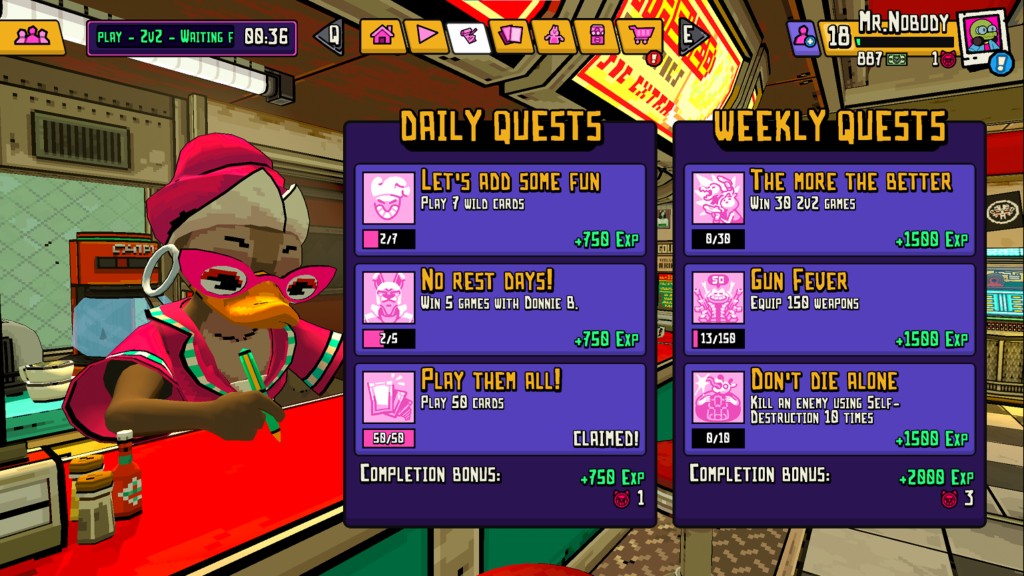
There are daily and weekly quests, because of course there are, and they give much larger amounts of EXP than just playing games. This would be fine, except for one thing.
You can’t complete these quests in games withfriends, or anything that isn’t random online matchmaking.
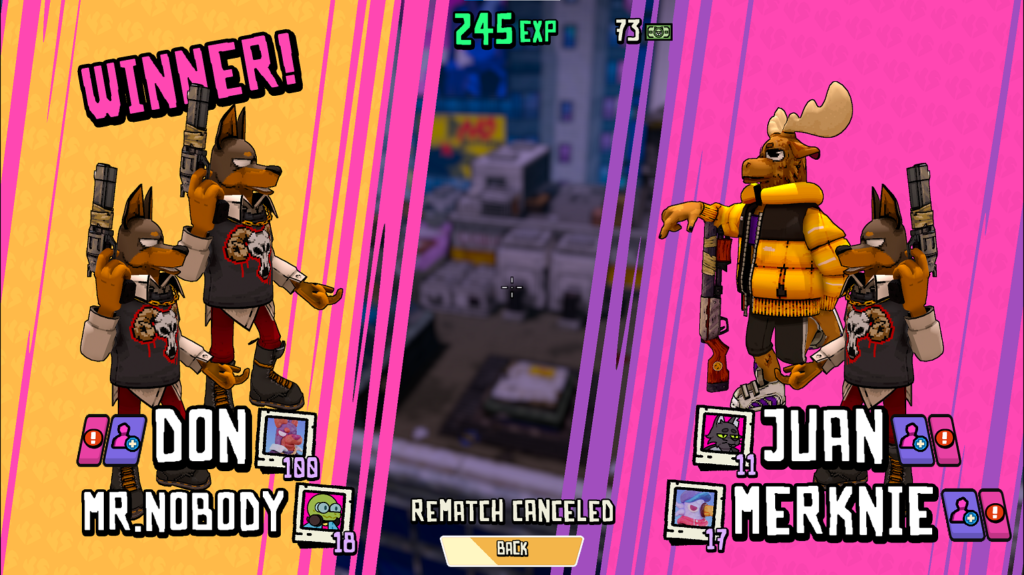
And the random online matchmaking, suffers from two really big issues. First of all, it’s very easy to just drop out of a match after a loss. So you can expect to see a lot of canceled rematches. This in turn means a fair amount of time spent waiting for the next match.
To be fair, I would also probably quit after losing a match to someone at progression level 100.
Secondly, it just isn’t quite as fun. The game is a lot more enjoyable with a group of friends shouting at each other over voice chat, and with the ability to make a fair set of 2v2’s by balancing teams.
But grinding online is the best way to unlock more cards and money to play with, and also the only way to unlock the in-game cosmetics.
So the weird end result is that the best way to play a game called Friends Vs Friends is, in fact, to not play it against your friends.
Overall
I like Friends Vs Friends. The gunplay is fun, and it feels fantastic as a group game. Unfortunately for my group of folks, it sort of got its lunch eaten by BattleBit in the FPS department. But we were having a good time with it before that.
It probably would have been better if the quests/progressions/unlocks didn’t work the way they did, or there was more capacity to really deckbuild. As it is, it’s fun, but the deckbuilding is never about building cool combos. Ultimately deckbuilding is just a “Stuff as much good stuff as you can” sort of vibe.
Overall thought, it’s good! I just wish there was a bit more to it, and some tweaks to a few systems because it could have been great.
Grotto Beasts is an entertaining TCG with a really clever resource system that I haven’t seen used before. It’s good fun. But at the end of this writeup, I’m not going to recommend buying it. I absolutely recommend playing it! Just… not spending money on it. But we’ll get to that.
The most unique part of Grotto Beasts to me is the resource system. It’s very interesting and not particularly complex, but it is very different from anything I’ve seen in a TCG, so I want to go over it in detail first.
Grotto Beasts’ Resource System
Every card card in the game has a cost. To “play” a card, you have to pay its cost, which you do by placing cards facedown into a zone called the summoning pool. The summoning pool cannot be rearranged, and is not a discard pile/graveyard.
Here’s the neat part: whenever an opponent plays a card, you draw cards equal to the cost of that card from your summoning pool. If you didn’t have enough cards in your pool, you continue drawing from your deck..
In addition, except for the first card you play each turn, you cannot play cards if your opponent’s summoning pool is empty.
I found that in the games I played, this led to a bunch of really interesting decisions about what cards to use to pay various costs, and how to order them into the summoning pool. A heavy cost card might be useless now, but placing it at the very bottom makes it hard to get back. Likewise, it gives the game a sort of tempo pace. Dropping a high cost card into your opponent lets them draw a fair number of cards back, and can give them the answers they need to deal with it.
The Rest of the Systems
The rest of Grotto Beasts’ systems are functional and fun, if not as fascinating. Combat is similar to Magic, where all attackers attack at once. Unlike Magic, attack values are summed, and then defense values are summed. Each player chooses how to allocate damage across the enemy line. Cards only have one stat for combat, Power, so it’s fairly easy to keep track of what’s what.
Damage that isn’t blocked goes through, and when it does, the player who did the damage banishes cards off the top of their deck into a score pile, somewhat akin to Pokemon’s prize card system. These cards can’t be looked at, and the first player to get 10 prizes wins. There are also cards that can generate prizes with their effects.
The Good, the Bad, and the Jerma
The Good
For all intents and purposes, this card game was created as Twitch streamer merch. That said, the game itself is strong, generally fun to play, and has interesting and unique systems. I have no real complaints about the mechanical structure of the game, and it’s much better quality then what I would expect for a tie-in product. God we live in a weird world.
Ed Note: As far as I can tell based on the rulebooks, while a wide number of people contributed to this project, only one person is specifically credited with the game’s design: J. Evan Raitt.
One big thing that I really appreciate about the design is that outside of a single six sided die, it doesn’t require any external components or trackers for things like health, counters, or life. It also doesn’t have a complex zone setup system. I mention this mostly because it’s one of my pet peeves with Nostalgix.
The Bad
But while I don’t have complaints about the game’s design structure, I do have two incredibly large bones to pick with some of the specific designs. First, the starter decks. There are two starters decks, and they felt extremely unevenly matched.
One is called Super Luck, and it’s mechanically themed around coin flips and luck. It offers cards that increase the payoffs of winning coin flips, with some ability manipulate those flips. It has a consistent identity and strategy.
The other is called Lot O’ Grottos. It feels much weaker for a variety of reasons. First, the grottos themselves are primarily a defensive tool for the deck, and some provide search and discard pile recursing. But the deck’s stat lines on its creatures are incredibly low. One of the “tricks” the decks has is a 4 drop card that lets you sacrifice creatures at the start of a turn to get a card that costs one more. Except while the deck has two copies of a card that costs 6, it has no card that costs 5, and only two cards that cost 4. That means it’s a card that turns 1 drops into two drops, which aren’t much stronger.
In addition, the Super Luck deck gets a card named Festive Mimic. It’s a 3 cost, 2 power card that has an effect that triggers when it’s played. Its effect is “Roll a die, then draw that many cards.”
Grottos gets a card named Bobbin. It’s 3 cost, 2 power card, that has an effect that triggers when played. Its effect is “Draw a card.”
This isn’t the greatest sin I’ve ever seen committed. I’m more sympathetic to a card game that prints a version of Swords to Plowshares than I am to one that prints the Power Nine (Looking at you, MetaZoo)
However, these are problems with the design of specific cards, not the core mechanics. I haven’t written about this specifically here, but the initial sets of Magic were kind of janky, and the initial sets of the Pokémon TCG led to a dumpster fire meta. A set TCG with some bad initial set design does not make a bad game.
The Jerma
Indie card games are my kryptonite. I will play one demo game of something I’ve never heard of before, and that will be enough to sell me on it. Show me something even mildly exciting, and I will be forking over cash for a booster box.
So why don’t I recommend Grotto Beasts? Ultimately, pricing and production quality.
The cost of cardboard is too damn high.
Grotto Beasts’ boosters are $10 a pop, while the 2P starter set is $80. The starter set contains 2 decks, and 2 boosters, making each deck come out to $30 for 40 cards. For comparison, the Pokémon starter sets retail at aprox $15-20 a deck, with the higher end comp/premium products going for $30.
These prices are high, which is unfortunate and might be tolerable except for one final thing: production quality.
The physical cards are kind of crap. After just three games, the cards themselves were showing scratches and scuffs on the edges. In addition to this, one of the cards I opened in the boosters was straight up missing any sort of finish on the front of the card.
I spent part of this weekend running a pre-release for the new Pokémon set with the same friend I played Grotto Beasts with. And we both agreed that the print quality of Grotto Beasts is much lower quality than current Pokémon cards.
In Conclusion
I absolutely recommend playing Grotto Beasts if you get a chance. While the game has a few mechanical issues, they’re nothing worse than the very first set of any other TCG.
But the sky-high pricing and miserable production quality of the product means I just can’t recommend it, and I don’t plan on buying it, especially with the issue of the starter decks being incredibly unevenly matched.
If you love Jerma, and want to support the project, more out of the sort of tradeoff that we as humans make when we buy content creator merch, you can find the game here.
I, however, am NOT going to go to this website here with a list of all the Grotto Beasts cards and download the images. Then I am NOT going to put them into a big sheet, and I am NOT going to find a way to print them as make my own bootleg set of of the cards to play with.
Two interesting indie TCG’s from PAX Unplugged this year were Genesis and Gem Blenders. Here’s my general thoughts on the two.
TCGs are a complex subject. There’s the supply chain. There’s the fact that printing booster packs is expensive. There’s the fact that the space of trading card games has been dominated by the big three (Magic, Pokemon, Yu-Gi-Oh) for years on end. There’s an argument about whether or not these games are effectively lottery tickets with a better consolation prize. There’s the impacts that TCGs have on smaller game stores, and a billion other factors revolving around them. There’s the question how many lifestyle games the market can support.
I will be addressing exactly zero of these topics in this writeup. Instead, I’ll be looking at two indie TCGs I saw at PAX Unplugged: Genesis and Gem Blenders.
Genesis: Battle of Champions
Genesis is a 2-4 player independent TCG. Unlike many other TCGs I’ve played, Genesis is actually played on a board: a large 5×6 grid. Each player starts with a hero out, and you win by being the last hero standing.
Heroes define a few important elements of the game including your starting health, and also the cards and archetypes you can include in your deck. Unfortunately, I can’t speak to the deck construction or color archetypes as I only played one game of Genesis, and it was with preconstructed decks.
Anyway, back to the gameplay. There’s a few interesting things about Genesis that I want call out. First, you start with your full mana pool, and it doesn’t regenerate during the game. For example, my character started with about 125 mana, and was down to 10 by the time the game finished. This means that you can drop your most powerful cards on turn one if you wish.
Mana is the most common limitation in existing TCGs. But in Genesis, it felt like I was limited by cards in hand, and space on the board. Many of the monsters felt a bit fragile in the large scheme of things, usually taking only 2/3 hits to kill.
Two other things I want to mention. The game has a stack for resolving actions that was a little difficult to parse during my demo, but I’m sure would be fine once I got used to it, and direction matters. One of the primary things you do is rotate cards to face various directions, indicating where they can attack.
Overall, Genesis was interesting. I was curious enough to pick up some preconstructed decks, but that was primarily as samples to add to my board game collection. I’m not hugely in the market for another TCG at the moment, and I wouldn’t say I was really grabbed by the art or world building in my incredibly brief exposure to it.
If you want to learn more about the game, or find yourself curious, you can check it out here.
Gem Blenders
Most Indie TCGs tend to end up mimicking on of the big three in at least some small way. For most of them, this ends up being reminiscent of Magic’s land/non-land system. You have cards that generate resources, but are very hard to remove, and cards that are used to move toward your victory condition, but are easier to remove.
Gem Blenders flips that, and uses something that will probably be more familiar to players of the Pokemon TCG: You start with a set of 4 blenders out, and you put Gems onto them. Blenders can then “Blend” into higher tier blenders with better stats once they have the prerequisite gems attached to them.
Unlike Pokemon, Blenders don’t get knocked out, so the game is mostly about playing your gem per turn, and slowly trying to build advantageous board state. I also got crushed by the individual demoing it at the show. So it can join Mythic Mischief in that category.
The one other interesting thing to me was Gem Blenders’ action system. There’s no limit on the number of action cards you can play per turn, but you can only play a max of 5 total in a game.
Side note: It was interesting to me that both Gem Blenders and Genesis had these mechanics where you started with a full set of resources, and spent it as the game went on.
Gem Blenders was more appealing to me and I actually got a chance to sit down with the creator. We chatted for a bit about his longer term goals for Gem Blenders, what he sees as important for an indie TCG, and why he wants Gem Blenders to be a TCG in the first place.
It was a really interesting chat, and I hope to get a chance to transcribe it and put it up on the site. It’s been a busy last few months.
If you’re curious about Gem Blenders, and would like to learn more, you can find the game’s site here.
Wrap Up
Overall, I liked my limited time with Gem Blenders a bit more than Genesis. A large portion of that is just personal taste. I found Gem Blenders’ weird art style to be appealing, and I like games where I build up forces overall a bit more than games where I just shred stuff down.
I still think both of these are neat games, and I picked up starter sets for both. Will I play them as full TCGs? Unlikely. Magic and Pokemon already occupy most of my interest for the time being. But I’m happy to see some indie TCGs that really seem to be trying to be solid card games, and not FOMO messes.
I don’t have anything good to put in this opening paragraph. Maybe I should just talk about how good the food is in Philadelphia? It’s really tasty. Reading Terminal is delicious, even if PAX Unplugged does pack it to the brim. Even if it can take 40 minutes for someone to get you an egg and cheese on a roll.
Anyway, enough about sandwiches. Let’s talk about board games. Today I’ll be covering the board games at the show that are either adapted from, or licensed from video games. It’s an arbitrary category, but one with a fair number of entries. Also, interestingly enough, all of them are based off games I’ve played.
Shovel Knight: Dungeon Duels
I want to open this part of the writeup by noting that I love Shovel Knight the video game. I did a writeup on it where I said as much. Which makes it a bit hard to say the next bit.
Shovel Knight: Dungeon Duels feels like the literal definition of overproduced Kickstarter Ameritrash.
That’s kind of a bold claim, so let me make some observations to back it up. From a mechanical standpoint, the game is incredibly uninspired. The goal is to get the most victory points. You do this by defeating enemies, and clearing out a boss. This, in turn, is done by moving across a board.
You have three actions per turn: moving, attacking, and jumping. Of those actions, only moving doesn’t require you to roll dice. You can’t just move your way to victory, because the board is covered in spikes. You’ll need to roll to jump over those. And if you fail? Fall into a pit, and lose half your victory points. You want to attack something? Roll dice, and hope you get enough successes to do something valuable. Because if you don’t, you might die, and lose half of your victory points.
Should you manage to survive long enough to get to a shop tile, you can spend your victory points to buy a completely random upgrade. It could be +1 dice to all your rolls! It could be the ability to make ranged attacks. It could be a worse item for a slot you already have filled, because it’s a random draw from a deck. Upgrades are frequently utterly worthless and get thrown away immediately.
Of course, dying doesn’t knock you out of the game. You’ll get to replace your wonderfully crafted miniature at the start of the next round on the far side of the board. And that’s good, because aside from the aforementioned falling into pits by missing a jump, or just taking enough damage to die, you can also get pushed back into pits by enemies if they damage you.
Now, this can’t happen during the boss fight. Instead, if you get knocked off the board during a boss fight, your character goes prone, and has to spend an action to get back up. If you get unlucky, the boss can do this to you before you even get to take a turn. And yes, someone in my demo was on the receiving end of this.
These are all the mechanical reasons I have for calling Shovel Knight: Dungeon Duels “Ameritrash.” The game is incredibly random with a focus on dice rolls for resolving most meaningful interactions. You have minimal capacity to make meaningful choices around upgrading or building your character.
This game was Kickstarted. It has 44 miniatures. And they are very nice minis! I like these characters so much from playing the video games, that I was and am still tempted by them because of how much fun they would be to paint. But those minis are also probably a large portion of why this game costs $125. It has a 58 page rulebook, apparently? It has custom dice, and tokens, and lots of playable characters.
My personal verdict: cut down on the minis and include a fun game. Or even keep the minis and include a fun game! Or, scratch that, screw the game, just let me buy the minis from you directly. Because they’re the best part about what I played here.
SolForge Fusion
Continuing a trend of writing things that guarantee I will never end up on a press list for prerelease copies of anything, let’s talk about SolForge Fusion. Like with Dungeon Duels, I really liked SolForge Fusion’s parent game, SolForge. Also like with Dungeon Duels, I really don’t like SolForge Fusion. It’s for a very different set of reasons though, and to explain them, we need to talk about SolForge briefly.
Or perhaps it would be more accurate to talk about what SolForge was. You see, SolForge is dead. And unlike many games that I’ve written about in my end of year wrap-ups, SolForge didn’t really do anything to deserve to die. It just didn’t make enough money for the company to continue supporting it. Which honestly kind of sucks, because SolForge was one of the best digital CCG’s to exist.
The key word in that sentence, and the root of a lot of problems we’re going to be talking about, is “digital.” SolForge’s key mechanic was digital-only, and it worked like this: whenever you play a card, an upgraded version of the card is added to your discarded cards. When you run out of cards in your deck, you shuffle your discarded cards back into a new deck, and continue the game, now with some of your more powerful cards. It also had a reliance on triggered effects. Also damage and buffs on creatures didn’t wear off between turns.
All of these were good and interesting designs that worked well digitally. The computer could manage resolving triggered effects, tracking stats, and upgrading your cards. Because all of these were handled by the computer, games were quick, fun, and could allow for ridiculous numbers and scaling.
Perhaps you see where I am going with this.
Works great with a single digitally managed card. Works less great when it’s 3 physical cards that have to be swapped out.
You see, all of these mechanics technically could work in a paper card game. Each paper deck would need to have three times the cards, forcing you to keep track of which ones you played. And because damage and buffs don’t wear off, you’d have to have a billion tokens for keeping track of damage. And you’d need to manually track all triggered effects, and also manually resolve the full combat step for the board.
This is all technically possible in the same way that it is technically possible eat an entire card board box. You can do it, but I don’t know why you would, and it probably wouldn’t be a good time.
All of this is to say that SolForge Fusion is effectively a port of the aforementioned mechanics to tabletop. It’s not a straight port by any means, with many cards being heavily changed around, and the numbers having been rescaled a fair amount. But it’s still a port!
Anyway, as if this wasn’t funny enough, two days ago I got this in an email:
So yeah. They’re planning to make a digital version of a physical card game based off the mechanics off a digital game that was shut down for ultimately just… not really making enough money.
It would be cool if this went well, but I’m not exactly holding my breath. And again, the digital version doesn’t exist yet. Until a digital version exists, playing SolForge Fusion requires managing a set of decent mechanics that are fundamentally flawed in meat-space.
Storybook Brawl Unnamed Deckbuilder
I’ve debated whether to put Storybook Brawl’s unnamed deckbuilder here with the other video game adaptations, or with a later page on games I played in the Unpub hall. Ultimately I decided to place it here.
I’ve written about Storybook Brawl before, but you don’t need to read that writeup now. Unlike the other games on this list, this board game is its own game. It’s also in the rawest state, if the fact that it doesn’t even have a real name wasn’t enough of indicator.
Unlike Storybook Brawl, instead of building a set of characters that you play out onto a single large map, it’s much closer to a deck builder with simultaneous play competitive elements. And while it maintains some mechanics (such as the idea of tripling, and playing a single spell per turn), this unnamed deckbuilder mostly puts its own twists on the video game’s mechanics.
I wouldn’t say that I love this as-of-yet-unnamed game. But given that it’s still an alpha, there’s both time to improve and tweak things, and also to refine the game as a whole. Despite its flaws, Storybook Brawl’s unnamed deckbuilder is probably the most interesting of the three games on this list, despite not being a full game yet.
So in summary…
What have we learned today? Well, mostly that Panda Cult and Stone Blade Entertainment are incredibly unlikely to send me review copies for any reason whatsoever in the future. And the same is probably true for Storybook Brawl, if for no other reason than the fact that their parent company lost $16 billion dollars.
On a less sarcastic note, I think the main takeaway should be that if you’re going to adapt anything, it’s probably a better idea to try to work with the strengths of the target format than to just try to port things straight across.
More PAX Unplugged writeups in the week(s) to come! And in the meantime, why not follow us on Twitter, assuming it hasn’t burnt to the ground yet.