Holo Vs Robo – a Plants Vs Zombies inspired Hololive Fan Game

I tried to cook bacon this morning after removing 2-3 feet of snow from around my car. As a result, I type this in an apartment filled with an incredible sort of grey haze, like a small cloud of carcinogenic fog has decided to take a nap, sprawling from the kitchen toward the general living room space.

None of this has anything to do with Holo Vs Robo, but if at any point my thoughts wander a little too far, it’s probably from the smoke inhalation.

Anyway. Holo Vs Robo. It’s a Hololive themed Plants Vs Zombies clone. It’s a perfectly okay game, if a bit underwhelming currently in some areas. If you like Hololive, and never played Plants Vs Zombies, you’ll probably like this. If you don’t know what Hololive is, it’s a Japanese VTuber company, and if you don’t what VTubers are, you can either watch this video, or live in blissful ignorance.

On the other hand, apparently Plants Vs Zombies came out 16 years ago, back when I still had hope for the future, and joy in my heart, and given that it’s been turned from a lovely polished single game, to a franchise that included a class-based shooter (that I actually really liked) and a billion terrible mobile games, I figure it’s probably worth discussing the mechanics at least a little bit.

Gameplay

Overall, this is a Tower Defense game. If you’re not familar with the genre, it goes something like this: Waves of enemies spawn in, and you the player need to build structures to attack and stop them from reaching your base. When I call Holo Vs Robo a Plants Vs Zombies clone, it’s not because the two are both tower defense games, it’s because HvR pretty much lifts all of it’s mechanics wholesale from PvZ.

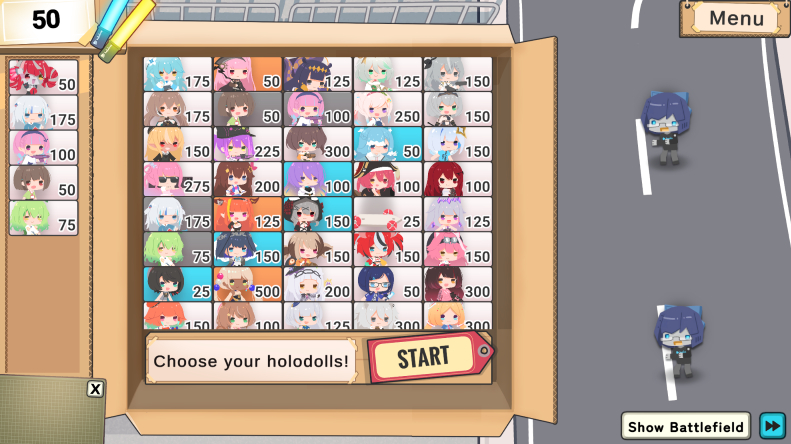
This includes things like the pre-battle screen. Here, you’ll select the up to 8 units you’ll be able to use in any given battle that you want to bring in, while on the right side of the screen being given a preview of the enemy types you’re going to face. Enemies start out as fairly simple robots, and evolve into fancier versions as the game goes on, most of which are some sort of Hololive callback or in-joke.
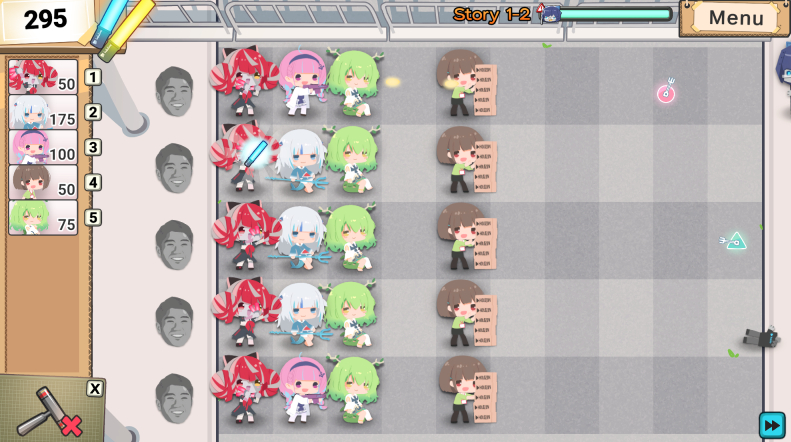
Once you’re in a level, you’ll spend Cheer (sun/money) to place down towers. Towers have a variety of properties, best demonstrated by going over the ones I have in the above image.

Furthest on the Left, we have Ollie, the red-haired one. Ollie doesn’t attack, but does generate additional Cheer to buy more towers. In the second lane from the left, we have Gura (White Hair/Blue Shirt) and Aqua (Pink Hair). Gura shoots bullets that travel down her lane, and the lane above and below her, while Aqua shoots fast weak attacks down the lane she’s placed in. The green one is Fauna, who heals towers in front of her, and the brown haired one is Nodoka, who acts as a wall.

So there’s your general list of tower behaviors: Generate resources, attack, heal, or generally serve as a wall.

You might notice that there’s no enemies actually visable on the screen, because they’re getting pretty much as fast as they spawn in, at least in this specific case.

There are some special robots, and a few levels that are a fair amount more challenging, but overall, this is not a very hard game. In my case, I found everything but the bonus content and sliding pannel levels to be pretty easy, taking about 11 hours total to do 90% of the games content.

Complaints and Praise

I don’t think Holo Vs Robo is a bad game, but that’s mostly because Plants Vs Zombies wasn’t a bad game. There are some things I am more tolerable of, and some which I am less tolerable of. There’s also a few things I quite like.

As a small thing, the menu options is a bit shit, and following a grand tradition of a certain types of games, I had to launch the game with custom unity flags to make it run on my ultrawide, something I’ve found myself doing a lot more then I’d like to as of late.

As a larger thing, the game doesn’t really do as much to solve the fundamental problem of tower defense games: Once you find a setup that works, you tend to just run that setup until it stops working. This was also a problem that Plants Vs Zombies had, but again: That game came out 16 years ago. While a few levels spice things up, there are still really limited options for Cheer generation, and many of the “good” units… just stay good throughout the entire game. As a result, I don’t really remember what I did during the last 10 levels prior to the finale.

I did really enjoy a lot of the bonus content. There’s some fun goofy little mini-games in addition to the story mode. The art for the little chibi Hololive members is pretty great.

Overall, I don’t really recomend Holo Vs Robo to non-Hololive fans at the moment. It’s a perfectly fine game, but so much of the humor and enjoyment here is based on knowing Hololive in-jokes, that I have to imagine it’ll feel a bit non-sequiter for anyone else.

For Hololive fans, if you’ve never played the original Plants Vs Zombies, this might not be a bad place to try it out. It’s $7.00 on Steam.

Side Note: As a Hololive fan, I was a bit bummed to discover that the Hololive member I follow (and whose on my computer case), Mori Calliope wasn’t available as a tower, but as one of the single use powerups, and IMO, the worst one in the game. It’s a not tragedy or anything, but I can imagine folks who discover their favorite member either isn’t available, or just kinda sucks being a little disappointed like I was. I wish the game did offer more ways to use each tower type. It’s a small thing, but something I did find myself thinking about.
Isle of Arrows

Isle of Arrows offers an interesting take on the tower defense genre, but a dependence on good RNG to survive pulls it down.

I don’t hate Isle of Arrows, but I can’t recommend it. It has a nice art style, and interesting core mechanics. But the reason the game took me 12 hours to beat is that randomness plays too heavy a factor. Having good runs is difficult, and having satisfying runs almost impossible.

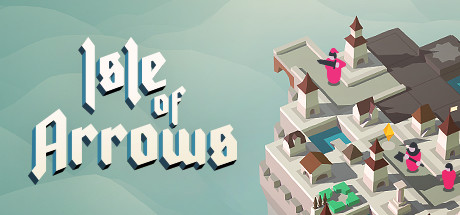
Very minor quibble: the situation present here in the game’s Steam banner can never happen in game. And now you will share in that suffering with me.

Isle of Arrows is a tower defense tile placement game. You start with a single pre-placed arrow tower, a few pre-placed road tiles, a bomb and a bridge.

Your job is to turn this.

Into something like this.

Game Mechanics and Systems

You have 4 resources: Life, Gold, Bridges, and Bombs. If enemies reach the tiny gold octahedron at the end of the route, you lose a life. Enemies themselves will always spawn on the last road tile on a path to your octahedron.

Gold is the only real spending resource. Each round, you’re given a tile for free that you can place. You can either place that tile, or skip it. Then you can spend 2 more gold to draw the next tile. Repeat until you’re out of gold. For example, if I had 10 gold, I could place my current tile, then advance choosing to place or skip up to 5 more tiles.

It’s important to note that you can only ever see the next single tile that you’ll draw. While enemies can drop gold, your primary source of gold is income. It’s almost interest: each round, you’ll get 1 gold, plus 1 more for each 10 gold you have stored. (Up to a max of +4 at 30 gold banked.)

The tiles you draw have placement requirements, though. Tiles must be connected to another tile you’ve already placed, they can’t overlap with existing structures, and they have to be placed on ground.

Which brings us to the last two resources: Bombs and Bridges. They both serve a similar purpose in allowing you to break some of the rules. Bombs can be spent to place a tile on an already existing tile, and bridges can be spent to allow you to build out into the air. While there are ways to get more bombs and bridges, there’s no way to guarantee it.

There are a few more tile types. There are roads that can be placed to expand the path to your shiny defense shape, and there are towers that can be placed to shoot enemies as they travel along the roads. There are also traps, which have some effects on enemies placed along the road, and non-combat tiles such as water that often come attached to other tiles. Finally, you can place economy tiles to generate resources, usually as a one time effect based on where you place them.

Isle of Arrows has a beautiful isometric look. It’s fun to watch your island expand! But Isle of Arrows has a big fundamental problem: the randomness.

The Problem

At its simplest, the problem boils down to a question of DPS. There’s no guarantee that you’ll draw enough towers with tiles to have enough damage to clear late game waves. But more importantly, there’s no guarantee you’ll see any specific tower. So it’s hard to strategize. You can’t build or plan with the expectation of “Eventually I’ll get X.” You can play 40 rounds, and never get a ballista. Or you can get 3 sniper towers in the first 10 tiles, and zero in the next seventy.

As a result, I couldn’t set up and build to do anything clever. Sure, I could try to to build a long straight road that would be cleared with a boulder tower, but I’d often never see one. I could set up a winding route that would be perfect with ballista, but if it didn’t show up, that route was just a waste of space.

As a result, my strategy was pretty much always the same: pool gold until I got to 30 banked. After that, I’d just place tiles wherever they provided maximum utility in the moment. There was no grand strategy, or clever synergies. Instead, it was just a fight stay ahead of the curve.

I think this is why my brain feels a bit melted after playing Isle of Arrows. I never really changed up my core strategy. Instead, I just tried to have any tower I placed cover as many tiles as possible, and hoped for the best.

I think a peak example of this randomness was visible in my clear of the game’s final level, Burning Embers. Burning Embers has a fire theme, and a tower called the cluster tower. Cluster towers get a damage bonus for each other cluster tower they’re linked to. But they’re fairly rare, and in my first several attempts, I saw either one or zero of them.

But on what would be my final run, I lucked into an early cluster tower, and then several more later on. Those cluster towers made the difference, bringing down the final tanky enemies, because of that cluster damage bonus.

But there was no way to build or plan for this. There was no grand strategy. It was just “Hey, you got lucky on the rolls, here’s some good stuff.”

And more irritatingly, there are no systems to compensate for the inverse happening, and just getting screwed by RNG. Random draw is the only way to get towers and tiles. You can’t choose to spend an exorbitant amount of money to buy a single specific tower. You can’t choose to modify the pool you’re drawing from. You can make all the right choices, and still lose.

Getting Kobyashi-Maru’d isn’t fun, but it’s made even less fun by the fact that there is really only one strategy. As I mentioned before, it boils down to just getting as much value out of tiles on the turn you draw them.

Isle of Arrows is nicely polished. I want to like the random tile system for an interesting take on tower defense. But the randomness and capriciousness makes it feel like there’s no point to trying out multiple strategies, or trying to be clever.

Give me ways to mitigate being screwed by your system! Let me pay a premium to bring in certain towers if I can pool the money. Or do something akin to Loop Hero, where certain arrangements of tiles and towers morph into a larger super tower structure. Give me some form of decision making that isn’t just pushing my luck, or maximizing current utility.

Isle of Arrows is $13 on Steam, at time of writing. Any desire I have to continue playing the game is mostly out of a sense of spite, and to vindicate my own opinions. I’m confident I can clear all maps with all factions. After all, I’d just need to get lucky.

I’ll leave it to you, dear reader, to decide if that constitutes a endorsement.

Author’s Note: I didn’t really mention the faction mechanic. There are five factions outside the starter faction, they all change up the gameplay slightly. They usually make it harder. Architects don’t get flags to expand the island, but gets bridges after each wave. Cannoneers don’t get flags, but convert any extra life or bridges into bombs. Pathfinders can build roads both ways, but get swamped with road tiles. I’ve got two problems with factions. First, the general high level strategy doesn’t change per faction. Second, each faction is usually more difficult than the preceding one. As a result, clearing each map with an additional faction just feels like grindy busywork instead of an interesting choice of challenge, or a fun variant to try out on a map.

TLDR: There’s a faction system, but it feels like it exists to pad playtime, not make it more fun.

Dungeon Defenders: Going Rogue

Dungeon Defenders going rogue is undercooked and unfinished, don’t buy it.

Let me save you some time and money. Don’t buy Dungeon Defenders: Going Rogue. If you want to close this article now, or perhaps just read about a better Roguelike, or a better Tower Defense game, that’s fine.

I’m writing the rest of this article because posting a writeup that’s just one paragraph long is rude. Also, spite, because I spent $15 on this junk.

Dungeon Defenders: Going Rogue wants to be a combo tower defense game and roguelike. It’s also technically an entry in the Dungeon Defenders series. (More on the franchise’s weird history later.) If you’ve never played a Dungeon Defenders game, they were 3D tower defense games with action combat, and fairly heavy leveling/progression systems.

Dungeon Defenders: Going Rogue, is not quite that. Here’s how the traditional loop of a Dungeon Defenders game worked: you’d pick a map to run, and a difficulty for that map. A map consists of a series of waves of enemies to fight, and potentially some form of boss at the end. Killing enemies drops mana, and you use mana to build and upgrade towers. Enemies can also drop loot, items you can equip, and whatnot. If you get to the end of the map, you unlock more maps and challenges, and if you fail, you keep the loot you had so far, but you have to start over.

All this is combined with having a permanent character, from one of the game’s classes, who you level up and such, also with mana.

Dungeon Defenders: Going Rogue tries to take that formula, and turn it into a roguelike, but it just doesn’t do that very well.

Let’s quickly get mechanics out of the way. Like standard Dungeon Defenders, you have a hero, and you have the same sort of abilities. These abilities vary from class to class, but generally have a pattern. Each class has a basic attack, a secondary attack, a nuke, an activatable overcharge, and two tower slots. Unlike towers in normal Dungeon Defenders, these towers have time to live, and die once the the timer empties. But the cooldown to place a tower is far higher than the time a tower actually stays alive, so in practice, you can only ever have two towers up for a short amount of time. In an ostensible tower defense game, this is a bit strange.

The biggest issue I have with Going Rogue is that as a roguelike, it’s incredibly boring. A good roguelike offers a high skill ceiling for mechanical mastery (Dead Cells, Enter the Gungeon, Nuclear Throne), informational mastery (Slay the Spire, Inscryption), or preferably a combination of both (Binding of Issac, Spelunky). If your game is going to be based around playing effectively the same thing over and over, playing needs to feel rewarding, and runs need to feel different. A weaker player should have good runs where they can feel like they’re succeeding even if they don’t know everything, and a strong player should be able to salvage even bad runs.

But even if you disagree with my definition of what makes a roguelike good, I think you’ll agree that being boring is exceptionally bad in a roguelike. Every run cannot just feel the same. And that’s the issue with Going Rogue.

The way the game handles abilities and power growth is underwhelming. After you clear a level, you open a treasure chest, and the chest has a few random items in it. One of these are the game’s runes, which seem to be intended to function as value pickups. Ultimately, I find them mostly worthless, because there’s virtually never a reason to not pick them up, and they give uninteresting stat buffs, such as 5% health, or 10% movement speed. They’re numerically boring stat sticks. And most of the time you don’t even get to choose which ones you’re getting.

At end of 3 waves, when you clear a map, you get a slightly bigger chest with a special rune drop that lets you choose between 3 different runes. The problem is that the very generic runes mentioned before are still in the pool, and it’s entirely possible to roll the same one twice as one of your choices.

The weapons, trinkets, and towers suffer from a similar but slightly different issue. As a run progresses, better towers/weapons/trinkets drop from the end of level chest. And because they’re almost always net better, there’s virtually never a situation where you’d choose to keep your current item, even if it has interesting stats, over an item with more damage. Get a cool tower early on? Too bad, by the time you’re in the 3rd zone, it’ll have 1/5th of the DPS of any random trash that pops out from your end of level chest.

The end result is a system where you can’t construct a build. You can only pick up bigger numbers, and hope they’re big enough.

Perhaps this could all be ignored if combat felt good, but it doesn’t. It’s a weightless affair, where you swipe at enemies until their health bar empties, and they fall over and die. Particle effects and animations are unimpressive, and feel like greybox assets. There’s not an ounce of mechanical mastery required, and the fact that abilities have virtually no synergy does the game no favors either.

But that’s all subjective. Maybe I have bad taste. But regardless of my taste, the game is buggy. In five hours of playing, here are a few highlights of what I encountered:

Random disconnection from multiplayer for no reason, killing the run.

Items dropping with a description of “ITEM TEXT GOES HERE”, no stats, and a sell value of 9999.

Items all dropping with the exact same stats, instead of having random rolls.

So that’s Dungeon Defenders: Going Rogue. A unpolished, unfinished mess. A brawler with poor combat, a tower defense game with no towers, and a roguelike with no power progression. If you took your money, and set it on fire, you’d get more value. This is because while the money would be gone, at least you wouldn’t have wasted any time playing the game.

Ed Note. So, Dungeon Defenders as a series has a bit of weird history. There was Dungeon Defenders, then a shit ton of DLC, then Dungeon Defenders 2, and presumably even more DLC. At some point, the company making it sorta shut down, then someone else bought the rights/reformed the company? I’m not 100% clear. In any case, the folks who bought the rights again wanted to make a new Dungeon Defenders game. They didn’t have any money though, so they made Dungeon Defenders Awakened. It was mediocre. Then they made Dungeon Defenders Eternity which… no longer exists. And now they’ve made Dungeon Defenders: Going Rogue, which isn’t worth playing.

Ed Note 2: If for some reason you want to see actual gameplay, why not watch me play it with a friend here?