Deltarune – Chapter 1 & 2

So, Deltarune. I think it’s very good.

Deltarune is a turn-based RPG. It’s made by Toby Fox, the creator of the darlingest of indie darlings, Undertale. There are a large number of similarities between the two games, including rad as hell music, incredibly weird yet cohesive stories, and bullet hell gameplay mechanics for dodging enemy attacks.

They’re also both games that at least to my mind are much richer if you go into them with no spoilers. As such, if you enjoyed Undertale or games like Earthbound, I would encourage you to grab your gaming machine of choice, and download Chapter 1 & 2 right now. They’re free, and they’re available for PC, Switch, and PS4.

Now, it’s possible that this isn’t enough information for you. You want to know more about what you’re actually getting into. So this next section of the article is for those of you who are either on the fence, or not as interested. Perhaps you played Undertale and it never grabbed you. Perhaps you’ve had your fill of weird internet humor. Perhaps you’re tired of listening to Megalovania. Whatever the reason, I’d still suggest you check out Deltarune.

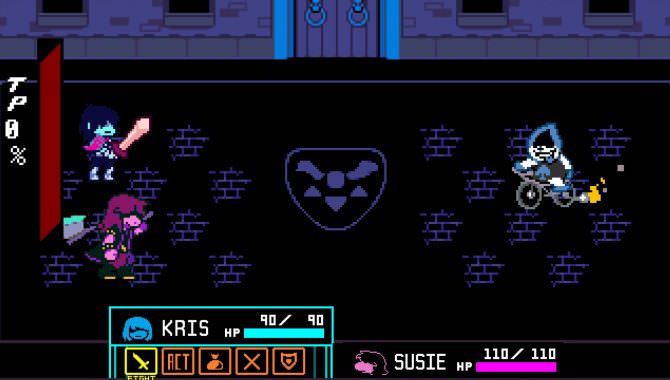
Deltarune is still just as weird as its famed predecessor, and the music is in my opinion just as good. However, Deltarune’s combat and ACTION system are vastly improved over those of Undertale.

One of Undertale’s primary selling points was that you didn’t have to kill anyone. You could play the game as traditional turn-based RPG with grinding, attacks, and murder. But you could also play through the game by choosing to talk and interact with enemies, and then SPARING them, ending combat without defeating them.

How the story unfolds if you choose to spare enemies is one of the most unique parts of the game. Unfortunately, choosing to spare “trash mobs” quickly becomes tedious after the first time you fight that type of enemy. Combat encounters in Undertale are fairly simple. Combat starts, and on your turn as a pacifist, you select various options in the interaction bar to try to butter up or calm down your opponent. Whenever they attack you, you play a bullet hell dodging mini-game to avoid being hit. While this is fine for bosses, it quickly becomes a boring for the other fights. Every type of normal enemy has the same sequence each time to “beat” the encounter.

But this writeup is about Deltarune, not Undertale. Deltarune still allows you to be a pacifist, but without making the encounters boring. There are a few new mechanics that solve this problem, as well as some general ways that combat encounters have been made more meaningful than they were in Undertale.

The first new mechanic is a system called TP. When enemies attack you in both Undertale and Deltarune, you play a short bullet hell sequence. This sequence varies wildly based on the enemy, but the general rule is: don’t get hit. Deltarune adds the TP gauge to these sequences. It’s used for various special actions and magic attacks including healing, and it fills by being just barely close enough to not take damage from attacks.

The second new mechanic is that pacifist actions also occasionally have their own mini-games associated with them. They’re nowhere near as elaborate as the bullet hell sequences mentioned above, but they’re more fun than simply choosing options on a menu like in Undertale.

And finally, you now have multiple party members to use. Some of the more interesting encounters in the game play with how pacifist options work differently for each party member. And this makes sense because some of your party members are… shall we say… “Less Inclined to Non-Violence” than others.

(Looking at you Susie.)

Deltarune keeps the parts of Undertale that were already loved by pretty much everyone (including the strange story, bizarre art and animation, and music that goes so much harder than it needs to), but just makes them more fun to experience.

I highly recommend you play Deltarune, or at least what’s out so far. I don’t think you’ll be disappointed.

Author Note: Images are from the IGDB because I was too lazy to take screenshots while I was playing.

Princess and Conquest

I bought this because I was kind of horny, and frankly, the money could have been better spent.

Princess and Conquest is “unique.” That’s not the same thing as good. I cannot come up with a single simple way to describe it, so I’m choosing to go with Pornographic Action RPG with Political Simulation elements. From what I’ve played so far, I would not recommend it.

I don’t really consider this blog to be “Family Friendly,” but I also don’t currently provide a way to easily opt out of seeing 18+ content. For that reason, I’m not going to provide any in-depth level of analysis of the game’s sexual content. That’s not to say I won’t talk about it, but there should be nothing in this blog post that will make anyone upset or hot and bothered.

General Concept

So, what is Princess and Conquest? Well, at the base, it’s an open-ish world RPG. After a brief tutorial that explains a few of the general mechanics, you’re tossed out into a large open world map. From here, you can whatever you want, as long as whatever you want consists of wandering around, exploring areas, having casual sex, and taking quests to complete for Swirlies, the game’s currency and XP. Combat is done in a sort of real time action RPG thing, where you can switch between members of your current party on the fly. Each member has their own equipment, stats, and abilities. Some have access to magic and projectile attacks, while others don’t.

This isn’t a static open world. There’s a day/night cycle, and time is constantly passing, during which the various kingdoms will declare war on each other, send armies at each other, and generally cause the world to slip into absolute chaos. You can choose to intervene in these fights for one side or another, in order to push the balance of power a given direction. Doing this also gains you affinity with the Princesses you aid, allowing you to convince them to stop trying to murder their neighbors and whatnot.

If you’re reading all of this, and thinking “Okay, that actually sounds kind of neat, and I’m horny and want to play this” pause that thought for a moment. Because Princess and Conquest is, as far as I can tell, made in RPG Maker.

I do not know why anyone would ever choose to make a game with real time combat and open world mechanics in RPG Maker. In another post on this site, I wrote about No Delivery, and noted how the game was impressive for utilizing the engine in interesting ways, and taking advantage of some of its quirks for neat effects.

Princess and Conquest does not do that. Instead, it takes an engine that was primarily built for single player traditional semi-linear turn based RPG’s and uses it for a game that relies primarily on simulation and real time action combat. While it’s impressive that they were able to get it to do this at all, a large number of the mechanics just feel terrible.

The worst one by far is combat. Switching between characters on the fly is incredibly floaty and feels laggy. The hitboxes for the player weapons can feel absolutely miserable, compounded by the fact that many enemies can deal damage on contact. One of the bosses can’t be damaged, even with projectile weapons, unless it is faced directly head on; otherwise projectiles just phase through. Another boss is be able to land hits while in its theoretically “Vulnerable” phase, in addition to not actually taking damage when attacked. In another instance, because of how projectiles were handled, I attacked, missed, and then couldn’t use the projectile again because it was still traveling and hadn’t been cleaned up.

I’m not sure where this part of the article will go, but I’m just gonna write it anyways. I also want to apologize for the relatively lower level of quality in this portion of the article. Sex, and by extension, porn, is complicated topic for a variety of reasons. Frankly, I don’t have desire to do a deep dive analysis and criticism of a $12 Steam game’s portrayal of fantasy sex. Just like I don’t feel like reviewing random videos on Pornhub. If that was what I wanted to do, this blog would have a different name, and likely a higher readership.

Sexual Content High Level View

For a brief bit of context: I’m a straight man. I’ve done some stuff. I would not consider myself particularly “Vanilla.” I’ve seen a fair amount of weird porn, and weird porn art. I’ve had sexual relations with both genders. Okay, context and perspective set? Good. Back to the game.

My primary issue with Princess and Conquest is that it doesn’t offer adequate ability to opt in or opt of the sex/sexual activities. In the time I’ve played so far, I’ve seen content and situations that I suspect would make some players highly uncomfortable. However, there is only one form of controllable interaction, and it’s not broad enough to cover what the game offers.

My secondary issue has to do with the nature of sex in Princess and Conquest. While I consider the above topic to be more of a general statement regarding sexual content, this next one is more of a personal opinion. Sex within Princess and Conquest is almost universally encouraged, as is getting characters that the player has sex with pregnant, through two mechanical benefits. First, having sex has a chance to get an egg which grants more party members, potentially a party member of a hard to find “race” or with better stats. Second, having sex with an NPC will increase the affinity the player has with the Princess character of the same race as the NPC. One of the player goals is to try to avoid massive chaos and breakdown, and affinity points are used to convince people to stop waging war. Since affinity points can otherwise be difficult to get without pissing someone else off, in order to prevent a world war you kinda have to fuck everyone you come across who is interested.

Okay, so enough of that. Again, please don’t take this as some form of full analysis of the game’s sexual content, or my views of sex. The above are merely my two major problems with how the game handles its pornographic content and mechanics.

Okay, so, back to the rest of the game. I have a bunch of smaller problems outside of sex and combat. Here’s a short list:
1. The game is buggy. Most of the time, these bugs don’t do too much. Sometimes, as I discovered to my incredible annoyance, they crash the game. And because of how the save system works, have fun going back to your last save.
Author Note: I actually went back and played some more of the game to get screenshots/see if I was being overly harsh. Then the game crashed.
2. Obtuse systems. The game wants to have a level of political strategy and simulation, but good luck understanding how population growth, eloping, or any other system works without the Wiki, because the game will not tell you. Or Tea Parties! Because I read the wiki, and I still don’t understand how Tea Parties work, or are supposed to work.
3. Frustrating map design. This wouldn’t be as bad if it wasn’t somewhat accentuated by the game engine, but the map design. Dear God, the map design. I want to make something clear. If you have game with a zone-based map, and you leave or enter zones by pressing in a given direction, DO NOT FUCKING MAKE IT SO THAT YOUR MAPS SPAWN THE PLAYER IN A LOCATION WHERE IF THEY PRESS THE BUTTON THEY USED TO LEAVE THE AREA A SECOND TIME, IT BRINGS THEM BACK INTO THE ZONE THEY JUST FUCKING LEFT.
4. Quest system weirdness. I do not like that I cannot have more than one active quest from the adventurers guild at once. I do not like that quest descriptions can be weirdly vague about what you need to do to complete them. And I absolutely hate the quests where the descriptions don’t actually give information about what you need to do to progress the quest.

So that’s Princess and Conquest. A unique concept and set of game mechanics using a game engine absolutely not intended for them, with not great, but functional results. For what it counts for, the writing and porn (from my mildly kinky straight male perspective) is decent, but does not mesh comfortably with the game’s mechanics. Currently, I do not recommend the game, and short of them rebuilding the entire thing in a game engine that can gracefully handle their design decisions, I likely will not ever recommend the game.

Content on these links is NSFW. If for some reason, you still want to play the game after all of this, you can find it on itch.io here or on Steam here. You’ll have to sign in though, as again, this is an adult only game.

Lucifer Within Us

Really good, but way too short.

Lucifer Within Us is very good. It’s an incredibly interesting deductive reasoning puzzle game that takes place in a world where exorcists (of which you are one) solve crimes. It is also very short.

This makes it kind of a problem to recommend. Here’s the closest metaphor I can come up with: Lucifer Within Us is a piece of fudge from that really nice bakery that you don’t go to, because even though the fudge is the most delicious thing in the world, it’s $12 an ounce. The fudge is delicious and incredible, but the money to fudge ratio is incredibly high.

So, first a brief overview of mechanics, and a screenshot, so I can reduce the number of words I have to write. Like I mentioned above, in Lucifer Within Us you’re an exorcist for the Church of the worship of Ain Soph. The first murder in over 100 years has just occurred, and you need to find the culprit, and name the demon possessing them. You do this by gathering evidence and interrogating witnesses to the crime.

Oh and also if you catch them in a lie, you can delve into their mind with divinely imbued powers and see into their soul, revealing possible motives for the crime.

You’re given access to the crime scene, and the witnesses. You can search the crime scene for physical evidence, and talk to the witnesses. Each witness gives you their version of events, which can be played out over a timeline. However, because it’s just their version of events, almost everyone will be hiding something about what actually happened. You’ll need to call them out on their contradictions and omissions to determine the truth.

Being able to scan through the timeline is a really cool mechanic.

Okay, first let’s talk about the good stuff.

Lucifer Within Us is an incredibly unique puzzle game/deductive reasoning game. There are a lot of things that can be complimented about it. Its unique blend of cyberpunk and faith. Its general art direction for its characters and world. The 3D models look like old school Runescape, but they suffice, and the art for the demons and characters reminds me of Hades. Look, this is the part where we say nice things about the game, okay? I do not give a shit that the 3D models are basic. It doesn’t matter. The transitions, effects, and everything else easily makes up for it. The mechanics are incredible, and I’ve never seen another game that works like this one does. I love the parallel timeline for suspects. The process of actually solving the crimes, in 2 hours of straight puzzle solving, hit a “Adventure Game Bullshit” moment only once. That’s a high fucking bar.

As a brief aside: talking about Lucifer Within Us is going to require spoiling either one of two things: the specific plot and details of the game, or the specific number of “levels” in the game. I’m choosing to spoil the later. The reason for this is since Lucifer Within Us is a narrative based puzzle game, I think more would be lost by revealing narrative and plot details than the other info.

And when I say short, I mean short. My own steam achievement list lets me estimate the game at being just over two hours in length. My playtime says that the game has 4 hours and 20 minutes on it, of which just under half was spent getting every achievement just so that I was sure that I hadn’t missed anything. I had not. This is compounded by the fact that it offers almost no replayability outside of the aforementioned achievements, which don’t add that much.

“Well” you might be thinking. “Perhaps he used his incredible reasoning skills and logic to speed through the game, without appreciating properly.” To which I reply, 1. Haha, funny joke implying I have skills and reasoning and 2. No. No it’s not. It’s because there are only 3 levels.

The length (or lack thereof) is compounded by the game’s ending. I have mixed feelings on it, and I’m not going to go into details here, but the last portion of the game feels as if Lucifer Within Us suffered from a massive cut in scope at some point in production. I’ve actually emailed the devs in the hope of getting an interview, because I really want to know what’s going on. The game ends with what amounts to PowerPoint presentation and a massive lore dump, despite the rest of the game carefully avoiding heavyhanded storytelling.

No, really.

Look, I’m gonna be honest. I do enjoy novelty and unique events. Would I refund the game currently if I could? No. It was $12. I’m always happy to see people pushing the envelope of neat game mechanics and design. Much of the writing and subtle world building present in Lucifer Within Us, along with the mechanics, is top notch. It is premium, grade A, good stuff. But I’d be lying the game’s ending didn’t disappoint me. I was just starting to get interested in the world, and then lore dump plus credits roll.

If you prize unique mechanics and storytelling over content length, I can recommend Lucifer Within Us. But if you’re expecting something that takes you more then a couple of hours to play through, you’ll likely be disappointed. It’s available on Steam, and also here on itch.io.

Ed Note: We reached out to Kitfox about trying to set up an interview to ask some questions about the game. I was going to add/include that as part of this writeup if it happened, but it’s been over a week, and I haven’t heard anything yet, so for now review will stand on it’s own.

Bloodborne

Note: The images in this article are from the press kit for Bloodborne, and the game’s concept art. Capturing screenshots from Bloodborne is annoying, and I’m not sure that a bunch more images would do too much for this writeup.

I like Bloodborne. I think it’s very much worth playing. With that said, writing about Bloodborne is hard because there is so much that I could write about. Almost every aspect, from the technology, to the multiplayer, to the art, to the story, to the lore, to just the design and mechanics could have more than its own article.

This article will not be digging into any of those topics to the level they might deserve. My end goal for anything I write for Gametrodon is to convince you, the reader, that a game has something interesting about it that makes it worth playing and engaging with.

In the case of Bloodborne, the game is 6 years old, and exclusive to the last console generation on PS4. I don’t think it really needs someone to advocate that it’s a unique experience, or a good game. The world already knows that it’s both those things. So instead, I’m going to advocate playing the game for folks who might have thought about playing it, but were put off by the game’s somewhat notorious pedigree and difficulty curve. It’s an article directed at… well… me. Me from 70 hours of Bloodborne ago.

First, a little bit of history for those who might not be familiar with Bloodborne, or why the game has the reputation it does. Bloodborne is made by From Software. If you look them up on Wikipedia, you will see the following quote.

FromSoftware, Inc. is a Japanese video game development company founded in November 1986 and a subsidiary of Kadokawa Corporation. The company is best known for their Armored Core and Souls series, including the related games Bloodborne, Sekiro, and the upcoming Elden Ring, known for their high levels of difficulty.

Wikipedia

“Known for their high levels of difficulty” is the key phrase here. FromSoftware’s Dark Souls series is responsible for naming an entire genre, the “Soulslike” game, in the same way that we get phrases like “Metroidvania.” The “You Died” screen is infamous.

At least in my case, this reputation meant that I had almost no interest in any of their games, despite the fact that they are almost universally praised on every level. This is because I think I misinterpreted “Hard” as “Unfair.”

It is not very difficult to make a game that is very hard to beat. Two examples I can think of would be Kaizo mods/levels for Super Mario Games, and the “I Want To Be The Guy” series. In the case of Kaizo, the difficulty often comes from requiring both near perfect inputs and an absolutely massive chain of them, all while having an almost perfect knowledge of its game. On the other hand, “I Want To Be The Guy” simply puts the player into situations where without knowledge about what is going to happen, the player simply cannot succeed, such as platforms that move when you try to jump on top of them.

Bloodborne’s difficulty doesn’t come from anything like that. Bloodborne doesn’t rely on cheap shots or perfect mechanics to make things difficult. Instead, the difficulty comes punishing you heavily for mistakes or misplays. But almost every time I died, much like with Spelunky 2, I understood why I died. Bloodborne wants you win. It’s just not going to give it to you for free.

Here’s an example: in an area that feels about mid-way through the game, there’s a large rolling log trap that if it hits you, will pretty much just instantly kill you. While this might seem like bullshit, there’re a few important elements about the area that make me view it as incredibly smart game design instead. The first element is that the trap is located incredibly close to one of the game’s respawn points (lanterns), and after only two enemies, making it incredibly easy to get back to your corpse after the trap kills you. The second is that when you look at the area, you’ll see that the trap is actually only triggered when you run across a large button directly in the middle of the road.

This means that after you spot the trap, it’s very easy to avoid it, travel deeper into the marsh, and then get killed by a second trap that’s almost identical.

So why is this first trap important? Well, because to my mind, it’s actually very generous. While deaths in Bloodborne can be punishing, this one isn’t. The purpose of the log trap near the respawn point isn’t to unfairly kill the player, it’s to introduce the concept of the trap to the player, to show the player what it looks like, what happens when they trigger it, and to warn the player that this is an element that might still be encountered farther on. In essence, it’s actually functioning as a tutorial.

The same is true of many of the enemies. Some of the enemies that can combo you to death are first encountered in areas that are either actively detrimental to the enemy, or very near respawn points. And for almost all enemies in the game, choosing to run away and simply not fight them is an entirely valid option.

Bloodborne is not unfair. It asks you to think, and to actively work to defeat it, but it’s rooting for you the whole time. If the pedigree and rumors have made you skip it, or some of the other games made by FromSoftware, I urge you to reconsider. Bloodborne is incredibly satisfying, and worth playing, and if you persevere, you can and will beat it.

And the sun will rise.

Author Note: A brief story for those that aren’t convinced. After beating Bloodborne, I found myself wondering if I’d actually gotten better at the game, or if the game’s small incremental stat buffs, weapon improvements, and other systems had made it so that I eventually made progress without improving. So I made a brand new character with the lowest stats, didn’t take any of the free weapons offered, and replayed the first portion of the game.

A section that took me about 8 hours initially only took me 2 hours with the new character. Two bosses that initially took me over 10-15 tries each took only 3 tries each with this incredibly weak character, and I was using a garbage weapon that I found on the ground and I’d never used prior to this run.

MicroMacro: Crime City

Zootopia with a more realistic police presence.

If Where’s Waldo, Richard Scarry’s Busytown, and Frank Miller’s Sin City had a threesome, the end result would be Crime City. That pretty much sums up MicroMacro. I like it.

“But that doesn’t actually explain anything about the game.” You say. And you’re right! But it does give me a great chance to act like I’ve actually read Sin City, and seem more cultured then I am. (I haven’t.)

So let’s have Mr. Cat explain the game for us instead. I’m sure he can help us with-

Oh dear. I guess I’ll have to do it instead.

Poor Mr. Cat. He’s yet another victim of Crime City, a lawless wasteland of blackmail, assassinations, and robbery.

MicroMacro is a hidden object/character game. Much like Where’s Waldo, you’re looking for small details in a crowd of faces and scenery, and like Busytown, it takes place across a adorable town of cute animal people. Unlike Busytown however, the city has the general tone of hardened noir. It’s filled with call girls, gun stores, fetish clubs, corrupt politicians and open air farmers markets.

This massive map makes up the titular crime city. You “play” the game by picking out case, and then going through the challenges each case offers. For example, in the case of Mr. Cat, the first step is to find the unfortunate victim. Cases are rated by how difficult they are to solve, and made up of steps. Almost all steps asks you to say “where” on the map a specific event in question occurred. The whole map has a grid system on it, so the location of an event can be referred to as A5, somewhat like battleship. (There are some exceptions to this, but I’ll cover them in gripes, because they’re related.)

As you advance through each step in the case, you’ll get more information about the crime, the perpetrator, and the motive. Requests can involve being asked to find murder weapons, trace the route taken through the city by someone involved, and occasionally trying to locate the corpse of the unfortunate individual.

Generally speaking, MicroMacro feels pretty fair as far as these things go. In the three cases I played through, there were no instances of adventure game logic or complete bullshit in play. There was one moment of some things being very cleverly hidden, but not unfairly.

With that said, I do have two gripes with the game. One is fairly minor, and it’s the fact that the game has somewhat limited replayability. This isn’t super surprising. It’s like complaining that Waldo doesn’t rehide himself each time you open the book. I think this concern might be a bit alleviated by the fact that once you finish all the cases, there are actually a few small bonus cases that aren’t included. You can find a few of them here on the game’s website, and get another one by signing up for their email list.

The bigger gripe is that the game has no good way to check your answers to a given question, without seeing the actual answer. This can be a bit frustrating, because if your group makes a guess, whoever checks the answer effectively doesn’t get to play for the rest of that request. There are also a few rare situations where the answer isn’t a battleship style grid reference, but a chain of events you’re expected to list off.

These are minor though. I like MicroMacro. I think you could probably even play the game on your own if you really wanted too, but it would be less fun than doing it with friends gathered around a big table. If this made you curious, you can find a demo of the game here, and you can likely find the game itself at your friendly local game store.